Friday, January 14, 2011

On the All-Time Money List

It takes money to make moneyWell, things didn’t work out so well for Mr. Moneymaker yesterday at the PokerStars Caribbean Adventure Main Event. Still sitting in second place with 16 left, a rapid tumble resulted in the 2003 WSOP ME champ begin eliminated in 11th. Ana Marquez, the leader entering play yesterday, also fell short of making tomorrow’s final table, finishing in 10th.

Chris Moneymaker earned $130,000 for his finish, which will bring his overall total tourney winnings to just under $3.2 million. Still keeps him well outside the Top 100, according to Hendon Mob’s current rankings. You need to have at least $3.55 million to be in that exclusive club.

I found myself looking back at that “All-Time Money List” some this week, inspired to do so after Daniel Negreanu reclaimed the top spot following his second-place finish in the “Super High Roller” event at the PCA. The $1 million Negreanu earned there catapulted him back ahead of Phil Ivey and into first. At the moment, Hendon Mob lists Negreanu as having $14,116,192 in career tourney winnings, Ivey next with $13,859,944, and Jamie Gold in third with $12,231,105.

Like Moneymaker, the great majority of Gold’s earnings came from his WSOP Main Event win, with his $12 million first prize in 2006 still the largest amount ever won in a poker tournament. That win put Gold in first for more than three years before Negreanu passed him in September 2009 following his runner-up finish at the WSOP Europe Main Event. Ivey then passed Negreanu during the Aussie Millions in January 2010, sitting in first for nearly a year before Kid Poker took the lead once more.

For many reasons, the list obviously cannot be regarded as an unambiguous indicator of poker ability or greatness. It only tracks live tourney winnings. And it only considers cashes, not taking buy-ins into account. Marcus Bateman wrote a little something about this latter point this week in a short piece on the all-time list. And Negreanu himself pointed out several of the drawbacks of the list, too, during his interview on the Two Plus Two Pokercast this week (Episode 155, 1/10/11).

Hendon Mob All-Time List, 1/13/11They discussed the all-time list some over on The Poker Beat this week, too (the 1/11/11 episode). There Scott Huff brought up an interesting issue related to the list, namely what appears to be the difficulty most players will necessarily have in their efforts to challenge the current leaders.

“It does seem like it’s going to be tough for someone who doesn’t have huge sponsorship dollars behind them or is hugely successful in poker to the point where they are really a brand in and of themselves to really compete on an all-time list,” said Huff, referring in particular to events such as the “Super High Roller” at the PCA which sported a $100,000 buy-in and thus necessarily excluded all but those with the highest bankrolls and/or most backing.

In other words, the guys at the top (like Negreanu and Ivey) are obviously better suited to play in big buy-in events than are folks positioned further down the list, and thus are going to have more opportunities to make million-dollar scores like Negreanu did earlier this week.

Gary Wise responded smartly to the observation (I thought), noting that “those guys [like Negreanu and Ivey] have earned the right to be playing at the higher stakes,” and while there may be other flaws with regard to the list being a true ranking of poker players, there wasn’t anything especially unfair about the guys at the top using their big bankrolls to build further on their record-setting totals.

The exchange made me think about how the issue being discussed kind of reflected what happens all the time in poker -- namely, that having the big stack at the table is always advantageous, giving one more options and often putting one in a better position to increase one’s stack (and by more) than is the case for the smaller stacks. Happens every day at my small-stakes PLO tables where I always buy in for the maximum, immediately enjoying an edge over those content to try to battle with smaller stacks.

All in all, though, I guess I find the list only mildly curious -- a good conversation-starter, perhaps, but not much more.

Labels: , , ,

Thursday, January 13, 2011

Captivated by the PCA

PokerStars Caribbean AdventureGetting interesting down in the Bahamas, where the PokerStars Caribbean Adventure Main Event has now played through Day 4. The plan yesterday had been to play down to 24 players (three eight-handed tables). But the final hand early yesterday evening saw three bustouts happen on different tables, leaving just 22 players to come back for today’s Day 5.

The top of the leaderboard heading into play today is compelling for a couple of reasons. For one, Ana Marquez of Spain leads the way, the only woman left in the event. And Chris Moneymaker is right behind her in second.

Marquez currently has only one small cash in a Venetian Deep Stack event last summer on her poker resume. Meanwhile, everyone knows Moneymaker’s previous biggest cash -- his first one, too. Interestingly, the $2.3 million due the winner of the 2011 PCA isn’t that far from the $2.5 million Moneymaker earned for his 2003 WSOP Main Event triumph.

Will obviously be highly interesting to see if Moneymaker can stick around for the final table of this one. Such is the lot of the man who remains the most famous amateur ever to win the WSOP Main Event.

Intrigue automatically builds whenever Moneymaker comes within shouting distance of a big final table or bracelet. Heck, even when he survives half the field with an above-average stack, the former Tennessee accountant necessarily gets our attention.

I remember at the 2009 WSOP where I helped cover the big “Special 40th Annual No-Limit Hold’em Event,” the one with the big $40,000 buy-in. A small, tough field of 201 entered, and after Day 1 just 89 remained with Bruno Fitoussi on top and Moneymaker in second place. (Had a bit to say about that at the time here.)

If you recall, there was a lot of hype built up around that one, the biggest buy-in NLHE event in WSOP history. And all eyes were on Moneymaker on Day 2. He made it through the dinner break still in relatively fine shape, but lost a big all-in race versus Tony G with pocket queens versus A-K, then ran pocket tens into Ted Forrest’s K-K to get bounced shy of the money in 38th place. (Wrote a little about Moneymaker’s exit from that event here.)

Chris Moneymaker playing Day 1a of the 2010 WSOP Main EventHe’s well in the money this time, though. And seemingly well positioned to make it to that final eight. Adding to the building excitement here is the fact that the PCA Main Event final table is going to be broadcast from start to finish, beginning on ESPN3.com at 5 p.m. Eastern time, then moving over to ESPN2 at 10 p.m.

That’s right! Same-day, final table action right there on our teevees!

I’m not completely sure about how the coverage will be handled, though it sounds like we’ll be seeing the event on a one-hour delay with hole cards being shown along the way. The EPT Live team headed by James Hartigan will be there for the ESPN3 stuff (with Daniel Negreanu commentating as well), then I believe Lon McEachern and David Williams will be in a studio providing some input as well once things move over to ESPN2. A glance at the ESPN2 schedule shows that the network has nothing scheduled for the next eight hours, so it appears the plan will be to show every hand of the sucker right down to the conclusion.

Poker nuts like you and me will enjoy the show regardless of which eight players make it to the final table. But you gotta think if Moneymaker is there, too, there are going to be a lot more eyes on ESPN2 late Saturday night.

Listening to the latest ESPN Poker Edge podcast with Andrew Feldman and Bernard Lee (the 1/12/11 episode), it seems once again that poker finds itself situated in that same awkward, uncertain spot it has been for some time now -- the game’s popularity is obviously continuing to rise, but trouble looms.

Feldman and Lee talked a bit about Moneymaker’s deep run and how fascinating it would be should “the stars and moons align” (as Lee put it) and the 2003 WSOP ME champ somehow take this one down.

The pair also noted how the turnout of 1,560 for the PCA Main Event, while impressive, hadn’t reached the 2,000 or so some had predicted for the tournament. Since the PCA ME field has traditionally been filled by online qualifiers, Feldman and Lee interpreted the turnout as having perhaps been affected by the fact that the “growth of the online [poker] world is really slowing.”

All of which would make a Moneymaker final table appearance -- or even a victory -- all the more curious to watch, both for the drama it would create down there at the Atlantis and for whatever “effect” might subsequently ensue.

In any event, I know I’ll be checking in again today over at PokerNews as well as at the PokerStars blog (from which that pic of Moneymaker at the 2010 WSOP comes, btw) for ongoing coverage of the PCA ME.

Labels: , , ,

Wednesday, January 12, 2011

On PokerStars Home Games

Welcome... I hope you brought beerI first started playing online poker many years ago. PokerStars was the first site I joined, and for several months I only played for play money. In fact, even after I made my first deposit, I continued to split time between the play money games and real money games. Eventually I managed to build up that initial deposit into a modest roll, then at some point left the play money games behind for good.

When I think back to those days of battling for play chips, a couple of things spring to mind. One is how useful it was to practice that way. Even though the play was at times crazily erratic, with the absence of real money encouraging a lot of loose, undisciplined play, I know I learned a lot both in the ring games and tournaments that proved helpful for me over on the cash side.

There was one other aspect of the play money games I remember -- a lot of socializing in the chat box. In fact, I recall getting to know quite a number of folks, players whom I eventually found myself searching for whenever I signed on. If they happened to be online too, I would usually join their tables and engage in what was often a lot of fun, entertaining banter while playing.

Whereas I took a lot of the strategy I’d learned over to the cash games once I made that move, the socializing/chatting I quickly left behind. I encountered a few players here and there who would try to open up genuinely friendly conversations -- that is, players who wanted to talk about something other than an opponent’s resemblance to barnyard animals or invite others to have relations with themselves -- but for the most part it was all business, even when playing for pennies.

It’s pretty much been that way ever since for me online. I’ll occasionally find myself in special tournaments or situations where I’m playing against friends (or friendly types) and some socializing will happen, but for the most part I’m completely on my own, each session another silent, solo flight.

PokerStars Home GamesFor a couple of reasons, then, the announcement this week of these new PokerStars Home Games made me think again about those early play money days. One was the fact that the Home Games are being rolled out initially on the dot-net (i.e., play money) side only, although word is they’ll become available on the cash side in the very near future. The other reason, though, was how the idea of setting up these private “clubs” reminded me of those early chat-filled games.

I’ve been reading around about the new Home Games, exploring the FAQs to find out more about how they’ll work. It looks like each player is only allowed to set up a single “club” (for which he or she will act as “Club Manager”), but everyone is able to participate in as many as three different clubs. Also, each club is limited to 50 participants.

When setting up a club, the Club Manager chooses a name and also creates a special invitation code that he or she then gives to invited players. From what I can tell, there isn’t a way to send that invite/code through the PokerStars client, but it has to be done separately (e.g., via email). Once a player gets an invite, he or she will click on a “Join a Poker Club” button and enter the code. Sounds a little like those ESPN “clubs” for fantasy leagues or pick’em pools, actually.

The Club Manager also acts as a Club Administrator, and can additionally grant administrative privileges to other invited players, including scheduling tournaments and setting up customized ring games. Most of the games are available (hold’em, Omaha, stud, H.O.R.S.E.), and via the game management tools one can customize a number of details like the way the club lobby looks and so on. Sounds like there are ways to set up leaderboards, player stats, and other fun stuff, too.

Interestingly, the Chat Moderators who are available to arbitrate all of the other cash games and poker tournaments on the site will not be around to help out for the Home Games, the idea being you’re playing with people you know (and trust) and thus there won’t be a need for the Mods to come settle disputes. Could end up creating some issues, I suppose, including problems with collusion (Home Games players are able to play from the same IP address, says the FAQ), but this kind of makes sense.

This apartme is too smalOnce this opens up on the dot-com side, I’m thinking it might be cool to set up a “Hard-Boiled Poker Club,” although I kind of wish I could invite more than 50 friends to play. I imagine PokerStars will probably keep tweaking things and perhaps will lift that restriction down the road if some ask them to do so.

Could be strange, actually, to “host” games like this online. Probably would feel some responsibility to ensure all were enjoying themselves whenever they came to my little “club” to play. In any event, I think for those who do end up taking part in this Home Games idea, the main purpose for participating would have to be to increase one’s enjoyment of the game -- to socialize and have fun -- and not (necessarily) to profit.

I know that’s an idea that is foreign to some poker players, namely, that one can play poker for reasons other than to make money. But for a lot of us “recreational” players (as I’ve here confessed myself to be), there really are other reasons why we like to play.

Something I learned -- along with basic strategy, hand rankings, and the like -- way back during those days of playing for play chips.

Labels: , , ,

Tuesday, January 11, 2011

“Poker in American Film and Culture” Readings & Viewings

'Poker in American Film and Culture'I mentioned last week the new college course I’m teaching, called “Poker in American Film and Culture.” We were all set to begin yesterday, but snow and ice caused classes to be cancelled, so it appears we won’t be able to get started until tomorrow.

I guess this means I have to revise my whole blind/ante structure now. :)

Actually missing a day is no biggie... we’ll be able to catch up without much difficulty, I imagine. I have completed the syllabus and since some have expressed interest I thought I’d share a list of the reading/viewing assignments. Right now it appears I’ll be able to teach the class again after this semester, so as we move through these units this spring I’ll be thinking about which assignments I want to keep and what other ones I might want to include next time around.

Unit 1: Origins, Rules, and Variants
  • David Mamet, “The Things Poker Teaches Us” (essay, 1982)
  • John Lukacs, “Poker and the American Character” (essay, 1963)
  • James McManus, Cowboys Full, (history, 2009), chapters 1-5, 17, 18, 32
  • James McManus, 'Cowboys Full' (2009)This first unit -- just covering the first few classes -- introduces poker as a subject worthy of academic study as well as a lens through which we can examine numerous aspects of American culture from the early 19th century to the present.

    The Mamet essay (which I mentioned at the end of yesterday’s post) sounds a few general notes about poker that we’ll return to throughout the semester. Mamet concludes that poker teaches us “character,” so the Lukacs piece will follow-up on that idea a bit by more specifically talking about “American Character.” (I wrote at length about the Lukacs essay a few months back here and here.) Then the first chapter of McManus’s book -- in which he spells out his plan to talk about how poker is interwoven in “American DNA” -- will also give us a number of things to look for going forward.

    The next few McManus chapters then talk about all of those games like “mus” and “primiera” and “as nas” and “poque” that can be regarded as poker’s precursors. The later chapters talk about draw poker, stud poker, and hold’em, and that’s where we’ll make sure everybody at least knows the rules to these games before going forward.

    As I mentioned last week, Cowboys Full is kind of a “core” text for the class, especially here in the early going. Here’s my review of McManus’s history from the fall of 2009 when the book first appeared.

    Unit 2: The History of Poker
  • McManus, Cowboys Full, chapters 6-16, 19-22, 24, 26, 28-30, 33, 34
  • James Hildreth, excerpt from Dragoon Campaigns (memoir, 1836)
  • David Spanier, Total Poker, (essays, 1977), chapter 2 (“Origins”) and chapter 3 (“Presidents and Poker”)
  • David Spanier, 'Total Poker' (1977)These couple of weeks the class will mainly be a history class, and we’ll primarily be sticking with McManus’s version of the story of poker in the U.S., although here I’m bringing in Spanier to supplement things a bit as well as to introduce another voice into the discussion. I’m a big fan of Spanier’s collection, by the way (reviewed here). The Hildreth excerpt presents the first instance of the word “poker” appearing in print.

    We’ll basically be carrying the story up through the middle of the 20th century, covering poker’s spread across America in saloons and on riverboats, Civil War poker, the stories of Wild Bill Hickok and other characters from the Old West, and notable anecdotes involving presidents and poker. We’ll also look at McManus’s observations about poker’s relevance during the World Wars, Vietnam, and the Cold War.

    Unit 3: The Culture of Poker
  • John Blackbridge, excerpt from Practical Guide Book (strategy, 1880)
  • George Devol, excerpt from Forty Years a Gambler on the Mississippi (memoir, 1887)
  • Herbert O. Yardley, excerpt from The Education of a Poker Player (strategy/memoir, 1957)
  • McManus, Cowboys Full, chapters 23, 25, 27
  • George Devol, 'Forty Years a Gambler on the Mississippi' (1887)We start this unit by backtracking a little to revisit the idea that poker was formerly “the cheating game” in America (with Blackbridge and Devol), before later (with Yardley) becoming a “square game.” The McManus chapters provide more background and detail regarding Yardley’s interesting story, including about his experience as a codebreaker for the U.S. government. (I wrote a bit about Yardley’s landmark -- and best-selling -- poker text here.)

    Then we move into some other readings that help illustrate the “culture of poker” in the U.S. from 1950s to present.
  • McManus, Cowboys Full, chapters 31, 35-40
  • Spanier, Total Poker, chapter 5 (“Breakfast in Vegas”)
  • David Hayano, excerpt from Poker Faces (anthropological study, 1982)
  • Dick Miles, “Lowball in a Time Capsule” (article, 1967)
  • Jon Bradshaw, excerpt from Fast Company (essays, 1975)
  • Paul McGuire, excerpt from Lost Vegas (memoir/history, 2010)
  • Al Alvarez, The Biggest Game in Town (history, 1983)
  • Al Alvarez, 'The Biggest Game in Town' (1983)Here we’ll start out talking about the birth of Las Vegas, move into the California Poker scene, then read and discuss the World Series of Poker. McManus writes about all three, of course, so we’ll be dipping back into Cowboys Full for the relevant chapters.

    McManus and Spanier will help us talk about the early days of Vegas, including that big game at Binion’s between Johnny Moss and Nick “the Greek” Dandalos. Hayano and Miles provide a lot of background for those Gardena games (material that will then get dramatized with that cool opening of California Split the students will watch later).

    The excerpt from Bradshaw (reviewed here) concerns the 1973 WSOP, and from Dr. Pauly’s book I’ve chosen chapter 35 (from the 2008 WSOP). Then we’ll read Alvarez’s great account of the 1981 WSOP, a book that includes a lot of insightful commentary about Vegas and American culture.

    Unit 4: Poker in Culture -- Literature
  • Mark Twain, “The Professor’s Yarn” (story from Life on the Mississippi, 1882)
  • Stephen Crane, “A Poker Game” (story, 1900)
  • Bertolt Brecht, “Four Men and a Poker Game, or Too Much Luck is Bad Luck” (story, 1926)
  • James Thurber, “Everything is Wild” (story, 1932)
  • Robert McLaughlin, “Let’s Get Rid of the Ribbon Clerks” (story, 1945)
  • John Updike, “Poker Night” (story, 1987)
  • Jesse May, Shut Up and Deal (novel, 1998)
  • Jesse May, 'Shut Up and Deal' (1998)As I’ll explain to the class, it will begin as a history course, then here will turn into a literature class (before becoming a film course, then a class in sociology or even psychology). Here we’ll consider literary texts in which poker is of special thematic importance. Actually, we’ll be finishing Alvarez at the start of this unit, which kind of fits as I consider The Biggest Game in Town a literary triumph as well as an exemplary piece of journalism.

    All of the stories appear in the 2004 anthology Read ‘Em and Weep edited by John Stravinsky. I think it will be especially interesting to read them along with May’s novel after having learned about poker’s history in such detail. There are a number of other texts I might’ve included here (such as Rick Bennet’s King of a Small World which I talked about here a few weeks ago), and I imagine in later iterations of the course I’ll likely substitute some of those to see how the students respond.

    By the way, Tim Peters discussed Shut Up and Deal way back on Episode 2 of The Hard-Boiled Poker Radio Show, if you want to hear more about the novel.

    Unit 5: Poker in Culture -- Film
  • The Cincinnati Kid (film, dir. Norman Jewison, 1965)
  • Spanier, Total Poker, chapter 5 (“Movies”)
  • Anthony Holden, Big Deal (memoir/history), chapter 4 (“Read ‘Em and Weep”)
  • California Split (film, dir. Robert Altman, 1974)
  • Joseph Walsh, excerpt from Gambler on the Loose (memoir, 2008)
  • Rounders (film, dir. John Dahl, 1998)
  • 'The Cincinnati Kid' (dir. Norman Jewison, 1965)Just three required films here, although as I said last week I’ll probably concoct an assignment that allows students to choose other films to write about if they wish. I also plan to show a lot of clips from various films along the way all semester to help illustrate various themes and issues suggested by the readings, so film will be a prominent part of the course throughout.

    For the film unit, I wanted us to focus on what I consider well made films that really use a lot of the poker-related ideas and themes that we will have read about for the previous weeks by the time we view them. The readings here are supplemental, with Spanier and Holden both commenting on The Cincinnati Kid and Split screenwriter Walsh telling stories about his relationship with Elliott Gould and the making of that film. (See here for more on Walsh’s book.)

    Looking back, I realize I have never really written a great deal about Rounders here on the blog, although it has obviously come up frequently. I wrote a full-fledged review of Altman’s California Split, a film I admire a lot. And I devoted a series of posts long ago to The Cincinnati Kid, including a review, a "commentary on the commentary" from the DVD, a discussion of Richard Jessup’s original 1964 novel, and an analysis of differences between the endings of the novel and the film. (That last one contains spoilers, dontcha know!)

    Unit 6: Poker in Culture -- Gender Roles, Morality, Law, Technology
  • Spanier, Total Poker, chapter 6 (“Loving and Losing”) and chapter 10 (“Morals”); and “Net Poker” (essay from The Hand I Played, 2001)
  • McManus, Cowboys Full, chapters 45, 48, 49
  • Barbara Connors, “Power Play” (from Women’s Poker Night, essay, 2007)
  • Mark Twain, “Science vs. Luck” (story, 1870)
  • Barbara Tuchman, “A Game, Gentlemen, A Game...” (essay, 1966)
  • William J. Florence, excerpt from The Gentleman’s Handbook on Poker (strategy, 1890)
  • Roger Dunstan, “History of Gambling in the United States” (history, 1997)
  • Martin Harris, “Laak-Eslami Team Defeats Polaris in Man-Machine Poker Championship” (article, 2007)
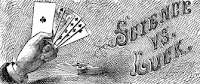
  • 'Science vs. Luck' by Mark Twain (1870)I’ve kind of jumbled the order of these readings here a bit, but you get the idea -- kind of a miscellany of topics with which to close out the semester.

    We’ll first talk about men, women, so-called “gender roles,” and the like, using Spanier, a chapter from McManus, and Connors’s essay from Women’s Poker Night (a book I reviewed here). Then we’ll have one class where we get into the whole “luck-vs.-skill” debate (with Twain and Tuchman), which I think will be relevant to the subsequent discussion of morality which will begin with another chapter from Spanier and that old strategy bit from Florence.

    We’ll then talk a bit about gambling laws in the U.S., reading Dunstan’s historical overview and McManus’s UIGEA commentary. Then we’ll end the course talking about online poker, poker “bots,” and artificial intelligence, using another of Spanier’s essays (from The Hand I Played), some more from McManus, and my little report from one of the Polaris matches.

    Students will write three essays along the way as well as take two exams. Like I say, I do plan to make some changes for the next time I teach the course. I also expect to learn a lot from my students, too, about these texts and the issues we discuss. Don’t really plan right now on writing too much here on Hard-Boiled Poker about the class, although I imagine I will bring it up from time to time.

    Wish me luck. Or skill. Or both.

    Labels: ,

    Monday, January 10, 2011

    Viktor Blom is Isildur1 and Other Revelations

    Viktor Blom is Isildur1, and Other RevelationsEveryone knew already.

    That is to say -- among those who follow such things, anyway -- no one was surprised by the announcement on Saturday down at the Atlantis Resort and Casino that Viktor Blom was indeed Isildur1. On the heels of the announcement, our man Otis swiftly published a cool feature in which he spoke with Blom, an introduction of sorts to the 20-year-old Swede about whom so much has been written since late 2009.

    Jokes about this “worst kept secret” in poker have been part of the fun, of course. So has the sometimes-serious, sometimes-not speculation about Isildur1’s identity. I’m thinking of Dr. Pauly’s faux “interview” with Blom from last spring. Or Jen Newell and I contemplating in our “He Said/She Said” columns at Woman Poker Player the significance of how most assumed (correctly, as it happened) from the get-go that Isildur1 had to be a man.

    Some have suggested PokerStars might’ve derived additional benefit from prolonging the mystery even further. However, it appears that doing so wouldn’t really have been feasible, especially if Blom were to continue to play in live events. According to the PokerStars piece, the offer to become a Team Pro “came with a price” -- namely, that Blom would have to end the charade once and for all.

    “It felt like the right time,” Blom told Otis. And in truth, despite all the fun and intrigue, for the guessing game to have lasted more than a year was probably long enough.

    A couple of thoughts came to mind for me following the “revelation” on Saturday. One was that no matter who Isildur1 turned out to be, we knew him pretty well already -- a seemingly fearless, ultra-aggressive, unpredictable player who in a few short months had managed to gain the respect and/or awe of many of the world’s top pros.

    In the Stars piece he tells how he turned $2,000 into $2 million in just three weeks. We know how he took a lot of that roll to Full Tilt Poker and built it even higher before crashing hard against Brian Hastings (et al.) in December 2009. According to Poker Table Ratings, Blom has been involved in all 10 of the biggest pots in online poker history (and 18 of the top 20), including that monstrous $1,356,946.50 PLO pot Patrik Antonius won off of him.

    That “Isildur1” turns out to be a private, perhaps even a bit shy young man in need of a haircut (or at least a comb) certainly adds to the portrait, but those details hardly distinguish him. It’s the force-of-nature-like online persona with which those details contrast that makes them at all interesting, really.

    The other thought I had while reading about Blom’s introduction in the Bahamas was how it kind of dramatized something that happens to all of us when we play poker, albeit in a much more extravagant, even grandiose way. That is the way poker forces us to “reveal” our true selves, so to speak.

    That second thought probably occurred to me because I’m about to start teaching that course I mentioned last week, the “Poker in American Film and Culture” class in which we’ll be reading all sorts of discussions of poker and its significance. In particular, I’m thinking about one of our first scheduled readings, the playwright David Mamet’s short essay from 1986 called “The Things Poker Teaches Us.”

    Among the several points Mamet makes, he mentions how “poker reveals to the frank observer something... of import -- it will teach him about his own nature.” It’s inevitable, really. The more we play, the more we necessarily reveal about our characters or our true “natures” -- both to our opponents and to ourselves.

    Such a process had been happening with Isildur1 for quite a while now. We (and his opponents) had been getting to know him more and more with each passing hand. The revelation of his “real” name and other biographical details perhaps adds further to the character sketch, though the process had been ongoing for quite some now.

    Mamet gets into various psychological traits such as “a need to be abused” or “a need to be loved” and so forth in his catalogue of such disclosures, though I’m sure you can imagine other elements of the self that poker potentially exposes. As Anthony Holden says in Big Deal (another text we’ll be looking at this semester), “a man’s character is stripped bare at the poker table.”

    That second thought might have been a little abstract, but you get the idea. We know Isildur1/Blom a little better today. And so do his opponents. And I imagine many of us will keep watching, seeing what else gets revealed

    Labels: , , ,

    Friday, January 07, 2011

    UB Keeping It Real... Real Weird, Anyway

    Prahlad Friedman joins UBI mentioned last week how I wasn’t all that engrossed in the comings and goings happening over at UltimateBet (or “UB”). Truth be told, I’m only marginally interested by such matters with regard to any of the sites, UB or otherwise.

    As a small-time player, such sponsorships make little or no difference to me, not affecting one way or another my choice to play on a given site. There are probably at least a dozen other factors of greater relevance when I make such a decision, although I understand the influence sponsored players may have when it comes to attracting new players.

    And as a poker writer, sponsorships are really only of interest insofar as they affect the tourneys I cover or other stories on which I might end up reporting. Which they do, now and then.

    That said, I should probably clarify that while it doesn’t really matter that much to me who has left UB and who has joined them, I’m as intrigued as anyone by all of the hubbub the recent moves have created. And so, like most of you I imagine, I have been following a lot of the interviews and articles, too.

    I listened to Annie Duke’s interview on this week’s episode of The Final Table podcast, the one co-hosted by Dennis Phillips. I read Phil Hellmuth’s interview for CardPlayer. I also read Prahlad Friedman’s very interesting interview with Bluff Magazine that appeared yesterday soon after his signing with the site was finally announced once and for all.

    And I’ve followed a lot of the back-and-forthing on Twitter and in the forums, too. Fascinating to see some of the reactions to Friedman’s signing with same site that cheated him, as well as to the fact that his doing so comes after previously stating (several times) that he’d never sign with any site.

    The whole situation with Friedman is truly peculiar. Talk about stranger than fiction. Just try explaining it to someone who isn’t as involved with the scene as we are. After the fifth or sixth twist and turn, you start to sound like a crazy person. Or at least an unreliable narrator.

    Of course, the easiest explanation is to write off Friedman’s decision as a simple money grab, even if doing so means ignoring much of what he says in the Bluff piece. Even if that were the case, though, for the UB saga to take this unexpected turn is still quite remarkable.

    The whole thing caused me to step back just a bit and opine on “Sponsorships in Online Poker” on Betfair poker today. I didn’t weigh in on Friedman in particular (though I do mention the news of his signing), but rather tried to make a few general observations about the value and significance of online sponsorships.

    Late last week, UB pro and media and operations consultant Joe Sebok wrote a post on his blog following the departures of Duke and Hellmuth. “We’ll be announcing our newest Team UB member next week,” he wrote, telling his readers to “stay tuned” because it was “going to be a doozy.”

    Whatever else Friedman’s signing might signify, it was most definitely that.

    Labels: , , , , ,

    Thursday, January 06, 2011

    Partisan Politics in Poker

    PokerStars Caribbean AdventureLike a lot of you, I imagine, I’m giving a bit of attention this afternoon to the start of that $100,000 buy-in “Super High Roller” event down at the Atlantis Resort and Casino, the big kick-off to this year’s PokerStars Caribbean Adventure.

    Appears they’ve attracted a larger field than many had anticipated. Registration remains open through the fourth level, but after a little over an hour of play it looks as though more than 35 players have bought in. Heck of a line-up, too, as one would expect, with just about every single entrant sporting a recognizable name.

    Among those playing today are Humberto Brenes, Bill Chen, Antonio Esfandiari, Hoyt Corkins, David Benyamine, Jason Mercier, Daniel Negreanu, Eugene Katchalov, Bryn Kenney, Vivek Rajkumar, Scott Seiver, Ashton Griffin, Jason Somerville, Andrew Lichetenberger, Tobias Reinkemeier, Phil Laak, Andrew Robl, Nick Schulman, James Obst, Bertrand Grospellier, Tom Marchese, Sorel Mizzi, and Jonathan Duhamel.

    Cirque du Soleil ringmaster (and everyone's favorite whale) Guy Laliberte is also there. So, too, is Mike "Timex" McDonald, whom you might recall announced last spring that he was taking a break from poker. Both David Bakers are there, too! And it appears Viktor Blom, a.k.a. the man who would be Isildur1 -- has sat down during the last couple of minutes as well.

    Of course, one notices pretty quickly when skimming the list of entrants how none of the Team Full Tilt pros (Ivey, Dwan, Antonius, etc.) have signed up. One imagines some or even many of those players might’ve wanted to take part in this one, the final table for which will be televised on ESPN2. But unless something changes before registration closes, it is possible their affiliations with FTP have made it impossible for them to participate.

    I’m reminded of Tony G’s comments near the end of his SuperStar Showdown match with Isildur1 this past Sunday. Tony G, a PartyPoker-sponsored player, noted in the chatbox how he appreciated being allowed by his site to play an “away game” (so to speak) at PokerStars. It’s a point he elaborated further during his interview on this week’s TwoPlusTwo Pokercast.

    I suppose I understand in a general way the need for sites to segregate themselves (and their players) amid such a competitive industry, but from a fan’s perspective it still kind of stinks. Sort of recalls some of the stubborn, partisan politicking we are used to seeing in this country whereby a given legislator’s party affiliation sometimes rules out any form of negotiation or compromise.

    Guess I’ll just have to watch the Full Tilt guys on “Poker After Dark” (where the PokerStars players can’t go). Meanwhile, I’ll follow everyone else at the PCA Super High Roller by checking PokerNews’ live reports as well as the PokerStars blog.

    (EDIT (added 1/8/11): Ultimately two players from Full Tilt did eventually participate in the PCA Super High Roller -- David Benyamine [Team Full Tilt] and Andrew Lichtenberger [Red Pro])

    Labels: , , ,

    Wednesday, January 05, 2011

    Poker in the Classroom

    Back to schoolWell, the holidays are all over. Time to go back to work. And for some of us, back to school, too!

    It’s true... your humble gumshoe will be back in the classroom soon. Right now I am in the middle of finalizing my syllabus for a new course I’m teaching this spring, called “Poker in American Film and Culture.”

    That’s right. I’ll be teaching a poker class. No shinola!

    The college course (in American Studies) has been in the works for some time now, which means I’ve had the luxury of imagining an unending variety of texts, assignments, and other fun stuff to include. But the time to plan and prepare is running out. Gonna have to make some decisions and commit to them.

    In other words, the action is on me.

    I’ve actually already selected my primary texts for the course, the main purpose of which will be to examine the different ways the story of poker in the U.S. helps illustrate various facets of American culture and identity from the early 19th century to the present. We will be studying the history of the game as well as examining many cultural products (stories, films, etc.) in which poker is of special thematic importance.

    'Cowboys Full: The Story of Poker' by James McManus (2009)James McManus’ 2009 history, Cowboys Full, recently made available in paperback, is going to serve as kind of a “core” text with which we’ll begin the class and then keep going back to throughout the semester. McManus has taught a similar course for a number of years, in fact. I have already spoken with him some about my class, and probably will do so again as things proceed.

    Other required texts include The Biggest Game in Town by Al Alvarez (1983) and Big Deal by Anthony Holden (1990). Both cover some of the same ground (i.e., offering comprehensive sketches of the World Series of Poker), though both include a lot of great analysis of various “American” values and/or qualities that the game helps illustrate.

    Like Alvarez and Holden, David Spanier (another Brit) also brings a non-American’s perspective to the game in his eclectic group of essays Total Poker (1977), another required text. I’m also having the class pick up Jessie May’s poker novel Shut Up and Deal (1998), as well as read a number of selections from the 2004 anthology Read ‘Em and Weep edited by John Stravinsky. Will additionally supplement things with a “course reader” that’ll include a few other articles and excerpts.

    Still rearranging things, but right now the units are as follows: (1) Origins, Rules, and Variants; (2) The History of Poker; (3) The Culture of Poker; (4) Poker in Culture -- Literature; (5) Poker in Culture -- Film; (6) Poker in Culture -- Law and Morality.

    Right now for the film unit I’m planning to require everyone to view The Cincinnati Kid (dir. Norman Jewison, 1965), California Split (dir. Robert Altman, 1974), and Rounders (dir. John Dahl, 1998). These are movies we’ll all watch and discuss as a class, but I am also thinking of having a writing assignment in which I invite students to watch another film in which poker figures prominently -- from a provided list -- and write about it using our class readings as secondary sources.

    Like I say, I’m still at work finalizing the sucker. Wanted to pass along a rough outline right now, though, of what I’m planning to do. Looks like I will get to teach the class again in the fall, too, which means I’ll get to see what works well the first time and make changes for the next go-round.

    Gambling Tales PodcastIf you want to hear more about the class, go check out the latest episode of the Gambling Tales Podcast (episode 20) where I discussed the class in greater detail with Falstaff and Special K. By the way, the guys are also sponsoring a freeroll tourney on Full Tilt Poker tomorrow night (at 9 p.m. Eastern time), the password for which comes up during the show -- so check it out.

    Once I do finally settle the schedule, I’ll come back here and provide a final list of reading/watching assignments for your perusal. Have a feeling I’ll also be sharing things here from time to time about the class as it goes along, too. While I’m hopeful (and reasonably confident) the students will get something useful from the class, I fully expect to learn a lot myself along the way.

    What school is for, ain’t it?

    Labels: , , ,

    Tuesday, January 04, 2011

    The Challenge to Follow the Durrrr Challenges

    The current graph of the first 'durrrr challenge'Already a lot happening in poker here during the first few weeks of 2011. Or “twentyleven,” as I have suggested we agree to call it. I mean, really, that extra syllable is such a bother, ain’t it? Plus, think of all the time we’ll save saying it this way!

    The PokerStars Caribbean Adventure kicks off soon, with that “Super High Roller” $100,000 buy-in event starting on Thursday, then the $10,000+$300 Main Event getting going on Saturday. This month will also see another WSOP-Circuit event take place at the Choctaw Casino Resort in Durant, Oklahoma. There’s the Beau Rivage Southern Poker Championship down in Biloxi, Mississippi coming up, too. And, of course, the Aussie Millions is just around the corner as well.

    Meanwhile, on the tube this week a new season of “Poker After Dark” is premiering, with a big $100,000 buy-in sit-n-go featuring Phil Ivey, Erik Lindgren, Huck Seed, John Juanda, Phil Galfond, and Tom “durrrr” Dwan.

    Speaking of Dwan, I was reminded yesterday that his “durrrr challenge” with Daniel “jungleman12” Cates is still ongoing. Actually both of the challenges are still ongoing, technically speaking. Was almost funny to think how the previous night’s SuperStar Showdown on PokerStars between Tony G and Isildur1 had grabbed so much more attention, even though the stakes for that match were so much less (relatively speaking) than those for which Dwan and Cates are playing.

    If you recall, the “durrrr challenge” involves Dwan and an opponent playing 50,000 heads-up hands of either no-limit hold’em or pot-limit Omaha, with the blinds being a minimum of $200/$400. (The blinds in the SuperStar Showdown are at least $50/$100.) If Dwan is up at the end of the 50,000 hands, he wins whatever profit he’s made plus an additional $500,000 from his opponent. If his challenger is up, that player gets the profit plus $1.5 million from Dwan.

    Remember also that Dwan said way back in late 2008 when he first announced the challenge that the one player he would not compete with would be Galfond. (Perhaps another encouragement to watch “Poker After Dark” this week.)

    The first challenge between Dwan and Antonius, begun in February 2009, has gone quiet over the last few months. Dwan currently enjoys a lead of about $2.05 million over Patrik Antonius. They’ve played 39,436 hands of the scheduled 50,000, but none since early August 2010.

    The second challenge between Dwan and Cates started in late August. So far those two have played 17,108 hands -- a little over a third of the way -- with Cates currently up over $820,000. Unlike the Antonius match in which PLO is the game, Dwan and Cates are playing NLH.

    Last night saw several $100,000-plus pots, including one of $216,505.50 won by Cates in which both players turned heart flushes, but Cates had the better of the two. You can check the “Durrrr challenge” page over on the Full Tilt Poker website for more information, including graphs, stats, hands, etc.

    Despite the big pots, it’s hard to get too psyched about Dwan’s challenges, primarily because with so many hands left to play, the end is much, much too far off to add much excitement to the watching of any individual hands. Indeed, with the Antonius match one wonders if the pair will ever get to the 50,000-hand mark. Perhaps the Finnish player will just concede the sucker first.

    Comparing it to the PokerStars SuperStar Showdown, it’s kind of like the difference between a single game -- a game of special importance, like an NFL playoff game -- and an entire college football season. I pick college football because without a playoff it ends in anticlimax, limping to the finish with a lot of relatively non-significant battles punctuating the season’s final days.

    Never mind the fact that here in 2011 we ain’t got time to follow something of such length. It’s twentyleven, man!

    Or, as the Black Widow of Poker yesterday suggested we call it -- a craps-inspired proposal that would save us even more time -- “twenty-yo.”

    Sounds cooler, that.

    Labels: , , ,

    Monday, January 03, 2011

    A Farce, A Tragedy: Tony G in the SuperStar Showdown

    Tony GWas there on the virtual rail with a lot of others last night for that second PokerStars SuperStar Showdown, this one pitting Tony Guoga, a.k.a. “Tony G,” against the secretive Swede, Isildur1.

    Knew this one would likely provide a bit more drama than did the first Showdown between Isildur1 and Isaac Haxton. Not only was the colorful and often melodramatic Tony G involved, but he and Isildur1 apparently have some sort of personal relationship as well.

    Tony G has spoken out frequently about Isildur1 since he first came on the scene in late 2009. In fact, early on, Tony G eagerly identified him as Viktor Blom, although later would become more equivocal about the matter. Also recall how back last spring Tony G was prepared to provide partial backing for the international man of mystery to play in the PartyPoker IV Big Game. Other arrangements had been made, too, including talk of allowing Isildur1 to play while wearing a mask (no shinola), but the Swede backed out at the last minute.

    Also was curious to see some pot-limit Omaha this time, as the combatants were slated to play two tables of PLO along with two tables of no-limit hold’em, spreading out their 2,500 hands evenly across all four tables.

    The match ended up lasting nearly nine hours -- about twice the length of the first Showdown -- with Isildur1 finally coming out on top by $44,820. Lots of crazy swings throughout, with Tony G taking an early lead of nearly $70,000 during the first third of the match, then sinking fast during the middle act to fall behind more than $77,000.

    The pair were close to even coming down the stretch, with Isildur1 clinging to a lead of less than $10,000. As the final hands played out, Tony G valiantly began pushing all in frequently on the last remaining no-limit hold’em table, clawing back a bit before finally running into Isildur1’s pocket kings to ensure he’d be ending the match in the red.

    For complete details of the match, check out Change100’s recap on the PokerStars blog. Michael “merchdawg” Reed also followed the proceedings, tweeting frequently, and wrote up the sucker as well over at Part Time Poker.

    Adding considerably to the interest (and entertainment) last night were Tony G’s frequent contributions to the chat box. As you might imagine, he was quite boisterous early on when leading the match, frequently questioning (perhaps with tongue in cheek) Isildur1’s abilities in an obvious attempt to provoke.

    When things started going against the G, the Lithuanian unsurprisingly grew quiet. Then, as the last couple of hundred hands played out, he became a bit petulant about the Showdown format (again, see Change100’s recap for details). Finally, when it became obvious he was not going to be able to come back Tony G launched into a kind of maudlin-sounding, dramatic monologue in which he admitted defeat.

    Tony G: well done isildur
    Tony G: ure a legend
    Tony G: people want to watch you
    Tony G: yu defeated me fair and square


    As the concession speech continued, a number of PokerStars Team Pros had gathered on the rail -- including David Williams, Daniel “KidPoker” Negreanu, Lex Veldhuis, Jose “Nacho” Barbero, and Arnaud Mattern -- congratulating both players for their efforts.

    That’s when Tony G -- a sponsored pro over at PartyPoker -- made what I thought was an interesting observation.

    Tony G: you boys a big players
    Tony G: I go back to home gorund
    Tony G: my site that i play on after this
    Tony G: was nice to be away
    Tony G: and I think everyone should have a chance to play away
    Tony G: every nw and again
    Tony G: n matter where you pro at


    Phil Gordon (of Full Tilt Poker) made a similar point on “This Week in Poker” a couple of months ago when he stated how he disliked the fact that pros from differing sites weren’t able to compete against one another on many of the televised shows. (Wrote about this a little at the time in a post titled “TWiP notes.”)

    Fans of poker would surely agree that the segregation of big name pros onto different sites ain’t necessarily to be preferred, although I kind of doubt we’ll see any changes along those lines any time soon. Who knows, though? Perhaps this SuperStar Showdown might encourage some occasional border crossing such as Tony G is suggesting.

    Tony G then quickly slipped back into his soliloquy of surrender:

    Tony G: isildur1 is hte legend
    Tony G: well done your of many so be strong isildur
    Tony G: people love you
    Tony G: and you are all class
    Tony G: i am outcalssed
    KidPoker [TeamPro]: Tony how do you think Hellmuth would do vs Isildur?
    L. Veldhuis [TeamPro]: looool

    Tony G: no idea
    Tony G: he has many bracels
    Tony G: I have n\one
    Tony G: he must do better
    Tony G: I am an ordinary player I feel anyone can play like me
    Tony G: just pretend to have sme ability
    Tony G: but I have HART
    Tony G: and I am "qualified"
    Tony G: i been playing from day 1
    Tony G: with erik123
    Tony G: so not many of us old elephans left
    Tony G: you guys are all so much better
    Tony G: much higher class
    Tony G: much higher class


    I suppose the typos could be said to add further pathos. By “HART” Tony G meant heart, of course. And by “elephans” elephants, although I think he really meant dinosaurs, identifying himself as an “old school” type while interestingly adding that he perhaps doesn’t even consider himself a serious pro but rather a somewhat glorified “ordinary” player distinguished mainly by his courage.

    In a weird way, that elephant reference made me think momentarily of George Orwell’s famous essay “Shooting an Elephant.” After evoking some sympathy for the beast with references to its “distracted grandmotherly air,” Orwell then describes in detail what happened when he finally shoots the elephant. “He looked suddenly stricken, shrunken, immensely old,” motionless for a few moments before “he sagged flabbily to his knees.”

    Since the young Orwell botches the shooting miserably, it takes a long, long time for the elephant finally to die. Sort of like Tony G, whose frequent breaks -- and final speech -- had helped make the match go on much longer than anticipated.

    The speech continued unabated, even after Isildur1 finally piped up to say “Gg, nice playing with u... u really did have heart... so close”:

    Tony G: all over
    Tony G: I have been humilated
    Tony G: well done
    Tony G: let me go and look for my bike
    Tony G: BIKE time
    Tony G: was fun
    Tony G: well wrth it all
    Tony G: let me go fr my big walk
    Tony G: and see you all on my blog
    Tony G: i desrve to walk for 30miles today


    End scene. Leave it to the G to build a heads-up online poker match -- a “FARSE,” as he complainingly called it earlier -- into a full-fledged tragedy. He lost, but even in defeat he was still at work, building further on that “larger than life” image.

    Actually, I do remember him at one point saying he wasn’t “god enough” to win.

    Labels: , , , ,

    Newer Posts
    Older Posts

    Copyright © 2006-2021 Hard-Boiled Poker.
    All Rights Reserved.