Thursday, October 07, 2010

Seeing Poker “Out in the World”

Poker is on the map“Played poker when I arrived in Reno, now trying to buy the band back for the show tonight.”

Saw that on my Twitter feed last night, a tweet from Steve Martin, comedian, actor, and banjo player. Martin is currently touring with a bluegrass-playing outfit, the Steep Canyon Rangers. As that tweet indicates they just had a gig in Reno. (Martin is relatively new to Twitter -- follow him @SteveMartinToGo, if yr innersted.)

Not the first time Martin has made a humorous reference to poker. Some might remember his appearance on the “Late Show with David Letterman” (back in February 2009) when he told a story about playing online poker under the influence of Ambien. I wrote about that here in a post titled “Steve Martin Is a Card,” including linking to a clip of him telling the story. Funny stuff.

By now, references to poker in popular culture have become quite commonplace. I thought it was interesting at the time to note how the story Martin told on Letterman -- a story that involved his betraying a familiarity with online poker and not really having to explain it at length to the audience in order for his joke to be understood -- could be taken as another piece of evidence that poker (and even online poker) had “surfaced” in the mainstream.

There have been at least a couple of other items of late which one might say further exhibit poker’s prominence in popular culture. Last week Vera Valmore and I were watching “The Office” when an allusion to the World Poker Tour popped up kind of surprisingly, eliciting a laugh of recognition from us both.

Pam uses strategy learned from the 'World Poker Tour' on 'The Office'One of the episode’s storylines involved Pam, the former receptionist now salesperson, struggling to make any commissions in her new position. She comes up with a plan -- a kind of bluff, if you will -- to embellish her salary. She tells Gabe Lewis, a coordinating director for Sabre, the company that has taken over the one for which Pam works, that she is the “Office Administrator” and has not seen payment on her checks for her duties as such.

Toward the end of the episode, Gabe calls Pam for a meeting and explains to her that he’s searched through the last three years’ worth of records and has found nothing to indicate the position she claims to have exists. Yet he’s reluctant to accuse her of anything untoward.

“Can you just admit... admit...?” he impotently utters. He can’t say it. “Admit what?” Pam replies with defiance. He ultimately backs down, unable to come right out and call her bluff. Afterwards, Pam explains how she approached the situation.

“The first lesson of watching World Poker Tour at 2 a.m. -- you play the opponent, not the cards,” she explains.

Kind of unexpected, that, but an apt application of the oft-repeated bromide from the WPT and other poker commentary dating back many, many years before.

Map of Online CommunitiesOne last item to share, another indication of poker’s continuing emergence into the mainstream -- this neat, newly-updated “Map of Online Communities” that some of you might have seen getting referenced a lot yesterday.

The map attempts to represent graphically the amount of "social activity" happening in a given community, something the mapmaker explains isn't necessarily demonstrates by the number of members but by other indicators of how much the sites are actually used to facilitate social interaction. Thus, the larger the community on the map, the more socializing that is happening there.

Clicking on the picture (or here) gets you to a larger version, where you can more clearly see Facebook’s dominance and the emergence of Twitter and Skype being illustrated by their relative size. And if you look in the lower right corner, you’ll see a section for “Forums,” where the poker forum Two Plus Two actually rates a small little island situated in between the similarly-sized Lay It Low (a site for “lowriders”) and the larger gaming and trading community D2JSP.

For poker even to show up on the map is noteworthy, I think. Although, like I say, we’re starting to become accustomed to seeing poker “out in the world” (so to speak).

Labels: , , ,

Wednesday, October 06, 2010

Tournaments Are Like Short Stories, Cash Games Like Novels

Squeeze, 'Argybargy' (1980)Anybody here remember Squeeze? That cool pop/rock outfit who were part of the group of Beatlesque Brits including Elvis Costello, Nick Lowe, XTC, and a few others?

Squeeze had a couple of great songwriters in the group -- Glenn Tilbrook and Chris Difford -- who often were listed as co-writers of most of their tunes, further encouraging the Beatles comparisons. Jools Holland, the well-known TV host of The Tube (in the 80s) and the long-running Later... with Jools Holland, was there early on, too, and came and went during the band’s career as it stretched out over a couple of decades.

Argybargy (1980) was always my fave Squeeze LP, with East Side Story (1981) a close second. The former is packed with memorable pop nuggets like “Pulling Mussels (From the Shell),” “Another Nail in My Heart,” “Separate Beds,” among others.

The tune kicking off the second side of my U.S. copy of the record is “If I Didn’t Love You.” (Not sure, but I think the U.K. version might have a different running order.) As the title suggests, the song kind of reflects on a difficult relationship, and includes a great little couplet that inspired the title of this post: “Singles remind me of kisses / Albums remind me of plans.”

Think I’m gonna have to write about Argybargy sometime on my music blog -- 33 1/3 Revolutions Per Minute -- if I can find the time to do so. Have been busy with a lot else of late, writing-wise, though, including writing more fiction than I have in a good while.

It was last fall that I got my first novel -- Same Difference -- out into the world, although it took a while after that for it finally to become available on Amazon and elsewhere. It’s a detective novel, set in mid-70s New York City, with the story carrying the detective-narrator Richard Owen through a number of different episodes and locales that betray my fascination with ’70s culture and film.

Since then I’ve begun working on a second novel -- not a sequel but a new story with a different set of characters and altogether new setting. Also, as was the case with Same Difference, I am not intending to involve poker in this one, either, although there will be some gambling, I think.

Truckin'Has been a while since I’ve tried shorter fiction, although I did have a short story ready when Dr. Pauly called on me recently regarding his Truckin’ series. The story is called “Burial Detail” and it’s another hard-boiled-type mystery. If you’re curious, check out the October 2010 issue of Truckin’ and let me know what you think. For those on the fence about whether or not to commit to a whole novel by yr scribblin’ friend, read the story and perhaps that’ll help you decide.

It occurred to me that reading a short story is perhaps not unlike sitting down for a sit-n-go or even a multi-table tournament. That is, you know before you start what sort of time commitment -- often not too considerable -- you’re getting into. And you also pretty much know you will be taking it all of the way to the end, however the end happens to transpire.

Meanwhile, you probably aren’t going to be reading an entire novel at a single sitting. I’ve been told by some who’ve read Same Difference that it does succeed as a “page-turner,” with characters and plot twists that make you want to keep reading. But I doubt anyone would ever read it start to finish without taking a break at some point. In that way, novels might be compared to cash games, where you can come and go as you please.

'Hitchcock / Truffaut' (1967)I say Squeeze made me think of this analogy, but there’s an observation Alfred Hitchcock once made about film adaptation that probably suggested it to me as well. It comes up in Francois Truffaut’s interviews of Hitchcock, where the master of suspense compares the experience of watching a movie to reading.

“A film cannot be compared to a play or novel,” says Hitchcock. “It is closer to a short story, which, as a rule, sustains one idea that culminates when the action has reached the highest point of the dramatic curve. As you know, a short story is rarely put down in the middle, and in this sense it resembles a film. And it is because of this peculiarity that there must be a steady development of the plot and the creation of gripping situations....”

Think about it. A poker tournament “sustains one idea,” that is, the efforts of all to claim every last chip and be the winner. In other words, all of the action or “gripping situations” that happen -- while perhaps meaningful in different ways to the individual players -- necessarily also contribute to that single “point” of it all, i.e., to determine a winner. Thus is the tourney like a short story.

A cash game, meanwhile, might have lots of different “ideas” that interact in complicated ways, depending on the disparate approaches taken to the game by the players. A “theme” might well emerge (e.g., the game is especially “loose”) that perhaps gives some coherence to it all and helps one interpret the various scenes and characters. But in the end, there can be lots of different ideas that come into play before the “action has reached the highest point of the dramatic curve.”

And, importantly, you can always stop in the middle, if you like.

Labels: , , , , , , ,

Tuesday, October 05, 2010

Stacks Get Big, Emotions Run High: ESPN’s Coverage of 2010 WSOP Main Event Continues Tonight

Stacks Get Big, Emotions Run High: ESPN’s Coverage of 2010 WSOP Main Event Continues TonightTonight on ESPN we’ll see two more hours of coverage devoted to the latter half of Day 6 of the 2010 World Series of Poker Main Event. Looking forward to it, I am.

At the end of play on that day, just 78 players remained of the original field of 7,319. There would be just two more days of poker in July, from which emerged the final nine who will be returning to the Rio All-Suite Hotel & Casino in November to play the sucker out once and for all.

On the whole, I’ve been enjoying the coverage thus far, and I especially like that ESPN decided to devote more hours to these latter days of play than to the Day 1s. Sure, we got to know certain figures -- like the barking man, Ted Bort -- more closely than we might’ve cared to along the way, but overall I’m appreciating how the storytelling has gone thus far. Makes sense spending more time on these later days, when really just about every hand is significant, considerably affecting the shape of the “plot” we’re watching unfold.

Tonight I’m especially looking forward to one hand in particular, one that I’m almost certain will be included. It occurred right at the end of the night, a huge hand between Manuel Davidian and Filippo Candio. (By the way, if you’re one of those following ESPN’s coverage and looking to avoid spoilers, you might stop here and come back to this post tomorrow.)

Looking back, I see that in July I titled my Hard-Boiled Poker post about that day “Intense.” Funny -- I didn’t even mention this particular hand in that post. But I think I was still feeling its effects when I wrote it.

If I recall correctly, they had reached that point in the evening where just 10 minutes remained on the tourney clock. The procedure then is to stop the clock and draw a card to determine how many more hands will be played. I believe they pull from a deck just five cards -- a three, four, five, six, and seven -- and whichever card is randomly selected from those dictates how many more hands will be played before stopping.

The card-drawing ensures all tables play the same number of hands during that final portion of the evening. A four was drawn that night, and so we were within those final four hands when this big one took place.

On Day 6 I had moved around a bit, covering different areas as the day went along as part of the PokerNews team there live blogging the proceedings. As we got close to the end of the night, I was sent over to the secondary feature table to grab chip counts once the players there began bagging up. So I happened to be there when this hand between Davidian and Candio happened.

I won’t recount all of the particulars of the hand here -- you can read my post about the hand over on PokerNews, if you like -- but basically a series of raises before the flop created a situation in which Candio was all in with A-K against Davidian’s pocket tens, a king flopped, and Candio’s hand held up. The hand gave Candio more than 5 million chips, which put him near the top 10 at night’s end. Meanwhile, Davidian was crippled to around 100,000, and in the very next hand would be eliminated in 80th place.

The hand produced a lot of emotion from both players -- unrestrained excitement from Candio, and utter dejection from Davidian. That’s one reason why I think it’ll air tonight. Also, it involved Candio, who has already been shown on ESPN a few times and who would go on to experience some more good fortune and make it to the November Nine. He’s already begun to emerge as a significant “character” in the story, so I think we’ll be seeing another episode in his WSOP adventure tonight.

I remember another reporter afterwards asking me about the hand. He wasn’t a guy I knew, and my sense was he was a non-poker writer there to put together some sort of feature about the WSOP. I think he had a one-day media pass or something, if I’m not mistaken.

He had been standing right next to me as it happened, but seemed a little uncertain what it was that we had witnessed. He wanted to know how big the pot was, and what those chips signified. In fact, it seemed like from his questioning that he didn’t necessarily know that it wasn’t really five million-plus “dollars” that had gone to Candio there, but tournament chips.

He also asked me about Candio’s excited reaction afterwards, and whether or not I thought it was out of bounds. I told him it was perhaps a little much, but that I didn’t necessarily think it was that objectionable. I notice in my hand report I mention the reaction, but don’t linger over it too much. It was part of the story there, to be sure, but my instinct at the time was not to focus on it too greatly.

To be honest, that question from the other reporter wasn’t necessarily an easy one to answer. It’s hard sometimes to say what is excessive and what isn’t when it comes to players’ reactions. Like many, I much prefer the players who manage to restrain themselves from getting too carried away with the celebrations. But I also understand that in some cases -- such as the end of Day 6 of the WSOP Main Event -- that might be easier said than done.

I’m going to guess that Candio gets a bit of heat on the forums from some after tonight’s broadcast, although it depends in part on how his reaction afterwards is presented. Would be surprised if ESPN’s emphasis did not highlight the emotions on display after the hand was over. Which will be understandable, if that’s how the story indeed gets “told.”

Just like the players, I suppose you could say those doing the reporting can show differing levels of restraint, too.

Labels: , , , , ,

Monday, October 04, 2010

Break-Even Poker

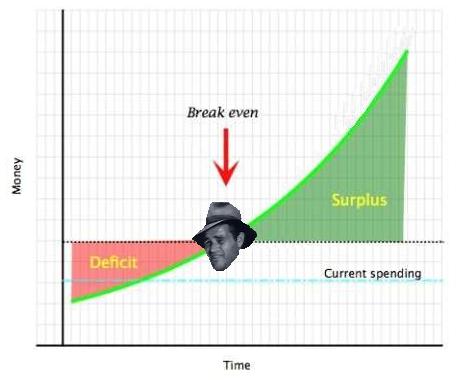
Break-Even PokerWas talking to Vera Valmore some over the weekend about what has become a kind of ongoing frustration for me at the tables. The post title gives you an idea. Ding-dang it I keep runnin’ in place!

I still consider myself a recreational player, one of those part-timers who maybe takes the game a bit more seriously than most but who for a variety of reasons will never likely rise above the micro- and low-limit games where I feel most comfortable.

That said, over the years I’ve consistently managed to eke out some profit from my hobby, ending each year up enough to withdraw some cabbage from my accounts. Nothing too spectacular, but it’s always been nice to recognize that I’m coming out ahead. Better than the alternative, anyway.

That hasn’t really been the case over the last year or so, however, where my records -- which I still carefully keep after every session -- show I have essentially become a “break-even” player for quite some time. Still better than losing, sure. But a little bit trying after having come out ahead previously.

While talking to Vera, I found myself trying to diagnose the problem. I realized soon there were probably multiple explanations for why I’d seemingly hit a wall the way I had. Or, to choose a less violent metaphor, “plateaued.”

But to single out one particular issue, I realized that my thinking with regard to individual sessions had become such that I was virtually guaranteeing I was going to limit my successes at the tables. Let me try to explain what I’m realizing I’m doing...

I wrote a post here early last year called “On Being Results Oriented” in which I confessed to being such. Which, really, is like confessing to being human. In that post I make reference to a chapter in Tommy Angelo’s Elements of Poker in which he addresses the subject -- and makes a similar confession.

“When I win, I think I played better than I did,” he writes. “When I lose, I think I played worse than I did.”

Like a lot of players, I play the same sort of mind games with myself following sessions. And really, a further lack of discipline with regard to reviewing sessions and hands -- something I admit I’m not doing at all these days -- helps make it easier simply to tell myself I “played good” or “played bad” depending on how I ended up at session’s end.

That’s a problem, obviously. But that’s not the one I’m wanting to highlight here. Rather, I want to talk about another issue comes up for me during the session itself, often happening right about the same moment -- that is, just after the session has begun and the first few decisive pots in which I’ve been involved have occurred.

To use Angelo’s terminology, I most often begin my sessions with what feels like my “A-game.” That is to say, that’s when I am almost always paying close attention to my opponents, making what I think are good decisions, and approaching the game in such a way that I believe I have all of my “tools” or plays available to me.

In other words, I’m smart when I start.

I’m not saying I never make any mistakes early in sessions, nor that I’m necessarily going to be a better player than my opponents when I first sit down. But I do think whatever edge I might have is usually greatest there during the early stages of play.

Then come those first few significant hands in which I’m either rewarded for my good play or suffer some misfortune and am not. Such is poker. Here’s the revelation I had, though -- it doesn’t matter which way things turn out in those early hands, I almost always stop playing my “A-game” and descend into my “B-” or “C-game” where I’m no longer drawing on all of my “tools” or moves, my game having become artificially restricted, thus making my decisions less optimal.

It goes differently depending on whether I have started out winning or losing, but I think the consequence is largely the same. I might be smart when I start, but then dumb I become.

If I start out winning those first few pots -- and getting ahead -- I am suddenly conscious of an urge to leave. I don’t want to lose the profit I’ve gained, and I’m certain this fear is affecting everything in a negative way. It’s not that I necessarily tighten up and grow more conservative, but something is happening to knock me off my “A-game” and limit my ability to build on my early profit.

On the other hand, if I lose money early on -- which more often than not happens after coming out on the wrong side of a so-called “coin-flip” or two, or experiencing hands in which I play correctly and get the money in good, but fail to win -- I also start playing sub-optimally, though the reasons for doing so are different. I press a bit, desirous to get back what I’ve lost, and probably too become overly loose and -- even worse -- passive.

And to go back to results, the consequence of all of this seems to have been a lot of short winning sessions and a few longer losing ones. Which currently has been adding up to a whole lotta break-even poker.

I could pull out hand examples and go into all of this in greater detail, but I don’t want to go on much longer here. The point is I’m realizing my sessions almost always seem to be marked by these two distinct stages -- an initial “A-game” period followed by a period in which I play less well.

I’ve talked here before about how Vera is an equestrian who rides dressage and competes on a regular basis, so she’s familiar with the psychology of sports/competition -- and how we often tend to psyche ourselves out of performing at our best. So she’s a good one to talk to, and I think helped me realize this particular problem.

Of course, it isn’t the only problem I’m having, I think. But an important one definitely worthy of some attention.

Labels: , , ,

Friday, October 01, 2010

Washington Dealt Out

Washington Dealt OutYou probably heard that as of yesterday, PokerStars is now prohibiting players in the state of Washington from playing for real money at the site.

To be specific, you cannot play at Stars if you are currently a resident of Washington, nor can you play on the site if you are visiting Washington. In fact, current residents can’t even go outside of the state and play either, as their accounts will remain blocked from real money play as long as they have Washington addresses.

The news came quite abruptly -- without any real forewarning -- prompted, it appears, by the Washington state Supreme Court’s recent ruling upholding the state’s law against online gambling. That ruling came a little over a week ago. The law had been challenged as violating a federal commerce clause regarding interstate business, but it looks like the state’s Supreme Court wasn’t swayed by that argument, and thus decided not to fiddle with the state legislature’s earlier decision to make online gambling illegal (back in 2006, I think).

While Washington-based players scramble to figure out what to do next, many are speculating both about why PokerStars decided to pull the plug once and for all on Washington, as well as what might happen next.

Some are suggesting that PokerStars’ decision to block Washington customers -- rather than merely to recommend they consult applicable state and local laws before playing -- is connected to Barney Frank’s proposed bill, the Internet Gambling Regulation, Consumer Protection, and Enforcement Act (H.R. 2267), which was passed by the House Financial Services Committee which Frank chairs and still awaits consideration by the full House.

If you recall, that bill, designed to create a mechanism by which to license and regulate online gambling in the U.S., had a number of amendments added to it by the House Financial Services committee, including a couple concerning “bad actors” or sites that would be denied licenses to operate in the U.S. going forward thanks to their having failed to comply with federal and/or state gambling laws prior to the new bill being passed. (Click here for a rundown on H.R. 2267 and all of those amendments.)

PokerStars has already said it doesn’t feel as though it should fall into that “bad actors” category, stating that in its view -- and that of the site’s legal counsel -- those amendments would not “adversely affect the availability of a license for a respected operator such as PokerStars” whose “activities in the US are and at all times have been lawful.”

Thus does blocking Washington state’s residents appear to some as fitting with the strategy to remain lawful and thus available to receive a license should H.R. 2267 ever become law.

Others wonder what this might mean moving forward.

Those folks are wondering about things like states “opting out” of the new law, should it pass. Or whether this decision might mean that if it were to happen down the road that PokerStars was not granted a license to operate in the U.S., it would not try to do so anyway. Or what other U.S.-facing sites (like Full Tilt Poker, especially) will be doing with regard to Washington. Among other concerns.

As with most things related to online poker/gambling and the law, I can’t claim to have any real idea where we’re headed. The news about Washington clearly isn’t good, though, whatever it may indicate.

Labels: , , , ,

Thursday, September 30, 2010

The Search for a System

NFL football is distractingAm struggling thus far in my NFL pick’em pool. In three weeks I’ve sunk close to the bottom of the 40-plus entrants after a sad stretch of pedstrian prognosticatin’.

We are just picking winners (not versus the spread), and I was correct on 10 of 16 the first week, but then went a measly 8-8 both of the last two weeks.

Have been kidding around on Twitter some about employing various “systems” for picking the games. One was to go by the relative height of the teams’ mascots; e.g., Giants are obviously taller than Panthers, so pick New York over Carolina, etc.

Was just joking, of course. That is to say, I picked those first two weeks “straight” -- i.e., went by what I thought I knew about the 32 teams thus far in the young season and chose those I legitimately thought would win.

Still, got some funny responses, including this one from @AtlantaMJ:


As the weekend rolled around last week, I was looking over the games and realized I had little feel for picking them, other than simply to go with favorites. That’s essentially what I’d done for Week 2, and it didn’t do very well. So I threw out a line on Twitter about my struggles, and the Poker Grump responded with the suggestion to pick teams based on their overall weight.

He was kidding, too, but for fun I found a site that listed each team’s average weight per player, then checked to see how the picks would go. Realizing there was really only a couple of games where I’d probably have chosen differently, I decided to go with the system, which I eventually dubbed “LBS” (the Largest Behinds System).

In all 16 games, I picked the teams that had the higher average weight per player. Like I say, the picks actually came reasonably close to what I’d have done otherwise. In fact, there were only two games on the entire schedule that I know for certain I would have picked differently. I would not have picked Atlanta to beat New Orleans, nor would I have picked Dallas to beat Houston.

As it happened, using LBS helped me get both of those games correct.

After the 1 p.m. games I was 7-2 and feeling pretty smug. But I ended up being on the wrong side of most of those close games during the 4 p.m. slot, then missed both the night games on Sunday and Monday to end up 8-8 again.

This week the PokerGrump was suggesting picking teams according to the relative position of the cities; i.e., going with all of the teams whose cities are north of their opponents, or vice-versa. He determined that during Week 3 the northernmost teams went 10-6, while during Week 2 the southernmost teams went 11-5.

“So clearly the trick is going to be figuring out in advance which weeks are ‘north’ weeks and which are ‘south’ weeks,” the PokerGrump concluded, adding (with tongue still in cheek), “But other than that little glitch, it appears to be a foolproof system.”

My response was that all he needed to do was develop a system for determining that and he’d be set.

I think I’ll go back to trying my best to make “straight” picks this week, and hopefully will make up some ground on my fellow forecasters.

I like watching NFL regardless, and get an extra kick out of having a team to root for in every single game. But as I’ve said before here, I’d hate to have serious money riding on any of these games.

Am much more comfortable looking for good spots to get my money in during a poker hand, where I can know with great certainty whether I’m a favorite or not, than relying on, say, Sebastian Janikowski to make a 32-yard field goal with time running out to win.

The fact is, in poker one can rely on “systems” -- as long as they relate to the game, of course, and are not built upon silly superstitions and other extraneous factors that are not relevant. Simply knowing correct pot odds is a “system,” really, the knowledge of which can give one an edge over an opponent who is less familiar with such.

Sebastian JanikowskiIncidentally, Janikowski, the Oakland kicker who missed that potential game-winner versus Arizona last week, is the highest-paid kicker in the NFL, having just signed a contract in the offseason that netted him $16 million over the next four years. And I picked the Raiders, ’cause, well, they weigh a little more than Arizona.

Hmm... now that I think about it, I believe Janikowski is the heaviest place-kicker in the NFL at 250 lbs.

Oh, man... I wuz doomed!

Labels: , , ,

Wednesday, September 29, 2010

Are WSOPE Bracelets “Real”?

Are WSOPE Bracelets “Real”?The World Series of Poker Europe Main Event concluded yesterday, with James Bord of England besting an especially tough field of 346. Thus ends the five-event series, at which five WSOP gold bracelets were awarded.

Not coincidentally, there has been a lot of discussion of late over whether or not WSOPE bracelets are “real” World Series bracelets and/or should be counted in that “most bracelets, all-time” list currently led by Phil Hellmuth (with 11) and Doyle Brunson (10) and Johnny Chan (10).

The Entities over at Wicked Chops helped stir things up regarding this topic yesterday by drawing attention to a comment made by WPT Executive Tour Director Matt Savage last week on their excellent weekly show, This Week in Poker (the 9/21/10 episode). (If you’re not familiar with TWiP, click here for a quick overview.)

The question to Savage -- sent in by Jay “whojedi” Newnum -- was “How do you feel about bracelets being awarded outside of Vegas?” Savage answered without hesitation. “I don’t like it,” he said. “I don’t think it’s like a real bracelet.”

Savage then alluded to how the WSOP could very well start applying its brand elsewhere (“they could have WSOP Asia, WSOP Latin America,” etc.), the implication being that doing so would further devalue the bracelets’ significance. “I mean, the WSOP was founded in Las Vegas,” added Savage. “That’s kind of what it’s about, so I don’t think those bracelets [i.e., the ones awarded in London at the WSOPE] are as valuable.”

The post over at Wicked Chops yesterday quickly drew a comment from Harrah’s/WSOP Vice President Ty Stewart, who strongly disagreed with Savage’s position while also foregrounding the competition that exists between the WPT and WSOP, especially in Europe. “It doesn’t take an investigative journalist to understand Mr. Savage’s parent company is motivated to be antagonistic to other activities in the European marketplace,” writes Stewart.

What Stewart suggests, of course, is that Savage’s devaluing of non-Vegas WSOP bracelets is connected to the WPT’s efforts to compete with the WSOP in places like London, and may or may not represent a sincere view to which Savage personally subscribes.

While I’m well aware that there indeed exists genuine competition between the WSOP and WPT -- being fought on several fronts at once -- I still think Savage’s comment was sincere and represents his personal opinion on the subject. And the fact is, there are many other folks (including players, media, and fans) who aren’t tied to the WPT or groups in competition with the WSOP who share Savage’s view that indeed the WSOPE bracelets aren’t as “real” or prestigious as the ones won in Vegas.

The Hardcore Poker ShowAnother person who doesn’t believe the WSOPE bracelets are equal to the ones won in Vegas is the fellow with the most bracelets of all, Phil Hellmuth. The Poker Brat was a guest on the most recent Hardcore Poker Show podcast (the 9/27/10 episode) where he was asked the same question Savage was about the relative significance of winning a WSOPE bracelet.

“Honestly, it’s not the same thing,” Hellmuth began. “I have a feeling that if I had won a bracelet over there [at WSOP Europe], there would have been a lot of people stepping up saying ‘It’s not the same thing,’ and it would’ve been hard for me to argue against that.”

The conversation continued for a few more minutes, with Hellmuth elaborating on some of the reasons why he believes the WSOPE bracelets can't really be considered on the same level as those won at the World Series in Vegas.

Hellmuth made some good points, actually -- kind of surprising how uncharacteristically balanced and aware he sounds here, really -- including drawing attention to the fact that when it comes to his race with the current leaders in all-time bracelets, neither Brunson nor Chan even made the trip to the WSOPE this year.

“Everybody knows that it’s not really a bracelet,” Hellmuth concludes, adding that when it comes to record-keeping, the WSOP should establish different categories for bracelets won outside of Vegas, thereby referring to someone as having one a certain number of each rather than compiling all together.

Click here to listen to the interview, if you’re curious. Hellmuth comes on about 17 minutes into the show, and the conversation about bracelets begins a little after the 23-minute mark.

As the comments on the Wicked Chops post further show, opinions over this issue are divided. Questions about the “legitimacy” or relative significance of the WSOPE bracelets have been asked since before the first WSOPE in 2007. I recounted some of that debate in a Betfair piece a couple of weeks ago which talks a little about the short history of the WSOPE, “London Calling: 2010 WSOP Europe Coming Soon.”

In that column I alluded to some of the early questioning, then added the comment that “by now that debate has subsided somewhat, thanks in large part to the high quality of player fields the WSOPE has attracted during its first three years.” (Perhaps I spoke to soon!)

So do I think WSOPE bracelets are “real”? Well, sure.

I think it is fine -- and perhaps inevitable -- for us all to debate whether, say, Gus Hansen’s victory in WSOPE Event No. 4, the £10,350 no-limit hold’em heads-up event, is as great an achievement as Ayaz Mahmood’s in WSOP Event No. 35, the $10,000 NLHE heads-up event in Vegas. The tourneys were the same in some ways, but different in many, many more.

Indeed, I think if one were to try to compare any two WSOP tournaments, the list of relevant factors making the two events different would be so long it would rapidly become evident that it is a little silly to try to claim any two tourneys are the “same thing.” In fact, one could argue differences between the 2010 WSOPE events and those played in Vegas at the 2010 WSOP are much less significant than the differences between the 2010 WSOP events and those played in the 1970s and 1980s at the WSOP.

So, yeah, I think WSOPE bracelets are “real” bracelets. I also think that for a variety of reasons they continue to carry less prestige, ultimately, than do the ones won in Vegas. But that’s true of bracelets won in Vegas, too, with some being more esteemed than others.

That said, I acknowledge that others can decide for themselves what is “real” and what isn’t. I am an existentialist, after all.

Labels: , , , , ,

Tuesday, September 28, 2010

WCOOP 2010 Concludes

Was an intense 12 hours last-night-slash-this-morning watching and live blogging Day 2 of Event No. 62, the $5,200 buy-in, no-limit hold’em Main Event over at PokerStars. F-Train and I were on duty, and even with the short breaks we’re talking nonstop scribbling, editing, and publishing.

You can check out the live blog for a comprehensive account of how they went from 271 players down to just one, POTTERPOKER, who ended up taking a still-amazing-to-think-about $2,278,097.50 for winning the sucker. Took about 23 hours of playing time altogether over the two days, so that’s about a hundred grand per hour there.

Not a lot of energy left to write still more about what happened, but I will share a couple of quick thoughts. About the good and the not-so-good, I suppose. Will start with the latter.

It was pretty early yesterday -- within the first 45 minutes of play -- that we noticed one player suddenly break from the pack and surge into the chip lead. He’d already gotten close to the 1,000,000-chip mark, then won a big pot with pocket eights versus an opponent’s A-A to move up to almost 1.38 million, which at the time was a good bit ahead of the rest of the 185 players still in it. Indeed, he was the only one over a million at that point.

When reporting on these online tourneys, we operate similarly to the way we follow live events. In other words, with that many players still left, we track notables while also keeping an eye on the leaders. The logistics are different, of course, but the “storytelling” goals are not.

So I started tracking our new chip leader, and was fairly amazed to watch as it took less than hour for him to lose all of those chips and go out in 140th place.

There were three big hands I saw, all pretty darned reckless. The first came less than 15 minutes after having amassed that big stack, a hand in which he lost about 750,000 -- a lot of it on a pretty thin semi-bluff on the turn. He’d lose about 400,000 more on a similar hand shortly thereafter, jamming with two overs and a gutshot and getting called by a player with just second pair who obviously suspected he was light (and perhaps tilty).

He’d build back to over 400,000 -- which was still above average at the time -- but got all of that in the middle on the turn again, this time drawing as close to dead as might be possible. The board was 2-2-A-2, his opponent had an ace, and he had K-J, so I guess the case deuce would’ve brought him a chop.

When this player had gotten to 1.38 million or so, the blinds were 3,000/6,000 (with 30-minute levels). That’s about 230 big blinds. So that rapid exit was some not-so-good, I think it’s safe to say. Now for the good.

WCOOPOnce they were down to three tables or so, the quality of play appeared to increase considerably. I say “appeared” as a kind of double-disclaimer, as I don’t want to suggest I am the best judge of such things, nor can anyone know with 100% certainty how folks are playing without seeing hole cards, anyway. There were a couple of hands where players seemed to have made a misstep here and there, but for the most part, these guys all looked like they had a more-than-good idea of what the hell they were doing.

Probably the most interesting hand of the night came with 17 players left and involved the eventual winner, POTTERPOKER, Bryn Kenney, and two other players. (Kenney, incidentally, finished 28th at this year’s WSOP Main Event.) A good example, I thought, of the relatively more shrewd decision-making we were watching toward the end.

With the blinds up to 30,000/60,000, a player in early position raised to 123,113, and POTTERPOKER, sitting to that player’s left, called. A late position player also called, then Kenney reraised to 420,000 from the blinds. Looked like a squeeze, and it did force the original raiser to fold.

POTTERPOKER then reraised again, however, to 720,500. That forced out the other caller, and sent Kenney into the tank. Kenney finally made his decision and shoved all in for about 2.6 million. POTTERPOKER quickly called, showing pocket queens to Kenney’s pocket tens. The board didn’t help Kenney, and he was out. An intriguing hand all around, I thought.

That hand put POTTERPOKER close to the chip lead, I believe, and by the time they reached the final table he was well out in front. He’d been very aggressive at the final table bubble to extend his lead, then after running well for a short stretch once they got to nine had built what was essentially an insurmountable lead.

A lot of interesting poker, then. And for the highest stakes ever for an online tournament!

Speaking of high-stakes, interesting poker, I plan to look in today to see how that WSOPE Main Event plays out. Though perhaps it will be slightly less interesting now that both Phil Ivey and Viktor Blom (a.k.a., the man thought to be “Isildur1”) have been eliminated.

That delayed live stream (over on ESPN3) has proven to be a bit of a disappointment, insofar as it isn’t available to all (or most, seemingly). Might be just as well for me, though. I could probably stand to step away from the computer for a day or five.

Labels: , ,

Monday, September 27, 2010

Stop! Thief! Who, Me?

It's not what it looks likeHad a good weekend, a lot of it occupied with reporting on PokerStars’ WCOOP and following the World Series of Poker Europe coverage over on PokerNews. Both of those series are coming close to concluding, with the last two events of WCOOP ending today, and the WSOPE Main Event finishing up tomorrow.

Didn’t spend the entire weekend in front of the computer. I did get out and exercise some. Am back to running again, usually just 2-3 miles at a time. I also had one other item on my “to do list” for the weekend -- grocery shopping. So that got me out of the house, too.

I went to get groceries on Sunday afternoon, having finally given up on my miserable Carolina Panthers, who couldn’t even compete with the also pretty darned miserable Bengals yesterday. Ended up being a lengthy, cart-filling trip, as we were in need of just about everything. So I’d been there probably close to an hour when a humorous incident arose.

By then I had made it through all but a couple of aisles, and found myself there in the frozen foods section trying to decide what prepared lunches might serve Vera Valmore well during the coming week. A number of tables in the center of the aisle plus a couple of other shoppers made it a little difficult to negotiate the space, so I’d stepped away from cart for a moment to gather a couple of items. When I got back, I noticed a large, elderly woman with a cart blocking the end of the aisle, so I whipped it around and went back out in the other direction.

A couple of minutes later I was standing in front of the eggs, and had just grabbed a carton to place in my cart when I noticed a carton already sitting there atop the rest of the items. “Hello?” came a woman’s voice, and I looked up to see the lady from before heading in my direction, walking behind a full cart.

I instantly realized what had happened. We’d swapped carts, and in fact both of us had added a couple of items before noticing. We shared a laugh while sorting things out, and soon all was well again.

Something vaguely uncanny about that sort of mix-up. I’m sure you’ve been there, say, when you head back out into a poorly-lit parking lot and try your key in a vehicle with a similar shape and/or color to yours and realize it isn’t your car. You suddenly become aware of yourself in a different way, imagining how you might look to others.

“It’s not what it looks like!” you might think to yourself. “I’m not really a thief!”

No one is looking (hopefully). But you instinctively try with your body language to communicate the idea that it was an honest mistake. You’re a trustworthy person, not at all the sort who deliberately tries to take what doesn’t belong to you.

Since most of my waking hours have been taken up with poker lately, I couldn’t help but think how this sort of consciousness of how others perceive you comes and goes at the poker table. At least for me, anyway. The best players are always attuned to such, though I imagine for most of us (like me) thoughts about how others see our actions are only intermittent, coming and going in relation to the plays we’re making.

Sometimes this happens to me when I’ve made a bluff -- often on the river -- and I instantly realize only after placing the bet how unlikely it is that my “story” of the hand is going to be believed.

Usually the formula creating that situation begins with some preflop aggression from me, followed by some bit of faltering between preflop and the river -- say, a check on the turn that betrays the weakness of my hand. Then comes the river, and a circumstance in which the only way I can possibly win the pot is to bet my opponent off the hand.

Then I choose what feels like the wrong amount. Or perhaps I time my bet in such a way that makes it seem more obvious I don’t have the goods. In any event, it is usually only after I’ve made the bet that I’m saying to myself some variation of “ooh... bad,” and think there’s little chance that my desire not to be considered a “thief” is going to be believed.

It’s that “hand in the cookie jar” moment -- like looking down and realizing you’re standing behind someone else’s cart.

“It’s not what it looks like!” you think. But there you are.

We’ll see how many bluffs get picked off at today’s WSOPE Main Event, where they are playing down to the final table. I believe there will be some delayed coverage online both today and tomorrow -- check out the ESPN poker page for information on that.

Will also be following that WCOOP Main Event closely, too, as I’ll be live blogging the sucker with F-Train. Check in over at the PokerStars blog for that, if yr curious.

Labels: , ,

Friday, September 24, 2010

For the To Do List

The To Do ListLooks like another busy weekend for your humble scribe. Hell, it’s been a busy week.

Among the various scribbling I’ve done lately is a review of a book called Peak Performance Poker by Travis Steffen which went up over on Betfair today.

I liked this book more than I thought I would, and can see myself going back to it again to reread some of its advice.

It’s really more of a sports psychology book than a poker book per se, but the advice readily applies to the situation faced by poker players, I think. All about improving the body and the mind, and how those two necessarily go together.

Funny, one bit of advice Steffen gives concerns making “to do” lists, something I already tended to do before but was encouraged to keep doing after reading his recommendation. Helps me a lot just to stay organized and get things done, not to mention the small but significant pleasure one gets from striking those items off the list one by one.

Anyhow, I did like the book, so if you are looking for something like this to read you might consider putting it on your list.

On the “to do” list for me this weekend are a few items, including a last bit of work with the PokerStars’ World Championship of Online Poker which finally comes to an end after three-plus weeks. The big one is Sunday -- Event No. 62, a.k.a. the “Main Event,” a $5,200 buy-in, two-day, no-limit hold’em tournament which not only comes with a jaw-dropping $10 million guarantee, but also a $2 million guarantee for first. That’s gonna be one decent ROI for someone, come Monday.

Last year 2,144 entered the big one at WCOOP, meaning it eclipsed the $10 million guarantee. Yevgeniy “Jovial Gent” Timoshenko took it down, earning a little over $1.71 million. J.P. “djk123” Kelly made the final table, finishing fourth, as was Jamie “Xaston” Kaplan (whom I was writing about earlier this week), who took fifth.

I’ll also be continuing to follow the Main Event (Event No. 5, £10,350 NLHE) over at the World Series of Poker Europe this weekend. Looks like they ended up drawing 346 entrants this time around, which is up from last year (334) though not as high as the 362 who played in both 2007 and 2008.

And this afternoon I’ll definitely be checking in to see who wins the rubber match between Jim “Mr_BigQueso” Collopy and Gus Hansen in the finals of WSOPE Event No. 4, the £10,350 NLHE heads-up event.

(EDIT [added 9/25/10]: That third match was postponed, as both players were involved in Day 1b of the WSOPE Main Event on Friday. Again, as I wrote about earlier this week, the situation reminds me of what happened this summer at the WSOP at the Heads-Up event there. Also makes me wonder about the best way to handle structures in heads-up tourneys.)

You probably heard about Dwyte Pilgrim winning the World Poker Tour Borgata tourney last night. I have to say Pilgrim and Collopy might be two of the most entertaining players I’ve covered at events this year, so it is kind of fun to see both doing well this week. Hansen is always an interesting guy to watch, too -- definitely too bad the WSOPE heads-up event isn’t being televised anywhere.

Angry BirdsHeard over Twitter Hansen was playing Angry Birds earlier today. Have you played that game? I wouldn’t think Travis Steffen would recommend it as part of one’s “game day” preparation. Those damn green pigs! Puts me on tilt just thinking of ’em, sitting there staring at me with their dumb grins after I’ve failed to take ’em out.

Another thing for the “to do” list, I guess. Smash some green pigs.

Labels: , , , ,

Newer Posts
Older Posts

Copyright © 2006-2021 Hard-Boiled Poker.
All Rights Reserved.