Tuesday, January 13, 2009

A Game for All Situations
Life is like a jokeLast week, the Poker Shrink wrote a post in which he shared a few “random thoughts,” one of which was to say he is “not a big fan of the ‘Poker is like Life’ books and articles.” His primary objection has to do with the fact that such comparisons are usually “too general to carry any more wisdom than a dribble glass.”

I’m with the Shrink on this one. I even claim over in my long-outdated profile that readers will not be finding any “of that dizzy ‘poker-is-like-life-because’ applesauce” on the blog, followed by an explanation that “Nothing is ‘like’ life, by the way -- either it’s living or it ain’t.”

About a year ago, I wrote a post in which I tried to explain further what I meant by that bit of sass. In that post, I joked about seeing a house for sale being advertised as “close to everything,” arguing that one gets about as much meaning out of saying poker -- or anything, for that matter -- is “like life.” Gonna have to be a little more precise than that, friend, to say anything at all.

Of course, that isn’t to say I won’t sometimes use poker analogies to explain particular non-pokery phenomena. Who doesn’t? Was kinda-sorta doing as much yesterday with that post about running that included a couple of indirect comparisons of my new exercise routine to poker.

But that’s a much more specific exercise (pun intended).

For example, over the last couple of days I’ve found myself in a few conversations about the Carolina Panthers’ shockingly awful playoff performance against the Arizona Cardinals this past Saturday. You might have missed it. The Panthers were big favorites and playing at home, and got crushed 33-13, with quarterback Jake Delhomme throwing five interceptions and losing a fumble, too. Just miserable. (And on his friggin’ birthday, too!)

Jake DelhommeAfter the second or third interception, Delhomme pretty obviously had come altogether unglued. He hardly seemed able to function. He kept stubbornly firing balls to receivers who were double- and triple-teamed. In other words, he’d become the football equivalent of someone on tilt. And frankly, the poker metaphor was so apt it seemed (to me, at least) to shed genuine light on what had happened Saturday night.

Basically, before he’d even gotten warmed up, Delhomme had lost a couple of big ones and gotten unsettled. Then he started playing emotionally, making poor decisions and acting desperately in order to get it all back as quickly as possible. And, as often happens to guys who play that way, such rash, undisciplined behavior just made it worse.

Speaking of using poker analogies to describe non-poker situations, yesterday I was watching CNN’s “The Situation Room” (where situations are always sure to be situated) and heard Wolf Blitzer reporting on how Roland Burris, the man picked by embattled Illinois governor Rod Blagojevich to fill president-elect Obama’s now-vacant senate seat, was in fact going to able to take the seat sometime this week. That despite the Democrats’ obvious desire not to allow Blagojevich -- who presently faces federal arrest charges accusing him, among other things, of soliciting bribes in exchange for the very senate seat appointment -- to be allowed to make such a decision.

The Situation RoomBlitzer then spoke to Dana Bash, CNN’s correspondent on Capitol Hill. Blitzer asked Bash to explain how the Democratic leadership so quickly changed their tune after many of their highest-ranking members had said last week they wouldn’t allow the appointment to be made. Bash responded by saying “the bottom line is that Rod Blagojevich, the governor of Illinois, called the bluff of the Democratic leadership” by going ahead and selecting Burris.

Bash then went on to tell a “quick anecdote” about a conversation she’d had yesterday morning with a “senior Democratic senator” concerning the Burris situation. “I was talking to him getting into the elevator,” said Bash. “And this senator said, look, when you’re dealt a losing hand, you skip to the end. And that is precisely why you have seen this turnabout inside the Democratic leadership. And they’re going to seat Roland Burris later this week.”

Blitzer responded with a clarification: “When you are dealt a losing hand, you quickly fold. And that’s what they apparently did.”

Of course, in this case, it sure seemed like the Dems put in a hefty raise and stuck around a street or two with their losing hand before dumping it, but no matter. We get the idea. Thanks, poker.

Poker may not be not “like” life, but it sometimes helps in the explainin’.

Labels: , , ,

Monday, January 12, 2009

Going the Extra Mile

Going the Extra MileOn what was almost a pure lark, on New Year’s Day I went for a run.

I say “almost” because the idea had, in fact, been lingering somewhere along the edges of conscious thought for a few weeks, at least. As evidenced by the fact that lately on drives home I’d been mentally noting the distance between certain intersections and my doorstep. Lots of sidewalks, not too hilly (I’d also noted, vaguely). Let’s see... If I ran to that spot and back, that’d be a mile, two miles, three miles...

Then I’d go home and forget about it.

I’m not at all adverse to physical activity, but I had gotten out of the habit of regularly exercising over the last few months. Would hit the gym once every week or two and ride the bike for half an hour, and take occasional walks around the neighborhood with Vera. But that was about it.

Anyhow, I’d seen that report on CNN. You probably did, too. The one they were running during the holidays over and again that said something about a new study showing that people who run regularly live longer. Can’t say I paid too close attention to what exactly Dr. Sanjay Gupta was saying, but I suppose it must’ve encouraged me to think more concretely about actually going out and hitting the pavement.

So, as 2009 dawned, I dug out a pair of sweat pants, found a suitably masculine-looking toboggan (i.e., the one without the tassels), and took off.

About eighteen or so minutes later I was back home, having made it two miles. Was sore the next day (knees, calves, back), but ran it again, anyway. Felt even worse on January 3rd (neck, thighs), but did the route a third time. When I woke up feeling even worse on the fourth, I found it impossible not to curse Dr. Gupta and all the other quacks espousing the running thing. Live longer? Okay, fine. But who wants to live like this?

Nonetheless, I made myself do it again.

Now we’re nearing mid-month, and I have managed to run every day here in the new year, save one when it rained (that day I went to the gym and rode the bike). Yes, the pain did eventually wane, though not entirely. My time hasn’t really improved much, but that isn’t such a concern.

Yesterday, as I reached my usual turnaround spot, I took a deep breath and kept going, making my new goal that intersection I’d mentally marked as one-and-a-half miles from home. I was literally going the extra mile.

I motored along, Can’s album Future Days thumping out a sympathetic rhythm in my earbuds. (Love that 1970s krautrock, don’t you?) Several more paces down this new road and I found myself thinking about all those short little sessions of $0.50/$1.00 six-handed limit hold’em I have been playing here in the new year.

Following several months of enduring daily swings of $50, $75, or sometimes even more playing pot-limit Omaha, I recently moved back over to LHE (wrote about that here), where I’ve been very consciously restricting my play, only logging 50-100 hands at a time, often cutting sessions short once I’ve made even as little as a few bucks. After eleven days of such modest play, I’ve managed to trip up over the $100 mark already. Have run well, I suppose, but have lost my share of pots, too. A slow, steady climb, without much in the way of peaks or valleys.

Can’t help but think I’d probably wouldn’t be sitting much better having played PLO50. In fact, just glancing at my win rates for each game and the number of hands played, chances are good I wouldn’t have made any more. Of course, even if I’d made the exact same amount of cabbage playing Omaha, plodding along fifty cents or a buck at a time somehow seems like a healthier way to go.

I made it the three miles not too worse for wear. Will likely be sticking with just the two-mile run most days, though, perhaps saving the extra mile for Sundays. When I talk about the new exercise thing with some people, I’ve been joking that what I’m really doing is running a marathon. It’s just taking me two weeks to finish.

I know I’m essentially going in circles. But I still feel as though I’m getting somewhere.

Labels: ,

Friday, January 09, 2009

Level Zero Thinking at the Micro Stakes

Level ZeroMost of us have at least heard of the terms “Level 1 thinking,” “Level 2 thinking,” and so forth to describe certain categories of cogitatin’ at the poker tables. Some who write about poker tend to refer to these levels frequently, and it useful, I believe, to keep in mind not everyone is thinking about the same things or “on the same level.”

Phil Gordon is one writer/commentator who often brings up the different levels, so I’ll just refer to an old column of his to spell it out here.

Says Gordon, Level 1 thinking never gets past the question “What hand do I have?” That’s the beginning player who fails to consider anything beyond his or her own hand when deciding whether or not to proceed. Level 2 thinking additionally asks “What hand does my opponent have?” when making such decisions. Level 3 thinking goes even further, wondering also “What hand does my opponent think I have?” Level 4 then adds the question “What does my opponent think that I think [he or she has]?” And so forth.

When I see writers discussing these levels, I can’t remember ever seeing any of them take it beyond Level 4, which is probably just as well. We probably don’t need to be discussing what I think my opponent thinks I think my opponent thinks I think my opponent thinks I think my opponent thinks I have.

I don’t think so, anyway.

I’ve mentioned how I cashed out a big chunk back in December and decided to drop back down to play some $0.50/$1.00 limit hold’em. I know a lot of folks find LHE deadly boring, particularly at the micro stakes, but I’m having fun down here. I have mostly stuck with six-handed games, which are significantly less tedious than the full ring (and, for me, more profitable). You certainly find yourself up against a lot of Level 1 types at these stakes. But there are plenty of Level 2 people, and even Level 3, too. However, there is another type one encounters down here that generally doesn’t get discussed.

The Level Zero thinker.

This would be the player who doesn’t even seem to be thinking about his or her own hand. I’ve never played middle or high stakes LHE, but I’m reasonably sure one never finds any Level Zero folks at those levels -- except, perhaps, if they have imbibed so much they can no longer see their cards.

Here’s an example of what I’m referring to (RSS folks click on through to see this one):


Bad break for Challenger, who flopped bottom set to Champ’s top set. But really, how to explain Level Zero’s play with 5s2s here? At no point does Zero even have a draw, and he even calls on the end when anyone with a six or higher beats him.

The fact is, at these stakes, one will see this sort of play more than just once-in-a-blue-moon. It’s rare, to be sure, but there most definitely are these Level Zero guys out there who’ll pop up now and then. I actually referred to another example of one in a post last month called “Lost in the Funhouse.” There’s a replayer hand there, too, which shows a guy call a last bet on the river with 2d3c with the board showing Ad5sAhTs9h. Okay, so he chased a gutshot draw to the wheel to the river, but calling the river? Only if the other dude has four-high (and is thus playing the board, too) does he not lose.

Another clear example of Level Zero thinking.

I should note that some strategists actually call “Level 1” thinking “Level 0” and adjust the other levels accordingly. That’s because, as Ian Taylor and Matthew Hilger say in The Poker Mindset, when a player is focused only on his or her own cards “many poker theorists don’t even consider this a level of thinking at all.”

But there is something rattling around in there if the player appears aware of his or her own hand. And I suppose the Level Zero guys at the micro stakes are thinking something, too. Just not about poker.

The name is apt in another way as well. It also describes the eventual size of their stacks.

Labels: ,

Thursday, January 08, 2009

Keeping Score

Bill James' 1984 'Baseball Abstract'When I was a kid I watched a lot of baseball. Collected cards, scored the games, bought yearbooks, and all the rest. Loved it. Then other stuff came along that had the effect of lessening my interest considerably. Stuff like free agency. Huge salaries. Girls.

Before all that, though, I’d always get a copy of Bill James’ Baseball Abstract each preseason and read and reread the sucker all year. James is a long time baseball writer who specializes in various kinds of statistical analyses. James called his discipline “sabermetrics” (after the Society for American Baseball Research or SABR). Was responsible for all sorts of innovative ways of analyzing players’ performances, including inventing certain stats like “runs created” and “power/speed numbers” and the like.

I was scrounging around in the attic yesterday looking for those Abstracts. Came up empty, though I’m sure they are around somewhere. Hope I find them, as there should be a dozen or so complete sets of cards in the near vicinity, I’m guessing. I wanted to find the one with an essay proposing a new kind of box score, one that provided more detailed information than the relatively sparse ones we used to get in the sports page every morning. (Box scores have changed considerably since then, partially because of James’ influence, I think it is safe to say.)

Looking online I’m seeing the article I’m looking for was probably the one titled “Project Scoresheet.” Besides introducing a new kind of box score, James was also hoping to recruit fans from around the country to help compile data from all games in a more thorough way than was being done in the early 80s. (This was way before the internet, dontcha know.)

After a bit more hunting online, I see that James’ “Project” indeed was successful and continued through 1991, after which James joined a group called STATS, Inc. (“Sports Team Analysis and Tracking Systems”) that tracks statistics for other sports, too. He also apparently was hired by the Boston Red Sox a few years back as a consultant.

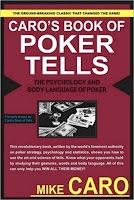
Why was I interested in such stuff? Well, I happened to have grabbed Mike Caro’s Caro’s Book of Poker Tells off the shelf the other day and as I was rereading I found myself recalling James’ Abstracts.

Caro and James have certain qualities in common, I think. Both are analytical thinkers, and both in their writings can be found time and again explicitly trying to be iconoclastic or innovative or whatever adjective you want to use for someone who is not satisfied with simply rehearsing “received wisdom.”

Mike Caro's 'MCU Poker Chart'In fact, as those of you who have read the Book of Poker Tells no doubt recall, Caro (like James) there introduced a new kind of “box score” or way of recording poker hands. In the book he explicitly (vainly?) expresses a desire that his “MCU Poker Charts” become “universally accepted” as the standard for conveying a poker hand. (“MCU” stands for the fictitious “Mike Caro University” from which emanate all of Caro’s seminars, writings, etc.) If you click on the picture you can see a larger version the chart, if yr curious.

The charts work well enough in the book, although obviously they never really came close to becoming the “standard” for recording and conveying all of the information from a poker hand. In fact, they are probably too busy and non-intuitive, although when reading the book one gets used to them easily enough. No surprise, really, that the “Charts” never really came close to becoming any sort of standard.

Mike Caro's 'Caro's Book of Poker Tells'In fact, one kind of gets the feeling Caro himself didn’t really have a lot invested in the idea of the “MCU Poker Charts.” I can’t find them anywhere on his website, nor are Word documents with the charts available on planetpoker.com (as even the most recent edition of Caro’s book promises).

I like Caro and would be one of those who’d argue he’s made significant contributions to poker over the years, the most significant being the way he helped shaped players’ awareness and analyses of physical tells. Them “Poker Charts,” though, are somewhat less significant, although I’ll give Caro some credit for drawing attention to the fact that when reporting poker hands one needs to be as thorough as possible.

Labels: , , , ,

Wednesday, January 07, 2009

On Player of the Year Awards

On Player of the Year AwardsSome of you may have heard or read about how John “the Razor” Phan was named Card Player’s “Player of the Year” for 2008. Phan also finished atop the 2008 POY list over at Bluff Magazine, thanks to his having earned over $2 million in prize money this year.

In addition to making several final tables, Phan won a couple of bracelets at the WSOP in 2008. I had the chance to cover the final table for one of them, Event No. 40, the $2,500 Deuce-to-Seven Triple Draw event. I wrote a couple of posts here about that final table.

One was back in late June, just after it took place. In that one, “2008 WSOP, Day 27: Cheers,” I wrote a bit about Phan’s ordering 10 cups of Corona once they had gotten down to three-handed. The other post, “Thriving vs. Surviving: John Phan & David Sklansky at the 2008 WSOP, Event No. 40 Final Table,” was written back in August after I’d returned, and there I contrast Phan’s aggressive style at that final table to the decidedly more conservative one employed by Sklansky (who’d finish sixth). Check ’em out, especially if you happen to be a Phan fan.

A few weeks ago I listened to Scott Huff talk about player of the year awards on Big Poker Sundays (the 12/18/08 episode). There Huff talked some about Phan and how his manner at the tables -- lots of deliberation, lots of confrontational table talk -- rubs some players the wrong way. Huff was more interested, though, in discussing POY awards and their value, generally speaking.

Huff suggested Card Player was the “gold standard” when it comes to player of the year awards, since “they have the most . . . scientific system for figuring this out,” although he admits “it is still flawed.” I’m not sure how “scientific” it is, but Card Player does certainly employ a fairly complicated rubric to assign points for its player of the year. And it is probably safe to say CP’s POY award is probably the one of which the majority of poker players and fans are most aware.

For last year’s award, Card Player only counted single events with at least $250,000 in the prize pool, or events that were played as part of series in which the overall prize pool for the entire series was $750,000. At least 60 entrants had to be playing in a given event for it to be counted, and the buy-in had to be at least $300.

That meant all of the big ones were in there -- the WSOP, the WSOPE, the EPT, the APPT, the Aussie Millions, and so forth. There were also many smaller events included, too, although when it comes to assigning points CP gives more for higher buy-in events and for events with more players. There was also even a provision in there to include online events in which the prize pool exceeded $5 million. Off the top of my head, I know the Main Event of PokerStars’ World Championship of Online Poker (played in September) had a prize pool of over $10 million, so it must have been included. There may have been one or two other online tourneys with big enough prize pools in there somewhere as well.

If you’re curious, you can sort through the entire Card Player 2008 Scoring Criteria by clicking here.

The system over at Bluff is similar insofar as players get points according to three main criteria: their finish, the amount of the buy-in, and the number of entrants. However, unlike Card Player, Bluff limits the number of tournaments it considers to just the big series: WSOP, WSOPE, WSOP Circuit events, WPT, Wynn Classic Tournaments, EPT, APPT, Aussie Millions, and the Monte Carlo Millions. Here’s the Bluff system, if yr interested.

I should add that both magazines include non-hold’em events in their rankings, too. That meant Phan’s Deuce-to-Seven Triple Draw bracelet win did help him, although the majority of his cashes and deep runs came in NLHE tourneys.

Big Poker SundaysGetting back to Huff’s commentary, the Big Poker Sundays host went on to make a couple of other, broader observations about POY awards. I thought both points were fairly provocative, and since I am curious to know what others think about them, I thought I would share Huff’s points here.

The first observation has to do with the “flawed” system currently used to determine POY. In response, Huff suggests an alternative method. “I would like to see it polled much like college football (minus the BCS),” says Huff. “I would like to see a poll of the people that are working in poker as journalists who follow and cover the tournament circuit. You know, people like B.J. Nemeth. People like Gary Wise . . . . Even people like Dr. Pauly. People who are around this all of the time, voting on who they think is deserving of the player of the year. And then also have the players vote on their peers.”

Huff goes on to say he doesn’t know how such a system would be weighted, but he thinks this polling method for determining the best player of the year would be preferable to the “scientific” method of assigning points currently used.

Such a poll would be quite interesting, I think. However, as much as I respect folks like Nemeth, Wise, and the good doctor, I think even they would tell you their own votes for player of the year would be of limited value. I know for a fact that Nemeth has spent a lot of time thinking about different ways of determining POY -- in fact, last summer he shared some of his thoughts on this very subject with me. While I won’t go into any of the details of Nemeth’s ideas here (which are terrific, by the way), I will say none of them give any weight at all to his own opinion or “vote” on who the player of the year should be.

Dunno about Wise or Dr. Pauly, but I would guess they, too, would be suitably humble about their own abilities to say who is the best player they’ve covered this year.

Huff’s other observation was to point out the relative value of POY awards. He thinks they are important, and thus improving the system for determining player of the year “would give even more legitimacy to an award that I think is necessary when we’re trying to still promote poker as a sport, and trying to get people to watch it.”

Huff is on to something here, I think. He maintains “the more statistics that we have, the more accessible those statistics are, the more sense that they make, and also being able to tell people out there in the general public who are watching poker as entertainment, to be able to tell them this person is definitively the ‘best player in the world for this year’ as far as tournaments are concerned, is an important thing.” Huff acknowledges that some would disagree with his view, but believes that “as a fan of poker” such awards do, in his opinion, serve an important purpose.

He’s probably right that POY awards do have the ability to excite the interest of casual poker fans -- i.e., those who watch poker on television much as they would any other sport, and are therefore interested in following certain players and learning how they rate against one another.

Even so, I don’t think a poll of journalists and/or players is going to be the way to make such an award more “legitimate” or give it a more prominent status than the relatively modest one it currently enjoys, even among the most ardent poker fans.

Labels: , , , , ,

Tuesday, January 06, 2009

Leaving the PLO Party

Leaving the PLO PartyLast month I alluded a couple of times to my having endured a downswing at the pot-limit Omaha tables. Really came down to one horrific week, kicked off by a single, enormous pot (the largest ever for me) that I lost when a river card that gave me aces full also happened to give my opponent a straight flush. Followed that with some more misfortune, compounded by poor decisions and other tilty behavior.

Having felt as though I’d momentarily “lost the plot” (so to speak), I decided the best course was just to pull out a big chunk of my online roll, leaving myself a few hundy each on PokerStars and Full Tilt, and take a short break to refocus. I slowly made my way back and played break even poker for the last part of December, though still wasn’t feeling particularly confident about my decision-making or reads. Ended the year just shy of my best-ever total (2006), a record I’d have easily broken had I avoided that bad patch.

January 1 dawned and sometime that afternoon I rejoined a PLO game (6-handed, $25 max. buy-in). After an hour or so I was down a bit, rebought and built back up some, then lost what amounted to about a $70 coin flip.

If I remember the hand correctly, it had folded to me in the cutoff and I raised pot (85 cents) with J-9-7-7 double-suited (spades and hearts, I think). The button called, as did both blinds, then the flop came 7c5s4s. The blinds checked to me, I bet the pot, and it folded back to the big blind who reraised pot.

That he’s flopped a straight is pretty much a given. But I also know I have a monster draw here and am probably a favorite. Best case is he has a random 8-6-x-x hand (or maybe 6-3-x-x) and no redraws, meaning I am actually about 2-to-1 to win the hand. Worst case is he’s flopped the straight and has a better spade flush draw; there I am a little shy of 40% to win.

If I were writing a 2+2 book, at this point I’d inject a couple of pages of math to justify my decision to gamble here. If I reshove, there’s no way he’s folding -- that is, I’m guaranteed to be playing for my whole stack (about $35 at the time). In the book I’d go on about how there was a 40% chance he had the straight and no redraw, a 30% chance he had the straight and a higher flush draw, a 20% chance he has just a flush draw, and a 10% chance he’s bluffing. (Actually, there’s no way he’s bluffing, but they always include the 10% for bluffing so I will, too.) And then I’d have a table showing (.67 x .40) + (.38 x .30) + (.32 x .20) + (1.00 x .10) = .268 + .114 + .064 + .10 = 0.546 or 54.6% and thereby justify my taking the gamble.

I mean, hey, if I take this proposition 20 times, I stand to win 11, right? (Silly stuff, I know.)

Of course, I ain’t thinking any of that crap. I’m thinking this guy thinks he’s cute check-raising me, and there’s no friggin’ way I’m stepping aside. Besides, I’m probably the dadgummed favorite. Reraise pot!

Indeed, he’s only got the straight without any spades in his hand. But I miss out, and lose the pot.

Oh, well. I found another table and played some more, winning back a little, then losing a little more. Then I realized something.

I wasn’t enjoying myself. Not at all.

Imagine you’re at a party, say one of those where you were sort of obligated to go but didn’t really know anybody all that well and probably would’ve skipped it if doing so wouldn’t have made you feel guilty afterwards. Say a work colleague invited you, and you couldn’t get out of it.

Now let’s say the night before the party you develop some sort of unpleasant sinus infection. Not bad enough to cause you to miss work, but nevertheless requiring some heavy duty medication to keep you on your feet. You make it through the next day all right, during which you see your colleague and reassure him you’ll be at the party.

After a bit of hassle finding the place, you finally arrive and it isn’t until you walk in the door that you realize you cannot drink thanks to the medication you’ve taken. (Sometimes you ignore such warnings, but you know tonight you won’t be doing so.)

Someone brought limoncello.An hour passes. Everyone is having a terrific time. There’s imported beer, red and white wine, and a dude in the kitchen is mixing drinks, too, for anyone who wants ’em. One couple even brought some sort of homemade liqueur called limoncello that takes a month to make, uses lemon rinds, water, sugar, and Everclear or something. After another hour a few of the ladies have begun dipping into that, the drink’s potency evidenced by the fact that one of them keeps telling you when she passes by that she likes your hat.

The music is loud, mostly focusing on pop hits that came just a few years after you last listened to or cared for such stuff. You’re trying to have a good time, getting to know a few folks via brief, shouted conversations here and there. At some point you are standing there with your glass of water realizing you’ve been cornered by this one dude who keeps pointing at you with his Heineken bottle.

What is he saying? Seems to be going on about how 41 states cannot balance their budgets and who’s gonna ask for a bailout next and can you believe how the cable companies screw us and he’s been looking into six-month CDs and oh MY GOD WHAT AM I DOING HERE?

That’s sort of how I felt sitting there at the PLO table on New Year’s Day. Just wasn’t diggin’ this party no more. So I left.

Probably a good idea, given the size of my now smallish online bankroll. Went over to the $0.50/$1.00 limit hold’em tables and had fun passing chips back and forth. Began winning, too (making it more fun, natch).

Have stuck around at those tables for the first few days of the new year, and I think I’ll probably remain in that neighborhood. For a while, anyway. The music is quieter. Most appear to be having just soft drinks and coffee.

Gotta let this medicine do its work.

Labels: , ,

Monday, January 05, 2009

False Start

False StartBeen watching a lot of football over the last few weeks. Saw one particular bowl game the other day, the Kentucky-East Carolina one. The Liberty Bowl, I think. A close game (won by Kentucky), and thus interesting enough to see through to the finish. Even so, I had to disagree with the color commentator when he suggested near the end that the game’s competitiveness proved that 34 bowls aren’t too many.

By that time -- late in the fourth quarter -- I had already long decided I was watching a sloppily-played football game. All apologies to Wildcat and Pirate fans, but those were two fairly middling teams going at it that day. Everything about the game was below average -- the play, the coaching, even the refs. Especially the refs, actually. Several horrific calls, some made despite lengthy consultation in the replay booth. In fact, the winning touchdown -- a returned fumble by Kentucky -- came on a play in which the refs missed the fact that the defensive tackle recovering the ball had his knee down prior to his game-winning jaunt down the sideline.

Like I say, to me the poorly-played game seemed pretty strong evidence that having 68 of 119 eligible teams playing in college football’s post-season -- well over half -- is a bit much. But that’s not the topic of today’s post.

I read somewhere once that in football the “false start” is the most frequently called penalty, causing something like 20% (or more) of the flags thrown. Offensive holding is a close second, I believe.

False starts are frustrating, of course, particularly because unlike most penalties, they are often “mental errors” that could have easily been avoided had the offender -- usually an over-eager lineman -- listened to the quarterback’s signal more closely and/or possessed the mind-body discipline to prevent himself from moving an instant before the ball was snapped.

In poker, I think the “false start” is probably a fairly frequent occurrence as well. In fact, if we really scrutinized our play and gave ourselves “penalties” for all of our missteps at the tables, I’d bet “false starts” would make up a significant percentage of our overall “yardage” lost.

Most of you probably know exactly what I’m talking about. You sit down and at the beginning of your session play in a manner -- usually less carefully -- totally unlike your usual, controlled game. Playing that way partly stems from just being excited about rejoining the game, and having some impatience about getting involved early. So you play hands you might normally have passed without a thought, make a few rash calls or raises, and before your seat is warm you’re already searching the playbook for what to call when it’s first-and-fifteen.

I wrote a post a couple of New Year’s Days ago called “Getting Off to a Good Start” in which I talked about something Barry Tanenbaum, author of Advanced Limit Hold’em Strategy, had said on a podcast regarding the importance of winning the first hand one plays in a given session. You can read the post to see the full discussion, but the gist is that Tanenbaum recommends players “Always Start Slowly,” meaning essentially to avoid marginal situations and try one’s best to win that first showdown.

Doing so has at least a couple of benefits. For one, it affects how others perceive you, giving you what Tanenbaum calls a “winning image.” By winning that first showdown, you perhaps have given others reasons to respect your bets later on, or maybe to fold to your bluffs or semi-bluffs. Secondly, it affects how you perceive yourself (I think), adding to your confidence in much the same way that initial first down encourages a football team to believe they can move the ball even further.

Tommy Angelo also makes a similar point in Elements of Poker in a section titled “Take the Blind or Post Behind?” Angelo, who plays both limit and no-limit hold’em, says he now always waits for the blind to come around in limit, and only sometimes will go ahead and post from the cutoff in no-limit. He provides a bit of mathematical analysis of the issue, then talks about how he eventually came to realize the huge difference caused by this seemingly innocuous decision.

By posting from the cutoff, Angelo found himself getting involved in hands -- often aggressively -- that he normally wouldn’t be playing if he hadn’t already committed some chips to the pot. “It’s hand number one, and already I’m inviting instability,” was Angelo’s revelation. “It’s the difference between jumping in and settling in,” he continues. “It’s the difference between being afraid and being feared.”

By waiting for the big blind -- something he now always does in LHE -- Angelo realized he reduced variance (or “fluctuation”) and thus minimized the possibility of early tilting. In other words, starting slowly helps him, like Tanenbaum, avoid false starts.

After my lengthy, sometimes-thrilling, sometimes-abusive, year-and-a-half long relationship with pot-limit Omaha, I’m finding myself starting to play more limit hold’em again, and so have been trying to get back into the LHE mindset over the last few days. Had kind of a “false start” to the year, though, when I indulged in a one-night fling with PLO on January 1. I’ll share more about that tomorrow.

Meanwhile, let’s all try to limit those flags and play a good, sound game out there. As that philosopher of the gridiron Knute Rockne once said, “build up your weaknesses until they become strong points.”

Labels: , , , ,

Saturday, January 03, 2009

The Hard-Boiled Poker Radio Show, Episode 11: Poker Chip Draw

The Hard-Boiled Poker Radio ShowNew year, and a new episode. Click here to listen and/or head on over to the show’s blog to read more about it.

This one begins with a very cool song by Lorne Greene (of Bonanza fame) called “Five Card Stud.” Seriously, the show is worth downloading just to hear this song.

The main feature this time is an episode of the old radio show The Cisco Kid called “Poker Chip Draw.” Also, over on the show’s blog I’ve embedded an old episode of the TV show, if yr curious about such things. One of the first (or perhaps the first) shows filmed in color, I’ve been led to understand.

Since it is the new year and all, I find myself making all sorts of plans like everyone else, and one of them involves the Hard-Boiled Poker Radio Show. I have an idea I might be able to get onto a regular schedule whereby I produce a new show once every two weeks. I know I’ll be able to do it here at the start of the year, anyway, and hope I can keep it up as the year progresses. We’ll see.

Thanks once again to everyone who has listened to the show thus far and special thanks to those who’ve sent along comments. As I’ve said before, all feedback is especially welcome, and if anyone has ideas or suggestions, send me those, too. You can comment here, on the show’s blog, leave a review over in iTunes, or send an email to shamus at hardboiledpoker dot com

Labels: ,

Friday, January 02, 2009

Hard-Boiled Poker Year in Review (3 of 3)

Here’s the last of the three recap posts, this one covering September-December. The first discussed January-April, and the second May-September.

September

PokerStars' World Championship of Online PokerThis was the month I got involved with live blogging the World Championship of Online Poker for PokerStars. Made for an especially busy two-and-a-half weeks or so (I was essentially working two full-time jobs during that stretch). Was fun and satisfying, though, and I’m glad to say I’ve been able to do a few other writing gigs for Stars here and there since then.

As was the case during the summer with PokerNews, the WCOOP job again found me working with some terrific colleagues, making it all the more enjoyable. Looking back, I see there were a few WCOOP-related posts peppered in there during September, my favorite probably being Deal and Shuffle Up (9/17) in which I recounted some not-so-smooth negotiations at the end of one of the events when the players were trying to figure out a chop.

September was also the month of the first-ever PokerListings’ Run Good Challenge in which yr humble gumshoe run good and, as it happened, done good. In the first event, I bubbled, finishing fourth. You can guess my bustout hand in the title of the post chronicling that one: In Which It Is Demonstrated Why Jacks Are Sometimes Called “Hooks” (9/8). Came runner-up in Event 2 -- Lucky Man (9/15) -- then managed to take down the third one -- Running Good: Ace-Trey = 1st in Event 3 (9/22). That qualified me for the final where I finished fourth behind Amy Calistri (3rd), Michele Lewis (2nd), and Change100 (1st). The story of the final is told in Ladies Night: PokerListings Grand Finale (9/27).

Fired a few “shots in the dark” in September. In one, Where Are You Going, Where Have You Been? (9/9), I speculated about what it would be like to play poker against an earlier version of oneself. In the other, Listening (9/12), an excerpt from Eudora Welty’s autobiography inspired a brief meditation on paying attention to others (and oneself).

There was yet another bill proposed in Congress, which I wrote about in First Step for H.R. 6870, the Payments System Protection Act of 2008 (9/19). If yr really interested in looking back over all the legislative posts on HBP from the year, you can click on the category “law” to access those posts. Or check out a post in early October (mentioned again below) that collects all the different UIGEA-challenging bills. Click through on the 9/19 post, though, if you wanna see the cool “I’m just a bill” Schoolhouse Rocks clip again.

Late in the month, Kentucky Governor Steve Beshear made that move to try to block 141 online gambling sites from his state, something I wrote about in Kentucky Gov. Wants to Block Online Gambling Sites: Does He Have a Hand? (9/24) and again in Running on Empty (9/26). He’d get there, actually, although that one is now in limbo on appeal.

Finally, I revisited the issue of the poker media and its role -- well, specifically, Card Player magazine -- in a post titled On Poker Mags (Redux) (9/29). There I get on the magazine’s case a bit for what seemed an insincere explanation for their having whitewashed the Scotty Nguyen $50,000 H.O.R.S.E. fiasco.

October

Shamus Watching the WSOP on televisionOn the last day of September, the Kahnawake Gaming Commission delivered a presser that stated 1994 WSOP Main Event champion Russ Hamilton was “the main person responsible for and benefiting from the multiple cheating incidents.” Wrote about that a bit in Hamilton, UltimateBet, & the WSOP (10/1).

As stated above, Bill Collector: Senator Introduces Internet Skill Game Licensing and Control Act of 2008 (S. 3616) (10/6) summarizes all them UIGEA-opposing bills in one handy place. And while we’re on the subject, The Terrible Twos for the UIGEA (10/13) uses the occasion of the second anniversary of Bush’s signing the UIGEA into law for some “big picture”-type speculatin’.

Along with all of youse, I was still watching the WSOP on ESPN in October (and still waiting for that dadgummed final table to play out). Wrote one post mid-month about that, One (More) Time: Reliving My Last Day Reporting on the 2008 WSOP (10/15). A few days later I complained a little about the fact that we were all Still Waiting (for the WSOP Main Event final table) (10/21).

Reported on Kentucky Governor Beshear’s surprising success in that suit against the online gambling sites in Kentucky Takes It Down (10/16), then cheekily reflected on it a little more in Chance, Though Not the Only Element of the Franklin Circuit Court, Is the Element Which Defines Its Essence (10/17), although that latter post is really more about my not-so-hot showing in the LeTune Challenge.

Living to Work, Working to Live (10/23) was another “shot in the dark” inspired by a famous essay by the mystery writer Dorothy Sayers. The essay isn’t about poker -- it’s about work and its place in our lives -- but I tried there to apply some of her ideas to poker.

The month concluded with a real treat, The Hard-Boiled Poker Interview: Dennis Phillips (10/29). Had a very enjoyable 20-minute phone conversation with the then chip-leader of the WSOP Main Event, just about all of which is written up there in the post.

November

Endgame: UIGEA Regs FinalizedMonth began with rumblings that the U.S. Treasury Dept. might try to finalize those UIGEA regs soon, as in before the Bush administration had moved out. Shared that rumor in U.S. Treasury Dept. to Finalize UIGEA Regs in November? (11/1). About ten days later, the rumor became fact, and I wrote about the long and winding road that got us to that point in Endgame: UIGEA Regs Finalized (11/12). Some are saying this doesn’t mean all that much in a practical sense, and in fact the Obama administration could come in and quickly undo all sorts of things done here at the end of the Bush regime, including the UIGEA. Still uneasy about the whole mess, though.

The WSOP Main Event was finally completed. I wrote one post analyzing the nine players -- 2008 WSOP Main Event Final Table Resumes Tomorrow (11/8). I also wrote a few more posts in there about the goings-on as the FT played out, though I’ll just point to one reflecting once again on the decision to delay the sucker, Was It Good for You? (On the WSOP ME Final Table Delay) (11/11).

A post titled Getting Down to the Nuts & Bolts (11/19) actually brings together a number of different issues/concerns. There I tell about a discussion I had with a non-poker-playing work colleague regarding the UIGEA, which then leads to some thoughts about how many people view poker and/or gambling. The origin of the phrase “the nuts” is also explained in this post.

Harrah’s Sports and Entertainment Director of Communications Seth Palansky stated on Gary Wise’s podcast in November that two of the “November Nine” had been offered guest spots on major network talk shows (The Tonight Show & Ellen), and both had turned down the opportunities. Story kind of fishy, actually. In any event, in The Secret Struggle of the Starmaker (on Marketing the 2008 WSOP Main Event final table) (11/21) I reflected on Palansky’s claim.

As always, there were a few posts about my own play (“on the street”) scattered here and there. And Bingo Was My Name-O (11/6) shared a funny anecdote from the online tables (involving some chatbox hilarity). Also, the second Run Good Challenge cranked up near the end of the month, and I told about my non-cash in the first event -- as well as what happened after I busted -- in LOL Shrinkaments (Run Good Challenge 2 Underway) (11/24).

December

60 Minutes reporting on the Absolute Poker & UltimateBet insider cheating scandals60 Minutes finally aired its report on the Absolute Poker/UltimateBet insider cheating scandals on the last day of November, so we were all buzzing about that as December began. I started the month writing a couple of posts responding to the segment: On 60 Minutes’ “The Cheaters” (12/1) & More on 60 Minutes “The Cheaters” (12/2).

Then I wrote a response to Mason Malmuth’s strange commentary on the Two Plus Two Pokercast that, as far as he was concerned, the most important issue brought up by the segment was Todd “Dan Druff” Witteles’ prominence in the piece potentially bringing inordinate attention to the NeverWin Poker website. Kind of a weird, narrow-minded response (I thought) that utterly failed to appreciate what was genuinely significant about the report. In any event, judging from all of the comments, my post Silver Lining? (12/3) certainly appeared to stir the pot a bit.

Got my calendar screwed up and missed the second event of Run Good Challenge 2. Made the third one. Didn’t cash, but wrote it up nonetheless in Run Good Challenge 2: Breakin’ It Down (12/8).

A rumor surfaced in December that the WSOP was thinking of doing away with rebuy tournaments. In Rebuy! (12/11), I explained why I oppose such a move.

In This Book Might Be Out of Your Range (12/13), I tell about a new eBook that has just come out, a poker strategy text by Cole South and Tri Nguyen, for which the authors are charging a whopping $1,850. I am not making this up.

The Ultimate UltimateBet Post (12/16) falsely claimed to be the last UB-related post I would write for a while. There you’ll find me linking back to all of the other UB posts from the past year. Of course, I’d have to write about UB again later in the month after UB-spokesman Phil Hellmuth was shipped the pot in a game of heads-up LHE on the site in which he held the worst hand! See Honey, I Was Supposed to Lose That Hand! (12/20) & Ultimate Coincidence (12/22) for more.

PartyPoker co-owner Anurag Dikshit surprisingly pleaded guilty to violating the 1961 Wire Act, essentially helping create the groundwork for a precedent suggesting online poker is, in fact, made illegal by the old law. Not cool. I wonder about the man’s motives in Can Someone Explain Dikshit to Me? (12/17).

I’ll wrap this up with reference to a book review of Tommy Angelo’s Elements of Poker (12/26) which I finally got around to reading here at year’s end. Angelo’s book was published in December 2007, so didn’t make my little catalogue of poker books from 2008. Have to say I recommend Angelo’s book before all of those, though. Particularly to readers of this blog, I’d think.

Speaking of, thanks again, everyone, for helping make for a terrific 2008!

Labels: ,

Thursday, January 01, 2009

Hard-Boiled Poker Year in Review (2 of 3)

Happy 2009, all. Everyone feeling chipper this morning? Continuing on with the recap today, this time looking at May-August.

May

2008 WSOP ME Final Table Rescheduled to NovemberAs the month began, we all heard the news -- 2008 WSOP ME Final Table Rescheduled to November (5/1), an announcement which prompted me to draw an analogy with Luigi Pirandello’s famous experimental play in a post titled Nine Players In Search of a Final Table (5/1).

The announcement also inspired a brief history of the World Series of Poker and its marketing, The WSOP Main Event: Birth, Build Up, Boom . . . Bastardized? (5/5). In kind of the same vein, a week later I wrote another editorial of sorts talking more broadly about television and game shows, Television & Poker; or, the Search for a Happy Medium (5/12). Perhaps one of the few poker blog posts this year in which Marshall McLuhan comes up.

When the WSOPE schedule was announced later in May, I noticed that the WSOPE Will Take Place Before WSOP Is Over (5/23). I’d discover later that Harrah’s/WSOP hadn’t really considered that fact at all when they decided on the final table delay.

Early in the month I asked Is PLO the “Game of the Future”? (5/6). It was certainly the game of my (immediate) future, as pot-limit Omaha did end up being my primary game for 2008. However, earlier in the year I was playing a lot of stud games, too, and chronicled one “crazy ass Stud/8 hand” in Seven Dwarfs & Seventy-One Big Bets (5/14).

The UltimateBet story continued to develop in May, as evidenced by a few posts: Report on UltimateBet Cheating “Scheme” Due Soon (5/6); Multiple “Super-Users” Cheated On UltimateBet (5/16); UltimateBet Cheating Scandal Finally “News” (Sort of) (5/23); and UB Owns Up (Sort of) (5/30). Check out those parenthetical qualifiers in the latter two titles. “Sort of” indicates a trend when it comes to news about UB, wouldn’t you say?

Just before taking off to Vegas to help cover the WSOP for PokerNews, I wrote my three-part series on “Sartre’s Gambler” in which I examined that short passage in Being and Nothingness in which Sartre uses a gambler as an example to illustrate a point about existentialism: (Part One, Part Two, & Part Three [all 5/20]).

Finally, the month concluded with my flying out and getting settled for seven weeks of poker reporting. The job officially began in early June, but I did head over to the Rio early on and did a day’s worth of live blogging to get my feet wet: 2008 WSOP, Day 2: Live from the Rio (5/31).

Pretty soon, though, I’d be in up to my ears!

June

On Covering the WSOPI’ve mentioned before here how going out to Vegas to help cover the WSOP was one of those life detours I hadn’t seen coming (even six months before). The experience turned out to be incredibly satisfying and rewarding. I learned a lot, and also had the privilege of working with a number of terrific people. We were a team out there, and I’m proud to have had the chance to have served as a capable role-player.

I posted every day in June, sometimes more than once per day, producing something around 36,000 words here on the blog (in addition to the thousands I wrote while live blogging over at PokerNews). Pretty sure that’s the most prolific month I’ve ever had, writing-wise. Certainly the busiest on HBP.

I’m glad now to have this comprehensive journal of my WSOP experience, enabling me to read and relive it all. Kind of hard to pick out certain posts to highlight here, but I’ll just list a few:

2008 WSOP, Day 4: Into the Fire (6/3) tells of my somewhat nervous first day on the job. By the next day -- 2008 WSOP, Day 5: Storytelling -- I was already starting to get a little more comfortable with the machinations of live blogging and trying to be creative on-the-fly.

Skipping ahead a bit, 2008 WSOP, Day 12: Buffets, Bustouts, and Bullsh*t (6/11) is a fairly representative “day in the life”-type post that chronicles the craziness. Soon after came a post telling of the conclusion of what was probably the most memorable tourney of the entire WSOP for me, 2008 WSOP, Day 14: Reporting from the Eye of the Hurricane (6/13). That was the one where I related what it was like helping report the final table of Event No. 19, the $1,500 Pot-Limit Omaha event won by Vanessa Selbst. In which runner-up Jamie Pickering, the Aussie strip club owner, began downing drinks and repeatedly raising pot without looking at his cards. No shinola!

2008 WSOP, Day 17: Laughs & Lightning Bolts
(6/16) shares a couple of grins from behind the scenes. Later that night/next morning -- in 2008 WSOP, Day 17: Brasilia (6/16) -- I was telling about what it was like to cover a tournament that had gotten down the last couple of tables, with six of the remaining players being Chris Ferguson, Daniel Negreanu, David Benyamine, John Juanda, Johnny Chan, and Phil Hellmuth.

Found enough respite in there to write a reflective post On Covering the WSOP (6/19). Then it was back to the grind.

2008 WSOP, Day 21: Tigers & Grizzlies (6/20) shares some rib-tickling table talk between Layne Flack and Ted Forrest. In 2008 WSOP, Day 25: More Clichés Than You Can Shake a Stick At (6/23), F-Train and I have a contest to see who can induce the most groans via the written word. And 2008 WSOP, Day 26: Cowboy Hats, Cigars, and Draw Poker (6/24) actually finds me reporting from the bathroom stalls in the Rio, Dr. Pauly-style. As I say there, I’m tempted to make a joke about the good Doctor having marked his territory.

Finally, I’ll point you to the last post of the month, 2008 WSOP, Day 31: Tell Everyone You Know and Duplicate (6/30), in which I prove sheer dominance in the field of pun-making, as well as relate a hilarious anecdote about poker player-slash-entrepreneur Tommy Vu.

July

Playing Poker & Writing About PokerContinuing with selections from my time at the WSOP, 2008 WSOP, Day 34: Three Tales (7/2) offers a nice bit of journalistic reflection, I think, recording various observations from Event No. 46, the $5,000 No-Limit Hold’em Six-Handed event.

The Main Event then began on the 3rd. I was reporting up through Day 5 of the Main Event (the 12th, I believe). 2008 WSOP, Day 37: Pop Stars, Sexual Puns, and Magic Swords (7/6) is a fun post relating a variety of shenanigans from one of the Day Ones.

Then, on the day off between the Day Ones and Day Twos, the PokerNews staff had a blast playing soccer, basketball, and a freeroll -- plus attending a PokerStars-hosted party at the Palms -- all discussed in 2008 WSOP, Day 39: Taking Shots (7/8). That was a helluva fun day for me. I cashed in the freeroll. We won the b-ball game. And I managed to sink a fifty-foot shot, scoring another prop bet bonus.

In 2008 WSOP, Day 41: Chuck Norris Doesn’t Dodge Bullets; Bullets Dodge Chuck Norris (7/10), I’m telling about reporting on a player named Chuck Norris. Not the Chuck Norris. But that was his name. And, as you can imagine, fun was had. Then 2008 WSOP, Day 44: IGHN (7/13) concerns my last day reporting, relating some of the emotions I was experiencing there at the end. It was tough to be away from home for that long. But it was also tough to leave.

Once I was back home, I was reflecting on it all again in Playing Poker & Writing About Poker (7/21). I also picked up an old copy of Gambling Times as a kind of comparative exercise shared John Hill’s Reporting on the 1979 WSOP (7/24). Mr. Hill actually came around and left a nice comment on that post just the other day, in fact.

Meanwhile, the UltimateBet scandal was back on the radar, in On the Horizon: The Future of UltimateBet? (7/23) & UB & AP Think Makeover Gives Them a Do-Over (7/25). Where it would pretty much remain for the rest of the year.

August

Reality TVAs the summer progressed, I was watching the WSOP on ESPN, catching glimpses of myself and my buds in the background, an uncanny experience discussed in Reality TV (8/6). The next day, I wrote a post that has been one of the most-hit on the blog this year, one called The Most Popular Table In Online Poker (8/7). That’s the one where I tell about that table on Full Tilt Poker with the seemingly-permanent 250-person waiting list.

Perspectives on Poker (8/8) relates five different anecdotes, all of which add up to yet another lesson in understanding poker’s (modest) place in the larger culture. Along the same lines, I wrote a two-parter, “Poker & Pop Culture: Rolling Stone (1967-2007)” (Part One [8/11] & Part Two [8/12]), which looks at all of the references to poker in Rolling Stone magazine during its first forty years.

Whenever I post about Mason Malmuth, I always tend to get a lot of response. Such was the case with A Sticky Issue (8/14), in which I discussed the Two Plus Two owner’s apparent paranoia regarding the free sharing of strategy content on his website. Comments rose into the double-digits on that one.

Had a decent strategy-type post in there that also looked back at the WSOP a bit called Thriving vs. Surviving: John Phan & David Sklansky at the 2008 WSOP, Event No. 40 Final Table (8/19). There I applied some of what I had been reading in Arnold Snyder’s books to what I saw happening at that particular Deuce-to-Seven Triple Draw final table (won by Phan).

“It’s No Fun When Scotty Got the Gun” (8/22) was my take on the Scotty Nguyen $50,000 H.O.R.S.E. final table fiasco, as presented by ESPN. The post titled The Chicken or the Egg (8/27) is kind of a follow-up that considers whether poker makes us crazy, or because we’re crazy we play poker.

One more recap post to go, then we can all get on with our lives.

Labels: ,

Newer Posts
Older Posts

Copyright © 2006-2021 Hard-Boiled Poker.
All Rights Reserved.