Friday, March 11, 2011

Travel Report: WSOP-C Atlantic City, Arrival

WSOP CircuitI might have been dreaming. Could have sworn I heard shouting coming from the parking deck across the street from my room at Caesars Atlantic City.

Sounded like someone saying “we’ve still got one grand” over and over, adding “we’re in Atlantic City.” His interlocutor was female, and while I couldn’t make out her responses they seem to have been antagonistic to whatever plan he had in mind. Went on for quite a while, and whether real or imagined, the exhange was enough to remind me I wasn’t sleeping in my own bed.

My flights yesterday were both smooth. Speaking of gambling tales, on one leg I was seated near a member of one of the NASCAR crews who spent most of the journey excitedly relating his recent adventure in Las Vegas to his neighbor.

The tour had a stop there last weekened, I believe, and this fellow told how he’d taken a Mason jar filled with $63 worth of coins along with him. Ran it up to $500 or so, he said, before leaving Las Vegas with “about a hundred.” (Which probably meant something a little less than $63.) Had friends -- apparently lacking his discipline -- who lost two or three grand, though.

So, you know, it was like he was up. A lot.

Took a cab through the dreary, pounding, early evening rain and made it up to my room a little after dinner time. Ended up spending some time scoping out the scene downstairs, including finding the large ballroom where the WSOP Circuit $1,650 buy-in Main Event will be happening today.

Found WSOP Media Director Nolan Dalla there monitoring the conclusion of a preliminary event, and he and I had a good time talking about what we’ve each been up to since last summer. Dalla’s a sports bettor, and he and I also talked some college hoops and some of the conference tourneys he would have his eye on this weekend.

Now that I think about it, all that shouting about what to do with the last thousand dollars probably was a dream, suggested to me by that bit of eavesdropping on the plane, my rereading the end of Jesse May’s Shut Up and Deal and a couple of chapters of Alvarez’s The Biggest Game in Town on the flights, and my conversation with Dalla.

In any case, it is sounding like there ought to be 300 or so hopefuls showing up this afternoon, themselves all dreaming of a handsome payday and a WSOP Circuit ring come this weekend. And each willing to part with more than a grand to get there.

Check in over at PokerNews today to see how things go.

Labels: , , ,

Thursday, March 10, 2011

Travel Report: WSOP-C Atlantic City, Pregame

Caesars Atlantic CityNot a lot of time for scribblin’ this morning as I’m getting things together for a quick trip to Atlantic City to help cover this weekend’s WSOP Circuit event for PokerNews. In a few hours I will be heading to Caesars Atlantic City where the $1,650 buy-in event begins tomorrow.

The newly-refurbished WSOP Circuit schedule has succeeded in getting the tour some extra attention. Announced last summer and kicked off in August, the 2010-2011 schedule featured added events as well as a new points system in which top finishers win their way into a WSOP Circuit National Championship event in a couple of months.

I believe the plan is still for the top 100 point-getters to play in that Championship event (to be held at Caesars in Las Vegas), with the top 10 finishers in that one dividing up a handsome $1 million prize pool. Additionally, the winner will be getting a WSOP bracelet, too, right there before the WSOP proper gets going at the end of May.

Some players have clinched spots in the Championship already. These include those who have won the Main Events at each WSOP Circuit stop, the "Casino Champion" at each stop (i.e., the player earning the most points in the overall series at a given site), and those who made the final tables at the “Regional Championships” played thus far (at Horseshoe Hammond and Harrah's Atlantic City). Two more Regional Championships are still to come -- at Harrah's Rincon and Harrah's New Orleans -- before they get to Caesars in Vegas at the end of May.

Here’s the full WSOP Circuit schedule, here’s how the points system works, and here’s the current leaderboard.

This will be my second trip in just a few days to an east-coast poker destination, as Vera and I just got back from a quick visit to West Palm Beach, Florida where I made a brief return to the poker room at the Palm Beach Kennel Club. (Wrote about my visit there a year ago.)

They were still buzzing, actually, about the WSOP Circuit event that just concluded at the PBKC, won by local boy John Riordan. I say local “boy” because, well, Riordan is only 19 years old, and while he’s allowed to play in tourneys in Florida (where legislation regarding poker has opened things up considerably since last summer), he won’t be eligible to go to Caesars Las Vegas to play in the Championship.

Pacific AvenueAm definitely looking forward to the AC trip, as I’ve never been. Have mentioned it to a couple of people who in response brought up Monopoly, the game we’ve all played in which all the streets and place names (in the U.S. version) were taken from the New Jersey city. Indeed, Caesars Atlantic City is on Pacific Avenue, where the rent has probably gone up a bit since the mid-1930s when that deed card was printed.

Been rereading Jesse May’s Shut Up and Deal lately, a book set in the mid-1990s and with several scenes there in AC just after poker was legalized (in 1993). Further whetting my interest to see at least some of the place, albeit a couple of decades later.

I hope to deliver a few trip reports here, but we’ll see how the time goes. Looking at the structure sheet for the Main Event, it appears we are in for a long day of reporting tomorrow. Check in over at PokerNews to see things are going.

Monopoly guyAnd come back here, too, where I’ll be sure to let you know if I see this guy high-steppin’ around.

Labels: , , ,

Wednesday, March 09, 2011

Rereading The Biggest Game in Town: America, Where Gambling is a Form of Patriotism (6 of 6)

'The Biggest Game in Town' (1983) by Al AlvarezReturning one final time to Chapter 3 of the The Biggest Game in Town by Al Alvarez...

Just after that bit from Mickey Appleman about the “romance” of poker, the author elaborates further on the point and how he interprets it as a “romance of personal liberty” the life of a gambler can provide.

It is this sense of freedom from the “straight” world “that mesmerizes all the high rollers,” Alvarez insists. “They pride themselves on the fact that they survive spectacularly well outside the system.”

No bosses. Even the government has limited (or no) influence, given the way the money changing hands is rarely if ever reported as taxable income or expenses. In other words, complete independence -- or at least the belief one enjoys such -- with one’s success and/or failure directly consequent to one’s “own unaided talents.”

Alvarez concludes the chapter with an exchange he had with Jack Binion regarding this business of “personal liberty” and living “outside the system.” Binion tells Alvarez a story about an older gambler who -- like many of the high rollers -- had gone busto several times. Finally, at age 73, he hits a hot streak and finds himself up $700,000. Ignoring others’ advice, he saves none of it and ends up broke once more. The story could be said to symbolize various things, I suppose, but here it mainly functions as yet another example of personal freedom.

That’s when Binion brings up America. Where freedom rings and rings, dontcha know.

Speaking of the old fellow losing his roll yet again, Binion notes how “‘If you go broke here in America, you don’t really starve to death.’” His point isn’t really to refer to the various programs in place to aid the needy, but rather to argue that class differences in the U.S. aren’t as significant as they are in other countries. “‘Once you reach the lower middle class in United States,’” says Binion, “‘there’s no great difference between the top and bottom.’”

Alvarez isn’t so sure about this point of view, particularly when Binion insists that “‘if these guys [the high rollers] go broke they are going to have to play cheaper. That’s the only difference.’” Alvarez responds with incredulity at such nonchalance. “‘Cheaper?’” he says to Binion. “‘There are fortunes changing hands every day.’”

Alvarez notes how Binion shakes his head in apparent disappointment at his having failed to understand. Again we’re back to that disconnect between the “different ordering of reality” the high-stakes gamblers recognize and the world in which the rest of us live -- a world where the difference between $700,000 and $700 means a whole heckuva lot.

America, Where Gambling is a Form of PatriotismBinion tries to explain the “free enterprise system” and how it allows each individual to spend his or her money however he or she wishes. Such a system also allows each person to assign value with freedom, too, e.g., to pay $100 for a bottle of wine. “‘To me that’s not worth it,’” says Binion, “‘but I’m not going to say it is foolish or wrong to spend that kind of money’” on a bottle of wine.

“‘That’s America,’” he adds, as if to provide a succinct explanation for what appears to be a highly complicated -- even paradoxical -- “system.” It’s all a bit of a head-scratcher for Alvarez -- “the uncomprehending foreigner,” as he imagines himself to appear to Binion.

America, land of the free. Where it is possible, if one desires, to exchange hundreds of thousands of dollars for small, round, clay chips, then utterly disregard all of the other goods for which that money might have been exchanged. Binion says “That’s America.” Alvarez adds “that, too, is Las Vegas -- the only place on earth where they justify gambling as a form of patriotism.”

These are passages I find most interesting to discuss with my “Poker in American Film and Culture” class. They seem to help support the course’s thesis, namely, that poker can serve as a “lens” through which to examine and learn about American culture. In a way that’s kind of what Alvarez is doing throughout his entire book -- looking at poker while learning about the U.S.

That said, I admit I feel a little like Alvarez here at the end of Chapter 3, finding the “lesson” Binion is trying teach to be less than obvious. Nevertheless, the exchange readily shows how poker provides a context for all sorts of so-called “American” ideas and values (freedom, liberty, independence, the “pursuit of happiness,” etc.). And Alvarez’s conclusion does somehow ring true. Somehow it makes sense to regard “gambling as a form of patriotism” in America -- a country founded, expanded, governed, and populated by gamblers throughout its history.

Rereading 'The Biggest Game in Town'Thanks for indulging me for this little sequence of posts. (Will return to the usual programming tomorrow.) If you haven’t read The Biggest Game in Town before, I do hope I’ve intrigued you to pick it up. Not only will you learn a lot about the history of poker, the WSOP, and the culture of Vegas circa early 1980s, but a lot else, too, about the U.S., questions of “reality,” and human nature, generally speaking.

Labels: , , , ,

Tuesday, March 08, 2011

Rereading The Biggest Game in Town: Reality and Romance (5 of 6)

'The Biggest Game in Town' (1983) by Al Alvarez“Poker is a skill, it’s an art, it’s a science. You have to improve yourself continually and know your weaknesses. To be successful, you must be realistic.”

So said Mickey Appleman to Al Alvarez, as quoted in Chapter 3 in The Biggest Game in Town. In fact, talk about the need to “be realistic” with oneself in poker comes up quite frequently in the book.

For Appleman, the point primarily concerns understanding as well as possible one’s own abilities. As Appleman puts it in a later chapter when the topic arises once more, “There can be no self-deception for a poker player.... You have to be a realist to be successful. You can’t think you’ve played well if you lose consistently. Unless you can judge how well you play relative to the others, you have no chance.”

Perhaps influenced by what Appleman and others are telling him, later on Alvarez refers to poker as “one of the most realistic of all disciplines.” Here again the emphasis is on the way the game requires one to think clearly, to see things for what they are, to know oneself and to know others.

Of course, as has already been noted in these posts about The Biggest Game in Town, the whole idea of “reality” can get skewed rather quickly in poker. Especially when the game is being played for the highest stakes.

That proclamation about poker being a “realistic discipline” is made amid a brief biographical sketch of Doyle Brunson in which Alvarez describes some of the health-related wonders that have occurred during Texas Dolly’s long and interesting life.

Those familiar with Brunson’s story know about his having unexpectedly beaten cancer when a young man, as well as some of the other, similarly-surprising life turns he has experienced and which he’ll sometimes correlate with his faith. Thus does Alvarez note the irony of someone who regards his own life as having been punctuated by “miracles” having committed himself to the “realistic” world of poker.

(For more on Brunson and faith, see this post about The Godfather of Poker in which I suggest a comparison between the poker player’s autobiography and St. Augustine’s Confessions.)

Mickey ApplemanGetting back to Appleman and what he’s telling Alvarez back in Chapter 3, on this rereading I found it interesting to see where the veteran of the Mayfair Club and (now) four-time WSOP bracelet winner’s observations ended up going -- most particularly how after starting out talking about being “realistic” he ends up acknowledging that he is, in fact, a “romantic.”

In literary studies, scholars often speak of “reality” and “romance” as indicating contrasting perspectives, manifested in poems, stories, and novels as “realism” and “romanticism.” Perhaps it is that contrast that caused me to find Appleman’s seemingly effortless shift from espousing realism to talking about romance somewhat curious.

“I’m a romantic, and for me gambling is a romance,” explains Appleman, who in addition to being a poker player has always been a big-time sports bettor, too. “That’s what I enjoy; the rest is by the way. I play and I play and I play; then I pick up the pieces and see how I did. It’s only at that moment that I realize I was playing for real money.”

See the apparent contradiction? One has to be “realistic” in order to play well, says Appleman. But then he says that when he plays he explicitly denies “reality,” losing himself (so to speak) in the “romance” of the game as though the period spent at the table affords an opportunity to escape the “real” world.

Afterwards, Alvarez offers his own interpretation of Appleman’s thesis: “When he said, ‘Gambling is a romance,’ he was not referring to the smoke-filled rooms, the sullen tribal faces, or the stilted backchat that passes for conversation; he meant the art of the game at its highest level and the romance of personal liberty.”

In other words, it doesn’t have to be a contradiction to speak of poker as being a “realistic discipline” while also saying it provides a kind of “romantic” freedom from the so-called “real” world. Describing another, less successful player, Alvarez uses the term “fantasist” to describe his lack of self-knowledge, thus providing us a useful distinction here.

Appleman is no fantasist. He enjoys the “romance” of the game, but understands the difference between “reality” (self-knowledge) and fantasy (self-deception). Including how -- as discussed in that post about “reality” last week -- it is needful to think of “real money” differently while the cards are in the air.

Indeed, it’s even “realistic” to do so -- to think of the chips not as a steak dinner or the gas bill or next month’s rent or an automobile or a house, but as what they really are.

Chips.

Labels: , , , ,

Monday, March 07, 2011

Rereading The Biggest Game in Town: Playing Jimmy Chagra (4 of 6)

'The Biggest Game in Town' (1983) by Al AlvarezAmid discussing the seeming disregard for money exhibited by most high-stakes poker players in chapter 3 of The Biggest Game in Town, Al Alvarez briefly relates a few details of the story of Jimmy Chagra, the notorious drug trafficker who spent his last months of freedom gambling it up in Las Vegas in 1979.

I’ve mentioned Chagra here at least a couple of times before. After returning from covering the 2008 WSOP, I wrote a post about the coverage of the 1979 World Series of Poker in Gambling Times magazine. There I shared details of John Hill’s feature story on that year’s Series, including his reference to Chagra winning millions playing blackjack and craps during that spring’s WSOP.

Shortly after that post appeared, the author Hill came around to comment, noting that “Chagra was affable and friendly” in his recollection, “but one it would be best to put large distances between.” Hill notes how it wasn’t long after that year’s Series that Chagra would be arrested for the murder of the judge presiding over his impending trial for drug trafficking.

During the 1970s Chagra had built up a dope-dealing empire based primarily in Las Vegas and El Paso, Texas. He was finally arrested in 1978, then indicted in February 1979 on federal charges, with U.S. District Court Judge John H. Wood, Jr. of San Antonio scheduled to preside over his trial. Nicknamed “Maximum John,” Wood was known as a judge who tended to give the maximum for drug-related crimes, which for Chagra meant a possible life sentence.

On May 29, 1979 -- the day Chagra’s trial was to begin, I believe -- Wood was shot and killed outside of his home. Later it would be discovered that Chagra had hired a hit man, Charles Harrelson, to kill Wood. (Harrelson, incidentally, was the actor Woody Harrelson’s father, although he abandoned the family when Woody was still a child.)

Jimmy Chagra, wantedA couple of months later Chagra would be convicted of the drug-related crimes. He’d remain a fugitive for a few months before being tracked down and imprisoned. Chagra would end up confessing to another conspiracy charge, a failed attempt to assassinate a U.S. attorney. He served until 2003 when he was freed on parole and entered the witness protection program. He died in Arizona during the summer of 2008 (coincidentally just a day after my post about the 1979 WSOP).

Chagra would actually be acquitted of the conspiracy charges to kill Wood in a trial during which Oscar Goodman, currently mayor of Las Vegas, represented Chagra as his attorney. Meanwhile Harrelson and Chagra’s brother and wife were all convicted. (Later Chagra would admit to his involvement in the conspiracy in order to try to lessen punishment for his wife.)

Obviously there’s a lot more to Chagra’s story. Author Jack Sheehan interviewed Chagra just before his death in 2008 and is working on a book while also shopping around a screenplay in Hollywood. (More on that here.)

Starting around the mid-1970s, Chagra became very well known among the high-stakes players in Vegas as a “whale” with tons of cash who loved to gamble. Indeed, in his autobiography, The Godfather of Poker, Doyle Brunson refers to Chagra as “Moby Dick.” While only an average player, he always insisted on playing for the highest stakes possible, thereby attracting the attention of Brunson and the other players who it appears even developed a kind of cautious friendship with Chagra.

During those last months in 1979, then, one imagines that Chagra was especially eager to gamble it up with the millions’ worth of criminally-derived profit he’d accrued, knowing that his days of freedom were likely numbered. Alvarez calls it his “final fling,” characterizing Chagra as viewed from the perspective of Brunson and the others as “a Platonic ideal incarnate, a high roller with no tomorrow, backed by the virtually unlimited and untaxed resources of the narcotics business.”

Jimmy Chagra at Binions, 1979Arriving in Vegas a couple of years later, Alvarez asks around about how Chagra’s money got divided up among the high-stakes crowd. Unsurprisingly, no one gives up much in the way of specifics.

“‘The cash got distributed pretty good’” is all he can get out of most, with Jack “Treetop” Straus adding “‘It was like that TV program Fantasy Island. I kept waiting for Tattoo to come up and say it was all a dream: “Look boss! The plane! The plane!”’”

One part of the story I’d forgotten about and found most interesting on rereading this time was how after he’d been sent away to the U.S. Penitentiary in Leavenworth, Chagra still functioned as a “whale” of sorts from within the prison walls. Alvarez talks to someone who had a friend named Travis who was also serving time in Leavenworth and who happened to be an expert gin rummy player. This fellow would stake Travis to play against Chagra, also staked from without.

“‘While everyone was reminiscing about the good old days when Jimmy was in town, I was actually playing him,’” the man explains to Alvarez. Travis won a lot initially, and payments from Chagra’s connections arrived without fail. The story ends abruptly, however, when Travis dies of a heart attack, an ending that perhaps seems more sinister than Alvarez makes it out to be thanks to the dangerous Chagra’s involvement.

Alvarez sums up the prison game as exemplifying “the imaginative coup of scoring in impossible circumstances.” Kind of punctuates the larger-than-life, mythical status Chagra possessed amid this already unreal-seeming world Alvarez was visiting.

Much like Moby Dick, Chagra was a complicated symbol -- an “inexplicable natural phenomenon” (as Alvarez characterizes Jack Binion’s references to him) -- perhaps indicating something significant about poker and gambling and how those pursuits provide a context for human ambition. As well as other, less estimable traits.

Labels: , , ,

Friday, March 04, 2011

Rereading The Biggest Game in Town: Losing (3 of 6)

'The Biggest Game in Town' (1983) by Al AlvarezReturning to chapter 3 of The Biggest Game in Town by Al Alvarez, I wanted to say a few words about something Bobby Baldwin tells the author regarding what it takes to survive amid the high-stakes games frequented by him and some of the others to whom the author speaks.

Baldwin won the WSOP Main Event in 1978 at the young age of 28, at the time the youngest-ever to win the big one. That record would be broken in 1980 when the then 26-year-old Stuey “The Kid” Ungar won his first title. (Phil Hellmuth in 1989 would break Ungar’s record, to be broken again later by Peter Eastgate in 2008 and Joe Cada in 2009.)

By 1981 Baldwin had won all four of his WSOP bracelets as well as a great deal of respect from his fellow players. He would soon become a consultant for the Golden Nugget, then later would hold executive positions at the Mirage, the Bellagio, and eventually the City Center project. That small room in the center of the Bellagio poker room that has been home to many high-stakes games during the last decade -- “Bobby's Room” -- is named for Baldwin.

Bobby Baldwin, photo courtesy lasvegasvegas.comThat path Baldwin took from the world of high-stakes gambling and poker and into business probably suggests something of his personality and/or acumen. He continues to play poker and participate in the WSOP from time to time. I’ve seen him in a few events I’ve covered over recent years, such as the 2009 WSOP ME during which that photo was taken by FlipChip. But while he still can be found at the tables, over the years Baldwin has obviously found himself a more secure (or fitting) place behind the scenes in Vegas.

Back in 1981, though, when Alvarez spoke with him, Baldwin was still one of that core group of top poker pros whose brains the author was looking to pick in order to understand the “different ordering of reality” they seem to acknowledge (discussed last post).

Baldwin explains to Alvarez that in order to survive in the high-stakes games, it is necessary to possess “that intangible quality we call heart.” Confirming something David Mamet writes in “The Things Poker Teaches” (also from the early 1980s), Baldwin describes poker as a “character builder,” insisting that especially in the big games, “the mark of a top player is not how much he wins when he is winning but how he handles his losses.”

“You have to be able to live with adversity,” he adds, implying that adversity should be expected in the context of these games. Indeed, the act of taking a seat at the table means one is willingly inviting adversity into one’s life -- something every player should understand fully before sitting down.

Again, we’ve heard a lot of this before about how the best players are best at handling losing and accepting losing as a necessary part of the game. However, there was one statement by Baldwin that kind of stood out for me when rereading this passage again, something that struck me as perhaps further underscoring the profound difference between the top performers and the rest of us.

“I’ve lost several hundred thousand in one evening,” confesses Baldwin. “But I didn’t go up to my room and shoot myself; instead, I went to bed and slept like a baby.” He goes on to make the joke about other players also losing and sleeping like babies -- that is, “they sleep an hour and cry an hour, sleep an hour and cry an hour.” But Baldwin is saying he sleeps well. No crying. No worries.

“I myself find it easier to sleep when I lose than when I win,” he says. “That may sound odd, but it’s true. I think the reason is that when I have an extremely bad night I go to bed and escape from it in sleep. But when I’ve won I’m all pumped up and excited; I can’t unwind as quickly as I can when I’m down and semidepressed.”

A curious statement, I think, although I’ll admit I probably find it curious because I have so much difficulty identifying with it. I’m tempted to say that the statement indicates something significantly wrong -- that it somehow seems unhealthy to be able to “escape” so easily from being “down and semidepressed” into tranquil, untroubled sleep, as if doing so represents a failure to accept the “reality” of losing.

But then I remember the “different ordering of reality” acknowledged and experienced by Baldwin and his colleagues, thus making me less ready to deliver such a judgment.

While I imagine not a single reader of this blog will ever have experienced swings as large as Baldwin is describing, we’ve all won or lost amounts which are relatively significant to us, I’m guessing. And we’ve all been affected emotionally by those wins and losses.

What has been your experience? Do you sleep better after a big win or after a big loss?

Labels: , , ,

Thursday, March 03, 2011

Rereading The Biggest Game in Town: Poker’s Challenge to “Reality” (2 of 6)

'The Biggest Game in Town' (1983) by Al Alvarez“Reality,” as Vladimir Nabokov once advised, is a word that should always appear inside quotation marks. The recommendation concerns the subjective nature of our experience and how that often causes each of us to consider “reality” differently. Putting the word inside quotes underscores that idea, reminding us both that what I see as “reality” might not jibe with what you do.

I’ve written about Nabokov’s suggestion before, actually, in a post addressing how poker, like those quotation marks, also often reminds us that our ideas about what is “real” can be so wildly different. In fact, in that very post I also make passing reference to chapter 3 of Al Alvarez’s The Biggest Game in Town, the chapter on which I’m going to be focusing for the next several posts.

The first half of the chapter finds Alvarez talking to a few different players about how playing for high stakes affects not just how they think about money, but “reality” itself. Among those to whom he speaks about the subject is a fellow named A.J. Myers, a successful player who won a couple of WSOP bracelets in the early 1980s, including one in the $5,000 stud event in 1981, the year Alvarez visited the WSOP.

“‘The sums involved are beyond reason,’” Myers tells Alvarez, noting how even though he participates in those high-stakes games, he doesn’t quite share “the professional gamblers’ indifference to money” demonstrated by guys like Chip Reese, Doyle Brunson, Jack Straus, and others Alvarez talks to in the chapter.

“‘They look at me and there’s absolutely no understanding between us,’” explains Myers, highlighting the “different ordering of reality” (as Alvarez puts it) the high rollers experience when compared to most of the rest of us.

Myers thoughtfully reflects on the difficulties he sometimes had dealing with this constant challenge to his own sense of value and meaning, confessing that at one point he found it necessary to stop playing craps and other gambling games when doing so become too much to bear. “His dream life in Vegas was endangering his real life home,” says Alvarez as a way of summing up Myers’s struggle.

From there Alvarez talks to Reese and learns how he, too, experiences money -- and everything else -- quite differently than do most of us. Among his observations, Reese makes that point we’ve heard many times with regard to poker about how in order to play well one needs to be able to stop thinking about the money in “real” terms -- or at the very least to divorce money’s relationship to the “real” world while at the table.

Reese’s experience playing for such big sums, Alvarez suggests, has contributed to a “fractured sense of reality,” a judgment Reese himself admits is not altogether inaccurate. “‘Big-limit poker is a separate world,’” he says, “‘and makes it hard to relate to other aspects of what’s going on.’”

Alvarez adds some funny examples of Reese failing to appreciate “real” world issues associated with the cost of living. For example, for several months Reese paid a $2,000 water bill. Apparently a pipe leading to his house was broken and was leaking, thereby causing the exorbitantly-high cost. However, Reese unthinkingly paid the bill each month, never realizing it was many times what it should have been until the water company told him of the problem.

The implication is that since Reese and others have to forget about the “real” world -- most particularly with regard to money and what it can buy -- in order to play successfully, such prolonged periods of denying “reality” have an affect once they leave the table and rejoin the so-called “real” world.

These points about money (and chips representing money) being an “instrument” or “tool” or the “very language of the game” are all pretty familiar, probably, even if you haven’t read The Biggest Game in Town. Indeed, these are the passages from the book that are probably the most-often quoted, including by me here on Hard-Boiled Poker. (See, for example, this post from long ago about what Reese is talking about here titled “Money Is Nothing, Money Is Everything.”)

Upon rereading the chapter this time, though, another, separate issue concerning “reality” stood out for me, namely, how poker itself is a game that is all about people competing with one another over what is “real” and what is not. We battle for chips and money when we play, but we are also constantly challenging each other’s ideas of “reality,” too, via bluffs and other machinations that are purposely intended to induce doubt and uncertainty.

It was a statement by Brunson -- essentially a description of how players will eventually break down and go on tilt -- that caused me to think about this particular challenge to “reality” poker sometimes presents. Playing for long periods is like being in a “‘pressure cooker,’” explains Texas Dolly. “‘If you are not careful, you reach a boiling point and explode.’”

And that’s when “reality” can become especially tricky to pin down.

“‘Then you just throw your money away,’” he continues, adding how one’s opponents aren’t going to help you out of your duress. In fact, they’ll do all they can to worsen it. “‘They keep hammering and hammering at you, until you lose touch with reality about everything. That’s when people go off and lose large sums.’”

Rereading that again, it struck me that this effort to cause one’s opponents to “lose touch with reality” really is a significant part of the game. Sure, the poor fellow tilting off his bankroll is kind of an extreme example, but you could say such challenges to our perceptions of “reality” happen on a smaller scale many times when we play, even in a single hand.

Kind of funny to think that we willingly engage in such an activity -- that we actually consciously invite such challenges to our sense of what is “real.”

And that we like it. A lot.

Labels: , , , , , ,

Wednesday, March 02, 2011

Rereading The Biggest Game in Town: Prelude (1 of 6)

Rereading 'The Biggest Game in Town'About a month ago I wrote a post titled “The Test of Time” in which I talked a bit about blogs and writing and this desire I have to write something “meaningful and lasting about poker.” As we all know, poker can inspire in so many different ways, and over the years the game has encouraged a number of gifted writers to dedicate time and effort to producing some genuinely enduring works, having been moved to do so by their experiences with poker as well as by its history and culture.

One of the great benefits of teaching this “Poker in American Film and Culture” class this spring has been getting to assign some of these great writers’ works and reread them along with my students. It is fun and informative to hear their responses to the stories and ideas we’re reading together. It is also interesting to reread these works with an eye toward leading discussions about them, which necessarily requires that I read much more attentively and critically than I might have previously.

We’ve reached the midpoint of the semester and are now in the middle of The Biggest Game in Town by Al Alvarez (first published in 1983). I’m having the students read the entire book, which for us is serving as a kind of bridge between the historical material on which we’ve mostly been concentrating thus far and the fictional stories, novel, and films we’re about to encounter.

Alvarez is a literary critic and poet. Thus it isn’t surprising that his book -- a nonfictional, journalistic account of the 1981 WSOP -- is also quite “literary” in many ways, with a great deal of description, the exploration of various symbols and themes, characterization and dramatic plotting, and other such elements. Sure it’s history, but it often reads like an episodic novel, too, and therefore fits neatly into this little space I’ve carved out for it in the course.

Al AlvarezThe Biggest Game in Town is also about a lot more than just the 1981 WSOP. A slim volume of 55,000 words or so, the book includes many, many insights about poker, gambling, human nature, Las Vegas, American culture, and more, delivered both by Alvarez -- the visiting Englishman -- and by the dozens of players and others he interviewed for the book.

I’d read the book at least twice before, and had gone back to look at several sections again for various reasons, including when alluding to The Biggest Game in Town for posts I’ve written here and for other articles I’ve written elsewhere. However, rereading with my class has further proven to me how deserving it is to be accorded such a high place in most folks’ “best poker writing” lists.

Having been inspired somewhat during this most recent trip back through Alvarez’s narrative, I had an idea that I would devote a short series of posts to the book here both to respond to some of the stories and insights Alvarez is sharing and perhaps also to encourage others who haven’t read The Biggest Game in Town to pick it up.

In fact, in these posts I’m actually going to focus most of my attention on a single chapter (Chapter 3). At just over 20 pages, it is one of the longer chapters in the book, containing numerous anecdotes and brief interviews as it pursues a number of different themes already suggested in the first two chapters. Over the next week, I’m going to pull out five different topics from this chapter, do a little close reading of what is written, and then offer my own responses to issues raised.

Those five topics are as follows: (1) the way poker, especially when played for high stakes, challenges traditional ideas of “reality”; (2) living with adversity, most particularly dealing with losing; (3) the Jimmy Chagra story; (4) Mickey Appelman on the “romance” of poker and gambling; and (5) how in America gambling can be viewed as a form of patriotism.

This little excursion will necessarily carry us away from the news of the day over the next little while. But I trust you’ll be able to find plenty of information elsewhere on things like the NBC National Heads-Up Poker Championship happening this weekend, the latest developments and revelations in the UB insider cheating scandal, the conclusion of the WPT L.A. Poker Classic and the start of the don’t-call-it-NAPT-anymore event at the Bike, and/or whatever Charlie Sheen tweets next.

Most of that stuff will hold our attention for a little while before evaporating soon enough, I’m going to guess. Meanwhile, starting tomorrow, I’m going to see if I can successfully address (with the help of Alvarez) a few relatively more “timeless” topics inspired by poker.

Labels: , , ,

Tuesday, March 01, 2011

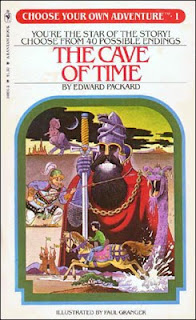
Choose Your Own Adventure

Choose Your Own AdventureCaught up with PokerRoad Radio this week, a podcast I’ll admit I hadn’t really paid too much attention to over the last few months. Just too many out there at the moment -- including some relatively new ones -- that have been competing for (and winning) my attention of late.

The Rabbit Hunt (over on CardRunners) and a few episodes of the PokerNews podcast are a couple I’ve found myself dialing up over the last few weeks. And, of course, the “Cold Call Show” on DonkDown Radio has claimed extra hours on the listening schedule, too, thanks to all of the Travis Makar-UB drama.

Feeling the void left by the recent end of The Poker Beat, I did manage to find time to check in on a couple of the new PRR shows from the L.A. Poker Classic, specifically the 2/27 and 2/28 episodes, co-hosted by Joe Stapleton and Barry Greenstein.

Both episodes were quite entertaining and informative, I thought, with Stapleton and Greenstein both quite funny and interesting throughout. There were a long catalogue of items covered, including some observations from Greenstein about the Makar revelations (on the 2/27 show), plus a number of interviews along the way, too.

I’m not going to summarize it all, but will point you to the PKRGSSP! blog where you can find daily rundowns of a number of podcasts, blogs, news sites, and other pokery productions. Also, over on Pokerati our buddy Merchdawg is offering weekly “podcast round-ups” as well, usually on Fridays, I believe, so check those two sources if you’re looking for poker podcast suggestions.

I did, however, want to highlight something from the 2/27 show I found particularly thought-provoking. Among those interviewed on that show was Joseph Cheong, third-place finisher at last year’s WSOP Main Event, an articulate, humble, and intelligent guest whom it’s hard not to like.

There was, as you might imagine, discussion with Cheong of the hand from the WSOP when at three-handed Cheong six-bet shoved with A-7-offsuit (a hand which I, too, discussed here). While the merits of the play weren’t necessarily being debated, Greenstein did ultimately express some appreciation for the fortitude Cheong showed in the hand and in the way he’s answered questions about it ever since.

“In some sense, Joseph sleeps well at night knowing that he didn’t dog it,” says the Bear, acknowledging that while things didn’t turn out so well in that hand or subsequently for him in the Main Event, Cheong at least had committed to a play that his decision-making process had suggested he make at the time, and thus wasn’t left wondering what might have happened if he hadn’t done so.

PokerRoad RadioThat discussion also included some more talk about how winning a tournament completely changes the way one looks back on it afterwards -- how, in other words, results really do tend to affect our thinking about our play. “When you win,” says Greenstein, “you don’t have to think about the stupid hand you could’ve played [differently], because it’s like all sins are forgiven.”

“Because it’s all on the path to victory, is what you’re saying?” asks Stapleton, and Greenstein agrees, saying further how not winning automatically causes one to think “well, if I’d have done this different, [or] if I’d have done that different, I might have won.”

Amid all of that Stapleton tosses in a quick analogy by referring to those old “Choose Your Own Adventure” books some of us read as kids. Remember those? In which you would read a page or two and then get to choose what the characters did next, each choice sending you to a different page in the book? At some point, say when “you ended up in the pit” (as Stapleton says in his example), you might end up having to backtrack to find the choice that led you astray.

I liked thinking about that analogy afterwards and how well it applies to the labyrinth-like experience each player has when playing a poker tournament. Every decision sends each of us in a different direction, with many other possibilities constantly occurring to us as we wind our way through our chosen adventure.

I still had those “Choose Your Own Adventure” books in mind later in the 2/27 show when Greenstein related the story of an interesting hand he’d played in the L.A. Poker Classic Main Event involving Josh Arieh, Allen Cunningham, and two other players. (The story begins around the 50-minute mark and lasts about five minutes.)

Tournaments are like labyrinthsIt’s a complicated hand, but to sum it up quickly, Greenstein found himself in an awkward spot, not knowing what exactly to do preflop with AQ-suited in middle position. He ended up just calling an early-position raise along with four others, then getting out after a ten-high flop encouraged significant action from Arieh and Cunningham.

In the end, Arieh’s pocket kings were crushed by Cunningham’s flopped set of fours, but that didn’t prevent Greenstein from indulging in a lot of second-guessing regarding his own play. All through the narration of both the pre-flop and post-flop action, Greenstein humorously points out time and again how he was wondering if he could’ve either forced everyone out or set up a reasonable heads-up situation with the all-in shove he never did make.

Even after Arieh and Cunningham end up all in on the flop, Greenstein jokes he had to sweat the turn and river, even though he was already out of the hand. “This is a self-centered story,” laughs Greenstein. “How did this affect Barry?”

As he explains, if an ace had spiked on the turn or river, he’d have felt bad thinking he’d missed that opportunity to shove before the flop and set up a heads-up situation versus Arieh’s K-K which Greenstein would have won.

In fact, a queen landed on the turn, giving Greenstein more (theoretical) outs. “Thankfully, no ace or queen came” on the river, Greenstein says, which amid all of this second-guessing enables Greenstein to congratulate himself -- again, with a lot of humility and self-deprecating humor attached -- that from a gleefully unembarrassed, results-oriented perspective he had indeed made the right decision not to have shoved all in. “I got to feel good that I didn’t go broke.”

In a way, Greenstein is acknowledging here (quite humorously) that he didn’t have the fortitude he was crediting Cheong for having earlier. Admitting that he was feeling “out of sync” with his play throughout the event, he further confesses to second-guessing himself constantly in this particular hand, only feeling better about things after the result of the hand shows he managed to avoid making a decision that would’ve resulted in his elimination.

Would seem self-contradictory but for the fact that the Bear obviously knows what he’s saying here about his own uncertain play. In any event, I found his “self-centered story” quite entertaining, not to mention further proof of how in tournaments we are constantly “choosing our own adventures” -- as well as how we tell of those adventures afterwards, too.

Labels: , , , ,

Monday, February 28, 2011

Blom By One Big Blind? Couldn’t Have Scripted That

The Bears come up shortLast night the Oscars were awarded. Was a bit distracted, though I did manage to watch some of the show with Vera.

Was flipping back to that exciting Knicks-Heat game for much of it, while also following the Sunday Warm-Up on PokerStars for which I wrote a recap. (Infected a bit by all the movie talk, I had a little fun in the wrap by referring to a number of films that had won Best Picture over the years -- check it out.)

Early in the evening I also found myself keeping an eye on that latest “SuperStar Showdown” involving Viktor “Isildur1” Blom and the qualifier Attila “DodgyFish72” Gulcsik. Gulcsik had prevailed in an $11 satellite to win the right to battle the swingy Swede.

Whereas the usual format for the Showdowns calls for Blom and his opponent to play $50/$100 blinds and bring at least $150,000 of their own money with which to play, in this special version the game was played with $5/$10 blinds and Gulcsik was staked with $15,000. Gulcsik would win whatever he had left from the original stake after 2,500 hands versus Blom, plus any profits, if there were any. Also, if either player managed to win all of the other’s $15K, that player would earn an additional $10,000.

I had the four tables of heads-up, no-limit hold’em open for a while early on, watching as Blom surged to a more than $10,000 lead by the halfway point. I wasn’t watching as closely during the second half of the match, but noticed folks tweeting that DodgyFish72 was closing the gap.

As Change100 recounts in her recap of the match, a flurry of all-in hands mostly won by Gulscik had brought him within just under $2,500 with 200 hands to go. Then came a couple more $1K-ish pots that went the qualifier’s way, and suddenly the pair were nearly even.

On the very last hand -- the 2,500th played -- Blom open-shoved from the button over the top of the $1,600 or so Gulscik had at that table, and DodgyFish72 folded. As it turned out, the $10 big blind Blom grabbed on that hand turned out to be the difference in the match, as the final tally showed Isildur1 just $10 ahead.

After being ahead by more than 1,000 big blinds, Blom won the match by one?!? Incredible.

'The Bad News Bears' (1976)Maybe it was the Oscars -- or Change100’s recap, in which she refers to the way the match ultimately failed to adhere to the usual cinematic formula of the underdog winning in the end -- but when contemplating what had transpired in the Showdown I found myself thinking about one of my all-time favorite movies, The Bad News Bears.

Saw this one in the theater when I was a little leaguer myself. Loved it then, and still love it today. I remember my parents being a bit surprised at the language used in the PG-rated flick, but for me getting to hear the kids say those words was just one of the film’s many excellent attributes.

If you haven’t seen the movie before and want to, I’ll warn you now I’m about to give away the ending. (And by the way, I’m talking about the original 1976 film directed by Michael Ritchie and starring Walter Matthau and Tatum O’Neal, not the terribad remake from 2005 with Billy Bob Thornton.)

In the film, Matthau plays Morris Buttermaker, an alcoholic and ex-minor leaguer who gets recruited (coerced, really) to coach the Bears, a squad made up of players not good enough to make the other teams in the league. In their first game they fall behind the Denny’s team (named the Yankees, natch) by 26 runs before Buttermaker forfeits.

Eventually Buttermaker brings in a couple of ringers to join the team, the hard-hitting Kelly (Jackie Earle Haley) and a girl pitcher Amanda (O’Neal) who is the daughter of an ex-girlfriend. Bolstered by the new additions, the Bears improve dramatically and make it all of the way to the championship game versus the hated Yankees.

Yankees 7, Bears 3A ton of fun stuff along the way, including a perhaps obvious (but no less important) lesson about adults being overly competitive when playing out their desires and needs through the kids. Along those lines, Buttermaker has a revelation of sorts during the championship game and near the end pulls the starters in order to give the scrubs some time on the field. The move causes the Bears to fall behind 7-3 heading into the bottom of the last inning, thereby setting up the film’s awesome climax.

The Yankees record the first two outs with little trouble, then a walk, a successful bunt, and another walk load the bases for Kelly. The Yankees actually try to issue an intentional walk to the dangerous Kelly (and give the Bears a run), but he lunges across the plate to hit one of the outside pitches anyway, driving it into the outfield and to the wall.

The music swells as three runs score, then Kelly charges toward the plate. But the relay throw arrives a moment before he does and... he’s... out.


The Bears -- like DodgyFish72 -- come up just short.

But as Change100 notes at the end of her Showdown recap, “even though David didn’t defeat Goliath, it sure feels like he won.” By film’s end, it is obvious that being a Bear is much, much preferable to being a Yankee. “Why are we celebrating?” asks one of the kids in the clubhouse as Buttermaker surprisingly delivers them beers from his cooler (no shinola!).

“Because you should be damn proud of yourselves,” explains the coach.

As should DodgyFish72, the one with whom -- like the Bears -- the great majority of us can identify with much more readily than with the other guy. Of course, while technically he “lost” he still gets to keep $14,990, a sweet consolation prize for sure.

I imagine he might use some of that to buy himself a beer or two.

Labels: , , , , , ,

Newer Posts
Older Posts

Copyright © 2006-2021 Hard-Boiled Poker.
All Rights Reserved.