Friday, September 12, 2008

Listening

ListeningThere’s a nifty passage in Eudora Welty’s autobiographical One Writer’s Beginnings in which she talks about what she experiences when reading. I especially like it because of how it actually does something interesting to those of us who read the passage -- as though we, too, get to experience (momentarily, anyway) exactly what Welty is describing.

Here is the passage:

“Ever since I was first read to, then started reading myself, there has never been a line read that I didn’t hear. As my eyes followed the sentence, a voice was saying it silently to me. Is isn’t my mother’s voice, or the voice of any person I can identify, certainly not my own. It is human, but inward, and it is inwardly that I listen to it. It is to me the voice of the story or the poem itself. The cadence, whatever it is that asks you to believe, the feeling that resides in the printed word, reaches me through the reader-voice.”

As you read that (silently to yourself, I would guess), didn’t you become self-conscious about whether or not you “heard” that “voice” she is describing? Did you hear it?

She goes on to talk about how this capacity to hear the “voice of the story or the poem itself” or “reader-voice” or whatever you want to call it may well be tied to her being a writer. Welty lived a long, long life (90-plus years) and wrote many novels and stories, and so perhaps was one of those people who is better equipped than most of us to “hear” what a book might be saying.

This passage gets excerpted and anthologized sometimes under the title “Listening.” I see all sorts of possible ways of interpreting this passage, but they all tend to come back to the simple notion of paying attention while you read -- of really listening to what the author is trying to say in a way that allows the book to “speak” to you in some fashion.

It is certainly possible to read without “listening.” I know sometimes I do it, and thus unlike Welty there have been many, many lines I have read in my life that I didn’t “hear.” I might sometimes be able to blame the author -- if the book isn’t interesting or well-written, I may well drift away, for sure. But then there are times when I’m just distracted, and no matter how good the quality of writing or insight, that “reader-voice” is mostly silent.

That one can draw an analogy here with what goes on at the poker table should be obvious to anyone who has read thus far, I’d think. Anyone who has been listening, anyway.

Some of us listen all the time at the table. Some of us can only do so now and then. And some of us don’t ever listen. That Full Tilt Poker commercial with Jennifer Harman -- you’ve seen it, the “Speak to me, buddy” one -- kind of dramatizes what we’re talking about here, I think. If you haven’t seen it, here it is:


As the commercial demonstrates, by “listening” we ain’t strictly talking about what we physically hear. There is an inward voice -- the voice of the hand, I suppose -- which we want to hear. You pay attention and your attention pays you.

Hey, listen up: Have a good weekend, everybody!

Labels: , ,

Thursday, September 11, 2008

Moonlighting

MoonlightingThat is the word for it. Shamus in the shadows. Playing it straight by day, living out a second, secret self at night.

Was on the World Series of Online Poker Event No. 11 yesterday, the $320 pot-limit Omaha/8 event. Goofy game. And not so simple to report, either. Big, split pots are frequent (and anticlimactic to report). And the big, scooped pots -- often report-worthy -- are usually not a little bit arduous to recount and explain.

One big difference between reporting online tourneys and live ones is the sheer amount of information one gets online. (Not to mention the speed with which that bombardment occurs.) Spaceman did a good job detailing this phenomenon -- and other relevant factors affecting the pursuit of one’s goal here -- in a post from earlier this week. Kind of makes it seem disingenuous to summarize a hand when you have every single detail at yr disposal there in a hand history.

Hell, on PokerStars you can even reanimate the sucker again and again, if you’d like. You could turn a single hand into a regular little novella, if you wanted. Was joking with one of my colleagues early on how nice it would have been at the WSOP had we been able just to click a replayer and get the players to do it again.

Best part of the evening was eavesdropping on the incessant chat over at Barry Greenstein’s table. A constant stream of questions for the Bear, from both railbirds and tablemates. And from what I could tell, Greenstein answered every one, no matter how silly or personal. One even asked how old he was when he’d lost his virginity. “Still holding out,” responded Greenstein cheekily.

Back on tonight (and for the next several days, too). Maybe when it’s all over a couple of weeks from now I’ll have more to say. No time right now, though. Big pot brewing over on Table 106.

Labels: , , , ,

Wednesday, September 10, 2008

Kudos

KudosPlayed a tiny bit of online poker yesterday, having a small window of opportunity on a rare day off from blogging PokerStars’ World Championship of Online Poker.

That PokerListings Run Good Challenge continues next Saturday with another no-limit hold’em tourney, this time using a turbo format. So instead of playing my usual PLO cash game -- which, in fact, I haven’t played at all for the last week -- I decided to join a little 18-player sit-n-go to practice.

Stumbled a bit early, but righted myself (largely by winning an all-in coin flip, admittedly) and was there with five players to go and a less than average stack (in fourth). Even though I was low on chips, I liked my chances as both of two chip leaders seemed on the passive side. The fellow in third place was a bit tricky, although as it turned out I didn’t tangle with him much during the endgame.

Meanwhile, the table’s short-stack (to my left) was absolutely refusing to play a single hand, folding a good 25 in a row. Then he took a chance calling all in with a flush draw and one card to come and he hit it. That made me the shorty. A couple of hands later, I raised with Q-Q, he shoved, and I called. He had A-K. Flop J-T-x, but an ace on the turn (and no king on the river), and I was bubble boy. Again!

PokerStars' World Championship of Online PokerWhich is why I’m playing $5.50 SNGs. For now I’ll leave the big buy-in tourneys to people like Haley and Pojo, both of whom cashed this week in WCOOP events.

Haley made a nice run in the 8-game event (known around these parts as “S.P.L.E.N.D.O.R.”); she writes a bit about it here. Pojo’s cash was yesterday in the 4-max no-limit hold’em event, where he was among the chip leaders for a while there early on. (I noticed at one break -- about four or five hours into the thing, I think -- he was in 11th place.) I was watching when he sent PokerStars pro Dario Minieri to the rail, the little guy’s scarf flappin’ in the wind behind him. Then he got moved to Hevad Khan’s table and held his own against that PS pro, too. Nice work, you two.

I’m sure I have other buds out there who are playing these events and I don’t know about it. (If so, tell me!) I mentioned last week how terrific (and unique) these structures are for the WCOOP events. Half-hour levels, for the most part, with the blinds/antes rising more gradually than you normally find in even the slower online tourneys. And the fields are massive, thus routinely making for big prize pools, too.

Covering the tourneys -- and reading all of these tourney-centric books -- is definitely making me want to play ’em more often. And perhaps lift my ambitions a bit beyond these tiny buy-in donkaments. Will be putting those thoughts on the back-burner for now, though, as my next day off from the WCOOP is a good ways down the road.

Good luck to all who are playing. You know I’ll be watching.

Labels: , , , ,

Tuesday, September 09, 2008

Where Are You Going, Where Have You Been?

Where Are You Going, Where Have You Been?Busy, busy, busy. I mentioned last week how I’m helping out with the live blogging of PokerStars’ World Championship of Online Poker. Worked the last four days straight, covering four different events.

Thus far I’ve partnered with fellow bloggers Drizz (Nickle and Dimes), April (This Is Not a Poker Blog), Tuscaloosa Johnny (Poker Nation), and Otis (Up for Poker). All cool cats with whom I’m very glad to be working.

Was kind of a late one last night, so I expect I’ll be dragging some today. Fact is, I’m essentially working two full-time jobs at the moment. I like ’em both, though, so I ain’t complainin’.

Speaking of living out multiple existences, I wanted to share one small observation today inspired by something I heard on Bart Hanson’s Cash Plays. In the car yesterday I happened to listen to Hanson’s interview with Allen “Chainsaw” Kessler from a couple of weeks back (the 8/27/08 episode). Not gonna get into Kessler’s character or anything really having to do with him -- although he is certainly an interesting case. Rather, I just wanted to share something he mentioned about Phil Ivey that caused me to brood briefly over the issue of self-identity and poker.

Kessler played with Ivey back in Atlantic City in the early 90s, mostly Stud/8 and Omaha/8. Hanson asked him some questions about those days, including asking Kessler what he thought of Ivey’s game back then. “He played great,” said Kessler without hesitation. “He always played great?” asked Hanson, a note of incredulity in his voice. “Or do you remember when he was bad?”

Kessler said no, he didn’t remember Ivey ever playing badly, at least when he played with him (when Ivey was in his early 20s). “No, I don’t remember…like I don’t remember him as that ‘Jerome’ or any of that stuff. He must have already been past that.”

The reference to “Jerome” there is, of course, to the pseudonym Ivey played under when he was legally too young to play in casinos. In order to play, Ivey used a fake ID with the name “Jerome Graham,” and he has talked in interviews about how everyone in Atlantic City knew him as Jerome until he turned 21. Hanson’s questions seem to imply that “Jerome” wasn’t the consistently stellar player Phil Ivey is, as does Kessler’s reference to those earlier days (before he played with him) as perhaps corresponding to what Hanson was alluding with his follow-up question.

It occurred to me hearing Kessler refer to how Ivey had “already been past that” earlier phase in his life and poker playing career in which he was known as “Jerome” that every poker player goes through similar phases in his or her development. In other words, we all have memories of earlier versions of ourselves as poker players, and in most cases those earlier versions are probably much different from the idea we have of ourselves today.

And, at some point, we probably all had to get “past that” earlier self in order to improve -- or at least endure -- as poker players.

What do you recall of that former self? Wouldn’t it be great to play him or her heads-up?

Labels: , , , ,

Monday, September 08, 2008

In Which It Is Demonstrated Why Pocket Jacks Are Sometimes Called “Hooks”

PokerListings Run Good ChallengeSo we played this little blogger event on Saturday, the PokerListings Run Good Challenge. By invite only. A nifty little freeroll with some decent cabbage for those who finish in the top three ($600/$300/$100). Only 12 were invited, and of those only 11 showed up (I think the “Entities” from Wicked Chops missed it). And Pokerati Dan also came too late to make anything happen, and so we were really starting with 10. A decent shot at some money, no matter how you look at it. Of course, as the name suggests, it would help to run good.

I’m hardly playing these no-limit hold’em tourneys at all these days, but as I’ve mentioned the last few weeks I have been reading quite a bit and so had some ideas swimming around in the ol’ cerebral stew about how I was a-gonna approach this sucker. Wasn’t terribly confident going in, but once things got started I quickly felt better, realizing I might’ve actually picked up a thing or two from my reading. Books are our friends.

To give you an idea how it went for me, I took a peek after all was said and done at my stats and discovered I’d managed to claim a ton of pots without showing. Out of 35 pots I won, PokerStars is actually saying I’d only shown three times the entire event. (That was of 130 hands total.) Not quite sure if that’s entirely accurate, but I do know I was avoiding the showdowns pretty much throughout.

Grabbed a medium-sized pot early to push out to 1,900 or so when everyone else was still hovering around the starting 1,500, and that gave me room to operate a little more freely and accumulate a bit. Maneuvered my way up over the 3,000-chip mark before the first hour was up, which had me in second or third place for most of those first four levels. During that time we’d lose Change100 and Matt from PokerListings, and just after the one-hour break the nine players remaining were consolidated onto one table. My opponents: Dr. Pauly, Amy Calistri, Kid Dynamite, Michele Lewis, the Poker Shrink, Spaceman, Poker Listings Dan, and Pokerati Dan.

At that point I had a little less than 3,000 in chips, which in fact put me in second behind the current leader, Poker Listings Dan, the strategy writer over at PokerListings, who had approximately twice that. It was at that point where I feel like I played only so-so poker, folding for a couple of orbits when I probably could have gotten involved a time or two. Was trying to gauge the table, though.

Finally at the start of Level 6 (blinds 100/200), I got active again. And players started busting. First Pokerati Dan, who’d blinded all of the way down to 95 chips before playing his first hand, got bounced. (“I played too tight,” said Dan in chat from the rail.) Then the Poker Shrink.

Then a short-stacked Dr. Pauly put a brutal beat on Kid Dynamite when he shoved his last 1,655 with the hammer (7-2) and got called by the Kid who held QsQh. The flop was benign, but the turn and river both came deuces, and the Kid was crippled. He’d go out in seventh, followed soon thereafter by the Spaceman (6th) and Amy (5th).

At four-handed (the money bubble), I was again in second place with roughly the same stack (3,160) I had when the final table started, a bit less than half of what Dan Skolovy had. After a dozen hands or so, I had held steady, but Dr. Pauly had snuck ahead of me, having about 4,200. Self-proclaimed “last woman sitting” was Michele Lewis with about 2,000.

Then came this hand. I’m a-gonna tell you what happened, but I offer it to all-a-you well-versed MTTers as a “what would you do?”

I’m on the button with 3,460 and get dealt JcJd. Blinds are still 100/200. Dan from Poker Listings, who has 6,785, raised to 600 from UTG/the cutoff. Now Dan is the head strategy writer over there at the PL, and we’d all already picked up that one key part of his strategy was either to raise or fold preflop, and almost never limp. So when he raises there, his range is fairly wide, I’m thinking. Probably has a better than average hand to raise my button, but not necessarily something better than pocket jacks.

Here’s where I ask you, what would you do?

Folding seemed weak. Calling with position might’ve been a good choice here, but if an ace, king, or queen flops -- more likely than not -- and Dan bets out, I’ve got a tough decision. If I call, the pot would be 1,200, and I’d have 2,860 left.

I decided I wanted to raise, and given my stack size figured I couldn’t make a real raise without pushing all in. So I did. Pauly and Michele folded, and Dan took a few seconds before calling and turning over AcJs. I was surprised he’d call with that, but elated that I was 70-30 to win here. (Do you call in that spot? What, really, could my range be there?)

Alas, an ace flopped, I couldn’t catch up, and I was out on the bubble.

So while I brood a little about how I might’ve folded into the money, Dan from Poker Listings eliminated Michele in 3rd on the very next next hand, then after 130 hands of back-and-forthing with Pauly would take first. That means the first-place prize money gets rolled over into the next tourney (this coming Saturday), although I’m not sure how it’ll be distributed.

My consolation prize: I get some leaderboard points for finishing in the top six. After three weeks of this, those who end up in the top six get to play a fourth freeroll the last Saturday of the month.

And I guess another consolation prize is the feeling that, for the most part, I played a tournament well. Congrats to Dan, Pauly, and Michele! And thanks again to PokerListings for the invite -- was a ton of fun, for sure.

Labels: , , , , , , , , , , , ,

Friday, September 05, 2008

PokerStars’ WCOOP Kicks Off Today

PokerStars' World Championship of Online Poker begins todayThe seventh annual World Championship of Online Poker begins today over on PokerStars and will run through September 22. Whereas Full Tilt Poker runs its special FTOPS tourneys so frequently they don’t seem that special, PokerStars only hosts the WCOOP once a year.

A total of 33 events will take place over the next two-and-a-half weeks, with the cumulative guaranteed prize pool being $30 million. The first event begins at 2:30 p.m. Eastern time today, a $200+$15 short-handed no-limit hold’em event. Then later today a pot-limit five-card draw event kicks off. According to the WCOOP stats page, there have been 88 tournaments total during the first six years of the WCOOP. Last year there were 23, so the series has grown again (significantly) with the addition of 10 more tourneys.

Looking down the schedule, one sees tourneys for every variant of poker offered on Stars -- pot-limit Omaha, Omaha/8, razz, stud, H.O.R.S.E., deuce-to-seven draw, and all the varieties of hold’em. There’s even an “8-game mixed” event like they had at this year’s WSOP (the one I campaigned to call S.P.L.E.N.D.O.R.) in which players will play the same eight games -- 2-7 triple draw, hold’em, Omaha/8, razz, stud, stud/8, no-limit hold’em, and pot-limit Omaha.

I’ve been following the WCOOP thread over in the MTT forum on 2+2 where posters are discussing the series and posting questions for a Stars rep who appears to be answering them all in rapid fashion. Many are commenting on the structures, which are for the most part quite unique when compared to other online tourneys.

For fun, I went over to Arnold Snyder’s Poker Tournament Formula website where one can find a downloadable Excel sheet that makes it fairly easy to determine a given tournament’s “patience factor” and thus “skill level,” a rubric created by Snyder and explained in his Poker Tournament Formula books. I plugged in the starting stacks and blinds/antes schedules for today’s WCOOP Event No. 1 and compared them to the typical Sunday Million tourney on Stars.

According to Snyder’s rubric, the “patience factor” for today’s WCOOP event (30.25) is more than double that of the typical Sunday Million tourney (14.48). One big reason for the difference is the fact that the levels in the WCOOP event will last 30 minutes as opposed to just 15 minutes per level in the Sunday Million. The starting stack for today’s event is smaller (just 3,000 as opposed to 10,000), but in addition to the levels lasting longer the blind/ante increases are slower, too.

That patience factor actually makes both “skill level 6” tourneys for Snyder, since he rates any online tournament with a patience factor over 12.5 as a 6, a rating he reserves for tournaments whose structures tend to reward skill and minimize luck (and thus are best reserved for highly-skilled players and avoided by novices).

Most of the posters on the 2+2 thread like the structures, although some are offering suggestions regarding particular events. However, a couple were complaining about how darn long the WCOOP events tend to go. Responding to those comments, accomplished online and live player Dani “Ansky” Stern chimed in earlier this week.

“Man, every year people complain that the structure is too long,” says Ansky, “and EVERY year the numbers get bigger and bigger and its always the best tournaments of the year. keep up the amazing structure, ITS ****ING ONCE A YEAR, GET OVER IT.” According to Ansky, the “WCOOP sets the standard in quality MTT structures online, please for the love of god do not scale it back to the standard pushbot fests that every other tournament is.”

PokerStars is going to be providing some extra coverage of the WCOOP events this year, including some live blogging à la what PokerNews does for the WSOP. You can find that coverage over on the PokerStars blog. And they’ve recruited yr humble gumshoe to help out some with that, so I’ll have a front row seat for a lot of the action.

It is likely, then, that I won’t be playing a lot of poker over the next two-and-a-half weeks, although I will be showing up on Saturday for the PokerListings Run Good Challenge. I wrote a little something about that earlier in the week.

Yesterday Spaceman offered an overview of the series and what it entails, so if yr curious head over there for more. Hopefully I don’t embarrass myself too greatly. Have been reading a lot about no-limit hold’em tourneys (such as the Snyder books), but haven’t been playing them hardly at all. Actually, just looking at the structure for tomorrow’s tourney (and using the spreadsheet), I see the “patience factor” there is 7.56, making for a skill level of 4. That means a little more luck should be involved -- good news for me!

Should be fun, especially given that I’ll be playing against a number of cool cats whom I got to meet and hang out with over the summer in Vegas. Best of luck to all!

And the rest of youse have yrselves a good weekend, too.

Labels: , ,

Thursday, September 04, 2008

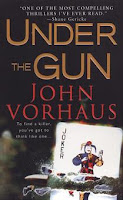
John Vorhaus’ Under the Gun

'Under the Gun' by John VorhausJohn Vorhaus is best known to poker players as the author of several strategy guides, including several titles in the popular Killer Poker series. He’s also involved in the entertainment industry, having written screenplays for various shows (including Married… with Children), and has additionally written a couple of instructional books about creative writing. With such a background, it isn’t surprising to find Vorhaus coming out with his first novel -- a poker-themed thriller with the nifty, hard-boiled, doubly significant title Under the Gun.

The book just came out a couple of days ago. I’d heard about it listening to Vorhaus be interviewed over on Lou Krieger’s Keep Flopping Aces (the 7/24/08 episode). I had the opportunity to read the book this week and enjoyed it. I can definitely recommend it as an entertaining page-turner, especially so for poker players.

The story concerns a mild-mannered accountant named Hal Harris whose brother Guy is a small-time poker player in Vegas hoping to hit it big. Guy manages to win a satellite into a huge $100,000-entry poker tourney called the Poker Apocalypse, and invites Hal out to celebrate. After a bit of prodding, Hal makes the trip, but shortly after his arrival Guy gets killed, leaving Hal the coveted entry chip -- which now not only represents Hal’s potential entry into the Apocalypse, but also an initial clue toward solving the crime.

It is a clever premise, and Vorhaus follows it up with other plot twists and characters that likewise demonstrate a certain ingenuity. The Poker Apocalypse, or, as Guy describes it, “the biggest poker tournament in the history of ever,” is itself a neat device around which to built a murder mystery. Cooked up by Kai Cortland, a high-rolling casino developer, the tourney is kind of a not-so-distantly-futuristic version of the World Series of Poker, complete with the requisite ostentation and media coverage.

Some of the characters Vorhaus invents seem drawn after certain types we see in the poker world today, though embellished to fit the slightly-exaggerated version of that world he presents in the novel. There’s the villainous Marko Dragic (“Dark Mark”), a poker player with a criminal past whom Hal will need to confront eventually in his dual quest to win the Apocalypse and to discover what happened to Guy. Slaughter Johnson is an old-timer who emerges to mentor Hal. Slaughter’s gritty daughter, Vinny, a dealer, is along to help Hal as well. And there’s Minty McGinty, the one-hundred pound dog Hal also inherits from his brother.

Vorhaus does well to create a plot that keeps the reader’s interest, and there are a number of small touches that add to the overall pleasure of the read. There are a few Raymond Chandleresque analogies here and there (e.g., “The Elvis of his common sense, as it were, had left the building of his brain”) which are certainly fun. And even relatively minor characters, such as a bathroom attendant who briefly figures into the goings-on, are presented with engaging backstories that keep us absorbed.

Of course, it should be said that by trying to construct a poker-themed fiction, Vorhaus follows a long, long line of others (fiction writers, film makers) who have struggled to do so successfully. Indeed, poker players -- especially serious ones -- who read Under the Gun are likely going to want to argue over the plausibility of certain aspects of Vorhaus’ story.

Additionally, non-poker players might object to the sometimes lengthy explanations of poker strategy and accounts of hands. Since Hal is not a poker player when the story begins, he has to learn everything, and so occasionally one encounters a stretch of instruction and/or hand analysis that I personally find highly readable but could imagine being less enthralling to some. (In fact, I don’t think it is that big of a stretch to say that some, attentive non-poker playing readers may actually pick up a number of useful tips about tournament poker from Under the Gun.)

I like the way Vorhaus presents the poker, though. It is nice (for a change) to read someone describing hands and the machinations of a tournament while secure in the knowledge that the author knows of what he speaks. (I noticed no “howlers” such as one regularly runs into in poker-themed films and stories.) And he does interweave the story of the tournament in with the sleuthing to find Guy’s killer fairly well, too. As I say, it is a page-turner, culminating with a suitably frenzied finale.

All in all a good time, and like I say should be especially fun for the poker player who likes a good thriller filled with comic touches. You can get the book via Amazon. You can also order it through Vorhaus’ website, Vorza’s Brain (where you can read the first chapter, too).

Labels: , , ,

Wednesday, September 03, 2008

The Hard-Boiled Poker Radio Show, Episode 8: Aces and Eights

The Hard-Boiled Poker Radio ShowNew episode is up. Sucker is over there in iTunes for yr downloadable consumption. The other RSS feeds should have it, too, I’d think. Go to the show’s blog for all the links and info for subscribing. You can also hear the show just by clicking here, if you wanna.

This episode has a theme of sorts -- characters. The Poker Grump kicks it off with a few sketches of characters he’s encountered at the poker tables (both live and virtual). Then the focus shifts to one character in particular, Wild Bill Hickok, best known to the poker world as the U.S. Marshal that got himself killed in a poker game while holding what came to be known as the “dead man’s hand,” aces and eights.

I give a little background on Hickok’s story, then read a poem by the American poet Billy Collins. The poem comes from Collins’ first collection (published back in 1977), which in fact was titled Pokerface. Collins went on to become the U.S. poet laureate, in fact serving two year-long terms (2001-2003). I added some music to the reading that kind of heightens the drama a little bit, I think. (And the humor, too.) Then I play an installment of the old time radio show Frontier Gentleman which dramatizes the killing of Hickok.

I might have included Bob Dylan’s song “Rambling, Gambling Willie” in this episode, but I didn’t. The song isn’t exactly about Wild Bill Hickok, but does feature the protagonist getting killed while holding aces and eights. I left it out, though, as I’ve been trying to stick to songs and radio shows that are well clear of any copyright restrictions.

And while I do talk about some of the background of Hickok’s story, I don’t spend any time at all wonderin’ about what the fifth card in his hand was. Des Wilson explores that question at length in his Ghosts at the Table, if that sort of thing intrigues you.

As always, if you happen to listen to the show, please send along any feedback -- either here, on the show’s blog, or via email at shamus at hardboiledpoker dot com.

Labels: ,

Tuesday, September 02, 2008

Showtime! ESPN Coverage of 2008 WSOP Main Event Begins Tonight

ESPN covers the WSOPAfter six weeks of showing preliminary events, tonight ESPN begins airing its coverage of the Main Event of the 2008 World Series of Poker. For the next nine weeks -- 18 hours total -- we will get to see ESPN’s version of the story of how 6,844 entrants came to the Rio during the early days of July, ponied up $10,000 each for Event No. 54, and played their way down to the final nine. Then will come a one-hour final table preview show on Nov. 4, followed by the two-hour repackaging of the final table itself to be shown on Nov. 11.

These episodes should prove interesting for a number of reasons. For me, I’m anticipating a lot of “feature table” action that I personally was unable to witness while covering the event for PokerNews. If my memory serves me correctly, during those first four “Day Ones” and perhaps even the two “Day Twos” none of us were allowed into the small stadium area where the feature table took place, so we couldn’t report on those hands at all. Neither was it very easy for us to get close to the second feature table, located just outside of the mini-arena. So most of what they show -- over these first few weeks, anyway -- will be brand new to me.

I recall Chau Giang getting a spot at that feature table there early on (and some of us wondering how, exactly, Giang managed to land a role as the star of the World Series). I know Ray Romano was seated in there (during Day Two, I think), and in fact I even snuck over and peeked in, seeing enough to report on a hand or two, as well as on Romano’s bustout. ESPN did allow us a reporter in there by the third day, I believe, and so from that point forward the feature tables did get some coverage on PokerNews (although I was always stationed at one of the outer sections). There was a pretty wild feature table hand on Day 4 involving Jean-Robert Bellande that should definitely be shown sometime later this month, I’d think. I remember getting a report on that one later that night while bowling with Whit Blanton, another player at the table at the time.

ESPN had its cameras elsewhere in the Rio, too, grabbing shots of other celebrities and stars as well as the occasional showdown. The dealers were issued these “All In” cardboard paddles which they would hold aloft whenever a player’s all in bet was called, giving the crew time to rush over and set up to film. So I’d anticipate seeing some of those hands interspersed within the coverage of the main tables.

I believe it was the last of the Day Ones, Day 1d, when F-Train and I were stationed over in the Blue section right next to Jamie Gold’s table. Gold lasted about six hours, not quite three levels, and there was an ESPN crew there the entire time recording practically every hand. Will be curious, then, to see how much of that particular table they air (probably in a couple of weeks). Not to mention to scan the background for familiar faces.

Of course, those of us with some awareness of what went down in July will not be able to avoid watching for early glimpses of the so-called “November Nine.” Given the relatively obscure status of those who eventually made it to the final table, it seems as though the odds were probably against ESPN getting much coverage of those guys during the initial couple of days. Which means for the first couple of weeks, anyway, we probably won’t be seeing much of Dennis Phillips, Ivan Demidov, Scott Montgomery, Peter Eastgate, Ylon Schwartz, Darus Suharto, David Rheem, Craig Marquis, or Kelly Kim.

Seems to me the guiding principle here will probably be to try to recreate the thrill ride that was ESPN’s packaging of the 2003 WSOP Main Event -- seven terrific hours of poker TV, culminating in the surprise victory by Chris Moneymaker. And for many of those watching (sometime in September, I believe), it was a surprise, as the outcome of the event, played out back in May at Binion’s Horseshoe, wasn’t known to most.

My sense is that while these first few hours of the 2008 Main Event will be mildly intriguing to some of us, they won’t come close to that level of excitement. Perhaps the buzz may pick up as we move through October and toward that final table preview show (scheduled for November 4), but right now it seems like a pretty steep hill for ESPN to climb.

Whatever happens, how these next two months of shows play out and are received will particularly affect whatever Harrah’s and ESPN decides to do with next year’s WSOP. And thus arguably should have some, more general effect on poker’s future as a whole, too.

Labels: , ,

Monday, September 01, 2008

Quantity vs. Quality

I don't want to workA Labor Day-themed picture for you, courtesy GraphJam. Great time-waster, that site. Save it for tomorrow, though, and get yr laughs while on the clock.

Thanks in part to the holiday today, I had some extra hours over the weekend to play some poker, and I’m sorry to report the results weren’t so hot. At least in terms of the cash games, where I played too long and thus ended an up-and-down month on a sour note. Pretty clear case of favoring quantity over quality, as the results bore out.

Jumped into a couple of tourneys as well, where I fared marginally better, scoring miniscule cashes in a big no-limit hold’em donkament and a low buy-in H.O.R.S.E. event. I played Saturdays with Pauly, too (pot-limit Omaha, $10+$1 buy-in), from which I got bounced near the end of the first hour. A semi-interesting (anti-)climax for me to that one.

After a bit of floundering during the first three-and-a-half levels, I found myself down to just 1,125 a few minutes before the first break. Things were looking up, though, as I was in late position holding a pair of sevens and staring at a 7-8-8 board.

Four of us had limped to see that flop, and when the player in the big blind made a pot-sized bet, I knew this would be a do-or-die hand for me. Very likely he had an eight, but very unlikely he had a seven to go with it. So I’m thinking I probably would have to fade ten outs (at most), which would make me a slight favorite, though not a huge one (like 55-45 or thereabouts). I reraised all in, and was less than pleased when the small blind called as well. There’s the other eight, I thought, and a bunch more outs to dodge. Figured I was probably a considerable dog now.

The big blind then repopped it all in, and the SB called, creating a side pot of 2,500 alongside that main pot of 3,775. When the hands were turned over, my spirits were momentarily lifted -- the SB held 5-9-J-8 and the BB 2-J-8-5. Since my two opponents had some of each other's outs, the extra man in didn’t really affect my odds. I was still the favorite, needing to avoid the three nines, the three deuces, the two fives, and the two jacks.

Alas, of the ten death cards, not one but two mercilessly floated down onto the virtual felt -- a five on the turn, then a jack on the river just to rub it in. I was out, done in by the not-so-wonderful underfull.

PokerListings Run Good ChallengeStill enjoyed the tourney, and have plans to play some more tournaments over the next few Saturdays as part of this PokerListings Run Good Challenge where I’ll be embarrassing myself royally versus other esteemed poker bloggers. (Prefontaine photo via the Poker Shrink.) Will share more later in the week on that one.

Meanwhile, I’m looking at a busy September, with some side writing gigs destined to take up a lot of hours here over the next three weeks or so. Might, in fact, prove difficult to keep up the at-least-one-post-every-weekday pace I have followed throughout 2008.

I noticed Dr. Pauly saying something last week about actually taking a day off from blogging, breaking a streak of 110 straight days of posting. One hell of a run, that, especially considering the usual length and depth of his posts.

Like I say, we’ll see if I find it necessary to take a similar break, though for now I ain’t planning to do so. Still, if forced to choose, gotta go with quality over quantity.

Labels: , , ,

Newer Posts
Older Posts

Copyright © 2006-2021 Hard-Boiled Poker.
All Rights Reserved.