Tuesday, August 16, 2011

The Limpede

Don't rock the boatI’ve begun reading Annie Duke and John Vorhaus’ new strategy text, Decide to Play Great Poker. Have completed the first of the book’s three parts, the one dealing with “Pre-Game and Pre-Flop Play.” Next up (“Play on the Flop”) is a lengthy part full of chapters concerning how to proceed following various flops/scenarios. Then comes the final part (“The Rest of It”) which looks like it focuses on some river situations and “Other Matters” including reviewing some additional concepts plus a last chapter on bankroll management.

There’s a term used in the first part, one I believe Vorhaus employed in his earlier Killer Poker books though I don’t know who deserves credit for coining it. Kind of sounds like a Tommy Angelo-type neologism, in fact, although like I say I’m not sure where it originated.

The term is “limpede” and refers to that scenario that sometimes occurs in no-limit hold’em in which a player limps in from early or middle position, thereby encouraging others to limp behind as well, thus creating a stampede of limpers or a “limpede.”

It’s a funny-sounding word. The sound of the word -- as well as the behavior to which it refers -- kind of makes me think of “lemmings,” too. And the scenario to which it refers is common enough that it probably represents a concept worth knowing about.

It does happen. Limping up front will sometimes encourage limpers all around. And I suppose you might say that whenever you have a bunch of limpers seeing a flop, any hand is likely to be “run over” by the herd. (Thus is limping with a premium hand up front generally not recommended.) Of course, sometimes amid all the limping it will happen that a player -- having been dealt a real hand and/or correctly sensing weakness all around -- will instead raise and (often) scatter the lot.

Been thinking further about this idea of the “limpede” and how it applies outside of poker. Kind of recalls those terrible stories from introductory psychology about the so-called “bystander effect.” You remember those? A violent crime is committed with numerous witnesses, yet no one intervenes or calls the police, the presence of others (also passively resisting any action) weirdly keeping everyone from acting.

We the sheepleJoining the “limpede” could be said to satisfy many desires -- to “play along” or participate in a non-conspicuous way, to avoid upsetting the status quo, to belong. Can be a powerful, highly influential force, as readily evidenced in politics and government, the business world, and elsewhere.

In other words, it’s hard sometimes for us to resist the urge just to follow along. But we must. Or rather, I must. You can do whatever.

Labels: , , ,

Friday, July 24, 2009

Play Poker, Quit Work and Sleep Till Noon! by John Fox

'Play Poker, Quit Work and Sleep Till Noon!' by John Fox (1977)When in Vegas this summer I did get a chance one afternoon to visit the Gamblers Book Shop again. The store has a new location since my last visit, having moved from its previous spot over on 11th Street near Charleston Blvd. to a smallish strip mall over on E. Tropicana Ave. The new store has just about everything the old one did, although I missed the room full of old magazines and used books which didn’t make the trip.

I bought one book while there, one with kind of a historical value as far as poker literature goes. The book is by John Fox and is called Play Poker, Quit Work and Sleep Till Noon! or The Complete Psychology, Mathematics and Tactics of Winning Poker.

When one opens the cover, the title page looks like it might have been patterned after the title pages of 17th- or 18th-century British novels and satires, extending on and on down the page: Play Poker, Quit Work and Sleep Till Noon! or Play Poker With “The Fox,” or Poker for the Greedy Player, or The Complete Guide to Winning Poker, or Poker: Who Wins, Who Loses, and Why, or The Secrets of a Professional Poker Player, or The Mathematics Professor Plays Draw Poker, or How to Be the Best Poker Player on Your Block (or the World), or Draw Poker Tactics and the Science of Behavioral Deductions, or How You Can Make a Living Playing Casino Poker, or How to Win at Poker Without Being Really Lucky, or A Brief Outline of Some of the More Fundamental Aspects of Draw Poker (in 600 Pages).

Fox’s book was first published in 1977, and as that long version of the title indicates the game on which it focuses is five-card draw. However, though much of the strategy discussed concerns that largely outmoded game, the majority of the book concerns psychological issues, with lots of specific pointers regarding tells, projecting an image, various strategems to elicit desired responses from opponents, and other advice not necessarily specific to draw poker.

Title page of John Fox's 'Play Poker, Quit Work and Sleep Till Noon!'As that long version of the title also probably suggests, Fox is quite the humorist, and employs a witty, engaging style throughout, peppering his discussions with funny anecdotes (some of which are laugh-out-loud hilarious) and what he calls “stratefices,” a word he invented to refer to “a tricky, extremely useful, carefully selected, profound, and more than a little underhanded maxim, principle, or rule.” When introducing the word, he explains its etymology in detail, claiming it combines elements of Greek, Latin, and Sanskrit, “in keeping with the learned nature of this erudite tome.”

The book was self-published, and has all the quirky, unexpected shifts in typeface, spacing, and sometimes erratic copy editing one might expect. Like I say, the book kind of reminds me of an old British satire, what with all of the digressions, the pseudo-academic apparatus, and other idiosyncracies -- including the author’s sort-of-crazy-sounding persona. For those who are familiar, think Robert Burton’s The Anatomy of Melancholy or Jonathan Swift’s A Tale of a Tub.

Fox’s book has a definite historical importance in poker literature, appearing a couple of years before Doyle Bruson’s Super/System and seven years before Mike Caro’s Book of Tells. Arnold Snyder, whose Poker Tournament Formula books I’ve recommended here before, speaks highly of Fox’s discussions of the psychology of poker and bluffing both in Play Poker, Quit Work and Sleep Till Noon! and in Fox’s second book, How to Hustle Home Poker (1981).

Says Snyder, Fox’s discussions “are truly exceptional,” adding that Fox’s first book “truly is in a class by itself as poker books go.” Snyder also points out how some of the “old timers I’ve talked with told me when Fox’s book first came out in 1977, it was viewed by many of the top players as a groundbreaking book on the game that did for poker what Ed Thorp’s Beat the Dealer did for blackjack.”

Snyder also commends Fox for the way he understands the relevance of mathematical probabilities in poker -- that is to say, knowing odds and frequencies are important, but not everything, and in some cases of no relevance whatsoever. Such a position provides fuel for Snyder in his ongoing fight with the “math heads” -- Mason Malmuth and David Sklansky. (I might come back to discussing this conflict in a post next week, actually.)

John Fox (center) in a photo from Mike Caro's 'Book of Tells'Caro acknowledges Fox in his Book of Tells, and in fact Fox appears in one of the photographs in Caro’s book (see left) in which he’s shown doing a poor job concealing his hand from the player to his right.

If you are interested in learning more about John Fox and his Play Poker, Quit Work and Sleep Till Noon!, the poker author John Vorhaus wrote a three-part series of columns for Card Player about the book last spring, titled “The Ageless Wisdom of John Fox.” The first two parts are available online (Part I, Part II), but I am not seeing the third installment, which appeared in the March 31, 2009 issue (Vol. 22, No. 6) -- apparently it didn’t make the cut for the online archive for that issue.

Anyhow, like Snyder and Vorhaus, I recommend Fox’s book as both an entertaining and useful read -- if you can find it, that is. It has long been out of print, and I’m seeing copies online being offered for $100 or more. I know the Gamblers Book Shop had a couple more on their shelves for considerably less than that, if yr really interested.

Labels: , , , , ,

Thursday, September 04, 2008

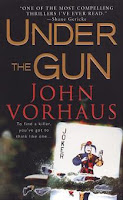
John Vorhaus’ Under the Gun

'Under the Gun' by John VorhausJohn Vorhaus is best known to poker players as the author of several strategy guides, including several titles in the popular Killer Poker series. He’s also involved in the entertainment industry, having written screenplays for various shows (including Married… with Children), and has additionally written a couple of instructional books about creative writing. With such a background, it isn’t surprising to find Vorhaus coming out with his first novel -- a poker-themed thriller with the nifty, hard-boiled, doubly significant title Under the Gun.

The book just came out a couple of days ago. I’d heard about it listening to Vorhaus be interviewed over on Lou Krieger’s Keep Flopping Aces (the 7/24/08 episode). I had the opportunity to read the book this week and enjoyed it. I can definitely recommend it as an entertaining page-turner, especially so for poker players.

The story concerns a mild-mannered accountant named Hal Harris whose brother Guy is a small-time poker player in Vegas hoping to hit it big. Guy manages to win a satellite into a huge $100,000-entry poker tourney called the Poker Apocalypse, and invites Hal out to celebrate. After a bit of prodding, Hal makes the trip, but shortly after his arrival Guy gets killed, leaving Hal the coveted entry chip -- which now not only represents Hal’s potential entry into the Apocalypse, but also an initial clue toward solving the crime.

It is a clever premise, and Vorhaus follows it up with other plot twists and characters that likewise demonstrate a certain ingenuity. The Poker Apocalypse, or, as Guy describes it, “the biggest poker tournament in the history of ever,” is itself a neat device around which to built a murder mystery. Cooked up by Kai Cortland, a high-rolling casino developer, the tourney is kind of a not-so-distantly-futuristic version of the World Series of Poker, complete with the requisite ostentation and media coverage.

Some of the characters Vorhaus invents seem drawn after certain types we see in the poker world today, though embellished to fit the slightly-exaggerated version of that world he presents in the novel. There’s the villainous Marko Dragic (“Dark Mark”), a poker player with a criminal past whom Hal will need to confront eventually in his dual quest to win the Apocalypse and to discover what happened to Guy. Slaughter Johnson is an old-timer who emerges to mentor Hal. Slaughter’s gritty daughter, Vinny, a dealer, is along to help Hal as well. And there’s Minty McGinty, the one-hundred pound dog Hal also inherits from his brother.

Vorhaus does well to create a plot that keeps the reader’s interest, and there are a number of small touches that add to the overall pleasure of the read. There are a few Raymond Chandleresque analogies here and there (e.g., “The Elvis of his common sense, as it were, had left the building of his brain”) which are certainly fun. And even relatively minor characters, such as a bathroom attendant who briefly figures into the goings-on, are presented with engaging backstories that keep us absorbed.

Of course, it should be said that by trying to construct a poker-themed fiction, Vorhaus follows a long, long line of others (fiction writers, film makers) who have struggled to do so successfully. Indeed, poker players -- especially serious ones -- who read Under the Gun are likely going to want to argue over the plausibility of certain aspects of Vorhaus’ story.

Additionally, non-poker players might object to the sometimes lengthy explanations of poker strategy and accounts of hands. Since Hal is not a poker player when the story begins, he has to learn everything, and so occasionally one encounters a stretch of instruction and/or hand analysis that I personally find highly readable but could imagine being less enthralling to some. (In fact, I don’t think it is that big of a stretch to say that some, attentive non-poker playing readers may actually pick up a number of useful tips about tournament poker from Under the Gun.)

I like the way Vorhaus presents the poker, though. It is nice (for a change) to read someone describing hands and the machinations of a tournament while secure in the knowledge that the author knows of what he speaks. (I noticed no “howlers” such as one regularly runs into in poker-themed films and stories.) And he does interweave the story of the tournament in with the sleuthing to find Guy’s killer fairly well, too. As I say, it is a page-turner, culminating with a suitably frenzied finale.

All in all a good time, and like I say should be especially fun for the poker player who likes a good thriller filled with comic touches. You can get the book via Amazon. You can also order it through Vorhaus’ website, Vorza’s Brain (where you can read the first chapter, too).

Labels: , , ,


Older Posts

Copyright © 2006-2021 Hard-Boiled Poker.
All Rights Reserved.