Wednesday, June 15, 2016

Running Into Cactus Jack
For a few different reasons -- including this new “Poker & Pop Culture” series of articles I’m writing for PokerNews -- I’m finding myself burrowing deep in digressive, distracting paths after uncovering this or that historical nugget about people in the past playing poker.

Recently there came one such distraction as I called up a copy of the September 1, 1934 Reading Eagle, the daily newspaper of Reading, Pennsylvania. In that issue appears a review of a new poker strategy book called the Stud Poker Blue Book by George Henry Fisher that had first been published three years before.

I was scouting about for information about Fisher’s book for yesterday’s column, the focus of which has to do with the introduction of stud in the nineteenth century and the relative dominance of draw poker among cultural representations of the game thereafter (even while stud gained in popularity). Here’s that one, if you’re curious:

  • Poker & Pop Culture: Following Draw, “Stud-Horse Poker” Gallops In
  • The review of Fisher’s book -- written by Westbrook Pegler as an installment of his regular column, titled “Fair Enough” -- is a positive one, ending with a few almost tongue-in-cheek complaints about bridge having come to rival poker in popularity.

    “For some reason bridge has claimed rating as the gentleman’s game and is considered to be desirable nowadays as a part of the social equipment of young officers of the army, along with dancing, tennis and the etiquette of the seven-fork formal dinner,” writes a derisive-sounding Pegler.

    “There is yet time to reestablish stud poker as the old army game,” he continues hopefully. “Possibly Vice President Garner, who is one of the great American experts in stud would help to install Mr. Fisher’s Stud Poker Blue Book as one of the official studies at West Point.”

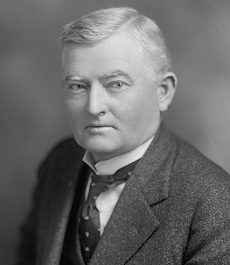
    Amid the kidding, I had to follow-up the reference to Franklin D. Roosevelt’s then-VP, John Nance Garner. FDR was of course an avid poker player, but I’d never thought much about Garner or his playing, so it was intriguing to see a casual reference to his stud expertise dropped here at the end of Pegler’s review.

    Hailing from Texas, “Cactus Jack” (as he was sometimes called) served in the Congress for three decades including as Speaker of the House for a couple of years, then was FDR’s VP for his first two four-year terms from 1933 to 1941. Though very active in Congress, he wasn’t so much as VP, and is famously quoted afterwards as having referred to the office of Vice-Presidency as “not worth a bucket of warm piss.” (The source for that quote isn’t clear, actually.)

    Like most politicians he had both proponents and enemies, and among the latter group belonged the famous labor leader John L. Lewis. Once while testifying to Congress in 1939, Lewis referred to Garner as “a labor-baiting, poker-playing, whiskey-drinking, evil old man” because “the majority of people will feel that anyone Lewis can’t control is all right.” (So reported Time magazine.)

    From what James McManus says about Garner in Cowboys Full, he actually “had grown up playing high-stakes draw” before becoming the stud expert (as Pegler calls him). McManus also points out how Garner wasn’t invited to FDR’s poker games, with their relationship deteriorating to the point that Roosevelt instead chose Henry Wallace to run with him as he won a third term.

    Incidentally, Garner would live to a ripe old age of 98. His 95th birthday happened to be November 22, 1963, the day John F. Kennedy was assassinated. Kennedy phoned Garner that morning at his home in Uvalde, Texas to wish him a happy birthday.

    Dan Rather -- then normally stationed in New Orleans -- was in Uvalde that morning to film a short piece with Garner, and had carried it to KRLD in Dallas where he dropped it off. Without an assignment for the rest of the day, Rather stuck around to watch the Kennedy motorcade. Shortly afterward he was among the first to pass along the news JFK had died, his report being picked up and shared over CBS radio even before Walter Cronkite’s famous pronouncement.

    There’s more to Cactus Jack’s poker story, I’m sure, though I’ve yet to dig further. Perhaps he was just too good of a player for FDR to want hanging around. In any case, that nickname suggests he was probably considered a bit prickly by others, too.

    Image: John Nance Garner, public domain.

    Labels: , , , , , , ,

    Thursday, June 09, 2016

    You Know Uno, Don’t You?

    Last weekend I enjoyed a family holiday in Charleston, South Carolina, kind of a three-day weekend. In between visits to the pool, walks on the beach, and a couple of fun meals dining out, I played games with my now seven-year-old nephew, about whom I’ve written here before.

    He got himself a big, thick deck of Uno cards at some point in the last year, and on a couple of occasions now we’ve played, including on this trip. It might be the first card game I’ve played with him in which he doesn’t make up new rules along the way, but sticks to the actual rules of the game. That said, he has invented some sort of postscript-type game involving three cards and picking one which he breaks out at the end of every Uno game, so he’s still adding to the standard game with this one, too.

    If you know Uno, you know the goal of the game is to discard all of your cards before your opponent does, with “Uno” being the word called out when a player is down to just a single card. The deck is comprised of four colors (red, green, blue, yellow) with the cards numbered, and there are a few special cards thrown in as well that reverse the order of play, skip a player, force an opponent to draw extra cards, and function as wild cards enabling the player to change the current color.

    This video spoofing Anime actually does a good job capturing what a game with my nephew is like:

    I believe players are supposed to start with seven cards, but my nephew likes to start with many, many more. We began with 26, actually, and that picture up top shows how difficult it was to hold that many at once (and that’s with adult-sized hands). I joked on Twitter that he likes “deep-stacked” Uno, and it’s true that starting with more cards does mean the game will go on a bit longer (ensuring there will be “more play”).

    In a game last weekend, I managed to get down to “Uno” twice but each time was thwarted by my nephew playing a card requiring me to draw. Then eventually he got down to one card while I only had 4 or 5. The upcard was a blue four, and I had both a blue card and a red four, meaning I could either keep it the same color or change it.

    I managed to talk myself into keeping it blue, and sure enough he had another blue card and won the game. When I showed him my red four he insisted I should have played it and changed the color, although I think he was just being results-oriented, knowing that had I done that he wouldn’t have won (not then, anyway).

    Thinking afterwards, I decided it probably was a better play to change the color, as it often happens in Uno you play several cards of the same color in a sequence until you run out, then work on the next color -- meaning the chances were probably slightly better that he had another blue card in his little hand than not.

    I think he’s probably about ready to learn about the rankings of poker hands. We’ve played War before, but no poker games. Simple five-card draw would have to be the best place to start, I’d think.

    That’s the game that has been on my mind lately, and is the first poker game I learned, I remember... probably when I was about his age.

    Labels: , , , ,

    Wednesday, June 08, 2016

    The Draw and Stud Kingdoms in the Poker Domain

    I’ve been thinking about draw poker and stud poker lately, and the idea that, in a sense, all variants can be categorized as having been derived from one or the other category of poker games.

    That is to say, if we created a taxonomy of card games with poker being the “domain” up at the top, draw and stud would be the top two “kingdoms” just underneath, with all the other games belonging to one or the other.

    In modern poker parlance, it’s common to see three categories of games identified -- flop games, draw games, and stud games. That’s a helpful system, say, if you’re choosing variants for a mixed game and want to ensure you’ve got a balance between different game types.

    You could, for example, have a nine-game rotation with three flop games (no-limit hold’em, pot-limit Omaha, Omaha hi/lo), three stud games (seven-card stud, seven-card stud hi/lo, and razz), and three draw games (2-7 triple draw, 2-7 no-limit draw, Badugi), which would also provide a good mix of a few “big bet” games among the fixed-limit ones.

    Then if you added further variants, you could try to keep the three categories balanced so as not to favor one over the others, since many players often come at a mixed game with more experience and/or knowledge in one of the three.

    However, if you go back in history and think about how poker was initially introduced and developed in the 19th century, it actually makes sense to slide the later-introduced flop games over and think of them as a subcategory of stud (its own “phylum,” you might say). In other words, while the hundreds of different poker variants introduce all sorts of distinctions making each unique, the most significant one determines whether or not a game can be said to derive from draw or stud -- namely, whether or not players can see any of the cards making up their opponents’ hands.

    Games derived from draw typically involve players showing none of their cards as they proceed through whatever rules govern the order of play, betting, hand ranking, and so on. Meanwhile games derived from stud typically involve players revealing some portion of their hand to each other, e.g., as “up cards” or shared “community cards.”

    Even with these two seemingly unblendable characteristics -- i.e., either all your cards are hidden, or they are not -- there exist some hybrids (we might call them) that try to combine draw and stud in some fashion. I’m thinking of draw games that involve sharing cards, of which Spit in the Ocean might have been the first step down that road (a draw game that has one card dealt face up in the middle to indicate what is wild). There are other draw games incorporating something like “community cards,” too, that seem to combine the categories.

    But you could argue as soon as any portion of a player’s hand is no longer hidden, the game no longer belongs to the draw “kingdom” and should be forced to emigrate over into stud.

    This point -- that all poker variants essentially come from either draw or stud -- is one made by Al Alvarez in his Poker: Bets, Bluffs and Bad Beats (2001). There he points out that all poker games, “even the craziest, are variations on two basic themes: closed or draw poker, in which all the cards are dealt facedown, and stud, in which four of the player’s five or seven cards are dealt faceup.”

    Alvarez is speaking of earlier pre-hold’em variants when making that point, but the taxonomy being suggested could still be said to include the flop games, which obviously were derived from stud.

    Could be fun, working out an entire taxonomy of poker variants. How would we classify Badeucy, for example? Put the Badeucy species in the poker domain, then the draw kingdom, then the fixed-limit phylum, then the multiple-draw class, then the lowball order, then the Badugi family, and finally the deuce-to-seven genus?

    I wrote about the first references to draw poker in this week’s “Poker & Pop Culture” column, noting how the introduction of the draw was the first meaningful variation from what might be called the “original” form of poker sometimes called “Old Poker” in which five cards were dealt, a round of betting followed, and then there was a showdown.

    In the column I make a few gestures toward the idea that being able to discard and draw evokes (in a way) various “American” ideas of being free to try to improve your status if desired. Check it out and see if you buy that argument or not:

  • Poker & Pop Culture: Life, Liberty, and the Pursuit of a Better Hand
  • I’ll be talking about the introduction of stud next week, and will be suggesting this point as well that all poker variants might be thought of as belonging to one of these two “kingdoms” of games. Let me know if you have any thoughts about any of this as I pull together my own.

    Image: “Taxonomic ranks” (adapted), Annina Breen. CC BY-SA 4.0.

    Labels: , , , , , ,

    Wednesday, May 21, 2014

    Gentlemen Do Not Bet the Nuts

    In 1864 The American Hoyle; or Gentleman’s Hand-Book of Games by William Brisbane Dick (writing/editing/compiling as “Trumps”) was among the first titles to spell out in detail rules for draw poker. It wasn’t the very first, but it did expand significantly on the “laws” of the game, the terminology employed while playing it, and hand rankings.

    Interestingly, as explained here, straights are still up for debate. The earliest versions of poker (including the 20-card variety) didn’t count straights or flushes, and the 1864 Hoyle explains how it remained the case that “straights are not considered in the game, although they are played in some localities.” Flushes weren’t part of the earliest variants of poker, either, but here are part of the line-up of possible hands.

    Since straights aren’t universally accepted, neither are straight flushes, although a footnote to the hand rankings does explain that when they are counted they should be considered as ranking higher than four of a kind. “It is strongly urged by some experts that the strongest hand at Draw Poker should be a Straight Flush, for the reason that it is more difficult to get than four of a kind.”

    The “experts” are right. A 52-card deck produces 2,598,960 possible five-card combinations, with only 40 of them being straight flushes (1 in 64,974) as opposed to 624 being quads (1 in 4,165).

    There’s one other point made in the footnote in favor of counting straight flushes I find kind of intriguing, namely, that doing so “removes from the game the objectionable feature of a known invincible hand.”

    Without straight flushes, any hand containing four aces would be known to be unbeatable, as would a hand containing four kings with an ace. With straight flushes there still exists, of course, the “invincible” hand of an ace-high straight flush (or royal flush), which could theoretically be equaled. (This possibility is explained in the footnote.) But there’s only four of those (1 in 640,974), making it exceedingly unlikely for the invincible-hand situation to arise.

    Setting aside this quibbling, though, it’s kind of curious to think of “a known invincible hand” being an “objectionable” feature in poker. The variants popular today obviously include this possibility, and in fact it is hard to imagine poker otherwise. Players know fairly frequently in hold’em, for instance, whether or not they hold the “nuts” or an unbeatable hand.

    Still wondering why this feature of the game might be considered “objectionable,” I continued on to read the last sentence of the footnote, which does provide an explanation of sorts.

    “No gentleman would care to bet on a ‘sure thing,’” it is explained, “and we therefore think the Straight Flush should be adopted when gentlemen play at this game.”

    Ah, right. This is a “gentleman’s hand-book of games,” imparting rules both for the games and for what it means to be a gentleman.

    Now, of course, one can earn a penalty for not betting the nuts when last to act. And claiming you were just being a gentleman is no excuse!

    Labels: , , , ,

    Thursday, May 06, 2010

    Draw Poker Drama

    Draw Poker DramaNight before last I had the task of covering one of the five-card draw tourneys for PokerStars (another SCOOP event). An interesting moment came up right at the end of that one that I thought I’d share. First, however, a little aside about covering draw games.

    From the reporting side of things, flop games, draw games, and stud games all present various elements and/or challenges unique to each.

    For flop games, the cards are important (of course), but a lot of the story of the hand is told via the betting. When it comes to flop games, getting bet amounts correct and keeping track of the size of the pot is easily the biggest challenge -- when reporting live tourneys, that is. (Grabbing all that from hand histories for these online events, natch.) Although at the live event, noting all of the cards in everyone’s hands at an Omaha showdown can be tricky sometimes, too.

    In terms of writing up action, stud games are probably the least enjoyable (for me) if only because it can get so unwieldy describing all of the streets, explaining hands as they are being built, and recounting the betting which can change order with every new card.

    Comparatively speaking, draw games are probably the easiest to follow. And -- perhaps contrary to expectations -- can be especially fun to watch and report on, too.

    There are lots of showdowns in draw games, which tends to make for a satisfying conclusion to the story of a hand. Can be a little wearying recounting the discards in each round of a triple-draw game, but there are ways of communicating that information without being too tedious. Fixed limit betting (as in stud games) isn’t always so exciting to recount, either. But some of these draw games feature pot-limit or no-limit betting, which can get pretty interesting as one tries to gauge how the bet sizes plus the number of cards drawn together can suggest hand strength.

    In fact, when I think about my favorite live tourneys covered, I remember the $2,500 Deuce-to-Seven Triple Draw event from 2008 -- event no. 40, won by John Phan -- as one of the more exciting events I’ve ever watched.

    Lots of drama in that one, partly thanks to Phan’s endearing-slash-provoking personality, but also thanks to the dynamics of the game itself. (F-Train and I were on that one -- you can see our coverage here.) Also, sometime after that event, I wrote a bit about that final table in a post that contrasted Phan’s aggressive play to that of David Sklansky, who finished sixth in that event.

    Anyhow, to get back to the SCOOP event I was covering earlier in the week. It was the “Low” version ($11 buy-in) of the pot-limit 5-card draw event. So just one draw, and just two rounds of betting. As I’m suggesting, it was a genuinely interesting event to watch, with a lot of head games going on as players routinely used position -- crucially important in pot-limit games and in draw games -- to put opponents to tough decisions.

    Once the tourney reached heads-up, the final two battled for a while until the one with the historically-significant username “Benny Binion” had built nearly a 6-to-1 advantage over his opponent, “fly44.” Then came a hand in which Benny had the button. Before the draw, he raised pot, fly44 reraised, and soon they had fly44 all in. fly44 discarded three cards, which had to be a good sign for Benny. Then Benny also discarded three cards. Even before the showdown, Benny was already typing gibberish in the chatbox, the reason for which was soon made clear.

    The hands were revealed,and fly44 had a pair of tens. Benny Binion showed Ks2dAd3c2c -- a pair of deuces. Then he typed “I had KK.” When discarding, he’d accidentally clicked on one of his kings and tossed it with his other cards. Now the poor guy was miserable, seeing he’d literally tossed away a winner.

    fly44 soon got back to even, and the whole thing was starting to turn into a tragedy of sorts, but Benny retook the advantage and eventually won the sucker.

    Curious to see. Actually, it will happen not infrequently in the lowball draw games that players will “break” their made hands before a last draw, fearing they are behind, only to discover they’d thrown away a winner.

    I particularly recall a hand from last summer, one involving Layne Flack and Eric Crain at the final table of the $2,500 Mixed Event, in which something along those lines had occurred. In a 2-7 Triple Draw hand, Crain stood pat after the last draw and Flack decided to toss one card. Crain then won the hand with a 9-5-4-3-2. Afterward, a fairly distraught Flack revealed he’d broken a hand that was in fact the same one Crain showed down, tossing the nine and picking up a jack.

    PokerNews has recently reconfigured its tourney archives a little, making it easier to find hands and link to ’em -- so, if yr curious, here’s that one: “Bad Break for Flack.” And yes, there is a pun in that headline.

    Anyhow, it was curious to watch Benny Binion talking about having accidentally broken his hand like that. He kept saying in the chatbox how he was rewatching it in the replayer, torturing himself for the next few minutes.

    There is no five-card draw at the WSOP, as all of the draw games are lowball games. In fact, they have been for some time. The last time a five-card high draw event was played for a bracelet was 1982.

    The winner? David Sklansky.

    Labels: , , , ,


    Older Posts

    Copyright © 2006-2021 Hard-Boiled Poker.
    All Rights Reserved.