Friday, March 09, 2012

Poker in Africa

WSOP AfricaWith all the other scandals and brouhahas dominating poker news of late, there wasn’t heck of a lot of attention given to that World Series of Poker Circuit series of events that took place in South Africa during the last week of February.

It was actually the second trip by the WSOP to the Emerald Resort and Casino in Gauteng, South Africa. Back in October 2010 came the first, with just two tournaments held, a $1,000 buy-in PLO event in which 37 entered, and a $5,000 NLH Main Event which drew 188. This time there were six events, four of which were low buy-in (less than $1,000), a $3,300 Main Event, and a $10,400 High Roller tourney.

They drew 20 for the High Roller, with Rob Fenner winning the ring and $97,000. A total of 218 played in the Main Event which was won by Joe-Boy Rahme -- apparently no relation to 2007 WSOP Main Event third-place finisher and fellow South African Raymond Rahme -- who took $158,595 for the win.

Meanwhile, the first preliminary event, a $350 buy-in NLH tourney won by Gauteng’s own Gregory Ronaldson, drew 324 entrants, a total which represents the biggest poker tournament ever held in Africa (in terms of field size). Ronaldson actually made the final table of the Main Event, too, and was thought by most to be a favorite to win it once they’d reached the final nine. Not only was Ronaldson second in chips with nine left, it was just a couple of months ago he was the talk of the Crown Casino in Australia when he won the $5K Heads-Up event at the Aussie Millions, knocking out Faraz Jaka on his way to defeating Sorel Mizzi in the final.

Ronaldson has also posted some decent results at the WSOP over the last couple of years, including a 198th-place finish in last year’s Main Event. He wasn’t the best finisher from South Africa, though, as Kosta Mamaliadis came close to making that international-flavored final table before getting knocked out in 13th.

The Emerald Casino in Gauteng, South AfricaRonaldson would come up short at the Emerald last week, however, going out in fifth. Still, he took over $60,000 away from the series, and from his interview over on PokerNews it sounds like he’ll not only be returning to the WSOP this summer but showing up at other stops on the tour as well.

When interviewed after his Main Event win over on the WSOP site, Joe-Boy Rahme talked about how poker has grown in South Africa over the last five years since his namesake’s deep run in the 2007 WSOP ME. “We’re sending more and more players to Vegas for the annual WSOP each year and they are having great results,” he noted. “We play mostly in home games, but casinos are starting to recognize us and more games are becoming available.”

It’s interesting to contemplate Africa’s increased involvement in poker, a continent with 56 countries and over 1 billion inhabitants. South Africa is by far the country where the most poker is being played in Africa with something like 45 casinos, although like in the U.S. the online game has met with resistance, with a law passed in 2010 strictly prohibiting all forms of online gambling.

The game is also quite popular in Morocco (where I had a chance to go to WPT Marrakech in late 2010) and Egypt. Tiny Swaziland -- which South Africa surrounds -- is a poker hotspot, too, it seems. In fact, if my cursory pass around the intertubes is to be trusted, it looks like over half of the countries in Africa have casinos.

The WSOP Circuit event in South Africa did award rings but didn’t count toward the 2011-2012 WSOPC points leaderboard like the tourneys at the other 17 circuit stops in the U.S. do. I assume this year’s healthy turnouts means the WSOP will head back to Gauteng next year for another series. Meanwhile, we’ll have to keep an eye out for Ronaldson, Joe-Boy Rahme, Jarred Solomon, Darren Kramer, Mark Vos, and other South Africans this summer at the WSOP in Vegas.

Labels: , ,

Thursday, March 08, 2012

Using Visuals To Help Us See

Kirk Goldsberry map of shots taken in the NBA from 2006 to 2011Earlier this week I was momentarily mesmerized by this graphic included in a short piece that appeared on Slate’s culture blog. The image appeared atop an article by David Haglund called “What Geography Can Teach Us About Basketball,” and the piece alludes to yet another way increasingly sophisticated analytical tools have become part of how sports are studied as well as the basis for strategy.

The picture represents a map of shots taken in the NBA over the previous five seasons (click to enlarge). Darker cells represent more shots attempted, and the color-coding shows the relative efficiency of the shots. Cells yielding the most points per shot are shaded red and orange, while the least “potent” cells are shaded blue and violet.

The chart was devised by a geography professor named Kirk Goldsberry using techniques he’d applied to study things like traffic patterns or how access to nutritional foods can differ depending on where someone lives. The study is titled “Court Vision: New Visual and Spatial Analytics for the NBA” and was presented this week at the Sloan Sports Analytics Conference.

As Haglund points out in his brief summary of Goldsberry’s work, the map shows what most basketball fans already knew, mainly that the most point-rich areas of the court are right around the basket and just outside the three-point line. That yellow strip up the middle also shows how players tend to do better shooting straight on than from either side.

Rajon Rondo's shots from 2006-2001The study includes images plotting out the shooting for particular players, and Haglund additionally asked Goldsberry to show him what Boston Celtics guard Rajon Rondo’s map looked like. The image plotting out Rondo’s shots appears to the left (again, click to enlarge) and curiously shows how when it comes to three-pointers Rondo has a kind of “sweet spot” there to the left of center where he is much more effective than he is when shooting from the right side of the court. Notice how that halo around the hoop leans to the left for Rondo, too, which is interesting since Rondo is in fact right-handed.

Reading the study and looking at these maps got me thinking about some of the analytical tools that have been used to track online poker play such as PokerTracker and Hold’em Manager and how they, too, can yield interesting information about patterns of play both generally and individually.

Once upon a time I was studying my PokerTracker stats fairly intently in an effort to learn more about what was working and what was not in my play. Early on I saw and became accustomed to the fact that everyone tended to make more money from the button and late position, as well as to lose the most from the blinds. And, of course, premium hands routinely yielded the most profit, too -- not just for me but for everyone else.

I recall noticing a few idiosyncracies for me as well, things that might be said to have corresponded to Rondo’s “sweet spot” where he hits a high percentage of threes as well as those rough areas where he misses the most. I remember once realizing I was probably losing more than I should with small pocket pairs. Overlaying my stats with everyone else’s would’ve told me more specifically whether I was outside the norm in that regard, although I don’t remember pursuing my study far enough to make any conclusions.

Not really tracking my play much at all anymore, I’m afraid, other than to note wins and losses in my little black book. Definitely worth doing, though, for those who are serious about the game and looking to improve. Just as I think this sort of analysis could probably benefit NBA players, too. Have to imagine Rondo, now in his sixth year in the league, has been shown his map, too, yes? And if he has maybe he will start passing up shots from those blue areas where he’s often cool, opting instead for the hot spots in red.

Where are your red areas or “sweet spots” at the poker table -- that is, spots that may uniquely fit with your skill set to bring you greater profit than most? And which areas make you more blue than most?

Labels: , , ,

Wednesday, March 07, 2012

A Bitar Taste

A Bitar TasteLate yesterday PokerStrategy posted a very brief interview with Ray Bitar, one of Full Tilt Poker’s founders and CEO of Tiltware, the site’s software and marketing company. Or its “shell” company, we might more properly say.

Bitar, of course, has become a much-reviled figure in the poker community thanks to his close involvement in the exceedingly poor management of FTP. Indeed, many single him out as a primary fall guy for the site’s many misdeeds, which include activities resulting in the site becoming the target of an indictment and civil complaint by the U.S. Department of Justice in April, further violations resulting in the loss of its license to operate and full shutdown in late June, and its apparent wasting away of the $350 million or so players thought they had in their accounts when the site went dark.

Amid “the rumble” we’ve lately been hearing several calls for Bitar, Howard Lederer, and/or Chris Ferguson to break their collective silence and say something about what happened to their popular online poker site. While Bitar was listed among those initially targeted by the DOJ’s indictment and civil complaint back in April, Lederer and Ferguson’s names were added as well in September to an amended version of the complaint.

It’s not really clear why those calls for these three to speak have become louder over the last few weeks, although I suspect the nearing of the one-year anniversary of Black Friday has something to do with it. I have said before here how I thought the petitions weren’t likely to be answered, as there seemed no reason now for Bitar, Lederer, or Ferguson to say anything at all given their considerable legal problems.

My initial thought, then, on hearing that Bitar had given an interview was to be surprised. Then I read the piece, another “exclusive” that recalls some of those we saw on PokerStrategy last fall when news of the possible purchase of FTP by Groupe Bernard Tapie first arose. I remember surmising then that perhaps FTP was settling some debts with its biggest affiliate by granting such traffic-heightening pieces.

Sort of feels like the same purpose has been served by this Bitar interview, which offers practically nothing of tangible value to FTP players but does certainly generate a lot of hits over on PokerStrategy, a site whose own CEO, Dominik Kofert, was recently voted as the 12th-most powerful person in poker on BLUFF’s Power 20. No slight to Matt Kaufman (he of the witty though now apparently erstwhile Poker Smell comic) who conducted the interview, but it’s pretty obvious there wasn’t much chance Bitar was going to offer much if anything for us to chew on.

Kaufman appeared on PKRGSSP’s show last night to give a little bit of background about the interview. It sounds like Kaufman had been bugging FTP attorneys (including Jeff Ifrah) to get an interview with Bitar and they’d long refused such requests. But this week they had “a change of heart,” saying “they wanted to do something.”

PokerStrategyKaufman did allude to PokerStrategy’s significant affiliate-relationship with FTP as likely not unrelated to the site landing such “exclusives.” The prominence of the news and strategy site outside of the U.S. likely also encourages Full Tilt’s wish to deliver their messages there, since so many of those who could possibly play on a new version of FTP (if it were ever to be relaunched) are likely familiar with PokerStrategy.

So Ifrah requested the interview and asked for questions to be submitted -- which were then vetted -- and answers were emailed back to Kaufman with no chance for follow-ups (obviously). The questions that were chosen were all of a very general nature, asking Bitar why he hasn’t spoken before, what he’s been doing since Black Friday, and “is there anything you would like to say?” And the answers were all very general as well, stating essentially that Bitar still hoped to get players their money, that he also hoped Full Tilt would somehow survive this mess in some form or another, and that he was sorry.

There is a lot of redundancy, too, among the responses. Even though his three answers only total about 450 words, Bitar managed to repeat the declaration that he is working toward getting players paid and keeping Full Tilt Poker alive no less than six times.

Bitar says that he has “been working every single day since Black Friday to ensure players are repaid,” which he calls his “top priority.” His also says his “primary focus has been and continues to be... the repayment of the players and the survival of the company.” And again, he mentions he is “doing everything possible” to make these things happen.

“I spend a good deal of my time making sure that FTP survives and that the players get paid,” Bitar goes on to say. “I continue to work on these issues, day and night until we resolve them,” he adds. And, in case we missed it before, he once more reminds us his “entire focus is on obtaining a successful resolution for the players.”

Alas, it’s hard not to be cynical and call the Bitar interview a weak echo of one of those FTPDoug “updates” that strung us along last spring and summer. Even the phrasing directly recalls those spoonfuls of poorly-conceived PR applesauce in which the mouthpiece informed us time and again that FTP “has worked tirelessly” and are “absolutely committed” and “we have been working around the clock to get this done” and so on. Recall as well how those updates often concluded with statements -- again, like Bitar’s -- that “it has not been easy to stay silent and watch the damage being done to our company brand.”

Ray BitarSo while I was surprised Bitar spoke at all, it isn’t that much of a surprise to find him sounding a lot like FTPDoug, since we all knew FTPDoug wasn’t speaking for himself, but just passing along what the higher-ups -- including Bitar -- told him to report. (At least he didn’t repeat another of FTPDoug’s infamous statements -- highlighted by the DOJ in the amended civil complaint in September -- that “your funds remain safe and secure at FTP.”)

Thus, as I say, there’s nothing tangible to take away from Bitar’s bite-sized blurbs. But really, why would we think he’d feed us anything? We already knew the shell game had ended long before. And that there wasn’t a single pea under any of them.

Labels: , , , ,

Tuesday, March 06, 2012

Something for the Short Stacks

For the short stacksOnline poker players falling into the “micro” or “low” stakes groups probably noticed a few tourney series happening in March that include events that potentially jibe with our short-stacked budgets.

The one over on the Merge network of sites, called Poker Maximus, started a couple of days ago and features 70 different events over the next three weeks. A lot of these tournaments have small entry fees which encourage those of us with tiny rolls on the sites to participate.

The first Poker Maximus event happened on Sunday, a $10+$1 no-limit hold’em tourney that had a $15,000 guarantee. A total of 5,055 entered, which meant a prize pool of more than $50K, with the winner earning a cool $7,384.85. Looks like there are about 15 more of these $11 buy-in events, as well as a few with smaller buy-ins, too. Meanwhile, other events go as big as $200+$15, with a $500+$30 one at the end.

Merge Network's Poker Maximus seriesI’ve mentioned before I do have a little bit of scratch on two Merge sites, Carbon and Hero, having won my rolls there in freebies last year (post-Black Friday). I continue to toil for pennies and nickels on both sites. Occasionally I’ll hover the cursor over my opponents’ avatars to see what countries they are from, and invariably all or nearly all are United States players. Not surprising, given how Americans looking for where to play poker online have so few options.

I’ll probably risk a few bucks here and there to play in a couple of these Poker Maximus events, although I’ll need to be careful not to risk so much as to find myself out on my gluteus maximus should I bust.

Another series even more squarely aimed at the micros is the one recently announced by PokerStars, the MicroMillions (which, sadly, we Yanks cannot play). That one will feature 100 different events with buy-ins ranging from $1 to $22, including a $0.11 rebuy tourney to kick it off.

PokerStars' MicroMillionsThe Stars series will run from March 15th through March 25th. Here’s the full schedule, if you’re curious. You know they’ll be attracting some monstrous fields -- way, way bigger than the Merge ones -- meaning some decent prize money despite the low buy-ins. There will also be an ongoing leaderboard with the top 100 performers winning additional goodies, including $109 SCOOP tickets (11th-100th), $1,000 SCOOP tickets (2nd-10th), and a full 2013 PCA package for the 1st-place finisher.

This would be the sort of series I would’ve loved to play if it had come around on PokerStars a year earlier. Indeed, just about all of my multi-table tourney play online has been of the low buy-in, big-field variety, which really is one of the cooler things online poker can provide that makes it different from live poker.

Grand Series of Poker VIII at Betfair PokerFinally, the eighth annual Grand Series of Poker is happening right now over on Betfair Poker, another site unavailable to us Yanks. This one began last week and will be continuing through March 11, and features 18 different events covering a variety of games and buy-ins.

And for the short-stacked types, there is a parallel "Mini-GSOP" happening at the same time in which the same events are playing out in which all of the buy-ins range from $5.50 to $22. My buddy Matthew Pitt is playing all 18 of the events (in both the regular GSOP and the Mini version) and writing about his experiences over on the Betfair Poker blog.

Meanwhile I will have to settle for a few, carefully chosen shots in the Merge series, though, where we Americans play with those additional, vague worries about cashing out should we win. Not to mention the site remaining open to us, period.

Labels: , , ,

Monday, March 05, 2012

Ideas and Execution

Empty pocketsHad a most excellent few days with Vera Valmore visiting my father in Florida. Did not play any poker this trip, opting instead to spend time running around with Vera and hanging out with Pop.

I did mostly unplug while we were gone, although I have since managed to catch some of the follow-up regarding last Thursday’s announcement that the Federated Sports + Gaming had declared Chapter 11 bankruptcy and what appear to be much weakened prospects for the Epic Poker League going forward.

As I was saying on Thursday when reflecting briefly about the news, for the EPL to struggle was not unexpected. I think most rational observers felt from the beginning that the league’s chances for success weren’t great. But even the most skeptical seemed to believe the league would at least make it through its initial season of events before talk of closing shop would arise.

I remember early last year when we first heard about the as-yet-unnamed league. I wrote something here titled “A League of Their Own” in which I kind of questioned the whole idea of trying to segregate out poker’s elite to compete exclusively against each other.

I also made a hardly unique comment in that post about the practicality of what the FS+G folks were then describing with regard to the big overlays and $1 million freeroll. “Am wondering a little about the money,” I said, “the securing of which will obviously prove crucial to the league’s survival.”

Yeah, I know. Obvious point is obvious.

The idea of a pro poker league still isn’t necessarily a bad one. Kim over at Infinite Edge has offered what seems to me a smart commentary on how the idea behind the EPL to try to create a professional poker league was in fact a good one -- even “noble” (as he says). But as Kim explains, in this case there existed from the start a disconnect between the theory and the execution.

Rather than create a sports-like league in which players took pride in competing against the best players in the game, the league ended up being all about trying to woo members of a select group into accepting what appeared an opportunity to profit financially (a +EV opportunity). Thus came the big overlays, the $1 million freeroll, and the big buy-ins, too, which would guarantee large prizes to those who succeeded -- all there because it was thought no one would play without such incentives to do so.

Kim suggests how a league might’ve been created with smaller cash prizes, say, with $100K freerolls (no buy-ins) in which the point wasn’t to make a big cash score but to pit the “best against the best... for undisputable honor and a high standing within the poker community.” That is, to play more for the glory, and not so much for the money.

That might not have worked either, of course. Money is, after all, a crucial element to poker -- the game is meaningless without it, some say -- and so it is hard to imagine creating a professional poker league in which money’s significance is somehow diminished (or made meaningless) while still remaining the same game.

So that might’ve struggled or failed, too. But as Kim suggests, it would’ve stayed true to the league’s idea.

Also, it wouldn’t have cost as much.

Labels: , ,

Friday, March 02, 2012

Power Trip

Checking the Twitter feedOn a retreat of sorts this weekend, having trucked to Florida with Vera Valmore for a short vacation. Kind of unplugging for a spell, too, if I can manage it. Hoping to recharge the mental battery a bit.

We’ve visited Florida a few times before, usually around this time of year, and have enjoyed ourselves in the past. There’s a dressage competition happening that Vera likes, and during our previous trips I’ve also been able to play some poker in what has become a booming poker state. Now my recently-retired Pop lives down here as well and so we’re staying with him this time.

All of which means I’m mostly off the grid for the next few days, although I did see that new “Power 20” list come trickling over the Twitter transom yesterday via the BLUFF magazine feed.

Last year BLUFF polled more than 100 folks to compile the list which was topped by Full Tilter Howard Lederer (#1) and PokerStars founder Isai Scheinberg (#2). Soon after came the Black Friday indictment and civil complaint, with Lederer having been added to the latter by the U.S. Department of Justice in September. As a result, Lederer has tumbled from this year’s list entirely, while Scheinberg has in fact grabbed the top spot -- just like he’s in the top spot on the DOJ indictment.

This year BLUFF “canvassed 51 poker industry insiders ranging from online operators, casino executives, media, players, agents and other influencers” to vote, asking them to “consider individuals whose influence on the industry and the game is mostly positive.”

That last caveat is kind of curious to consider, actually, with regard to a few of the names who made this year’s list. Indeed, in presenting the list the BLUFF staff can’t resist commenting on U.S. Attorney General Preet Bharara having surprisingly been voted into the fifth spot.

I’ve never been asked to vote for the BLUFF Power 20, although to be honest while I obviously follow the industry and have familiarity with a lot of what’s happening, I don’t feel all that qualified when it comes to judging where “power” in poker truly lies. Indeed, I don’t envy those among my colleagues who have been charged with what is really a difficult task.

It makes sense for such a list to include a preponderance of business execs and “movers and shakers.” And the presence of a few legislators -- and the one law enforcer, mentioned above -- is probably appropriate, too. Interesting, though, to consider there are only three poker players on the list: Daniel Negreanu (#9), Tony G (#11), and Annie Duke (#18).

BLUFF has been compiling Power 20s every year since 2005, and most years around a third of the spots have been occupied by poker pros. Looks like only three players were on the 2009 list, although that year BLUFF included a lot of “entities” like poker sites or “Professional Poker Players” (as a group) on the list. Are players (on the whole) less powerful today than in the past when it comes to having a “mostly positive” influence on the game?

Have a few more thoughts about some of the particular names included of this year’s list -- as well as those left off -- but like I say I’m gonna try to power down myself here, at least for the weekend.

Let’s see now... where’s the off button on this here iPhone?

Labels: ,

Thursday, March 01, 2012

Epic Limbo

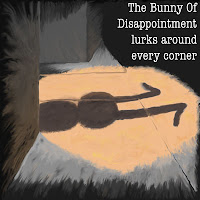
The Bunny of DisappointmentWas set to pen something today regarding what I thought was a well-managed feature in the Village Voice from earlier in the week regarding the plight of full-time American online poker players who’ve found themselves seeking new life paths following Black Friday.

The article by Chris Parker, titled “Online Poker Kings Cashed Out,” stumbles over a few particulars regarding Black Friday and its aftermath, but does a neat job overall profiling several U.S. players who were significantly affected by the shutdown. Probably the most interesting aspect of the article is how most of those to whom Parker spoke don’t really fit the stereotype for online grinders -- i.e., just one is a young (early 20s), unattached male for whom poker replaced college.

There is some discussion in the article, too, about the way Black Friday affected non-players, too, with references to book sellers and those involved with the business of televised poker. No mention in there of the so-called “poker media” and how writers, publishers, website owners, and others were also affected, but the point is nonetheless made that “the feds blew up an entire industry” when they unsealed the indictment and civil complaint last April.

Federated Sports + GamingSpeaking of the poker media, you no doubt heard yesterday’s news regarding Federated Sports + Gaming, owners of the Epic Poker League, having filed for bankruptcy. That was the news that has sidetracked me from the plan to discuss Parker’s Village Voice in more detail -- let me recommend that article, though, as a relatively good look-in from the mainstream upon our little, struggling poker world.

I’ve mentioned here several times how I’ve been able to contribute to the Epic Poker blog over the last six months or so with a weekly column in which I’ve discussed poker and popular culture, “Community Cards.” Has been great fun to do so, and as others have said with regard to working with the EPL folks I’ve nothing but good things to say about the experience.

Like the league itself, the future of the EPL blog is a bit up in the air at present. While things don’t appear especially rosy right now, the league hasn’t already folded as some of the talk yesterday seemed to suggest. Hard to resist the pull of that “Epic Fail” phrase, though. Heck, I’ve actually got an Epic Fail app on my iPhone that calls up photos from the hilarious website.

In a bit of goofy, grim irony, my last post went up late Tuesday night -- just before the announcement from FS+G -- and was titled “Jeremy Lin, Poker, and the Desire to Be Surprised.”

If you look back at my other CC columns, this last one is a bit more tangential than most when it comes to drawing a connection between poker and popular culture. To be honest I can think of at least a dozen others I like better or would sooner point to as evidence of what the column was about. Can’t help but grin, though, at my having picked up on Chuck Klosterman’s idea that we like surprises -- in fact crave them since so much of our lives seem to be plotted out for us these days.

Epic Poker LeagueIt was a slight surprise yesterday to hear that FS+G was declaring bankruptcy, although in truth it wasn’t as though the news dropped from the sky like some sort of unexpected bolt of lightning. I think most observers more or less knew the experiment to start a professional poker league with high buy-in events and huge overlays in this uncertain, post-Black Friday world was on shaky ground from the get-go. And the postponement of the fourth Main Event and $1 million freeroll finale (originally scheduled for mid-February) had only increased speculation that the league was far from thriving.

As FS+G Executive Chairman Jeffrey Pollack mentioned in his letter yesterday announcing the Chapter 11 filing, the EPL still plans to stage its fourth tournament series and the championship. Obviously, a failure to stage those events would be grievous given how all who participated in the first three tournament series did so with an expectation of the $1 million freeroll as an additional, potential overlay for them should they qualify for it. Not to mention inspire us all to look back with askance at that disciplinary action delivered by the EPL Standards and Conduct Committee last August against David “Chino” Rheem over his failure to honor his financial obligations.

So once again, we find ourselves in wait-and-see mode, hoping we don't see yet another poker-related story -- like the ones told in that Village Voice feature -- end in disappointment.

Labels: , , , ,

Wednesday, February 29, 2012

Ode to the Middle Man

Eliminating the Middle Man“Online poker middle man pleads guilty in NYC,” goes the headline. That’s from the Wall Street Journal, reporting on Ryan Lang’s plea in the U.S. District Court in Manhattan. Lang, of course, was one of the 11 men listed in the DOJ’s “Black Friday” indictment unsealed last April 15, 2011.

With the Unlawful Internet Gambling Enforcement Act of 2006 having essentially targeted the “middle man” when it came to U.S. players getting funds to and from online poker sites, Lang worked from Canada to help the sites get around the obstacle, using made-up companies and falsifying statements to facilitate the processing of payments.

The indictment describes Lang as having worked with all three of the targeted “Poker Companies” (PokerStars, Full Tilt Poker, and Absolute Poker/UB). Lang pleaded guilty to conspiracy to commit tax fraud, conspiracy to commit money laundering, accepting money in connection to Internet gambling, and violating the UIGEA.

Bradley Franzen, a payment processor, entered a plea agreement back in late May 2011, having bargained with prosecutors to cooperate in order to lessen his punishment. Brent Beckley, one of Absolute Poker’s co-founders who directed payments for the site, pleaded guilty to misleading banks in December 2011. And Ira Rubin, another payment processor, entered a plea agreement last month by admitting to some of the conspiracy counts against him.

Like Lang, those three are now all awaiting their sentences. Meanwhile both Chad Elie (another payment processor) and John Campos (part-owner and Vice Chairman of the Board at the now-closed SunFirst Bank in St. George, Utah) are fighting the charges against them and await trial.

That covers of all of the lower tier folks listed in the original indictment. PokerStars’ Isai Scheinberg (founder) and Paul Tate (payment director) continue to help manage the still-booming site as it serves players from around the world. TiltWare/Full Tilt Poker CEO Ray Bitar has been the frequent object of scorn and scrutiny since last spring, but hasn’t been heard from. Neither has Nelson Burtwick who helped direct payments for both Stars and Tilt nor Absolute Poker co-founder Scott Tom.

Like Bodog’s Calvin Ayre, who yesterday joined the list of American-serving online gambling site operators who have been indicted by the U.S. government, those five will likely never be setting foot in the country or anywhere else where extradition agreements might lead to their arrest.

In other words, while the many particulars of the Black Friday indictment -- and, of course, the civil complaint -- will continue to play out, Lang’s guilty plea kind of provides a bookend as far as the original “dirty 11” go. Will still be interesting to see how far Elie and Campos get with their arguments about poker falling outside the scope “unlawful gambling” as they challenge the UIGEA and try to wiggle out of the other counts against them (which from the outside seem even harder to refute).

I think back to October 2006. We all could readily see from reading the UIGEA what the whole “middle man” strategy was about. And some of us pessimistic types quickly realized how it had the potential to work and wreck our favorite game.

But years passed and we became less and less concerned about the middle man. And so we were surprised when he suddenly disappeared, leaving that big, empty, impassable divide between us. He let us down, the middle man. But we miss him just the same.

Labels: , ,

Tuesday, February 28, 2012

Bodog Catcher

Bodog catcherNearly a year after the Black Friday indictments -- and a long, long time since the feds first took an interest in Calvin Ayre and his Bodog gambling website -- Bodog’s dot-com domain was seized yesterday by the U.S. Department of Homeland Security. And this morning we have learned that Ayre has been indicted for operating an illegal gambling business offering sports betting and conspiracy to commit money laundering.

News of the domain seizure came last night, about two months after Bodog had shuffled everyone over to its new Bovada.lv site where Americans continue to play anonymous poker and bet on sports unimpeded.

It was just a few hours ago that news of the Ayre indictment being unsealed appeared over on Forbes. According to Nathan Vardi, the U.S. Attorney in Baltimore is charging Ayre with having violated Maryland state law by running (with others) his illegal gambling business “from June 2005 to January 2012.” Vardi explains that the indictment also highlights the moving of funds to and from various international accounts as well as “the hiring of media resellers and advertisers to promote Internet gambling.”

The fact that the feds have finally gotten to the point of acting with regard to Ayre and Bodog is noteworthy. Indeed, for a lot of observers one of the early follow-up thoughts regarding the Black Friday indictment and civil complaint targeting PokerStars, Full Tilt Poker, and Absolute/UB was “What about Bodog?”

The feds had seized funds from accounts being used by Bodog way back in 2008, and of course had been watching the site long before that. And even if Bodog was small scale, poker-wise, there was the sports betting. But it took 10-plus more months for any action against Bodog to arrive.

It will be interesting, of course, to see whether or not these moves will preface further efforts by the U.S. government to deal with Bovada’s continued acceptance of U.S. bets, or if their last-minute move back in December will successfully shield the operation from any interruption of service.

Some are responding to the news about Bodog and Ayre with cries of “Merge is next,” although it seems like the fact that Bodog/Bovada has always offered sports betting makes it a different animal than the other, small poker-only sites continuing to serve Americans. The allegations concerning advertising are interesting, too, perhaps having to do with the continued prominence of Bodog’s sportsbook in the U.S. as well as its popularity among American sports bettors.

Merge’s days in the U.S. may well be numbered, especially if any of the cashout procedures being used by the network’s sites make them vulnerable to those conspiracy to commit money laundering and/or bank fraud charges. Recall that alarm sounded Subject:Poker last September that the “DOJ Plans Action Against Merge.” While nothing ever came of that, those whispers that were then loudly relayed apparently emanated from the U.S. Attorney’s Office for the District of Maryland, too.

Since this Ayre indictment specifically references sports betting, the only form of online gambling unequivocally covered by the Federal Wire Act according to the DOJ’s revised opinion back in December, I don’t necessarily think this news has too much to do with the current prospects for Merge or other U.S.-facing poker sites. Other than to indicate in a general way what we already knew, namely, that the policing of online gambling continues to be of interest to prosecutors. (For more on the Ayre indictment, see Michael Gentile’s analysis over on PokerFuse.)

Still, even if the status of Merge and the other sites hasn’t changed, it remains tenuous. Maybe Bovada will post a line for us to bet on how long the remaining sites’ will last.

Labels: , , , ,

Monday, February 27, 2012

Moving On

Move On, DudeI was writing last week about these conflicting commentaries coming from Daniel Negreanu and Doyle Brunson regarding the Full Tilt Poker fiasco. I noted how I appreciated both sharing their views, even if neither added all that greatly to our understanding of what had happened, was currently happening, or might happen going forward.

On Friday, Matt Glantz came back with a follow-up to his earlier post regarding “The Silence of Full Tilt.” That was the one that kind of started all of the latter back-and-forthing between Negreanu and Brunson.

In the new post, “Whispers from Full Tilt,” Glantz provides some of what he learned after talking with various FTP shareholders regarding both the possibility of the Groupe Bernard Tapie deal ever happening and the reason for the continued silence from those associated with the beleaguered site.

Interestingly, it is the GBT deal -- which sounds as though it is almost certainly doomed to fall through -- which appears to be further encouraging shareholders’ silence. As Glantz puts it, people are keeping mum not “because they are worried about the deal falling apart,” but rather “because they are worried that if they say anything they will eventually be blamed for the deal falling apart.”

Almost all of the “insiders” with whom Glantz has spoken seem to believe the deal is not going to happen. Glantz shares that pessimistic view, advising his readers with money locked up on Full Tilt Poker to let go of the possibility of ever seeing their funds returned.

“I am recommending that these players move on as if their funds are gone,” writes Glantz. “Think of any money you may receive back from the FTP debacle in the future as found money.”

Experienced poker players are generally good at this sort of mind game, tricking themselves into thinking differently about money lost or won so as not to be influenced into subsequently making poor decisions. Kind of a special case, here, of course, representing a greater challenge to do as Glantz suggests and mentally erase whatever figure you had in your FTP account from your poker ledger before going forward.

Go check out Glantz’ post for more, including some speculation about other possible (though unlikely) future scenarios for FTP. As I say, Glantz shares some but not all of what he learned from talking with the shareholders, deciding against naming names as well as not passing along “the dirt” some of the shareholders told him regarding their colleagues.

Reading Glantz’ post caused me to think back over the last 10-and-a-half months to try to pinpoint when it was I had finally begun to consider the money I had on Full Tilt Poker as lost. The fact that it wasn’t a huge amount -- only a little under $300 -- made it easier to do so, of course. But if I am going to be honest it took me awhile to get there.

In early May cashing out seemed quite likely, especially when PokerStars had already sent me my check for a lot more. The May 15th non-announcement announcement from “FTP Doug” was troubling, though not enough to make me give up hope. It was two weeks later, though, when another “FTP Doug” message was delivered that it occurred to most of us that maybe we shouldn’t be so optimistic.

That was the message in which we learned the site was “raising capital to ensure that the US players are paid out in full as quickly as possible.” A day later came the news of Phil Ivey’s lawsuit (subsequently withdrawn) against the site he represented and partly-owned, weirdly delivered via a sequence of posts to his Facebook wall.

Was pretty clear then the shinola had hit the fan. Things only got worse, of course, with the loss of their license to operate and FTP shutting down altogether in late June, the DOJ’s amendment to the civil complaint in September, and this ongoing tease regarding the GBT sale that presently appears as likely as being dealt a suited pocket pair.

I suppose it was probably somewhere around late September -- right after the DOJ made its amendment and that “Ponzi scheme” proclamation -- that I gave up on cashing out from FTP, the whole GBT sale story never really inspiring me much to think otherwise.

Did you see that Ivey is back playing in the U.S. again, having participated in the WPT L.A. Poker Classic Main Event? Remember when he won the same event in 2008? Was hard not to pull for him then. But as I was saying last month when Ivey showed up at the Aussie Millions, it’s kind of hard these days not to feel ambivalent about his winning or losing.

As it happened, Ivey went out on the stone-cold bubble yesterday, finishing 55th when 54 pay. But like I say, it’s hard to care much about that. Because when we think of Ivey, we think of Full Tilt Poker. And when we think of Full Tilt Poker, well, it looks like we all bubbled that one.

Labels: , , ,

Newer Posts
Older Posts

Copyright © 2006-2021 Hard-Boiled Poker.
All Rights Reserved.