Saturday, November 07, 2009

Moon Begs the Question... WTF?

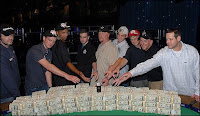
Hand No. 90, 2009 WSOP Main EventThey are on dinner break at the 2009 November Nine. James Akenhead is out in ninth, followed by Kevin Schaffel in eighth. Of the seven who remain, Eric Buchman is on top, Phil Ivey is starting to gather chips, and Jeff Shulman the short stack. An interesting first 112 hands to follow thus far, with a couple of pocket aces-vs.-pocket kings situations and some other drama here and there.

Not much doubt, though, what hand most of the poker world is talking about over dinner. That would be Hand No. 90, designated by our buddy FerricRamsium on the PokerNews live blog as “Begleiter Shoots the Moon.”

With seven players left, the blinds were 200,000/400,000 and antes 50,000. That means there was 950,000 in the middle when then chip leader Darvin Moon (with a little over 61 million when the hand began) opened with a raise to 1.3 million from UTG. Ivey folded, then Steven Begleiter (who had 24.3 million at the start of the hand) reraised to 3.9 million from the hijack seat. It folded back around to Moon who called. Pot a little over 7.5 million at this point.

The flop came 3s4s2d. Moon checked quickly, then “Begs” bet 5.35 million. Was listening to the audio play-by-play over at Bluff Magazine at the time. Joe Sebok, David Chicotsky, and (I believe) Mark Kroon were at the microphones, and they started getting excited as it appeared Moon was carving out chips to make a check-raise. That he did, to a whopping 15 million.

Then after a bit of a think Begleiter said he was all in. The pot was now over 44 million, and if my math is correct Moon was only looking at something like 5.4 million to make the call. On the broadcast, Sebok and company began to become increasingly incredulous as Moon somehow did not snap-call. Then, amazingly, it began to look like he was even contemplating folding!

And then he did! Andrew Feldman reported a little later via Twitter that Moon held K-Q offsuit -- not sure where he got that, but apparently Moon was doing a lot of talking afterwards, attempting to explain why he gave up on the hand despite facing something like 8-to-1 pot odds to make the call. When the hand was over, “Begs” had a little over 44 million, Moon had slipped to 42 million, and Eric Buchman had become the new chip leader with 51 million.

The hand most obviously recalls the big one between Dennis Phillips and Ivan Demidov from last year’s final table (Hand No. 18) -- you can read details of that one here. You recall that hand, in which some preflop back-and-forthing between Phillips and Demidov created a bloated pot preflop, then after leading with a smallish flop bet Phillips folded to Demidov’s shove, thereby losing half of his stack.

In that hand, Phillips had gotten himself into a tricky spot from out of position, and so ultimately found it necessary to abandon ship. Additionally, since Demidov had a slight chip lead over Phillips when the hand began, Phillips was in danger of being the first elimination from the final table after beginning the night with the chip lead. So he folded, staying alive in the tourney, and while he’d lose some more chips soon after that he’d rebound well enough to finish third.

Phillips most certainly made mistakes in that one, but even so, there was nothing especially bizarre about the hand. Even if he’d misplayed the hand, it wasn’t that difficult to see how he’d gotten himself into an uncomfortable spot by making what could be called “poker decisions” -- in other words, there was a way to follow his thinking that fit within the normal parameters of how hands tend to be played.

But Moon’s fold tonight. That was... well, like out of this world, man.

As Joe Sebok said on the broadcast, Moon could have a Tarot card and a Snickers wrapper and he should still be calling in that spot.

We’ll see on Tuesday whether or not Moon indeed had K-Q offsuit there, but really, it doesn’t matter. Of course the Maryland logger had so many chips prior to that blunder he still is in great shape with 41 million (second behind Buchman’s 51 million). Will be most intriguing to see what Moon is holding the next time he gets involved in a big hand.

Indeed, my main rooting interest at this juncture is to hope both Moon and Ivey stay alive as long as possible, as the tournament will necessarily remain especially interesting as long as one or both are there. ’Cos really, while Moon and Ivey may have almost nothing in common as players, there is one characteristic both share -- you never know what either might do.

Whatever happens, be assured that FerricRamsium and F-Train will be reporting it over at PokerNews.

Labels: , ,

2009 WSOP Main Event Final Table: Welcome Back, November Nine

The 2009 November NineThe final table of the 2009 World Series of Poker Main Event is set to begin about six hours from now. Have other, life stuff going on, and so I will be coming and going throughout the afternoon and evening (and maybe early morning) as far as following the coverage goes.

I will definitely be checking in on the coverage over on PokerNews, where I expect we’ll be seeing every hand reported in the live blog. I’ll also be tuning in over at Bluff Magazine to their audio play-by-play, which depending on who is doing the commentating can add a lot to one’s enjoyment when following tourneys from afar.

Am not going to try to make any predictions, but did decide to share a few thoughts regarding each of the nine players. (All them pics courtesy the great Flipchip.)

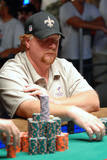
1. Darvin Moon (Seat 1) -- 58,930,000

Darvin Moon (Seat 1) -- 58,930,000In interviews Moon insists he’s the worst player of the final nine. He also suggests he’s intending to sit tight rather than be the big stack bully early on, waiting for good cards/spots and not giving courtesy double-ups. Many have expressed doubts about both claims. I’m going to guess that Moon does, for the most part, sit tight early on, though I expect he’ll still open pots from late position and/or when picking up big hands. Sure, he can fold his way to third or fourth, but I don’t really see that happening. Wouldn’t be surprised to see him in a relatively early confrontation or two versus a short-stacked opponent, whether or not he desires such. How those go will likely dictate how Moon’s endgame goes -- if he were to slip back to the middle of the pack, I wouldn’t be at all surprised for him to turtle up big time.

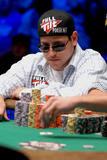
2. Eric Buchman (Seat 6) -- 34,800,000

Eric Buchman (Seat 6) -- 34,800,000A ten-year pro, Buchman really only became a big stack near the very end of the eight days in July. As an experienced tourney player who already had about $1 million in tourney winnings prior to making this deep run, Buchman is a favored pick among many. The fact that he’ll get to act directly after Begleiter on most hands early on is probably a big plus as well. Many expect Begleiter to be a somewhat unpredictable element, given his amateur status and big stack, so Buchman is in good shape to choose when and where he wants to try to outplay the amateur. Of course, the short stacks on his right (Cada and Saout) may force him to abandon some hands, too. Gotta believe he’s in a good spot here and so can’t really disagree with those picking him.

3. Steven Begleiter (Seat 5) -- 29,885,000

Steven Begleiter (Seat 5) -- 29,885,000The former bank executive is considered by most to be the one player with an above-average stack who is most likely to get himself into trouble in the early going. His amateur status, coupled with the memory of certain hands aired on ESPN in which he appeared more fortunate than skillful, has led most to view Begleiter as a target, especially for the short stacks seeking double-ups in favorable circumstances. That said, I think Begleiter -- who apparently hired Jonathan Little as a coach -- is probably aware of how he is perceived, and may well use his image to an advantage. Can’t really imagine “Begs” making it to heads-up, though stranger things have happened.

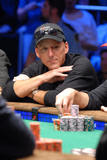
4. Jeff Shulman (Seat 9) -- 19,580,000

Jeff Shulman (Seat 9) -- 19,580,000You’re hearing a lot of references to this being Shulman’s second WSOP Main Event final table, although technically his seventh-place finish at the 2000 WSOP ME landed him just shy of the then six-handed FT. Even so, he and Ivey obviously are the only players among this year’s November Nine who have ever gotten anywhere near capturing the ME event bracelet before. Yesterday I mentioned that interview with Phil Hellmuth on ESPN’s podcast, The Poker Edge (11/5/09). Hellmuth, whom Shulman hired to coach him for this final table, spoke of their extensive study of the other players’ styles and tendencies. With or without any guidance from others, Shulman is a crafty player who is capable of a variety of moves and who gives off little in the way of tells. He’s also smart enough to avoid unnecessary risks, as shown more than once in the ESPN coverage. Don’t know if Shulman can actually win here, but I would be very surprised not to see him part of the final five.

5. Joe Cada (Seat 7) -- 13,215,000

Joe Cada (Seat 7) -- 13,215,000According to the media guide, the 21-year-old from Michigan accumulated some nice online scores prior to making his live tourney debut, earning over half a million clams, buying a house at 19, and (understandably) quitting community college. The hands shown on ESPN involving Cada mostly cast him in a favorable light, and some are quite high on his chances to break Eastgate’s record as youngest-ever ME winner. It will be interesting to see how he appears to view his 13 million-plus chip stack -- technically, he’s below average, and after just a few minutes of play when they move into Level 34, he’ll be sitting there with an “M” of less than 20. Will he feel urgency at that point or will he be sitting back while those with even fewer chips push the action?

6. Kevin Schaffel (Seat 4) -- 12,390,000

Kevin Schaffel (Seat 4) -- 12,390,000Interestingly -- though perhaps not surprisingly -- the three players at the final table whom everyone agrees should be designated “amateurs” are the three oldest players at the table: Moon (46), Begleiter (47), and Schaffel, who at 52 is the November Nine’s elder statesman. Schaffel does appear to have a lot more experience to draw from than the other two amateurs, though, having earned more than half a million in tourney winnings even before this event. He’s also made a couple of impressive runs in the Main Event before, finishing 42nd in 2004 and 324th in 2008. Of the nine, Schaffel was probably the least covered player by ESPN, and I also don’t remember reporting many (if any) hands of his when I was there this summer. So, like many -- perhaps including, most importantly, the other eight players -- I haven’t a lot to go on when assessing his chances.

7. Phil Ivey (Seat 3) -- 9,765,000

Phil Ivey (Seat 3) -- 9,765,000As was the case at the end of the summer, all eyes will be on poker’s “Tiger Woods.” Was listening to the Casino City Gang’s podcast from this week -- a new one I’ve started following and regularly enjoy -- and they noted with fascination how according to some sites Ivey had actually become the favorite to win it all thanks to the bets placed thus far. Obviously with Ivey -- as with Saout and Akenhead -- there’s little chance he gets anywhere today without successfully finding an early double-up. Then, who knows. Ivey becomes a true terror if he has the chips to make others abandon their hands, which -- as we saw over and over again this summer -- they will do. I’d love to see Ivey last as long as possible, but have to believe it is going to be a difficult afternoon for him.

8. Antoine Saout (Seat 8) -- 9,500,000

Antoine Saout (Seat 8) -- 9,500,000The Frenchman only received a bit more coverage than Schaffel on ESPN. He folded the better hand versus Ivey once. On another occasion he boldly bluffed Begleiter out of a pot with the worse hand and no draw. And he did make the WSOPE final table, too, where he finished seventh. Saout did a lot of folding near the end to survive to November, although I think now it is most likely we’ll see him (like Ivey and Akenhead) trying to make an early move to get back into contention. Remember with these short stacks that the differences in payouts among these bottom spots aren’t terribly huge: e.g., it is just a $40,000 jump from ninth to eighth, and just $104,000 from eighth to seventh. So unlike last year, when getting to eighth meant Kelly Kim won $1.28 million rather than $900K, there won’t be much incentive for the shorties to wait around in the early going.

9. James Akenhead (Seat 2) -- 6,800,000

James Akenhead (Seat 2) -- 6,800,000The British pro is probably the second-most respected player at the table besides Ivey, having a number of significant cashes over the last two years, including that runner-up in a 2008 WSOP $1,500 No-Limit Hold’em event (in which 3,929 entered) and a ninth-place finish at the 2009 WSOPE Main Event. Will be very dangerous should he get that double-up, and could well upset all sorts of imagined scenarios if he manages to accumulate a stack that allows him to play poker.

(EDIT [added 11/9/09]: Incidentally, if you happened to come to this post via that YouTube video with “Hard-Boiled Poker” in the title, I have no idea what the vid is or why it references “Hard-Boiled Poker.” Looks like some sort of content-grabbing thing?)

Labels: ,

Friday, November 06, 2009

2009 November Nine Just Hours Away... Time for Special Tactics!

ESPN's The Poker EdgeToday was listening back to some of these interviews with November Nine-alists on The Poker Edge from the past few weeks. Great stuff, and Andrew Feldman and the crew is continuing to produce shows right up until tomorrow’s final table. Don’t forget Feldman’s also got a blog goin’ over there on the ESPN Poker Club with polls and other whatnot, so check that out as well.

One of the eps I was listening to today was that one with chip leader Darvin Moon (the 9/25/09 episode). Just as we read earlier this week in Matt Waldron’s interview with Moon (from a while back), Moon insists on The Poker Edge that in that huge hand with Billy Kopp that his impression was the board had not paired on the turn. No shinola!

You’ll recall that when the flop came Kd9d2d both he and Kopp had flopped diamond flushes, with Moon holding QdJd, and Kopp 5d3d. The turn brought the 2h, Moon checked, Kopp bet 2 million, Moon check-raised to 6 million, Kopp shoved, and Moon called. Kopp was drawing dead.

“The flop come Kd9d6d,” says Moon to Feldman and co-host Phil Gordon, getting that third card wrong. “I checked and he checked.” Actually, Moon checked, Kopp bet 750,000 (a little under half the pot), and Moon called.

Darvin Moon, courtesy the great Flipchip“Turn card come 2h,” Moon continues. (Photo courtesy the great Flipchip.) “I checked, he bet 2 million, so I went all in, and when he said ‘all in’ my heart ’bout jumped on the table.”

I don’t believe Moon was misremembering the final sequence of bets -- he didn’t go all in first. Rather, he was just stumbling a little in the retelling, as made clear by his subsequent words. “When that happened, I mean I just leaned back in my chair, leaned back forward, and I said ‘I call.’”

Moon goes on to say how Kopp turned over 5d2d. “Didn’t the board pair on the turn?” asks Feldman. “No,” says Moon. Gordon reiterates that the board paired on the turn, but Moon insists “No, the board didn’t pair. It might’ve paired on the river. But it didn’t pair on the turn. The turn come the 2h. I’m very confident of that.”

“Interesting,” says Gordon.

After the interview was over Gordon and Feldman revisit the issue, and both seem ready to believe Moon, though as we all saw back in July -- and as was confirmed by the ESPN telecast earlier this week -- the original reports of the hand were correct.

In other words, Kopp, for whom the board pairing on the turn absolutely dictated his play on that street (see his explanation here), was playing against a guy who hadn’t noticed the board had paired! Doomed, he was.

Gotta love Moon, though. “Are you paying much attention to the telecasts?” Gordon asks him. There’s a pause.

“On the teevee?” Moon responds.

Moon has absolutely no desire to change his lifestyle one iota, regardless of how this sucker turns out. “I’ve got everything I want,” he says. “I don’t need anything. I mean, I’m 45 years old. I’ve live my first 45 years like this. Why change?”

That attitude similarly applies to his decision not to seek any sort of coaching for the final table.

“See, I’m not hiring no coach. I don’t understand all that. I’ve been called and asked if I would like to have coaching, and... naw. I mean, I’m going in there the same way I went in the last time. Just with a game plan of my own and if it works, it works, and if it don’t, it don’t.”

Speaking of coaches, the interview with Phil Hellmuth -- who is coaching Jeff Shulman -- from yesterday (the 11/5/09 episode) is pretty fascinating as well. Do note the Poker Brat has supplied Shulman with a “special tactic” that will “shock the world” when used. Awesome!

(Of course, one wonders how well them special tactics will work if the opponent ain’t clear on the community cards!)

Can’t wait.

Labels: , , , , , ,

Shamus the Scribbler Betfair Bound

With the 2009 World Series of Poker Main Event restart just a day away, most all of our thoughts are focused toward the Nevada desert. I’ll likely be posting some here later today and over the weekend, as I can’t imagine being able to resist commenting on the proceedings in some fashion. Might as well warn anyone who doesn’t want to know how things are going to avoid Hard-Boiled Poker (and just about every other poker-related site, too) until the show finally airs on ESPN Tuesday night.

I’ve yet to join any of the “pick’em” pools that have sprung up all around us during the last few days. I might still do so, but am kind of reluctant, partly because I don’t really want to follow the final table with any particular rooting interest regarding who finishes seventh, sixth, fifth, etc.

Like anyone else, I’m highly intrigued by the prospect of a Phil Ivey win, and I’ve also given some thought to the various consequences for each of the others coming out on top -- the whole “is it good for poker?” thing. A question which, by the way, the always cogent Nicole Gordon has addressed very well regarding each of the November Nine over at PokerNews.

But really, I’m just excited to see how all nine of these guys handle the situation. And to see what cards come their way.

Of course, while I am certainly thinking about what’s happening at the Rio All-Suite Hotel and Casino over the next few days, my thoughts are turned in the opposite direction as well -- across the Atlantic toward the U.K. Why? That’s because today marks the debut of a new column of mine over on Betfair!

Some of you recognize Betfair as the sponsoring site for the recent World Series of Poker Europe. It’s the largest online betting company in the U.K., and includes a fairly popular online poker site under its tent. The recently-turned-21 Annette Obrestad is probably the site’s best known sponsored pro.

Included on its site is a nifty poker blog to which Betfair has invited me to begin contributing. Am starting out today with a book review of James McManus’s Cowboys Full: The Story of Poker, a book I have written about here a bit. I also interviewed McManus last week, and for my next Betfair piece will be sharing that interview. The plan at present is for me to be posting over there once per week, and it looks like Fridays will be my day.

If you don’t have the Betfair blog already listed there in your favorite reader, here is the RSS feed. And if you happen to check out the review, do let me know what you think!

I’ll be posting more book reviews over there, I expect, as well as other pieces covering different poker-related subjects. I’ve already used two exclamation points in this post, so you can probably tell I’m fairly psyched about starting the new column. Much thanks to Dave Allan and the folks at Betfair for bringing me aboard.

Meanwhile, I’ll be talking to you again over here soon.

Labels: , , , ,

Thursday, November 05, 2009

2009 WSOP November Nine Tidbits... plus Tender Cuts, Nuggets, and Snack Sticks

Our buddy Kevmath over on Pokerati has linked us up to the official media guide for the 2009 World Series of Poker November Nine, a 26-page document which I assume was primarily pulled together by our other friend, the indefatigable Media Director of the WSOP, Nolan Dalla. Thought I’d pass along a few interesting trivia bits from the guide regarding this weekend’s festivities.

Play begins at the Penn & Teller Theater in the Rio All-Suite Hotel & Casino on Saturday at noon Vegas time, with the remaining nine playing down to the final two. Those two players will then return on Monday night at 10 p.m. Vegas time to play it out. Once again, here are those chippies and seat assignments:
Seat 1: Darvin Moon (1st, 58,930,000)
Seat 2: James Akenhead (9th, 6,800,000)
Seat 3: Phil Ivey (7th, 9,765,000)
Seat 4: Kevin Schaffel (6th, 12,390,000)
Seat 5: Steven Begleiter (3rd, 29,885,000)
Seat 6: Eric Buchman (2nd, 34,800,000)
Seat 7: Joe Cada (5th, 13,215,000)
Seat 8: Antoine Saout (8th, 9,500,000)
Seat 9: Jeff Shulman (4th, 19,580,000)
They are almost finished with Level 33 (just seven-plus minutes left), where the blinds are 120,000/240,000, and antes 30,000. That means after just a few hands they’ll be posting blinds of 150,000/300,000 and antes of 40,000.

Leafing through the guide, we learn a few new things about the players (in “thumbnail bios”). More interesting is a breakdown of the scheduled payouts:
1st -- $8,547,042
2nd -- $5,182,928
3rd -- $3,479,670
4th -- $2,502,890
5th -- $1,953,452
6th -- $1,587,160
7th -- $1,404,014
8th -- $1,300,231
9th -- $1,263,602
All nine players have already received ninth-place prize money ($1,263,602). The guide tells us that the remaining $15 million-plus was placed “in a risk-free Goldman Sachs Treasury-Only Money Market interest-bearing account,” and over the course of three-and-a-half months accrued $1,321 interest.

Yeah, that’s what it says. $1,321. As Mean Gene says in a comment over on Pokerati, that piddling total of “$1,321 wouldn’t cover the Jack’s Links Beef Jerky tab for Media Row for one week during the WSOP.”

Something highly weird going on with that figure, as last year a similar process was followed and the yet-to-be-awarded prize money had earned nearly $100,000 in interest during the 100-plus day wait for the final table. In any event, the interest was only added to the top eight spots, so the first guy to go on Saturday will not be taking home anything more than what he’s already received. That first-place prize easily eclipses the largest cash prizes earned in any other individual sport, the closest being the $3,048,055 Hélio Castroneves earned for winning the Indianapolis 500 in May of this year.

There is also a section explaining that a pro hasn’t won since 2001 (Carlos Mortensen). According to the guide, four of the nine players at this year’s final table are recognized as professionals -- Akenhead, Buchman, Cada, and Ivey -- with two more (Shulman and Saout) described as “semi-pros.” It’s a fuzzy distinction, really, but I’d think if Ivey, Shulman, Buchman, or Akenhead won, there wouldn’t be too much disputing the claim that the seven-year streak of amateurs winning the Main Event had been snapped. I guess Cada, too, although the dude had only been old enough to play live poker legally in the U.S. for six months or so prior to the start of this year’s WSOP.

Also of note, in 2009 there were a total of 60,875 player registrations for the 57 bracelet events, breaking last year’s record of 58,720.

Messin' With SasquatchThere’s some other stuff about the planned Hall of Fame ceremony during which Mike Sexton will be officially enshrined. And way, way more info about Jack Link’s Beef Jerky than one could ever hope for, including a comprehensive rundown of the company’s various offerings. Most distressing: something called the “Sasquatch Big Stick,” which comes in “Angry” and “Happy” flavors.

Uh, no thanks. Not messin’ with that.

Labels: , ,

Wednesday, November 04, 2009

Kopp Busted!

ESPN's coverage of the 2009 WSOP Main Event continuesLast night ESPN aired the final hours of its coverage from this summer’s World Series of Poker, culminating a lengthy run of 24 hours of programming devoted to the Main Event. As I have been noting here, I was coming and going a lot during the coverage of the first few days of the ME, but by the end I was pretty much riveted.

The two hours last night -- in which the final 18 players played down to nine -- were particularly intriguing, with lots of non-bustout hands shown. This was the first time all tourney that ESPN had all of the remaining players sitting in front of hole card cameras, as both the main feature table and the secondary table were equipped. So they had a lot of flexibility to pick and choose hands beyond the nine in which players were eliminated, and I think they made some good choices.

One of the more surprising hands to see was a bustout hand, actually. I’m talking about the one in which Ian Tavelli opened to 450,000 from under the gun (not quite a 3x raise, as the big blind was 160,000), then was reraised to 1.35 million by Steve Begleiter sitting to his left. Thanks to the hole card cameras, we see that Tavelli had pocket nines and Begleiter pocket kings. When the hand began, Tavelli had about 7.7 million and Begleiter about 20 million.

Then we watch James Akenhead, who I believe had around 8 million or so, look down at AdKd in middle position, and after a short think decide to toss his suited Big Slick. Next in line comes Eric Buchman in the hijack seat, who had something like 16 million, and we see him folding pocket tens. Joe Cada then looks down at pocket jacks (!). Cada takes a gander around the table, and he also chooses not to commit any of his 14 million chips or so.

Shamus watching the WSOP on ESPNA lot of big hands, and it seemed surprising to see that trio all choose to step aside. I have no idea what sort of image Tavelli had there, as he hadn’t been at any of my tables, so perhaps that UTG raise meant something. I had been watching Begleiter quite a bit just prior to his having been moved over to the main feature table, and while he had shown a willingness to gamble now and then, his amateur status might’ve made his reraise with the entire table left to act especially menacing. And perhaps Phil Ivey sitting in the big blind had some effect on how things went in that hand as well.

Ivey folded, however, Tavelli pushed, and “Begs” called. His kings held, and Tavelli was gone in 17th.

I’ve said before how I was at the secondary table that night (along with F-Train). Interestingly, once they had gotten to 18 and gone to two tables, the next four eliminations all took place at the main feature table. Then we went to dinner, and after coming back the next three -- Ben Lamb (14th), James Calderaro (13th), and Billy Kopp (12th) -- all happened at our table. Lamb and Calderaro’s eliminations were fairly anticlimactic, as both had gotten very short-stacked just prior to their bustouts.

But Kopp’s... well, as discussed here before, that was something different.

When watching it live, everything happened so quickly there really was no time to react or feel any sort of anticipation. It was essentially “hmm... the two big stacks at the table are mixing it up,” then suddenly Kopp was standing up and wincing, then walking away.

I’m assuming you watched the hand -- in which Kopp lost 80-plus big blinds -- and so I won’t rehearse the details. You can read F-Train’s write-up of the hand here. Also of interest is Ryan Nelson’s interview with Kopp from September over on PokerNews, in which Kopp explains what he was thinking at each stage of the hand. (Incidentally, contrast Kopp’s approach here with that of the folders over at the main feature table.)

Kopp BustedWatching the hand again last night was a little disorienting, that massive doom cloud hanging over Kopp’s head kind of affecting my focus. (Don’t, don’t, don’t!) One thing I was able to notice was that ESPN’s editing didn’t seem to alter the timing of the hand all that much.

That is to say, if my memory serves, the amount of time each player appeared to take to make each decision was pretty much what you saw last night. In other words, I believe Kopp really took about a half-minute there before announcing he was all in, and Moon about 15 seconds or so to make the call.

Kevmath was noting on Twitter last night how eerily quiet the crowd seemed after the hands were revealed. That I remember as well. WSOP Media Director Nolan Dalla was working alongside F-Train and myself that night. When the hands were revealed, it took us all a couple of beats to realize what was happening.

“He’s drawing dead?” asked Dalla quizzically. “He is,” we answered unsteadily. It didn’t seem possible.

Kopp had a small, vocal cheering section there, but Moon’s wife (shown on ESPN a few times) kept as reserved as her husband. So no big roars at Moon’s win, and really, Kopp (and his supporters) took less time storming out of there than it took the rest of us to piece together what we’d just seen.

Good stuff, for sure. And now I’m totally hooked to see how it plays out this weekend. As was the case last year, Bluff Magazine will be doing some sort of live audio commentary with graphical updates of chip counts. And, of course, PokerNews will be there as well, finishing out the live blog for Event 57.

Best wishes to all my buds heading out to Vegas and the Rio this weekend to cover the sucker. You know I’ll be following.

(EDIT [added 11/5/09]: As Sean G points out in his comment, a highly interesting twist to the big Moon-Kopp hand was the fact that Moon apparently did not realize the board had paired with that deuce on the turn. See the follow-up piece over at PokerNews for further details.)

Labels: , ,

Tuesday, November 03, 2009

2009 WSOP Main Event Still Incomplete (But Not for Long)

IncompleteBack in college, I was never one of those students who was much inclined to take an “Incomplete” for a course. Always preferred to get the sucker done and move on to the next round of classes without having a last assignment hanging over my head.

I do recall one occasion when I had to take an “I” after I’d screwed up a final paper (doing it on the wrong topic), and thus was given an “Incomplete” by the professor so as to give me a chance for a redo. Being the relatively conscientious student I was, I submitted the new paper early the next semester, but the procrastinating prof. ended up taking a year-and-a-half to take care of the grade. (No shinola.)

Wasn’t that big of a deal, but I recall sometimes thinking it wasn’t too cool to have that “I” following me like that. That “I” wasn’t me!

The idea of having to take an “Incomplete” came back to me again this weekend as I noted we’re now less than a week away from the final table of the 2009 World Series of Poker Main Event. Finally, finally, finally we'll get to see who will be this year’s champ.

I continue to dislike the delay in principle, but will admit to having gotten caught up in the hype a bit more this time around. Indeed, I am starting to realize how much I’ll miss being at the Rio this weekend to see the thing through, something I didn’t feel much at all last year.

I’ve had the tremendous opportunity the last two summers to live in Las Vegas and help cover the World Series of Poker. Have written at length here about my experiences (here’s a compilation of the 2008 reports, and here’s one from 2009). This past summer I was able to stick around right up to the end of play there on Day 8, a wild, adrenaline-fueled day and night punctuated by jaw-dropping hands that sent the huge, boisterous crowd of onlookers in the Amazon into hysterics time and again.

We all thought that last day was going to go deep into the next morning. If you recall, players began this year’s Main Event with triple stacks of 30,000 chips, meaning that by the time we reached this latter stage of the tourney, most all the players had mountains of chips sitting before them. The average stack for the 27 players returning on Day 8 was more than 7.2 million. A stack of that size amounted to more than 70 big blinds when play resumed early that Wednesday afternoon.

Boom, Boom, Boom!I had a flight scheduled for Thursday morning at 8:15 a.m., and thus had even brought my bags to the Amazon Room, anticipating the possibility of having to go straight from the Rio to McCarran should play stretch into the early morning. As it happened, the players were moving chips much, much faster than anyone had expected they would. By the dinner break they were already down to 14, and soon after we returned a couple more bustouts happened, meaning there was still daylight outside when just a dozen remained. Then -- as I assume most of us will watch tonight on ESPN -- it was “boom, boom, boom” and the final nine were set.
Seat 1: Darvin Moon (1st, 58,930,000)
Seat 2: James Akenhead (9th, 6,800,000)
Seat 3: Phil Ivey (7th, 9,765,000)
Seat 4: Kevin Schaffel (6th, 12,390,000)
Seat 5: Steven Begleiter (3rd, 29,885,000)
Seat 6: Eric Buchman (2nd, 34,800,000)
Seat 7: Joe Cada (5th, 13,215,000)
Seat 8: Antoine Saout (8th, 9,500,000)
Seat 9: Jeff Shulman (4th, 19,580,000)
Amid the roar of hundreds, Robbie Thompson bellowed out the names of the nine who’d made it, his self-aware, step-right-up baritone neatly heightening the drama as we all came to the realization that the summer’s last hand of poker had been played. A genuinely climactic moment, it was.

I got to sleep in the hotel one last time that night. Then a cab to the airport. Then home. Like everyone else who’d spent the last seven-plus weeks in Vegas, I was more than ready.

Like I say, last year once November rolled around I really didn’t experience much of a pull Vegas-ward once the sucker finally got going again. From the standpoint of a fan, I didn’t have much of an emotional investment in any of the final nine. And from a reporter’s P.O.V., I guess my relative newness to the business of covering the WSOP prevented me from feeling presumptuous enough to think that I had any special insight to provide regarding the tourney’s completion.

This year is different, though. I know these guys much, much better than was the case last year, both from having been there covering them right to the end and from having sought out the stories and interviews with them during these intervening months. No, I’m not talking about those nonsensical, space-filler type articles out there that purport to profile the players but in truth offer very little. Rather, I’m referring to the more studied coverage in which reporters smartly tell the stories of the final nine and handicap their chances.

Just to point you to a few good examples, Card Player has a couple of “Meet the November Nine” articles that do a nice, comprehensive job of introducing the players -- Part I and Part II. And Stephen Murphy has further added to CP’s coverage with quality profiles of each player. A little tricky to negotiate the CP archives, but I’m seeing seven of those profiles posted thus far -- Akenhead, Begleiter, Buchman, Cada, Ivey, Saout, Schaffel. (I think the other two are coming to the website soon, if they haven’t already -- will add links to those when I see ’em.)

I’m also digging what ESPN is doing both on their new, web-based show “Inside Deal,” and on the Poker Edge podcast. Several of the nine players have appeared as guests on the Inside Deal thus far, including Begleiter, Buchman, Cada, Ivey, Moon, and Schaffel. (Click the names to get to their respective episodes.) And those six plus Shulman have all appeared on the Poker Edge podcast as well.

Finally, I’ve recommended before the analyses of all nine players’ chances by Spaceman and Riggstad over on AlCantHang’s “Poker from the Rail” blog. Those commentaries can be found in three separate posts -- Part 1 (Moon, Buchman, Begleiter), Part 2 (Shulman, Cada, Schaffel), and Part 3 (Ivey, Saout, Akenhead).

Check out all those links and you’ll be about as well-informed as you can be regarding the 2009 November Nine, I’d imagine.

Of course, there is no way to know everything -- in other words, our knowledge of these guys is necessarily going to be incomplete, no matter how much we read, hear, and watch. But our knowledge of how the November Nine made out at the 2009 WSOP Main Event will be completed soon enough.

Yep, one last assignment for these guys. Then we’ll see what kind of grade they earned.

Labels: , , , , , ,

Monday, November 02, 2009

Post-Production is 20/20

Post-Production is 20/20Heard an interesting follow-up to that hand shown on ESPN’s coverage of the 2009 World Series of Poker last week, the one in which Phil Ivey mistakenly mucked what would have been the winning hand at showdown.

You’ve probably either watched the hand or heard all about it by now. With 24 players left, Ivey opened with a preflop raise from under the gun with 8s8d, and the table folded around to Jordan Smith who reraised from the big blind with Ad9c. Both players ended up cautiously checking down the flop, turn, and river, with the river As having put four spades on the board.

After Ivey checked behind on the end, Smith announced that he’d paired his ace. Ivey waited for Smith to show his hand, then surprisingly Ivey dropped his cards in front of the dealer, obviously not realizing he’d made a flush and thus held the better hand. The two million-plus chip pot went to Smith.

Barry Greenstein sporadically keeps an “audio blog” over on PokerRoad, and at the end of last week he spoke a bit about having talked to his friend Ivey about the hand.

Greenstein asked Ivey whether he knew about having mucked the winner prior to the hand being shown on ESPN, and Ivey said he did not. Ivey also said he was surprised no one called him before Greenstein did to tease him, but Greenstein explained that was because Ivey’s cell phone doesn’t work in Cabo, Mexico where he’s relaxing in preparation for the final table. (For those interested in Ivey’s “self-imposed exile” in Cabo, a recent “The Life of Ivey” video sheds some light.)

“I think this hand is never going to leave me,” Ivey told Greenstein, revealing that he does, in fact, at least have some awareness of how he’s perceived.

An ace on the riverWhat I found most interesting in Greenstein’s audio blog, though, was the Bear’s report that Ivey’s first response after having seen the hand was to ask “Is there a way they [i.e., ESPN] could doctor the hands?” He told Greenstein he didn’t remember there having been four spades on the board, and wondered if perhaps there could have been some funny business post-production. Greenstein said he guessed it was possible to doctor the footage, but he doubted that it had been done.

As I mentioned last week, Change100 was reporting from the feature table that day. Indeed, in her report of that hand, all of those board cards just as they appeared on ESPN. So yeah, not that we really would have suspected it anyway, but I think it is safe to say there was no post-prod doctoring here.

Ivey’s question reminded me of something I’ve witnessed from time to time while covering televised final tables at the WSOP. We all know how the productions are highly edited, well-crafted programs designed to be watched as a seamless narrative. Thus you can assume there are numerous examples of inserted reaction shots and the like that aren’t perhaps representative of the strict chronology of how events actually occurred -- and indeed, I’ve been able to pick up on a few of those now and then when watching the shows of tables I’ve covered. But I’m with Greenstein in the belief that there are never any outright doctoring of hands.

However, it does happen that there will occasionally be some on-the-fly “restaging” during the course of a televised final table. I’ve seen it happen several times that during a brief pause in the action, a dealer might be asked to repeat the dealing of a flop, turn, or river in order for ESPN to get a better looking shot. Perhaps the cards didn’t come out neatly enough the first time around, or the dealer’s hand was obscuring one of the cards from the overhead camera, and so a second take is ordered up. I recall one time watching this happen and the crowd reacting, obviously confused about what was going on. Then everyone had a laugh afterwards as it became clear they were watching a recreation of a hand that had just occurred.

'The Bear Blog' on PokerRoadIn his audio blog, Greenstein speculates that by the river Ivey had become convinced Smith was holding an ace in his hand, and so when the ace appeared on the river he’d completely overlooked the suits. Ivey said as much to Greenstein, noting how when it came to showdown, he was surprised to see Smith show A-9 offsuit, since Smith had reraised him from out of position. When he saw Smith’s hand, Ivey was, to employ one of Norman Chad’s favorite terms, “bamboozled.” So surprising it was to see his opponent’s hand, Ivey forgot his own.

Greenstein goes on to say how common it is to misread one’s hand, even among the pros, and expressed doubts that anyone who claims never to have misread his or her hand is telling the truth.

As I mentioned last week, Ivey’s misstep was hardly the biggest one that happened on that Day 8. Will certainly be watching tomorrow night. Indeed, there’s one hand in particular -- one which back in July I said “sort of emblematize[d] the entire frenzied last day” -- I know I want to see. Even if I know already how it turned out, and even remember all of the reactions of the individuals involved.

’Cos, well, those editors... they can do some neat stuff.

Labels: , , ,

Newer Posts
Older Posts

Copyright © 2006-2021 Hard-Boiled Poker.
All Rights Reserved.