Tuesday, August 19, 2008

Thriving vs. Surviving: John Phan & David Sklansky at the 2008 WSOP, Event No. 40 Final Table
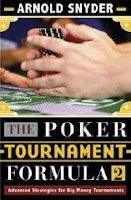
Arnold Snyder, 'The Poker Tournament Formula 2'Mentioned last post Arnold Snyder’s The Poker Tournament Formula 2. An interesting read. I’d definitely recommend it to the serious tourney player.

After focusing primarily on fast tourneys in the first one (and talking a lot about position play), Snyder looks more specifically in PTF2 at tourneys with slower structures. In both books Snyder talks about how to calculate a given tournament’s “patience factor” and therefore rank the relative “skill level” required of the event. On his website, Snyder has among other articles and information a downloadable “Patience Factor / Skill Level Tournament Calculator” -- really just an Excel spreadsheet into which you can insert the relevant numbers to compute tourney speeds. (The sheet probably isn’t of much use to you if you haven’t read the books.)

I didn’t want to discuss the book too much, but rather just mention a couple of passages that come up in PTF2 and how they reminded me of a particular event I covered at this summer’s World Series of Poker, Event No. 40, the $2,500 Deuce-to-Seven Triple Draw event.

Snyder begins his second tournament poker book with a discussion of John Phan, the highly-successful tourney player who has accumulated over $4 million in career earnings over the last decade. Snyder found himself playing with Phan a couple of times at the 2006 WSOP, and both times he experienced Phan’s especially aggressive, off-putting style of play with which he successfully accumulated huge chip stacks while punishing the table mercilessly. “Phan’s chip stack,” Snyder reflects, “combined with his aggressive style of play, literally had the rest of the table frozen, even though most of the players had very viable chip stacks in relation to the blinds.”

Snyder takes it upon himself to try to figure out what Phan was doing, and the result in large part is PTF2. He talks a lot in the early part of the book about a concept called “chip utility,” most simply defined as “the usefulness or serviceability of your chips.” Phan’s style not only won him chips, and thus gave him an increased “chip utility” at the table (i.e., he could now do more things with his chips), but it also reduced his opponents’ chip utility -- even those from whom he was not winning pots.

Reading this little tribute to “the Razor” made me think of the six-handed final table of Event No. 40, which began with Phan as the chip leader with nearly 300,000 chips. In fact, he’d led for a lot of the three-day tourney -- I know he was at the top of the leaderboard for most of the second day. Phan faced some tough opponents at this final table, including Gioi Luong, Robert Mizrachi, Ben Ponzi (who had one WSOP bracelet), and David Sklansky. Shun Uchida was the least decorated at the table, though he’d led the tourney at the end of Day 1 and would go on to finish second.

F-Train and I covered this one, and having watched Phan work the first couple of days we knew he’d be tough for the others to deal with at the final table. And indeed, he controlled the show for most of the night. If you read back through our coverage, you’ll see numerous references to Phan’s aggressive play (and table talk). I think we also mentioned in there somewhere the ten Coronas he ordered halfway through the night. I know I did in a post here, anyway.

John Phan winning Event No. 40 at the 2008 WSOPPhan won that tournament, taking his second bracelet of the series. Although I’m not too versed in 2-7 triple draw, it struck me as a game that suited Phan particularly well in that even though it was a limit tourney it afforded numerous opportunities for bluffing and/or intimidation -- especially if one had the chips to do so.

A lot of Snyder’s advice in both of his Poker Tournament books is offered independent of one’s actual cards -- in the fast tourneys he’s talking a lot about using position, and in the slower ones he focuses more squarely on using your chips. Of course, in a game like 2-7 Triple Draw, the actual cards tend to mean even less, with the betting and drawing really moving the action and forcing most of the decisions.

I mentioned David Sklansky was also at that final table. He’s the other reason why Snyder’s book made me think of Event No. 40.

Sklansky entered the final table with 78,000 chips, making him the short stack as play began with about 40 minutes left in Level 17 on Day 3. The blinds were 3,000/5,000 and limits 5,000/10,000 when play began, meaning he had not even eight big bets -- enough, perhaps, to play one hand (sort of) comfortably. Indeed, Sklansky had been nursing the short stack for pretty much all of Day 2, and we’d thought on numerous occasions we’d be reporting his elimination prior to the final table. But he hung on and made it. Finishing in the top six of an event in which 238 players entered is certainly an accomplishment.

We knew, though, Sklansky wouldn’t be winning this one. Not without cards, anyway. And sure enough, Sklansky’s stack dwindled down quickly. Just kind of randomly looking back through the blog, I see I wrote this post about one of the last hands from Level 17:
Sklansky Looking for Cards
David Sklansky raised from the hijack, Robert Mizrachi called from the button, and John Phan called from the small blind. On the first round, all took two cards, and all checked.

On the second draw, Phan stood pat, Sklansky took one, and Mizrachi took two. This time Phan bet, Sklansky called, and Mizrachi folded. Phan stood pat again on the last draw, while Sklansky took one again. Phan bet, and Sklansky folded. Phan has chipped up to 315,000.

Sklansky folded the next hand. On the next he was in the big blind, and had to fold after someone raised. He showed a king as he did.

Sklansky is down to 29,000.
Even in this limit tournament, Sklansky had just about zero “chip utility” of which to speak. As was the case with many hands we watched that night, we had no idea what cards players had on this one. But it kind of didn’t matter, other than the fact that whatever Sklansky drew on the third round, he wasn’t comfortable risking such a high percentage of his stack (the 10,000-chip big bet on the end) to see if he was good.

Sklansky's chips at the final table, Event No. 40, 2008 WSOPThen came the blinds, and Sklansky folded both times. He’d fold another orbit’s worth, then facing a three-bet in the big blind, would fold again.

Sklansky was down to 14,000. On his very last hand, he had just 12,000 to start, meaning even if he’d won the hand, he still would have just a couple of big bets with which to continue.

In his discussion of chip utility in PFT2, Snyder gets into it big time with Sklansky over the latter’s long-held argument for “reverse chip value theory” in tournaments -- what Snyder calls the “big boner” of tourney thinking dreamt up by the “math heads” (i.e., Sklansky and Mason Malmuth). It’s a provocative (and entertaining) discussion, one I think most tourney players should at least be curious about in that it forces one to rethink some of that so-called “received wisdom” we’ve had preached to us over the years.

This post has already run on too long, so I’m not going to get into the whole argument too deeply. I will summarize it, though. The “reverse chip value thory” -- which, Snyder points out, has informed a lot of tournament strategy writing over the last couple of decades -- is the idea that “the more chips a player has, the less each of his chips are worth,” and, conversely, “the fewer chips a player has, the more each of his chips are worth.”

This, of course, is the exact opposite of Snyder’s view. Snyder feels that the more chips you have, the more they are worth, insofar as they give one an increased chip utility. And recalling all of the utility Phan had with his chips there at the final table of Event No. 40 -- and how miserably little utility Sklansky had -- doesn’t contradict Snyder’s point here.

(This argument over the “reverse chip value theory” -- and other debates brought up by Snyder’s book -- continues over on Two Plus Two, with Sklansky predictably entering fray as well to fight back.)

Snyder speaks of how “so many players voluntarily surrender their utility” and instead revert to “survival-oriented strategies” in tournaments. It probably isn’t fair to say Sklansky had “surrendered” his utility by the time the final table started, although he certainly did somewhere along the way in Day 2, choosing rather just to survive than to do what was necessary to take all of his opponents’ chips.

Snyder ultimately characterizes a poker tournament as “a battle between the utility players and the survival players, and it’s not so much a battle as a rout.” From what I could tell, Event No. 40 of this year’s WSOP seemed to confirm that view.

Labels: , , , , ,

Monday, August 18, 2008

Worryin’ About Hurryin’: The 2008 WSOP Main Event Final Table

Was catching up on some podcasts over the weekend and heard Gary Wise’s interview with David Rheem on Wise Hand Poker (the 8/13/08 episode). Rheem is one of the so-called “November Nine” who made the delayed final table of this year’s World Series of Poker Main Event. You might remember Rheem from his appearance at the Event No. 4 final table (the $5,000 Mixed Hold’em event) shown on ESPN a couple of weeks ago. He entered that final table the chip leader, but ended up going out in fifth.

You might also recall back in July an article appeared in the South Florida Sun Sentinel reporting Rheem had an outstanding warrant in Hollywood, Florida for apparently having failed to appear in court in 2003 on a misdemeanor trespassing charge. Less widely circulated was a subsequent report that the 2003 warrant is apparently no longer valid.

I had heard Rheem interviewed once before on the Two Plus Two Pokercast (Episode 32, 7/14/08), but on Wise’s show Rheem mentioned something new. When asked his thoughts regarding the 117-day delay before the WSOP ME final table, Rheem admitted that when he began the tournament, he had no idea such a delay was scheduled.

According to Rheem, following Day 2 he had a decent-sized chip stack and was discussing the tournament with some friends. “They were, like, ‘you know, once you make the final table, you make a three-month break,’ and then, you know, I almost lost money on it because I didn’t believe them. I was like ‘I’ll bet you money that you don’t!’ And then when their arm was out ready to shake my hand, I knew they were serious.” Rheem said he then went to the Tournament Director to confirm, and that’s when he first found out about the delay.

There was no hurry, I guess. Not like it really mattered on Day 2.

Rheem seems pretty likable. So do his fellow final tablists Dennis Phillips, whom I heard interviewed on Phil Gordon’s The Poker Edge (7/24/08), and Craig Marquis, who appeared on The Poker Edge as well (8/7/08). Listening to their interviews got me wondering about where things stood heading into that final table, still nearly three months away.

Play stopped in the early morning hours of July 15th with exactly 21 minutes and 50 seconds left in Level 33. That means these guys played over 65 hours of poker to get to this point in the tourney. The blinds are currently 120,000/240,000 with 30,000 antes. Here’s what each player will have in front of him when the first hand gets dealt on November 9th:

2008 WSOP Main Event final tableOn the World Series of Poker website, there’s an article dated July 15th that purports to give final table seat assignments, but that information is incorrect. As Dennis Phillips mentioned on The Poker Edge, they will be drawing for seats five minutes before play begins on Nov. 9th.

I listed the number of big blinds each player currently has as well as the “M” or ratio of one’s stack to the current total of blinds and antes -- i.e., the “cost per round” figure popularized by Dan Harrington and Bill Robertie in their Harrington on Hold’em series.

On the most recent episode of The Poker Edge, Phil Gordon suggested that “the pace of play at that final table is going to be ridiculously slow.” He was referring to the fact that when it came to players like Marquis -- whom he said was “not exactly short-stacked, not exactly desperate yet” -- “you’ve got 40 big blinds, there’s no hurry.”

Indeed, if one looks at the “M” ratio of the nine players, a lot of them are still in that “Green Zone” (an “M” of 20 or higher) in which Harrington and Robertie say “all moves are available.” However, Arnold Snyder, in his discussion of “chip utility” in The Poker Tournament Formula 2, would certainly disagree with the notion that “there’s no hurry” when one is down to 40 big blinds.

For Snyder “full utility” is only possible when one has 100 big blinds or more, a situation only Phillips and Demidov currently enjoy. That, says Snyder, “is the minimum stack size required for unhampered post-flop play, including information bets and more advanced moves on later streets or against more aggressive deep-stacked opponents.” Snyder describes a stack size of 60 big blinds as still “competitive,” though not “fully functional.” Stacks of 30-60 big blinds have “moderate utility,” and below 30 makes one’s utility “low.”

Of concern here for players other than Phillips and Demidov is the fact that 20 minutes after they start play on November 9th -- i.e., probably less than one orbit -- the blinds and antes will be moving up to 150,000/300,000 plus 40,000. That means unless a player like Marquis picks up a pot within those first few hands, he’s down to 30 big blinds and “low utility” (according to Snyder’s rubric).

Gordon’s comment reminded me that he had said something similar last year at the start of the 2007 final table. Indeed, that final table also began with 120,000/240,000 blinds and antes of 30,000, with roughly the same total number of chips in play. After the first hand of that final table -- in which Jerry Yang raised to 1.4 million from under the gun, was called by a late position player, then took the pot with a big bet on the flop -- Ali Nejad spoke of the 630,000 that was in the pot before each hand began and how that was a decent-sized prize to go after.

“Yeah, but the blinds are very small in relation to the stack sizes here,” answered Gordon. “There’s not a single player at the table who’s ready to just push under the gun or raise all in…. It would surprise me greatly -- unless there are just some huge hands, like aces versus kings or something like that -- to see any elimination here in the first three or four hours of this tournament.”

Anybody remember where we were after four hours last year? No less than four players -- Philip Hilm, Lee Watkinson, Lee Childs, and Hevad Khan -- had already busted.

We’ve a long time to wait, still. But I tend to believe we’re probably gonna see some serious hurryin’ once we get there.

Labels: , , , , , , ,

Friday, August 15, 2008

Wanting to Walk Away

Online poker players are finding it increasingly more difficult to 'walk away' when they want toHas been a good while since I’ve tried to cash out any funds from the three sites on which I currently play (PokerStars, Full Tilt Poker, Bodog). How ’bout you?

There was a time -- pre-Unlawful Internet Gambling Enforcement Act -- when I’d routinely pull a spare hundy off a site and dump it into Neteller, then once a certain amount accumulated there with our once-favorite third-party vendor I’d go ahead and ship it to my bank account, no problemo. Starting in late 2006, once Neteller bailed on us Yanks, I’d instead wait until I’d built up a bit more than that on a given site before requesting a check. Have had to exercise some caution, of course, as I haven’t wanted to leave myself too small of a roll to continue comfortably on any given site. (I still have yet to explore depositing options for any site, and don’t plan to do so if I can help it.)

To this point, then, despite my backwards-ass government’s efforts to the contrary, I’ve encountered zero difficulties from any of my three sites when it comes to cashing out. (Same can’t be said for the sites on which I no longer play, but all that’s pretty far in the rearview by now.)

But like I say, it’s been a while -- perhaps six months -- since I’ve bothered to pull any cabbage off. Haven’t been playing Bodog as much lately, and so the roll is relatively small over there. Have had some technical issues over there, too (not unlike others, I see). Can’t seem to get the site to load on the laptop anymore -- don’t ask me why. I have, however, built up decent-sized chunks on both Stars and Full Tilt, and so had been starting to think about claiming some o’ that hard-earned cheddar.

I know some -- especially those who play at my small stakes -- don’t bother much with taking money off the table like this. But for me, doing so has always been an important part of poker, not to mention my enjoyment of it. Money left on the sites is always theoretically “in play” (even though I’d never dream of taking my whole roll to a table at once). Thus do I feel it should frankly be considered a very high priority for all online sites to make withdrawing one’s money as easy as they possibly can. Fer Chrissakes, it’s part of the game.

Of course, one could probably additionally argue the ethical imperative for online poker rooms to make withdrawing easy. Most sites at least nominally promote “responsible gambling” in some fashion or another, and it only makes sense that making it easy for players to “step away” (as it were) should be a big part of that effort.

But I personally happen to think it’s part of the game, too. Whether you agree with that or not, it’s most certainly a big part of how the very small percentage of us who don’t lose money at online poker -- something like 7-8% by most estimates -- manage to stay ahead.

Have to say, though, I’m feeling some serious trepidation about requesting any sort of cash out from any site at the moment.

Have been following that massive thread on 2+2 for the last month now detailing players’ difficulties getting funds off of Full Tilt in particular (although a few in that thread are complaining about Stars, too). There’s another thread, begun way back in April, that presently has several posters sharing their stories about having their withdrawal requests denied by Full Tilt. And I’m seeing a third thread, begun yesterday, that is also dedicated to posters explaining that none of the options presently offered by Full Tilt are working for them.

Have seen a few rumblings on other forums, too. Dan posted about it over at Pokerati yesterday. Read where PokerKat had posted her story over on the Poker Sift site, as well.

As I say, I haven’t tried to withdraw for a while, and so haven’t experienced this particular frustration first-hand myself. So I can’t really comment further on what is happening. I understand the feelings of those upset with a particular site, though I also know that whatever is happening, it probably isn’t entirely the site’s fault. The UIGEA, a law that still has never been enforced even a single time, has nevertheless helped create the situation in which this fundamental part of the poker experience -- the ability to “walk away” -- has been compromised.

Saturdays with PaulyIn any event, anybody with moneys over on PokerStars who is interested in some pot-limit Omaha tourney action should seriously consider playing in this week’s Saturday’s with Dr. Pauly tourney. Following up on his big fifth anniversary blowout, the good Doctor is throwing in a free entry into the Stars Sunday Million to this week’s victor. Haven’t been able to play the tourney in a good while (and may not be able to tomorrow, either), but that’s a damned nice overlay!

Take a shot, why dontcha? You might win!

We’ll worry about getting the funds off later.

Labels: , , , , ,

Thursday, August 14, 2008

A Sticky Issue

Mason Malmuth's post to moderators regarding 'stickies'Yesterday I read Bill Rini’s post in which he passed along some inside dope from Two Plus Two regarding strategy posts and “Grand Poobah” Mason Malmuth’s worry that the forums are negatively affecting the company’s book sales. If you didn’t happen to catch Bill’s post, here’s the skinny:

Back in May, 2+2 author Ed Miller put up a post on his popular “Noted Poker Authority” site announcing that “for the last nine months” he had been “receiving pressure and threats aimed at forcing me either to shut down Noted Poker Authority or to make the vast majority of its content available for pay only.” The upshot was that articles older than 30 days would no longer be accessible for free. Am not quite sure how the new system works or what the cost to view the older articles happens to be, but I do see that now one has to login in to see the older articles (such as that nice “shout out” Ed gave me back in January).

In any event, earlier this week Malmuth posted a message -- titled “Some Stickies Need to Be Modified” -- for the 2+2 moderators that begins with an allusion to Miller’s site. This message was apparently not intended to be seen by anyone other than the moderators, but a leak somewhere caused the message to be made public.

“Many of you are not going to like this,” Malmuth begins, “but we have had a terrible time with one of our authors creating a website with so much information on it that it was clearly going to destroy book sales.” 2+2 “is first and foremost a publishing company,” Malmuth points out, and apparently he has concluded that “many of our stickies are similar” in the way they deter readers from buying the company’s books.

The 2+2 forums work like most in that the most recent and most popular threads appear at the top of each individual forum. Forum moderators will create a “sticky” post whenever a particularly important topic comes up that needs to continue to appear at the top of the forum and not be pushed downward when newer threads are begun. For instance, in “News, Views, and Gossip” one finds a “UB scandal sticky” atop the page where many links to relevant posts/threads have been organized for readers’ convenience.

Some of the strategy-based forums had also begun collecting links to some of the best-received strategy posts into “stickies” for the same purpose -- i.e., to make life easier for the reader hoping to find these posts amid the hundreds of thousands that have been created since the site began back in 1997. (Actually, I’m not sure the site’s archival system currently allows one read posts from that far back, but you get the idea.)

In Malmuth’s note, he recognizes that while the site “contains a lot of quality information,” such information is a bit difficult to track down since it isn’t “readily accessible and well organized.” And what he’s noticed is “the stickies are doing just that,” that is, organizing the information in ways that make it easier for readers to access it. “Having links to lots of top quality posts may be serving as a substitute for book purchases,” worries Malmuth, so he is asking the moderators “to look at the stickies in your areas and consider deleting some of the links that can substitute for book purchases.”

My initial reaction to hearing this story was to chuckle at how a website’s owner can arrive at the conclusion that making his site less user-friendly is somehow in the site’s best interest. Malmuth and 2+2 have always been stubbornly iconoclastic (to their detriment, frankly) when it comes to all phases of book publishing -- from writing and editing to promotion and distribution -- so it isn’t at all surprising to see such a strange, backwards-seeming understanding of the relationship between different types of media (print and electronic) emerge from the same source.

I then recalled that little brouhaha that came up last December regarding an allegedly plagiarized passage appearing in Seven Card Stud for Advanced Players, a book co-authored by Malmuth and David Sklansky. I wrote a lengthy post about the dust-up then; you can read more about it there, if yr curious.

That little dust-up concerned a sample hand appearing in the pair’s book that was essentially identical to one that comes up in Chip Reese’s stud section of Super/System (published over a decade before). The similarity caused some to suggest the pair had stolen the material from Reese. As I said then, it appeared to me a fairly innocent slip on the part of the authors, though the pair’s mule-headed responses to the matter (in the 2+2 forums) revealed what I then described as a overly “functional view of style” wherein Malmuth and Sklansky both insist on quantifying things that simply cannot be quantified. Let me explain.

Defending himself against the charge of plagiarism, Sklansky posted the following dismissive comment on what happened: “But duh. Cmon. How easy would it have been for me to come up with a completely different example to perfectly describe the exact same concept? To ascribe this to anything other than an oversight is completely ridiculous. Chip’s chapter was very good but it was 50 pages. Our book has 300.”

That reference to the amount of pages at the end -- our book was six times longer than Reese’s section, chirps Sklansky, suggesting somehow it is six times more valuable -- is indicative of that tendency to overvalue quantity. But it is the idea that he could’ve picked a different example to illustrate the same concept -- and that making that sort of change would’ve somehow made the passage acceptable (and not plagiarism) -- that reveals an utter misunderstanding of the importance of form and its relation to content. And I think Malmuth’s directive to his moderators comes from the same sort of misapprehension about form and content Sklansky evinces in his defense against the plagiarism charge.

Malmuth believes that a significant number of visitors to the 2+2 forums who would have bought a 2+2 book decide not to because they can get all of the good, “quality information” on the site that they need. This view suggests that the form in which this information is presented is of no consequence -- that we don’t care whether it comes in a book written by a “noted poker authority” or via a post from some dude who goes by Butterfingers123. Just tell me what to do when my continuation bet on a raggedy flop gets check-raised by that LAG from UTG and I’m happy, right?

Wrong. While the centrality of print media in our culture has certainly been threatened in our electronic age, the formal differences between books and websites are so vast -- and significant -- one cannot reasonably argue that the 2+2 forums are going to “destroy book sales” for the company. Those of us who read books and want to read more books will continue to do so, no matter what “stickies” get created. And those of us who don’t read books still won’t read them, no matter what “stickies” get created.

Malmuth isn’t entirely indifferent to form, of course. After all, his primary worry here has to do with the formal characteristics of his website. He’d prefer the content of the site be presented in a less-organized, harder-to-navigate form, and is thus asking his moderators to help him achieve this goal by removing the helpful stickies. He seems thus to have some idea that form affects content -- that the content of his site (its usefulness, its value) will be affected by these changes to the site’s form.

But the attention to form here is utterly misplaced. If anything, the changes to the site’s form are intended to lessen the value of its content.

And to end on a less theoretical note, let’s think of the practical consequences of that change. If the site becomes less user-friendly, fewer will spend time on it. And thus fewer will become aware of the books. And fewer will buy them.

(EDIT [added 8/14/08, 5:30 p.m.]: It appears the message from Malmuth to the 2+2 mods was sent some time ago -- likely near the end of May, judging from the post count listed under Malmuth’s name in the message -- although it was not until earlier this week that it became known to anyone beyond the original recipients. Also, it looks as though after subsequent discussion the directive from Malmuth contained in the message was ultimately rescinded -- good news to those who appreciate the usefulness of the “stickies.” If you are curious, start here and read further to learn a bit more about the original message and its having been leaked this week.)

Labels: , , , , ,

Wednesday, August 13, 2008

Sometimes the Cards Play Us

Who is in control?I wrote a couple of weeks ago about how I’d run especially well during the second half of July. August hasn’t gone quite as smoothly -- lots of ups & downs, although I’ve held at just around break-even for the month thus far. Not too satisfied with how it is going, though, and I’m not talking exclusively about results.

What I’m referring to is this feeling, which I seem to have been having a lot over the last couple of weeks, that I haven’t much control over whether my sessions are ending in the red or in the black. Rather, it’s all coming down to the cards. (That is what it seems like, anyhow.)

Ever get that feeling? Like yr slowly losing yr “feel” or reading ability or whatever, becoming ever more reliant on the cards and not yr other well-honed poker skills to get you where you need to be?

I know, I know -- we are always reliant on the cards to some extent. An unlucky (or lucky) river can make or break a session, especially if one plays no-limit or pot-limit games. I suppose I’ve just had a higher than usual number of sessions lately that were dominated by these kinds of hands, where it seemed like there was little I could have done differently to avoid a fate that might as well have been predetermined for me by the order of the deal.

For example, on Tuesday I sat down at a 6-handed PLO table, buying in for the $25 maximum. Had played several orbits, slipping just under $20 while noting the erratic play of WildChild, a player sitting exactly opposite the table from me. He’d been doing a lot of preflop raising with random hands, which wouldn’t be remarkable but for the fact that he didn’t seem too cognizant of the importance of position. His recklessness often continued after the flop as well, and I’d already witnessed him having found himself in a couple of especially bad spots while struggling to maintain his $15 stack.

Then came a hand where I was dealt 2s3hAdAh in the big blind. Two players limped, and WildChild raised pot to $1.35. The player to his left called the raise, the small blind folded, and I went ahead and repopped it to $5.90. As I rule, I try not to go beserk with aces in PLO -- especially from early position -- but thought here I had a chance to isolate against what was likely a much inferior hand.

One limper folded, but the next -- SandCastle -- called my reraise. Didn’t like that too much. Then WildChild reraised to $13.25, putting himself all in. The player to his left folded, and I didn’t see I had much of a choice. I pushed my entire stack in, SandCastle made the call (making the total pot about $55), and as we were on Full Tilt our hands were then flipped over.

Don’t care much for races with aces -- even single-suited (and with faint straight hopes) -- especially when up against two opponents. WildChild showed 4c2d4d2h, a perfectly silly hand for him to be holding here. Wouldn’t be so bad to be heads up versus just him. But SandCastle had 6s6h7h7d, giving me a few more cards to fade. A six flopped, as did two hearts. But no third heart came, and I was stacked.

No biggie, but it is hard to feel like yr much in control in hands like these. I suppose I’d played the hand reasonably, mathematically speaking. I’d tried to push SandCastle out but couldn’t, and in the end had used my $20 to try to win a $55 pot (a little under 2-to-1, pot odds-wise) in a hand where I had a 43% chance to win. Do that a hundred times and I should be coming out ahead, I guess.

But once we push it all in, we’re all just-a wishin’ and hopin’.

Then yesterday I sat down at a full ring game at PokerStars and again found myself in situations where it seemed utterly necessary to yield to the cards -- to abandon oneself to fickle fortune and let it determine who the winners and losers would be.

Started with the very first hand when I flopped the nut straight, then ended up paying off a short-stack who managed to turn his two pair into a boat. I battled for a while, building back up to $36.50. Then came this hand:


Like I say, sometimes it seems like the cards are playing us. Here PoorSap decided not to raise with his A-A-x-x from the blinds, which he might have considered doing (he was single-suited and also had a king), but I completely understand not wanting to do that from early position. His check-raise on the river was terrific, frankly. I’d have had a hard time checking there, worrying that the second queen on the river would’ve scared my opponent into checking behind. But he knew I would bet out, which I suppose I probably would’ve done even with jacks full.

Didn’t matter, though. None of it did. There was nothing either of us could have done to avoid that conclusion to the hand. That’s a pretty lame starter I’m holding -- 4hQs6dQh -- but I’d have probably still called a preflop raise given the fact that the button folded and I would be last to act for the rest of the way. Perhaps I might’ve bet out on the flop, but I’d imagine PoorSap might take one off with his gutshot straight draw. (Maybe not, I dunno.) In any event, once that turn card came, our fates were both sealed.

I should add one disclaimer here. When one routinely plays crap hands (like my Q-Q-x-x) or hands from out of position, one tends to end up in these “what could I do?” positions much more frequently. And I’ve probably been guilty of that a bit here lately, letting my impatience encourage me to play (and proceed with) certain hands I normally wouldn’t be as eager to push if I were thinking more clearly.

When, say, in PLO you pick up something like two nines with two other cards that aren’t providing any real straight or flush potential and you decide to play ’em, hoping to hit a set, yr asking for trouble. The flop comes J-9-2, you get stacked off by J-J-x-x, then you scratch yr head wondering “what could I do?”

The good player understands the cards didn’t “play him” there. He recognizes his own not-insignificant role in his demise, and hopefully he learns something going forward.

But then there are times when it really is out of his control.

And, in a way, that can be fun, too. Especially if he isn’t the one the cards are playing for a sap.

Labels: , ,

Tuesday, August 12, 2008

Poker & Pop Culture: Rolling Stone (1967-2007) (2 of 2)

'Poker's New World Order'Following up on my search of the Rolling Stone archives for references to poker (see previous post), I wanted to give some attention to three other instances when the magazine did focus on poker in a somewhat meaningful way. Indeed, as I pointed out before, these were really the only three times in the first forty years of Rolling Stone that the magazine specifically addressed the game of poker at all, really. And even in these cases, one could argue the real focus was elsewhere.

Poker & Booze: College Life (1981)

The first is in a pair of companion articles about college life that present the phenomenon of professors and students socializing with one another. In the April 16, 1981 issue, several different pieces were presented under the heading “College 1981,” and these two -- “On Drinking with Professors” by Grif Fariello and “On Drinking with Students” by William Kittredge -- both bring up poker as a regular facet of teacher-student interactions outside the classroom.

Fariello and Kittredge were both at the University of Montana, and so in a sense they are writing about each other in these two articles. Kittredge’s article is decidedly pro-drinking with students, viewing it as an important part of his role as an educator. He looks down on a colleague who takes it too far and thus finds himself enmeshed in a sticky, adulterous liaison with a student. “No one ever said drinking with students would be easy,” says Kittredge. “Nothing sacred ever is.”

Then comes a discussion of the “Student Poker Game.” Kittredge recognizes that he, like other drinking teachers, “is supposed to bring lots of money and be a Terrific Sport.” He shouldn’t object or find it at all unusual for a student to take him to the cleaners, for “this is a teaching experience and not be confused with coldhearted gaming for profit.” Then they start smoking some dope.

The fact that he ends up losing at the poker game is largely immaterial to Kittredge. He continues to argue -- somewhat disingenously, one must admit -- for the importance of these occasions in which “personalities are being formed,” with Kittredge apparently being gravely serious about his own mentoring role.

The article by Fariello (the student) also celebrates the activity, arguing that “drinking with professors is an honor and a privilege and an rite of initiation into the higher reaches of academe.” He feels special to have been invited to such gatherings. He enjoys fraternizing with his prof, but also recognizes that after a few drinks “you come to realize these fellows are a lot like you -- or is it that you are a lot like them?” The exalted view of the teacher clearly becomes diminished as the drinks continue to flow.

When Fariello speaks of the poker game, winning and losing are a greater concern to him than to Kittredge. He enjoys the game because “my favorite professor was also a lousy poker player, and I could cover the cost of tuition and books just sitting across the table from him once a week.” (It isn’t clear whether he’s talking about Kittredge here or not.) The game is also of value to him for the less tangible rewards that come from dialogue and debate with well-read elders.

Fariello ends his piece with a reference to the “darkest valleys of Poker Night,” namely that time when the profs are too sloshed to go on and they all head to the nearest tavern to drink and talk some more. That’s when the teachers utterly expose their innermost selves, offering “painful admissions of failed hopes and unwritten books; the rending laments of professional ennui and disillusionment.”

In the end, I find the student’s self-aware, insightful piece much more convincing than the professor’s self-indulgent, screed-like defense of less-than-commendable behavior. (Doesn’t surprise me a bit that the student wins at poker while the teacher loses.) I would’ve thought to have found such articles in an earlier issue than one from 1981, although it would still be some time before administrations of colleges and universities began taking a less forgiving view of such untoward student-professor interactions.

The New Vegas (2006)

In the October 5, 2006 issue, Rolling Stone offered a lengthy overview of the “new Vegas,” with several short, illustrated blurbs punctuating the analysis. The overall conclusion by the authors is that after an unsuccessful attempt to transform Vegas into a family-oriented vacation destination, the place has returned with renewed enthusiasm to its “Sin City” roots, now having become “bizarrely hip.”

Among these blurbs are several mentions of poker and its newly-prominant place in Vegas’ gambling culture. “Poker chic has made gambling cool again,” chirps the author of the lead-in piece. There’s another short piece celebrating Antonio “the Magician” Esfandiari, who at the time had already won over $2.4 million on the circuit, but “is just as famous for being a dedicated club-hopper.” One gets the sense that it is the latter trait that landed him the spotlight here.

There’s another brief description of the “Big Game” in Bobby’s Room. There is also a passing reference to poker in a story about the band The Killers (who are from Vegas). The interviewer meets the band in Binion’s, and so reference is made to the Horseshoe’s décor made up of pictures of famous poker players.

Despite poker’s prominence, it is pointed out in another piece that poker is hardly the motor driving the gambling scene in Vegas. “Poker might get all the buzz, but it truth, Vegas is all about the slots.”

The Young Guns (2005)

Rolling Stone cover, June 16, 2005The last article I want to discuss is the only real “feature” that focuses on professional poker players that I found in the entire forty years of Rolling Stone, a four-pager in the June 16, 2005 issue titled “Poker’s New World Order.” The article by Ivan Solotaroff gets a teaser (“Poker’s Crazy Geniuses”) on that issue’s cover -- the only RS cover in its first forty years to mention poker at all -- and is accented by several photographs of those mentioned in the piece. (The first page of the article appears above at the start of this post.)

The focus of the article is “The Crew,” that group of young, bankroll-sharing players marshaled together by Russ “Dutch” Boyd following the 2003 World Series of Poker. The article discusses all seven members: Boyd, his brother Robert, Scott Fischman, David Smyth, Tony Lazar, Joe Bartholdi, and Brett Jungblut.

The piece starts out painting a somewhat glamorized portrait of the young men’s lifestyles, presenting us Robert Boyd cleaning up at the Borgata, Bartholdi killing at the Bellagio, and Smyth, Lazar, and Fischman all tearing up the games online. Bartholdi (for example) is described at “the tail end of a two-day binge that’s netted him a good week’s pay -- for a mid-cap CEO.” We read about Dutch Boyd having “stitched together this loosely knit crew of savants,” and how they all touch base at their “unofficial HQ,” a frat house-like condo on Rancho Drive about ten miles from the Strip.

The article then steps back to present the state of online poker circa mid-2005. Fischman is described as playing online poker “with 149,344 others” that night. We get a brief background on the founding of the World Poker Tour, mention is made of some of the more famous poker celebs (Negreanu, Lederer, Duke, Hansen, Laak), and Esfandiari chimes in to say of the burgeoning poker boom, “This story’s just beginning, believe me.”

Then the focus turns to Dutch Boyd. We get a detailed recounting of the PokerSpot debacle. Boyd helped start the online poker site in May 2000. By early 2001, the site was earning $160,000 a month, and “in the online poker forums, Boyd was predicting $50 million yearly profits for the top Internet card rooms.” Then comes the fall, which the author of the article tenuously ties to the dot-com crash, though does clarify how PokerSpot had its assets frozen by its credit card processor (Barclay Banks of London), and how Boyd continued to solicit new accounts, a move that could be interpreted as him having “turned pokerspot.com into a Ponzi scheme.”

PokerSpot finally ceased operations in late 2001, and the article leaves the PokerSpot story in the ambigous state in which it remains today. (Cashouts for many PokerSpot players remain “pending.”) We then read about Boyd’s bipolar disorder, his unrealized vision to create a rake-free online poker site, his stay at a mental hospital in Antigua, and his 12th place finish in the 2003 WSOP Main Event, after which he formed The Crew, infamously stating they would soon “take over the poker world” and thus giving the author a title for his article.

The dissolution of The Crew is then chronicled, with Bartholdi and Jungblut leaving first, and the others kind of drifting away by 2004. We’re left with an impression of Fischman as the true star of the group -- he was certainly the most successful member at the time, having won two WSOP bracelets and the WPT Young Guns title in ’04 -- and Boyd as a crazy schemer. Indeed, mention is made along the way of the over 1,000 domain names Boyd had registered. (If you haven’t noticed, over the last couple of weeks Boyd has begun trying to sell some of those domains on eBay and via his blog.)

Conclusion

Although everyone reads Rolling Stone, the magazine -- like the popular music industry it primarily covers -- does mostly target a younger demographic, and I think that, more than anything, explains why one doesn’t find a lot of references to poker in its first forty years of publication. During most of those forty years, poker was a game for older people (primarily men), folks whose interests rarely intersected with those looking for the latest about David Bowie, Madonna, the Spin Doctors, ‘N Sync, or Coldplay.

Indeed, all three of these more detailed looks at poker would have particular appeal to younger readers (i.e., those in their late teens or early twenties). Given that poker has recently become a game dominated by that very age group, perhaps Rolling Stone will find more reason to discuss the game in its pages in the coming years. In any event, I do think this little research project does tell us something about how poker has rated in the popular culture over the last forty years.

Labels: ,

Monday, August 11, 2008

Poker & Pop Culture: Rolling Stone (1967-2007) (1 of 2)

'Rolling Stone' on DVDI mentioned last post that my brother gave me this nifty birthday present, a DVD set collecting the first forty years of Rolling Stone magazine. Every page of every issue is scanned and readable on the computer screen, and, of course, one can perform the usual searches (by keywords, date, etc.) to track down that article you remember reading long ago but can’t quite put your finger on today.

Was curious to see what Rolling Stone might have written about poker over the last forty years (or, to be more precise, between 1967 and 2007). While the magazine obviously focuses on music, it has always provided commentary on other aspects of popular culture, too. I figured simply searching the archives for the word “poker” might reveal a little something about the cultural impact of the game over the last four decades. (If not that, perhaps I’d find some article or two of interest to share with you here.)

The whole exercise made me think of what Kevmath did back in March when Sports Illustrated made their entire archive available online. He searched through and found a number of interesting poker-related articles, then began a 2+2 thread with links to several of them.

My search of Rolling Stone was much, much less fruitful, I’m afraid. In fact, as far as so-called “professional” poker and the WSOP are concerned, neither really existed for Rolling Stone prior to 2005. Well, there was one mention of the WSOP in Peter Travers’ 1998 review of Rounders, but no articles about the event itself until the summer of ’05. That’s right -- it would take two full years after his Main Event triumph for Chris Moneymaker even to be mentioned in RS, and then only in passing.

The generic search for the word “poker” revealed a total of 59 “articles,” although some of these aren’t really articles at all, but simply appearances of the word in the Table of Contents or in blurb-like insets appearing within other articles.

In our analysis, we can toss out several of the references as largely extraneous to whatever conclusions we might want to draw here. For example, three were not to the game at all, but to the metal rod with which one stirs a fire.

There were about fifteen instances in which a person -- usually a musician or actor -- was described as “poker-faced.” The musicians included the Animals, Willie Nelson, the Rolling Stones’ drummer Charlie Watts, Dinosaur Jr. front man J Mascis, and Devo (twice), among others. The actors included John Huston, Dan Akyroyd (in Dragnet), Gary Oldman, and a few other, lesser known folks. (Oh, Stephen Colbert gets the descriptor, too.) There were also references to certain individuals not being “poker-faced,” such as Prince in his video for “Kiss.” Then certain groups, like the Flaming Lips, A Tribe Called Quest, Modest Mouse, were congratulated for their “poker-faced humor.”

That left just under forty actual references to the game of poker, although some of these references were also made simply by way of analogy, such as in a review of the 1993 documentary The War Room, where James Carville is shown playing politics “like a raucous game of high-stakes poker.”

Then there are the movie reviews of films which feature poker, such as Milos Forman’s 1971 film Taking Off in which characters play strip poker. Poker also comes up in the plot synopses of Honeymoon in Vegas (1992), Maverick (1994), Rounders (1998), Dickie Roberts: Former Child Star (2003), The 40-Year Old Virgin (2005), and Casino Royale (2006).

Peter Travers' Rolling Stone review of 'Rounders'Travers’ review of Rounders, by the way, is mostly positive, although he did find the film derivative of both The Cincinnati Kid and Good Will Hunting. He likes Matt Damon’s performance as Mike McDermott (he’s “a winner”), calls Ed Norton “riveting,” and finds John Malkovich “over the top.” Travers ultimately characterizes the film as “stylish entertainment and smartass fun,” pointing out that it limits itself somewhat because it does become a “crowd pleaser” (“the movie stacks the deck in favor of Mike”).

That leaves us just two dozen or so references to poker. Again, a couple of these are just incidental, such as an article in which Willie Nelson talks about his ownership of a truck stop in Texas which he jokingly says he won in a poker game (he didn’t).

There are a small number of instances where bands recorded songs about poker which get mentioned in reviews. The Everly Brothers had a song called “Three-Armed Poker-Playing River Rat” on their 1972 album Stories We Could Tell, but the reviewer wasn’t impressed. The Electric Light Orchestra has a song called “Poker” on Face the Music (1972) -- the reviewer likes that one. And in 2007 there was a quick blurb about magician Ricky Jay’s compilation of poker-related songs, Ricky Jay Plays Poker.

When the Beatles came to America in 1964, they played poker with photographer Curt Gunther -- not very well, apparently (Gunther made a couple hundy off the Fab Four). Marty Balin of Jefferson Airplane talks about playing poker during Woodstock. In a late 2004 interview with Kanye West, he talks about his love for video games, then the interviewer strangely asks him “What’s the most money you bet on a poker hand this year?” His answer is he doesn’t play poker, although he did lose a little at blackjack. And a 2001 feature on Jay-Z also tells of his love for the game Guts, described in the article as a “high-stakes poker game that’s all about balls.”

There’s a passing reference to poker in a creepy Stephen King short story that appeared in the magazine in 1984. I remember reading this story when it came out. It starts with a woman accidentally shooting herself in the head, yet weirdly surviving. She goes on to have a bunch of hallucinations and ultimately kill her husband (who, by the way, plays poker) and herself. I reread it and can’t say it strikes me as one of King’s finer moments.

There’s also an article about the rise of online gambling sites from September 1999, although it doesn’t mention online poker at all. (Just a passing reference to video poker.)

That brings us down to just ten or so mentions, although really we are just talking about three different “articles” per se. One involves a pair of articles about college students partying with their professors that appeared in the April 16, 1981 issue. Then there were a series of short pieces appearing in the October 5, 2006 issue about the “Best of Vegas,” several of which mention poker. And in the June 16, 2005 issue there was a feature article about “The Crew” -- that group of young poker players that included Joe Bartholdi, David Smyth, Scott Fischman, Tony Lazar, Brett Jungblut, and Dutch and Robert Boyd. Indeed, in the entire forty-year run, this one four-page article about “The Crew” is easily the most studied look at professional poker that appears in Rolling Stone.

Since this post has already run on to a decent length, I’m going to save the discussion of these latter three pieces for tomorrow. Suffice it to say, my scan of the archives demonstrates Rolling Stone’s ambivalence toward poker fairly unambiguously, I think. Not that we’d necessarily expect a music mag to care much about poker, but it still might be surprising to those who might (rightly or wrongly) think of Stu Ungar as a “rock star” to discover he’s never been mentioned in Rolling Stone a single time.

Labels: ,

Friday, August 08, 2008

Perspectives on Poker

Perspectives on PokerHave had a few occasions this week to contemplate poker’s popularity and its place in the “big picture.” Found myself recognizing several different perspectives on poker, all coming from different angles and in different contexts -- most of which were not the usual ones I encounter when it comes to pokery-type observations. As I considered whether I might be able to bring ’em all together here in a Friday post, I realized they might all add up to a kind of commentary on the current position of poker in the “mainstream” of society and/or culture.

These anecdotes begin as somewhat personal in nature, then become gradually less so. I present ’em here for yr consideration as to whether they add up to anything or not.

1. Week started with a consulting visit with an accountant regarding this “freelance writing” gig I’ve found myself pursuing ever more earnestly over the last couple of years. Thought it might be prudent tax-wise to look into whether I should be thinking about declaring certain expenses, establishing an LLC, or contemplating any other moves to increase the profitability of this here side job.

Won’t get into specifics, but there was something novel (for me) about sitting there and telling my “story” to a person I’d never met before, including sharing detailed info about my hobby (online poker), the blog and its history, getting recruited to write for PokerNews, and so forth.

As I described all of these things, I couldn’t help feeling a bit of hubris about it all. Maybe more than a bit. I mean, hell, it is a “success” story, in a way, involving winning money at poker, earning some attention (and some cabbage) for writing, and other stuff all of which might be thought to reflect generously on the storyteller.

My audience wasn’t all that moved, though. He was friendly, professional, and courteous, but I could tell none of this really meant much to him. Of course, a big part of his non-response probably came from the realization that I probably didn’t really need his services, but his few comments about poker pretty clearly revealed a less-than-enthusiastic attitude, miles away from the instinctive interest the rest of us maniacs have when it comes to poker.

2. Then came the ESPN broadcast of that final table on Tuesday which I worked (wrote about it earlier in the week). A few friends and family members watched in order to try to spot glimpses of me in the background. Meaning there were a few folks watching poker this week who never watch it otherwise, and who frankly cannot fathom the appeal of a show like the one ESPN puts on. Again, talking to them about the show demonstrated pretty clearly how little poker signifies to most.

Favorite moment came when my father called to say he’d caught a glimpse of me. He’d been watching Family Guy, but had flipped over during a commercial and just happened to see me. As much as I like poker, I could see watching Family Guy instead, too, if I were in his place.

3. I spent a few off-hand minutes this week enjoying this very cool, belated birthday gift from my brother, a DVD collection of the first forty years of Rolling Stone magazine. All of the issues have been scanned and are searchable by keyword. While searching for old articles about Brian Eno and Hüsker Dü, I thought it might be interesting to look up “poker” and see how this arbiter of popular culture had seen fit to report and/or opine on the game over the last forty years.

I’ll be writing more about what I found next week, but I’ll go ahead and share one finding with you today. It is safe to say that poker -- particularly so-called “professional” poker -- pretty much did not exist for Rolling Stone until the last couple of years. And if you think about it, did it for most other folks, either?

4. On Thursday, I saw where doubleas had shared an excerpt from a sports blog he reads called Two in the Box. The post from which the quote came began as a response to the ongoing Brett Favre saga. The author of the post, Monkey, was expressing his fatigue with the nonstop, wall-to-wall coverage of Favre on ESPN.

That rant led Monkey to fashion a top ten list “of others I could live without,” one item of which was “Professional Poker Players.” Says Monkey, “The infatuation period is finally over, and all that is left is grown men acting like 10-year-olds every time they get an (un)lucky card. Seriously, guys like Mike Matusow & Phil Hellmuth are not modern-day cowboys; they are immature narcissists who are too emotionally unstable to hold day jobs.”

Monkey has a point, we must admit. A couple, actually. Of course, those of us who pay attention know that adults acting childishly is not “all that is left” of televised poker. But it is more than understandable how that might seem the case to those who aren’t tuned in as closely. Even so, it’s hard to argue with the observation that “the infatuation period is finally over,” particularly when we compare poker’s place in popular culture today to where it was a few years ago.

5. Finally, with the 2008 Summer Olympics kicking off today, I recalled how four years ago there was a tongue-in-cheek campaign to get poker included as a sport this time around in Beijing. Does anyone else remember this? A website -- “Poker in Athens” -- even launched an online petition to have poker included at Beijing. (The site no longer exists.) Here’s an old BBC article about it, the author of which jokingly suggests Brits should sign the petition, as the campaign represents “the best chance we have of winning a medal.” Oof!

Such a proposal was rightly considered a fun, distracting bit of human interest then. And while I have noticed a thread or two on the forums about how poker players might be chosen and ranked in an Olympic competition, I haven’t seen any similar petitions this time around. A silly idea, to be sure (even if one thinks of poker as a sport), but not completely off-the-wall to have come up in 2004, even as a gag. No one’s thinking about poker that way today, though. Not even as a joke.

Like I say, just thought I would share these various perspectives and let you decide if they add up to anything.

Have a good weekend, all!

Labels: , , , , , , ,

Thursday, August 07, 2008

The Most Popular Table In Online Poker

Be part of the crowdThere is something strange going on over at Full Tilt Poker.

The strangeness is happening over on one of the sites’ high-stakes no-limit hold’em tables.

It looks like just another table, on the surface. The table in question is a $25/$50 heads up table -- called “pokernubz” -- and sits there among several other high-stakes NLHE tables, waiting for players to take their seats and start playing each other for the big money.

But here, check this out:


That’s right. 241 players are waiting to take a seat at Table pokernubz. WTF?

This is actually one of those “private” tables one sometimes finds over on Full Tilt Poker. There’s one such table down at the low limits where I usually hang out, a $25 max. pot-limit Omaha table called “SmBoatDrinks” where there is always a seat reserved for the player after whom the table is named. I wrote Full Tilt support once to ask about the table, and they explained to me that SmBoatDrinks had “purchased” his own table through the Iron Man Challenge promotion.

I looked into it. Looks as though one needs to accumulate 750 medals to be able to go into the “Iron Man Challenge Store” and get the private table created. The Iron Man Challenge is not unlike other programs (like Stars’ VIP program) that are designed to reward high volume play. Looks like the minimum amount of time it would take to accumulate the needed medals is six months. Don’t ask me how many hands one would have to play to get there -- I’ve never played enough to bother too much with the Iron Man stuff.

In any event, the player “pokernubz” was able to create for himself such a table some time during the spring. However, pokernubz apparently chose to make a table at a much higher limit that the one he currently plays. He can be found on the site from time to time, but sticks to $1/$2 NLHE. It appears he created the table with an idea that one day down the road he might be ready to play at the higher limit.

The long waiting list began to develop shortly after the table was created. This thread over on Two Plus Two that began in May provides some background on how the list became so large. The thread started with someone asking why the waiting list was so long (it had climbed over 50 names at that time). Then it appears 2+2ers soon decided en masse to join in the fun, artificially ballooning the number of players waiting to over two hundred. (Indeed, the picture appearing above of the marathon runners comes from the thread, a visual comment from one of the posters.)

pokernubz' tableFull Tilt Pro Eric Liu was sitting at the table earlier today, but he has just left. (He was there when I took the screen shot of the lobby page, which is why the name of the table appears in red.) Huck Seed was on the list at some point early on, but he either made to the table and left or removed his name. Craig Marquis is there now in 164th, hoping perhaps to get a crack at pokernubz before he plays the WSOP Main Event final table in November. Another player who has made a WSOP ME final table, Lee Watkinson, is also on the list right now in 176th.

There’s another thread over on the Hendon Mob forum as well discussing the list, with the original poster also asking why the waiting list was so long. Within a few responses, one poster said when he checked in on the list he put his name on it as well. “Not really sure why,” he added. He “just wanted to be part of the crowd.” Someone follows up saying “there’s your answer” to the original question. Indeed, the phenomenon resembles one of those virus-like “memes” in which the content becomes less and less significant and the act of being “part of the crowd” takes over.

Meanwhile, the world waits to see if pokernubz ever sits down at his own table. Perhaps one day his bankroll and skill level will have increased to the point where he is ready to play.

And when that day comes, he knows he’ll have a game.

Labels: , ,

Wednesday, August 06, 2008

Reality TV

Screen shot from ESPN's coverage of Event 4 of the 2008 WSOPLast night was fun. Started out the night making a pizza, kind of a new trick for me. Have made a couple over the last week, including building the crust from scratch. Toppings included a tomato sauce (with onions, basil, olive oil, a carrot, and a little garlic salt), portabello mushrooms, parsley, garlic, and mozzarella & parmesan cheeses. Crust a mix of regular flour & wheat, which adds a little flavor as well. Good stuff.

Then Vera and I watched -- pretty intently -- ESPN’s coverage of the final table of Event No. 4, the $5,000 Mixed Hold’em (Limit/No-Limit) event. Between the pizza and the TV show, I ended up missing the start of Dr. Pauly’s tourney, though I was kind of on the fence anyway, knowing I probably wasn’t going to get involved in a late night of poker. I’m seeing this morning that my PokerNews colleague, Garry Gates, actually won the sucker & so will be heading to the Borgata in September. Congrats, Garry! And kudos again to Pauly for hosting (and for five years).

I was looking forward to last night’s broadcast for a couple of reasons. One was to see how many times I could catch glimpses of myself in the background. Pure narcissism, I’ll admit it. The other was to compare ESPN’s repackaging of the final table with the experience of witnessing it live. Thought I’d share just a few impressions of the show.

The entire final table took 197 hands to complete, and with the breaks took around nine hours to play out. ESPN showed exactly 27 of those hands during the two hours of coverage (around 85 minutes with commercials). Each elimination hand was shown except for that of Pat Pezzin (who finished 8th). Poor Pezzin really got the short end of the coverage. (Hell, I might’ve been on screen more than he was.) Indeed, given the hands they did choose to show during the first hour, they really should’ve found the time to show this one hand of Pezzin’s, I’d think.

The first hour of the show was quite entertaining. I was surprised to hear Norman Chad editorialize about Justin Bonomo’s history of online cheating, although it actually makes sense that ESPN would acknowledge it here, especially given Bonomo’s starring role in this particular telecast. (By the way, Otis has a brief, smart reaction to Chad’s comment.) And I enjoyed Roland de Wolfe joking with David Williams about the Magic card game (“Never play a hobgoblin out of position”). From where we were stationed (about fifteen feet from the players), we couldn’t really hear much of the table talk, so all of this was new to me.

I noticed on a couple of hands small discrepencies between how we reported the action over at PokerNews and what was said or shown on ESPN (including one clear error on PN), but everything matched up for the most part. One thing I realized fairly quickly watching the broadcast was the fact that I had no memory of several of the hands shown -- namely, the ones about which I did not post. As my partner Tropical Steve and I were alternating hands, I would be typing up one hand while another was ongoing, and so usually gave little attention to those hands.

There were a few other little things I noticed and/or discovered when looking back through the reporting.

The first hand of the second hour -- the 15th of ESPN’s coverage -- was a very interesting no-limit hand in which Roland de Wolfe made a hero call on the river, successfully sniffing out a Bonomo bluff. This was a hand I wrote up -- Hand #84 of the final table. De Wolfe limped from the button with pocket sixes, David Rheem completed from the small blind, and Bonomo checked from the big blind. The flop came 8-8-7 with two clubs. Rheem checked, Bonomo bet 30,000 into the 46,000-chip pot, de Wolfe called, and Rheem got out. The turn was a deuce, putting a second spade on the board. Bonomo bet 80,000, and again de Wolfe called.

The river was the Qc. On the blog, I said “Bonomo didn’t take long to bet 200,000.” On the program last night it appeared Bonomo took about ten seconds to make his bet, and I think that was just about the actual time span. Then it appears de Wolfe takes about thirty seconds before making the call. (Bonomo had Ah4s, and de Wolfe took the pot.) On the blog, I reported that de Wolfe “went into the tank for several minutes” before making the call -- and I’m confident that was the case. I rarely would say “several minutes” in a post unless, indeed, at least 4-5 minutes had passed.

Even so, I don’t think the editing really misleads all that much, nor does it really throughout the broadcast. There were a couple of moments presented non-chronologically, but neither really mattered. They showed Phil Hellmuth make his cameo (and get booed by the crowd), then showed a hand that took place a good 15 minutes before Hellmuth had walked in. They had a reason for doing so, though, as they caught Hellmuth talking to de Wolfe about a hand in which Bonomo had laid a bad beat on de Wolfe -- so they edited in Hellmuth’s appearance just after that hand.

Probably the most affected part of the broadcast was the heads-up portion. Lindgren and Bonomo actually played 40 hands, but only four of those were shown (and Lindgren won all four). The first hand shown was one in which Lindgren had pocket aces and raised, then Bonomo, who held 7-2 offsuit, folded. That was in fact the eighth hand of heads-up. Then they show Lindgren ordering a Milwaukee’s Best Light, something he had done prior to the first hand being dealt.

Like I say, though, most of the edits didn’t create too false of an impression of how the final table actually went. Of course, from the show I don’t think one can necessarily appreciate the extent to which David Rheem and David Williams -- the chip leaders heading into that final table -- struggled to get anything going that night. Andrew Robl came off as not terribly strong player on the show, and while I don’t believe he was the greatest limit hold’em player at the table that night, the overall depiction of his play (the one hand they showed him winning was a huge suckout versus Howard Lederer early on) probably wasn’t entirely fair to him. And it does look like Lindgren was simply untouchable, catching cards and making correct reads at every turn. Which was only partly the case.

Even so, I have to give ESPN some credit for putting together a decent narrative and presenting the thing in a mostly accurate fashion. Like following a recipe, these shows. And like the one for the pizza I made last night, the one ESPN follows generally produces something halfway decent.

Labels: , ,

Newer Posts
Older Posts

Copyright © 2006-2021 Hard-Boiled Poker.
All Rights Reserved.