Friday, April 11, 2008

Here’s to the Great Beyond

Dan Michalski, Tom Schneider, and Karridy Askenasy, hosts of Beyond the TableAlas. No more riding shotgun with my friends. One of yr funnier poker podcasts has decided to call it quits after nearly two solid years of providing us a big ol’ stack of grins & giggles. Yesterday the hosts of Beyond the Table -- Dan Michalski (Pokerati), Tom Schneider (Oops! I Won Too Much Money), and Karridy Askenasy -- posted what they’ve indicated will be their final episode.

I first started listening to BTT back in the fall of 2006. Had been snooping around on the Hold ’em Radio site looking through the different shows and happened to download one of theirs. Found myself cracking up at a story Schneider told about playing a high-stakes mixed game in which Jean-Robert Bellande was doing a bit of angle-shooting. Grabbed a few more episodes and quickly came to appreciate both Askenasy & Michalski’s quick wit as well. I also really liked hearing how the poker pro responded to various questions/concerns presented by the two amateurs -- a neat dynamic, really, that seemed to me like another way the show distinguished itself from others. Pretty soon BTT became one of the shows I’d listen to immediately whenever a new episode appeared.

After a few months of listening I wrote a post about one episode where they had an interesting discussion about poker blogs. (Yes, aside from the laughs, they had some genuinely thoughtful discussions on there about all sorts of poker-related topics from time to time as well.) The guys responded to my post, and we’ve been in contact ever since.

Around March of last year the group moved away from Hold ’em Radio and began producing the show independently, no longer recording episodes live. About a month later I ended up in Vegas right around the time of the big $25K buy-in WPT World Championship at the Bellagio, at which time I got to meet Schneider as he played a qualifer for the main event. (Here’s the post describing our meet-up.) The Donkeybomber did manage to win his seat into the ME there and ended up making a decent run before busting out shy of the cash.

Schneider clearly must’ve benefitted in some intangible way from our meeting and/or the good vibes that came from doing the show, as he would go on to win two bracelets in last summer’s WSOP on his way to being named WSOP Player of the Year. Got a huge kick out of seeing him do so well. I know his co-hosts did, too. I ended up writing a few items here about Schneider’s odyssey, including a description of his first bracelet victory in the $2,500 Omaha/8-Stud/8 event, “Oops, I Won a Bracelet.”

Somewhere along the way I also began writing up “summaries” (so to speak) of episodes that were posted over on the Beyond the Table website. My favorite one of those was for the episode titled “Live and Otherwise” in which the guys took on the challenge of trying to record a show sans edits. Here’s my synopsis:
Following a pattern established by arena faves Frampton, Kiss, and Cheap Trick, this episode of Beyond the Table captures the group in a rare live performance. With no edits, overdubs, or other studio gimmickry, “Live and Otherwise” finds BTT returning to its off-the-cuff, improvisational roots.

The set gets going with a raucous medley of blues-based numbers, including soon-to-be-classics “Queens Done Done Me In (Again)” -- featuring a solo from Little Tommy Schneider -- and the Askenasy-penned “I Think My Hair Has a Mind of Its Own.” The group then transitions into a surprisingly peppy version of “House Hoppin’ Blues” chronicling Dan’s recent move Vegas-ward.

From there the boys turn topical, with rockers “Flight of the Dragon” (noting David Pham’s having locked up Player of the Year), “Enjoying the Game” (an homage to Chip Reese), and “Guilt Trip” (regarding the Vaughn-Mizzi account-purchasing affair). As an encore, the group surprises the audience with a new title, “Fortune’s Steward,” a brief romp recognizing Falstaff, author of PokerStage and tireless organizer of the recent WPBT Winter Gathering.
(No one caught my Shakespearean allusion there at the end, as far as I know.)

Will definitely miss listening to new shows, but I appreciate how difficult it is to crank out these on a regular basis. Kind of amazing, really, to think how much free fun the BTT guys gave us over the last couple of years. Thanks for that, fellas. And for everything else, too.

Labels: , , , ,

Thursday, April 10, 2008

Double Nickels on the Dime

Fifty-fiveFifty-five bracelets. Tying last year’s record for the most ever. To be awarded over the span of forty-nine days. (Barring, of course, some surprise announcement regarding that Main Event final table.) Looking at the calendar, it is just about seven weeks until Event No. 1, the World Championship Pot Limit Hold ’em event ($10,000 buy-in), kicks off at noon on Friday, May 30th.

I’ll be arriving in Vegas about a week before, getting there early to help cover the sucker over on PokerNews. Have to say, am starting to get a little distracted from the day-to-day applesauce as I try to envision being there for the whole spectacle . . . .

World Series of PokerSpent a little time looking over the schedule yesterday. Looks like if someone wanted to enter all 55 events it would cost that person $231,500 (not counting rebuys). That’s up quite a bit from last year’s total (under $200,000). Of course, that person would have to be a female casino employee aged fifty or older, since three of the events aren’t open to all: Event No. 15, the Ladies No Limit Hold ’em World Championship ($1,000 entry); Event No. 42, the Seniors No Limit Hold ’em World Championship ($1,000 entry); and Event No. 55, the Casino Employees No Limit Hold ’em event ($500 entry).

A few other tidbits . . .

  • The $50,000 H.O.R.S.E. event (No. 45) is back for a third time, again the most expensive buy-in by a long shot. Besides first-place money (which last year for Freddy Deeb was a cool $2,276,832) and the bracelet, this year’s winner will also be receiving the “David ‘Chip’ Reese Award” in honor of the recently-deceased poker great.

  • This year’s schedule features eight different “World Championship” events with $10,000 buy-ins: Pot Limit Hold ’em (Event No. 1); the Mixed Event, the one I’d like to be called call “S.P.L.E.N.D.O.R.” (No. 8); Stud (No. 14); Heads-Up No Limit Hold ’em (No. 25); Limit Hold ’em (No. 30); Omaha/8 (No. 37); Pot Limit Omaha (No. 50); and No Limit Hold ’em, or the Main Event (No. 54). Last year no events other than the $50K H.O.R.S.E., the $10K World Championship PLO Event, and the Main Event had higher than a $5,000 buy-in.

  • Buy-ins for the remaining events sort out thusly: seven $5,000 events (w/two rebuys); two $3,000 events, five $2,500 events; six $2,000 events; twenty-one $1,500 events (w/one rebuy); four $1,000 events (w/two rebuys); and the one $500 event for casino employees.

  • If all of the tournaments follow their scheduled dates, no more than two bracelets will be awarded on any single day. However, there will be several days when as many as six tournaments will be in progress. Starting June 4th, the next three weeks will feature five or six tourneys in action every single day. This ain’t no picnic. The Rio’s gonna be one busy place.

  • There are thirty-four Hold ’em events: twenty-five No Limit; four Limit; three Pot Limit; and two Limit/No Limit.

  • There are eight Omaha events: four Pot Limit Omaha & four Omaha/8.

  • There are four Stud events: two Stud High & two Stud/8.

  • There are two Deuce-to-Seven Lowball events, one limit (triple draw) and one no limit (single draw).

  • There is that one Razz event (No. 26, a $1,500 buy-in).

  • The remaining six events all feature some combination of the above listed games. Three of those are H.O.R.S.E. events. One combines Pot Limit Hold ‘em and Pot Limit Omaha. One combines Omaha/8 and Stud/8. And the other is the “Mixed Event,” i.e., S.P.L.E.N.D.O.R. (Stud, PLO, LHE, Stud/8, NLHE, 2-7 Triple Draw, Omaha/8, and Razz).

    Okay, enough trivia. Except for anyone who wants to tell me from where I got the post title. Extra points for identifying the additional reference appearing somewhere else in the above.

    Labels: ,

  • Wednesday, April 09, 2008

    Going the Extra Mile

    Going the Extra MileB.J. Nemeth, terrific tournament reporter for PokerNews and other outlets, has weighed in on the idea to postpone the final table of the WSOP Main Event in order to televise it live (or “plausibly live”) at some later date -- discussed a couple of days ago here. (Incidentally, the latest buzz appears to suggest we won’t necessarily see this change happen this summer, but will most certainly see something like it in 2009.)

    Head over to Tao of Poker and read Nemeth’s thoughts in the post dated April 8th. There Nemeth provides some good arguments for why he thinks the idea to create a “must see” final table event is a good one for poker. And while I still have reservations -- the main one concerning the notion of waiting three whole months to complete the tournament -- I can appreciate where Nemeth is coming from.

    Regardless of the position being argued, I especially like this kind of thoughtful, well-reasoned editorial. I appreciate writers who take the time to present their ideas clearly and thoughtfully, taking into consideration the audience’s needs (for clarity, for sound reasoning, etc.). Nice, also, to see a subject like this addressed with a sense of historical perspective (which Nemeth definitely has).

    Fact is, there are a number folks out there -- if you’re willing to seek ’em out -- who are writing about poker who will take the time to think ideas through and communicate them as effectively as they can. Poker ain’t all that different from the rest of the world, in that respect . . . .

    Pulitzer Prize for Journalism (public service)Speaking of, was reading this week about the recently-awarded Pulitzer prizes for journalism. Looks like The Washington Post was the big winner this time around, being recognized for their in-depth reports on subjects like the mistreatment of wounded veterans at Walter Reed Hospital, the Virginia Tech shootings, the political influence of Dick Cheney, among others. A lot of times the stories that get singled out for praise in this way are investigative pieces that bring together all of the most-valued characteristics of excellent journalism -- characteristics that make them “distinguished” in the judges’ minds.

    The criteria for judging are always somewhat subjective, of course, but to my way of thinking, the best journalism usually demonstrates a high degree of intellectual rigor, a faithfulness to “journalistic ethics” or responsible reporting, and evidence of supreme effort. Usually the winners are multi-part articles that (1) required a great deal from the author(s) in terms of investigative work, and (2) were written with an eye toward the “greater good” -- i.e., report on issues or concerns in a way that was both constructive and clearly of benefit to the community of readers.

    All of which caused me to reflect a bit on poker journalism. Can we perhaps point to examples of that sort of excellence in our little corner of the news landscape? Thinking back over the last couple of years, three spring to mind:

  • Amy Calistri and Tim Lavalli’s multi-part investigation of the two million extra chips that suddenly materialized near the end of the 2006 WSOP Main Event. The pair produced three exhaustive articles in September 2006, then a follow-up in early 2007 that shared industry reaction:
    “Two Million Questions. Will Poker Answer?: Part One”
    “Two Million Questions. Will Poker Answer?: Part Two”
    “Two Million Questions. Will Poker Answer?: Part Three”
    “Two Million Chips: Six Months After”
  • Haley Hintze’s “Anatomy of a Cybersquatter” series of reports from early 2007 documenting the curious twists and turns in the battle over the “wsop.com” domain. Hintze meticulously presented the story in seven installments:
    “Introduction: Binion’s Horseshoe on the Ropes”
    “Part 1: Bad Blood Runs Deep”
    “Part 2: Cybersquatting 101”
    “Part 3: From “World Series of Poker” to “WSOP””
    “Part 4: The Lawyers Always Get Theirs”
    “Part 5: One for All, and All for One”
    “Part 6: Not Quite Coda”
  • Jennifer Newell’s recent Poker Player Newspaper series on the Absolute Poker scandal. Her articles appeared from November 2007 to January 2008:
    “An Absolute Mess, Part 1”
    “An Absolute Mess, Part 2”
    “An Absolute Mess, Part 3”
    “An Absolute Mess, Part 4”
    “An Absolute Mess, Part 5”
    Of course, Newell’s series brought together and presented a lot of information compiled by those other super sleuths who helped crack the AP scandal in the first place. (And, as I wrote about a few weeks ago, still more folks also reported on that one as well.) By the way, I recently noticed Serge “Adanthar” Ravitch mention on his blog that the 60 Minutes story on Absolute Poker is “probably happening (at least, my segment is definitely getting shot).” Gary Wise mentioned on his podcast last week that he’d been interviewed as well.

    Plenty of other recent examples of excellence in poker journalism, too, of course. These were just a few that came to mind. Do go enjoy (and be inspired by) those series if you hadn’t already. And for more thoughtful discussion about poker, do check out Nemeth’s thoughts regarding that plan for a big ol’ ME final table extravaganza, as well.

    Labels: , , , , , ,

  • Tuesday, April 08, 2008

    Poker’s Endless Lesson; or, In Todd We Trust

    Todd BrunsonHave been playing more and more Stud-Eight-or-Better lately. Doing okay, actually. Also have noticed my variance is quite low when compared to other games, especially when I play on Stars where the antes are lower than on Full Tilt or Bodog.

    I’ve read up a bit, having worked through the Stud/8 half of Ray Zee’s book, High-Low-Split Poker for Advanced Players, as well as Todd Brunson’s chapter in Super/System 2. Am feeling increasingly comfortable gauging starting hands, remembering upcards, figuring out when to apply pressure, and keeping in mind the importance of scooping (what Brunson calls the “platinum rule” of the game).

    Like any game, intuition plays a big role in Stud/8, I think, insofar as one has to have a “feel” (so to speak) for what others have and are gunning for, as well as whether or not the situation is right to pursue one’s own hand. Of course, moving from flop games like Hold ’em & Omaha to stud games introduces some different situations that can have a tendency to screw with one’s “feel,” making intuition less reliable as a result.

    Keeping track of upcards, for instance, is a very alien-seeming obligation to Hold ’em & Omaha players. And while that can be hard enough to do, knowing what those upcards actually signify isn’t always as easy as it might appear.

    Here’s just one example of how our intuition -- esp. among us players of flop games who haven’t a lot of experience with keeping track of upcards -- can potentially fail us. I had a hand a couple of days ago in which I was dealt Q-5-Q rainbow with one of my queens showing. I instinctively glanced around to see if any other queens were out, then waited for the action to come around to me.

    Might be a playable hand in Stud high, but in Stud/8 this is a fairly crummy starter. Even a relative novice like me knows better than to get in too deep with a high-only hand like this. Making me even less likely to play the hand was the fact that to my right I saw two players each of whom had a king showing. There were a couple of limpers, the first king folded, then the second one -- the one to my immediate right -- completed.

    Like I said, I had already decided I’d probably be letting go of my queens. But tell me this. What do you think are the chances the fellow who completed has a king underneath?

    'Super/System 2'This is exactly one of those intuition-defying situations, I think. Todd Brunson writes about it specifically in his Super/System 2 chapter. His entry is divided into a list of concepts, and included is one titled “Dispelling a Long-Held Misconception.” His point there is to explain a mathematical truth that frankly seems counterintuitive until one really concentrates on the explanation. For those who haven’t read it, let me try to summarize. Brunson is making a point here about making assumptions about what our opponents might have underneath on the basis of what cards are showing on third street.

    Let’s say (says Brunson) we look around the table and see one player with an ace showing. A certain percentage of the time that player will also have at least one ace as a downcard as well. Brunson goes through the math to show that there is exactly a 13.94% chance that player has at least one ace underneath (if we don’t hold one of them, that is). So if that player completes or raises on third, we keep that possibility in mind as we proceed.

    Now let’s say we look around and see two players have aces showing as their door cards. What percentage of the time will one of them have an ace underneath as well? Without doing the calculations, we might be tempted to say the percentage must be less than in the previous scenario. After all, there are only two aces left, right?

    That is the long-held misconception, explains Brunson. In fact, there is a higher chance one of the two players has an ace underneath. Significantly higher, actually. As Brunson shows, in this case one of the two players will have at least one ace underneath 18.35% of the time.

    Going back to my hand, if I weren’t aware of Brunson’s tip, it might have seemed like there would be less chance the fellow who completed had a king underneath. Perhaps if I were a bit looser (or thick-headed), I’d have talked myself into playing my queens based on that assumption.

    Stud/8 handBut no. I let ‘em go. I knew better than to pursue a high-only hand like this. (The idea that it is worth going for half the pot -- except in certain cases -- is itself a misconception a lot of players have trouble dispelling.) And I’d also read Todd Brunson’s chapter and so had an idea my neighbor might have split kings after all. The hand played to the end, with my neighbor ending up sharing the pot with a low hand across the table. Sure enough, he’d had a king underneath. Full Tilt does reorder the downcards after the hand is done, but I’m reasonably sure he had that king under there to start out.

    How long would it have taken me to learned that bit about upcards and stud games? If you hadn’t known already, how long would it have taken you?

    A lot about poker I don’t know. One thing I do know, however. There’s always something new to learn.

    Labels: , , ,

    Monday, April 07, 2008

    WSOP to Create “Sequel” for Main Event Final Table?

    Nobody likes sequels. Not really. Unless we’re talking The Godfather or Dawn of the Dead, sequels just about always disappoint.

    Besides failing to live up to whatever made us like the originals, sequels also tend to change the nature of the relationship between creator and audience. I say that because usually sequels make much more explicit the commercial side of the exchange. That’s not to say, for instance, in the case of movies, making money wasn’t part of what was going on before. However, when we buy the ticket to a sequel, we enter the theater with a more conscious acknowledgement of our “consumer” status.

    You’ve no doubt heard by now about the apparent plan to delay the final table of this year’s World Series of Poker Main Event until October in order to air it live (or sort of live) on ESPN. If we fans of poker weren’t sure we were mostly regarded as consumers before, we are being reminded of that pretty loudly today.

    Tried not to rush to judgment on this one. But I keep thinking what is happening here is a commercially-motivated manufacturing of a weird sort of “sequel” to this year’s WSOP. And while I appreciate the earnestness of those arguing in favor of the idea, I just can’t bring myself to buy it.

    I’d seen that brief bit on Michael Craig’s blog last October about such an idea, but frankly dismissed it at the time as one of those sorta-interesting-but-hopelessly-flawed schemes that might sound nice in theory but would never work in practice. Craig had been at the WSOPE talking to officials like Ty Stewart, and on October 16th Craig went ahead and shared Stewart’s having told him about the idea “to play down to the final table and then adjourn the Series” for a couple of months in order to make arrangements to air the FT live.

    Craig came back the next day to relate (somewhat sheepishly) that Stewart hadn’t been too crazy about his having publicized the plan. Craig neverthless added a few more details in his second post, including some info from an email Stewart sent to him expressing a belief that he did “not believe that ESPN will dedicate more than a three hour window to the stunt” or “that a mainstream audience will have interest watching for a period longer than that anyway.”

    Stewart needn’t have worried too much about Craig letting the cat out of the bag, as the whole issue essentially disappeared from public consciousness until late last week when the story again popped up in a few different places. Then Dan “Scoop” Michalski (of Pokerati) gave us all some further specifics about what might happen. In a post Saturday morning, Dan made it sound as though it were pretty much a done deal, saying that “on the big pro-con list, the left side of the board has it all but locked up.”

    Says Dan, the idea will be to play down to the final nine as planned (the current schedule has that happening by July 14th), then shut ’er down for 90 days while ESPN gears up for a two-day, “plausibly live” presentation of the finale. They’ll play from nine down to two the first day, then handle heads-up the next. Officials won’t let ESPN monkey around with blind/ante structures (they say), although according to Dan, “Timing will be carefully coordinated so most people will be watching to see who will win, not how one wins (the Olympics broadcast model).”

    A smart, lengthy discussion going on in the comments to that Pokerati post. They’re also buzzing about it on Two Plus Two, Pocket Fives, Card Clubs, and elsewhere. Noticed one poster on Card Clubs liken the idea to NASCAR’s season-ending, ten-race “chase” instituted a few years back. “Big sell out but huge for ratings,” he said.

    You can check out them links for various arguments for and against this sucker (ain’t gonna rehearse ’em all here just now). I continue to hold out hope that despite Dan’s report, this idea ain’t gonna actually happen. As for my objections to the idea, they mostly resemble those same complaints whenever producers decide to pump out a sequel to the movie you thought was pretty damn good as it was . . .

    It mucks with yr memory and/or enjoyment of the original.

    It’s anticlimactic.

    And it’s all about the money.

    Labels: , , , , , ,

    Friday, April 04, 2008

    The Loneliness of the Short Distance Runner

    Sometimes you just gotta goMade a little (emphasis on “little”) joke over on PokerSift a week or so ago where I goofed on the old “out like a lion, in like a lamb” adage about the calendar turning from March to April. I wrote that, for me, “March came in like a lion, grazed around a bit like a wayward calf, swung back and forth like an orangutan, laid down for a while and hibernated like a black bear, got spooked like a horse after a car backfires, then went out like a screaming cheetah.”

    It was an up-and-down month, and in fact ended a tad down overall (after both January and February had been winners). After that last push to reach the Silver Star on PokerStars, I didn’t feel like playing at all on Monday, then only put in short sessions here and there during the week. If we’re talking results, the first week of April has been terrific for me, actually (more than making up for the small loss in March). But the fact is I’ve only been dabbling, playing a bit of Stud/8, a bit of PLO, and a bit of LHE. Meaning I ain’t exactly taking advantage of that shiny new star at the moment.

    I’ve come to recognize something about myself as a poker player that I think might make me different from a lot of folks -- at least the ones who keep blogs, post to forums, and in other ways communicate to the rest of the world about their poker-playing. I love the game, and while I’ll put in a long session now and then, I’m starting to realize I often just don’t want to sit there and play for more than a couple of hours, even if I can. I even felt that urge to leave when playing the live session a couple of weeks ago over at the Oaks Card Club in California. Even though the game was fun and reasonably comfortable for me, after a couple of hours I just wanted to move.

    Hard to tell, really, if what I’m describing is a product of nature or nurture. In other words, I don’t know for sure whether my lack of desire to put in the marathon sessions is an expression of some innate character trait I had before coming to poker or a result of my schedule (usually) forcing me to squeeze in hands between other obligations. Whatever the cause, I know that keeping sessions brief helps me (1) enjoy the game more, and (2) enjoy a higher success rate.

    Discipline was once a fairly serious problem for me. A long time back (in December ’06) I wrote a post where I mentioned a CardPlayer article by Steve Zolotow about discipline. In the article, Zolotow made a recommendation to “Look at your five biggest wins and five biggest losses. If you played significantly more hours during those losses than you did during your wins, you have a major discipline problem.” I followed his advice, and realized pretty quickly that the superlong sessions were almost always the ones where I’d gotten stuck and was trying to get it back, whereas most of the big winning sessions were much briefer.

    Not saying I’ve overcome that difficulty entirely, but I have noticed those protracted sessions are becoming less and less frequent. Probably experiencing something like a runner figuring out if he’s a sprinter, a quarter-miler, or a cross-country guy, I guess. In any case, when I consider both the amount of time I’ve played and my desire to play over the last week or two, March really has gone out like a lion and April in like a lamb.

    Labels: , ,

    Thursday, April 03, 2008

    Sunshine & Lollipops

    Sunshine & LollipopsI mentioned a few weeks back how I enjoy listening to Wise Hand Poker, Gary Wise’s weekly podcast over on Rounder’s Radio. I never catch the show live -- indeed, I don’t ever catch any of these poker shows live -- I just grab the downloads whenever they become available. So while I assume he had a new show last night, I only listened to last week’s show (the 3/26 episode) yesterday.

    It was a good one, in my opinion, with two more thorough, fairly absorbing interviews. The first was with John Caldwell, Editor-in-Chief of PokerNews. Wise and Caldwell talked at length about the current state of poker media, coverage of the Absolute Poker scandal, exclusivity deals (e.g., for covering the WSOP or WPT), among other topics. The second guest was Andy Bloch who shared a lot of interesting observations about the new film 21 and the book on which it was based, Ben Mezrich’s Bringing Down the House. Was quite intriguing to hear Bloch discuss the huge differences between what actually happened with the M.I.T. blackjack team and how the story has mutated (quite wildly, in some particulars) into its various fictional forms.

    Getting back to the first interview, though, there was one observation made by Caldwell that I found especially insightful -- something that brought together a couple of different ideas I had explored here before, but which in itself struck me as something I hadn’t necessarily consciously considered (nor written about, of course).

    I’ve written several times here about the poker media and the various (mostly commercial) reasons why it often fails to be “objective” -- or at least reasonably free and unrestrained -- when covering the poker world. Wasn’t that long ago I was discussing that issue in an earlier post about Wise Hand Poker in which I reflected on some of Wise’s interview with Linda Johnson. Johnson had told Wise about her experience as the publisher and owner of CardPlayer back in the 1990s, and her notion that part of her role was to be “a ‘good will’ part of the industry,” an idea she mainly connected to the fact that advertisers wouldn’t support the magazine otherwise.

    I’ve also written here more than once about the way poker is viewed by much of the general population as objectionable. Probably the most recent attempt to address that subject was about a month ago when I wrote “On the Poker Haters.” There I discussed a few of the many reasons why folks tend to denigrate poker as a disreputable activity.

    During the show, Wise brought up the tendency of some poker media outlets to gloss over or suppress negative stories about particular players or other occurrences. Then he asked Caldwell for his thoughts on the subject. This is where Caldwell made that point I thought brought together a couple of earlier interests of mine.

    Caldwell said that with regard to poker, “I try very hard to -- at least within some parameters of responsibility -- portray things in a positive light. Reason being, I feel like there are a lot of people out there that would like to see . . . that consider poker not okay. [If] the surge in the popularity of poker waned, they would like to see all of that stuff go away. So as a result, I’m going to do what I can to try to promote the game and try to put the game into a positive light . . . .”

    I suppose I have always been aware of this idea -- this need, really -- for those who cover poker to remain aware of poker’s negative reputation (particularly among non-poker players). The idea is certainly related to the more practical concern of keeping advertisers happy. However, I think it is safe to say Caldwell is really thinking not so much here about the bottom line as about the big picture.

    The truth of the matter is there are a lot of “poker haters” out there, and many are certainly on the lookout for further evidence to support their point of view. It makes sense, then, for those who cover poker to want to promote the game as a legitimate pastime/recreation/career. And I like Caldwell’s additional qualification that it is okay to do so “within some parameters of responsibility” -- another “big picture”-type point to make.

    Wise responded by asking Caldwell when he thought we were going to be able to know that poker had gotten past this stage in its development -- this stage of poker media needing to try to promote the game as well as simply report on it -- and therefore stop delivering what he called the “sunshine and lollipops version of the game.” (Wise admitted that he himself is guilty at times of coloring the game in a perhaps overly-rosy light, too.) Unfortunately, the conversation moved into another direction and the pair did not return to the question.

    If I were asked that question, I’d probably say that will happen only when poker becomes accepted into society as readily as other games, sports, and/or forms of popular entertainment. In other words, not any time soon -- indeed, probably not ever. The fact is, as long as poker continues to be regarded as a shady activity that provokes bitter reactions, those who cover it are gonna find at least some sunshine and lollipops to be necessary.

    Labels: , , , ,

    Wednesday, April 02, 2008

    UIGEA Regs: Burden without Benefit? Without a Doubt.

    Well, the coffee was sufficiently caffeinated and I made through the lengthy hearing. All in all an above average day for opponents of the Unlawful Internet Gambling Enforcement Act of 2006, I’d say. Here’s what happened.

    Opening Remarks

    The hearing was chaired by Luis Gutierrez (D-IL) who opened proceedings by saying he expected “a vigorous debate on the issues.” Later on he’d remark on how well attended the hearing was, as a good number of his committee colleagues ended up showing up to hear the testimony and participate. A few of them made opening statements before the first witnesses spoke.
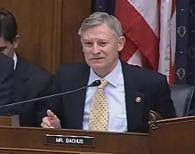
    Rep. Spencer Bachus (R-AL)The day began on a sour note with UIGEA proponent and self-appointed savior of humankind Spencer Bachus (R-AL) again sharing his view that “illegal internet gambling ruins lives and tears families apart.” As he did at the June 2007 hearing, he trotted out that highly misleading University of Connecticut study to suggest that “74% of those who have used the internet to gamble have become addicted to gambling, and many of these gambling addicts have turned to crime to support their habit.” (He also couldn’t resist bringing up Rev. Greg Hogan’s son yet again.) I explained at length back then how that study -- which Bachus calls “recent” even though it was conducted in 2002 -- doesn’t come close to proving what Bachus is claiming. Bachus once again established himself as an incredibly hard-headed and ill-informed participant in the discussion. Unfortunately, he’s the ranking member of the House Financial Services Committee and therefore gets to talk a lot at these things.
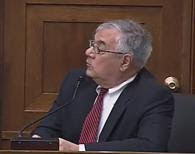
    Rep. Barney Frank (D-MA)Barney Frank (D-MA) then came on and clarified that while such moral righteousness was certainly a big part of why the UIGEA was passed in the first place, the topic of today’s hearing was the problem of enforcement. “Even those that agree with [the law],” said Frank, “ought to say ‘you know what, let’s find a different way to enforce it.’”

    A few more committee members added their two cents. Jeb Hensarling (R-TX) pointed out how he’d once been a small businessman himself, and thus knew how “[small] businesses tend to get risk averse.” His point was that when faced with uncertainty about how to proceed with the UIGEA, banks are very likely going to “overblock” all suspect transactions, even those that are clearly not restricted. Maxine Waters (D-CA) came on to say that while she had voted for the original House bill back in the summer of ’06 (H.R. 4411) -- and, of course, the Safe Port Act that included the UIGEA -- she was now thinking she’d vote differently if given another opportunity. Peter King (R-NY), one of the co-sponsors of Frank’s IGREA (H.R. 2046), added that he’d prefer “unlawful internet gambling” be restricted to sports gambling only so as to remove potential ambiguities.

    Panel 1 -- The Regulators

    Two witnesses representing the authors of the proposed UIGEA regulations then testified. First to speak was Louise Roseman of the Board of Governors of the Federal Reserve System. Then Valerie Abend of the Department of Treasury gave her statement. The Poker Players Alliance has posted both of their statements (Roseman & Abend).

    In a nutshell, both primarily communicated how difficult a task the regulators face in trying to hammer out any sort of concrete, non-ambiguous guidelines for financial transaction providers. They both referred to the 200-plus comments that had been made on the proposed regulations, and both essentially responded here by saying “we’re trying” and “we’re still working on it.” Then the questioning began.

    Rep. Gutierrez started off asking the witnesses about what the regulations mean when they refer to the moment when a financial institution “becomes aware” of a restricted transaction. Neither could really clarify the ambiguity of the phrase. “It is something we are looking at,” said Roseman. “We’ve not come to a final determination” regarding the extent of the banks’ obligation to monitor their clients, said Abend.

    Indeed, much of the question/answer period was taken up with Congressmen asking in various ways for clarity, and the regulators responding that the UIGEA doesn’t really give them enough guidance to produce that desired clarity.

    For example, Frank asked a series of questions about betting on horse racing, a form of gambling that is nominally excluded from the UIGEA even though such bets are not allowed in certain states. “Under your regulations as proposed -- they may be amended -- [if] I am a financial institution, do I or do I not process that payment [of one of my clients] for a bet on a horse?”

    Louise L. Roseman, Director, Division of Reserve Bank Operations and Payment Systems, Board of Governors of the Federal Reserve SystemRoseman took a shot at answering Frank’s question. (Indeed, she took the lead and answered most of the questions during this first panel.) “I would assume that most institutions would not process . . . ” she began. “No, no, no!” interrupted Frank. “I’m not asking you to ‘assume’ what they would do. You’re the regulator!” Roseman again said they’d have to look into such a question further. Frank wryly replied that, in effect, this law designed to prevent online gambling required banks to “gamble” (in a sense) when trying to decide what exactly they are being asked to do.

    Kenny Marchant (R-TX) asked if the finalized regulations would provide a clear definition of “unlawful internet gambling.” “I can’t say at this point what’s going to be in the final law,” Roseman replied. “The challenge we have is interpreting something -- particularly [with regard to existing] federal laws [about gambling] -- that Congress itself isn’t sure what they mean . . . . That is something that we are really struggling with at the moment.”

    Marchant then brought up what I thought was an interesting -- and revealing -- example of the problems banks would face. What could the banks do, he asked, if someone placed an illegal wager at an online site that identified itself not as a gambling business, but, say, as “Joe’s T-Shirt Shop”? “In that case, payment system participants would have no way of knowing that the transaction actually related to unlawful internet gambling and would likely process the transaction,” answered Roseman.

    Later Rep. King would bring back up his suggestion that only sports gambling be identified as illegal, but even there the banks could have the same problem identifying a transaction if the business wasn’t immediately recognizable as a gambling site. Replied King, “if even with something which everyone agrees is illegal, and everyone agrees should be controlled . . . if that can’t be [effectively prohibited], doesn’t that just show almost the impossibility of coming up with regulations that would cover an area which no one has been able to fully define?” Roseman said she could not disagree.

    A couple of other highlights during this first panel.

    Rep. Bachus tried to challenge the witnesses’ assertion that they “can’t assemble a list of bad actors” or illegal gambling operations. Recall that neither the UIGEA nor the proposed regulations purport to do this work, and instead leave it to the financial institutions to make such determinations. According to Bachus, the feds have been able to make such distinctions in other contexts and make lists of outlawed entities -- e.g., the Banks Secrecy Act, or the Specially Designated Nationals List (produced by the Office of Foreign Assets Control). If the feds could produce those lists, said Bachus, he was “mystified” why they couldn’t here.

    Roseman replied that “the one thing that really distinguishes a list here from the OFAC list is that the OFAC list talks about particular entities that you shouldn’t have transactions with . . . but in this case, [what is being targeted] is [a] restricted activity, not restricted parties. So even gambling operations would have a combination of payment transactions that would be restricted under this law and others that would not be.” Bachus disagreed. “Can’t you block ’em [altogether]?” he asked. In other words, if the party tried to make a single restricted transaction, couldn’t they be put on a list and forbidden to make all transactions? Roseman tried again to explain to Bachus that the law doesn’t work that way, but he wasn’t hearing her.

    Also, Robert Wexler (D-FL) chimed in to talk about skill-based games and try to make a distinction between, say, poker and other forms of gambling that do not involve skill. (You’ll recall Wexler is the one who last year proposed the “Skill Game Protection Act,” H.R. 2610.) A little off-topic, really, as the point of this hearing was primarily to address the regulations and problems of enforcement, and not specifically to entertain alternate legislation like Wexler’s bill. Still, it was interesting to hear Roseman respond that “we did get a lot of comments from poker players that made exactly that argument,” namely, that as a game of skill poker shouldn’t be covered by the UIGEA. However, as Roseman explained, “in the Act’s definition of what is a bet or wager, it does say that that includes ‘a game subject to chance.’ So there are a number of games like poker that involve a great deal of skill, but probably are also subject to chance . . . . It doesn’t say ‘having a predominant element of chance.’ It is just ‘subject to chance.’”

    That’s a point I’ve made repeatedly here on the blog, the first time way back in October 2006, a few days after Bush signed the thing into law. The fact is, as interesting as the skill-vs.-luck-in-poker debate can be, it has zero practical meaning in the context of the UIGEA in its present form.

    Gutierrez concluded the first panel by remarking that the regulators had “one hell of a complicated job” on their hands.

    Panel 2 - The Financial Institutions

    The second, shorter panel featured four witnesses, each of whom represented different areas of the American payments system. Harriet May spoke first on behalf of the Credit Union National Association. May stated that CUNA believed “compliance under the Act . . . [was] difficult, if not impossible for financial institutions,” and that the UIGEA simply could not be implemented “without creating a list similar to what OFAC publishes” (i.e., the Specially Designated Nationals List). She also voiced concern about the date of implementation, stating that financial institutions would need “at least 18 months if not longer to try to figure out what to do and conform to the new requirements.” Her full testimony can be read here.

    Wayne Abernathy, Executive Vice President, American Bankers AssociationShe was followed by Wayne Abernathy, the Executive Vice President of the American Bankers Association. His remarks weren’t much different from what the ABA said in their comments on the proposed regulations. He complained that the UIGEA unfairly “makes financial institutions the police, prosecutors, and judges in place of real law enforcement officers when it comes to the practice of [regulating] unlawful internet gambling.” He called the Act “an unprecedented delegation of governmental responsibility, with no prospect of practical success,” and predicted the burdens would threaten to compromise the efficiency of the entire payments system. Here is his full testimony.

    The last two witnesses were Leigh Williams, a representative of BITS (not an acronym) and the Financial Services Roundtable, and Ted Teruo Kitada of Wells Fargo. Both also highlighted the impracticality of the Act’s implementation. Williams called it a “policing activity” than may have reached “a point of diminishing returns,” while Kitada spoke of the imprecise definition of unlawful internet gambling and worried about the possible consequences to existing customers. Like May, Kitada also expressed grave concerns about the UIGEA’s implementation date. Their testimonies have also been posted (Williams & Kitada).

    The Q & A for this panel was less extensive, as many of the points they made had already been addressed previously. Also, the questioners were uniformly in agreement with their arguments, thus making the discussion a series of affirmations of the overall argument about the UIGEA’s lack of feasibility. Rep. Ron Paul (R-TX) specifically asked about the potential costs to banks in order to follow the UIGEA’s instructions, as well as the potential encumbrance of record-collecting and the monitoring of information. Abernathy agreed that the Act was unreasonably burdensome in both respects. Williams added that “regulatory uncertainty ironically [was] making it very difficult for us to estimate what the ultimate cost would be.”

    Gutierrez finally closed the hearing, pointing out that while he didn’t necessarily agree with Paul and Frank’s position on gambling, generally speaking, he certainly recognized the many problems with enforcement that had been highlighted during the previous couple of hours. Pointing out that he sometimes couldn’t determine the source of a charge on his own credit bill, he sympathized with the banks’ burden of making such determinations on a case-by-case basis, and agreed with most of those present that financial institutions shouldn’t be tasked with “sheriffing” in order to block restricted transactions.

    Conclusion

    Ultimately, the hearing appeared to prove quite decisively that the various burdens caused by the UIGEA greatly outweighed whatever potential benefits its authors and backers had once perceived it to provide. In fact, I wouldn’t necessarily characterize the hearing as a “vigorous debate” at all. Any rational observer -- regardless of his or her feelings about online gambling -- would simply have to recognize how destructive the UIGEA’s implementation would ultimately prove to be.

    The complaints of the financial institutions should carry some influence, I would think. Most promising to me, though, were the reservations expressed by the very authors of the regulations at today’s hearing. While it is possible they may go ahead and produce some sort of ambiguous, highly detrimental, finalized version of the law on schedule, my impression coming away from the hearing was that they may find themselves caught in an extended rethink for some time to come.

    Labels: , ,

    Harboring Hope for House Hearing

    HopeThere is a hearing scheduled this morning in the House regarding the Unlawful Internet Gambling Enforcement Act of 2006. I wasn’t all that enthused the last couple of times the UIGEA was discussed on Capitol Hill. Today’s hearing, however, strikes me as potentially more promising in terms of its practical effects.

    Back in November, there was a hearing before the House Judiciary Committee to discuss online gambling. That’s the one where Annie Duke testified. This hearing took place during the commenting period for the proposed UIGEA regulations, and in effect that’s all the hearing really amounted to -- i.e., a collection of comments on those regs that had been presented by the Board of Governors of the Federal Reserve System and Department of Treasury back in October. There was some positive vibe in the poker world following the hearing, but it didn’t really appear to stop or slow the wheels of the UIGEA machine as it courses toward implementation.

    Earlier, last June, was another hearing, this one before the House Financial Services Committee, which ostensibly addressed the question “Can Internet Gambling Be Effectively Regulated to Protect Consumers and the Payments System?” I wrote about this one at length in a post titled “A Hearing Impaired.” My title stemmed from my impression that what we had there were a number of folks talking past one another, with those who wanted to see the UIGEA finalized and implemented as soon as possible repeatedly demonstrating an inability (or refusal) to hear what those who opposed the law were saying.

    Today’s hearing is being held by the Subcommittee on Domestic and International Monetary Policy, Trade, and Technology, and it comes at a potentially pivotal moment in the UIGEA’s brief, frustrating history.

    Since the commenting period closed, we’ve heard from two Republican senators -- neither of whom is particularly interested in legalizing online gambling -- who both strongly oppose the UIGEA and the feds’ proposed regs. In a letter to the the Secretary of the U.S. Dept. of the Treasury and the Chairman of the Board of Governors of the Federal Reserve System, the senators argued “the proposed rules would inordinately burden every bank, credit union, credit card company, money transmitting business and payment system in the country, leading to non-uniform compliance and confusion.”

    That letter was sent back in February. Then in mid-March we began hearing some details about the comments, including the strong objections to the UIGEA levied by the American Banking Association. According to the ABA, “the UIGEA will in the end catch more banks in a compliance trap and do greater damage to the competitiveness of the American payments system, than it will stop gambling enterprises from profiting on illegal wagering.”

    The title of today’s hearing gives an good indication of where the discussion stands at the present moment: “Proposed UIGEA Regulations: Burden without Benefit?” The hosting entity -- the Subcommittee on Domestic and International Monetary Policy, Trade, and Technology -- is a subcommittee of the House Financial Services Committee, and the House Banking Committee (chaired by Barney Frank, D-MA), a committee which does, theoretically, have some influence over how the Federal Reserve & the Treasury conducts its business. All of which means today’s hearing might well have some effect on exactly how -- or even whether -- the regulations get finalized and the UIGEA finally implemented.

    There are a number of presenters lined up for today’s hearing, representing a variety of different interests and opinions on the matter. Thing gets cranked up about a half-hour from now.

    I know yr probably busy cleaning up after all the April Fool’s Day pranks, so I’m gonna go ahead follow the sucker for you and try to report back here either this afternoon or tomorrow.

    That’s my hope, anyway. The success of my plan depends heavily on how strong this here cup of java is. Better go brew me up some more.

    Labels: , ,

    Tuesday, April 01, 2008

    The Hard-Boiled Poker Radio Show, Episode 1: Dead Man’s Deal

    Okay, here it is. The debut episode now is available for download. This first one starts with a bit of an explanation, which I’ll summarize here.

    First off, the main idea for the HBPRS was to share some old time radio shows which prominently involve poker and/or gambling. I’ve collected a number of them, many of which are quite good. There are mysteries, adventure stories, westerns, and some comedies, too. Each episode will present one of those shows in its entirety, along with some background and context presented by yr humble gumshoe. The show featured in this first episode is from a series called Inner Sanctum Mysteries that was very popular during the 40s and early 50s. The show is called “Dead Man’s Deal” and first aired August 28, 1945.

    Each episode will also include some short subjects that lead up to the old radio show. For this first episode, Tim Peters (CardPlayer, “The Literature of Poker”) leads things off with a reflection on Al Alvarez’s The Biggest Game in Town. Then comes a song, “The Darktown Poker Club” by Bert Williams (from 1914). Then Rakewell, the Poker Grump (a.k.a. Bob Woolley) shares one of his “Tales from the Tables.” Finally, taking up the last half of the show, comes “Dead Man’s Deal.”

    A complete rundown of show notes appears over on the show’s blog. With each episode, I’ll be putting up a post over there with summaries and links. You can listen to the first episode by clicking here. You can also right-click the link, then choose “Save As” and download the file.

    I’ve also set up an RSS feed for the show which you can enter into yr podcast-receiver type programs and start getting the shows directly. That address is http://feeds.feedburner.com/hardboiledpokerradioshow. I don’t use iTunes myself, so I’m not completely up on how things work over there. I know that if you use other programs the feed works and the shows will start appearing as they should.

    As I mention on the podcast, I’m not gonna attempt a weekly show. More likely I’ll aim to produce one episode per month. If you do check out the show, please send along any feedback either by commenting over on the radio show blog or sending me an email at shamus at hardboiledpoker dot com. Would love to hear yr thoughts & suggestions.

    Labels: ,

    Newer Posts
    Older Posts

    Copyright © 2006-2021 Hard-Boiled Poker.
    All Rights Reserved.