Thursday, February 12, 2015

Mixing It Up

Just finished making Asian-Spiced Broccoli Tacos with Asian slaw and Sriracha mayo for dinner. There’s a picture of a couple of them at left before they were swiftly devoured.

Vera gave me a subscription to a site that sends menus each week, and so I’ve been mixing things up quite a bit when it comes to the meals I’ve been making. This dish was easier to prepare than you’d think, and something I’d never have thought to have fixed without the prompting. A lot of it just involved putting ingredients together in separate bowls and then... well... mixing them up.

Speaking of mixing it up, I wanted to point to a couple of articles over in PokerNews’ strategy section this week that talk about something other than no-limit hold’em.

The first is an interview from a couple of days ago I did with Ken Lo, author of The Poker Player’s Guide to Mixed Games, in which I asked him for his thoughts about the 2015 WSOP schedule -- specifically the non-NLHE offerings -- as well as for a bit of strategy advice.

Ken made some good points about the schedule and offered some worthwhile tips as well for players new to some of these games. Check it out: “The Schedule and Strategy: A Look at Mixed Games at the 2015 WSOP.”

Then today Neil Gibson shared a strategy article in which he passed along terse tips about five different non-NLHE games -- the kind of shorthand advice someone might tell a friend about to play a game he or she had never tried before. See “Tips You Can Text: Abbreviated Advice for Five Non-Hold’em Games.”

I remain a huge fan of non-hold’em variants. Sort of like appreciating other non-standard fare when preparing meals. Speaking of, I think I might have enough broccoli, slaw, and Sriracha mayo left for one more taco.

Labels: , , , , ,

Saturday, June 29, 2013

2013 WSOP, Day 31: Mixed Games, Vegetables

Back on the beat yesterday with Event No. 50, the $2,500 10-Game Mix. And yes, I did report some Badugi hands.

They’re down to 20 now from a starting field of 372, and last year’s 12th-place finisher in the WSOP Main Event Scott Abrams leads everyone at the moment. In addition to Abrams, Robert Williamson III returns to a healthy stack, while Greg Raymer, Bruno Fitoussi, and Konstantin Puchkov are among those on the short side who’ll need to gather some chips early.

The tourney was fun to follow, although frequently challenging. Tables all start with the same game but then change games every orbit, meaning it doesn’t take long for all to get out of sync and be playing different games as you move from one to the next. Thus is it necessary when sidling up to a table first to get a peek at the stack of black, rectangular placards indicating the different games and see which was on top, then follow the action from there.

At times one could tell players and dealers were having to slow down and remind each other what the games and stakes were. There were frequent references to laminated copies of the complicated structure sheet throughout the day and night. Comments were made about certain games being mostly foreign to some (especially Badugi). I’m sure there were errors made here and there as well, although we couldn’t always pick up on those.

Scotty Nguyen busted in 21st late last night in a stud hand, for instance, and I actually think from something he said on seventh street after looking up at the placard that he might have possibly thought the game was stud/8. Perhaps he did not, though, as I’m convinced with Nguyen almost anything is possible, baby, including feinting what might appear to be the making of such a slip.

That said, I do think it’s true that even the best players can occasionally get a little mixed up by the 10-game mix.

Of the 10 games, four are flop games (NLHE, LHE, PLO, O/8), three are stud games (razz, stud, stud/8), and three are draw games (2-7 NL single draw, 2-7 fixed limit triple draw, and Badugi).

As an observer, if you don’t get a glimpse of the placard right away it’s easy to be confused by what you’re watching as a hand play out, even though the larger categorical distinctions (flop, stud, draw) are stark enough. But it can still be challenging, say, to note all of the cards coming out in a stud/8 hand and the sequence in which they appear plus catch all the bets and everything else, especially if you start out with any uncertainty about which stud game is being played.

I found myself thinking a lot about the draw games, and how from the standpoint of an observer they appear a much more abstract form of poker insofar as it is only the drawing and betting that signifies and no community cards or upcards. We know nothing of the hands, and so the decisions made regarding bets and draws come to represent the terms of conflict between players, providing evidence of certain hand strengths but no actual cards onto which the viewer can fix.

From the players’ view, the draw games aren’t as abstract as they do have cards to look at in their hand and thus knowledge about what cards their opponents cannot have. I think on some level there exists a great deal of overlap between the 10 games for the players as far as making hands and the application of tournament strategy is concerned.

Was a long day and I enjoyed getting a chance to work with Josh before he leaves in a few days to start production on his film, Multiplex.

The day was pleasantly interrupted by an hour-long dinner with Vera for which we ordered some All American Dave for dinner, which was definitely as good as advertised by all of the players, staff, and media who’ve been championing it. I had the Dijon Almond Chicken while Vera got the Mango Wasabi Glazed Tuna, and there was a nice mix of vegetables to go along with our dishes including broccoli, asparagus, sweet potatoes, bell peppers, plus avocado slices and brown rice. Delicious.

The convenience of ordering -- they’ll bring the food right to the table, or you can walk out the back of the Rio and pick it up -- makes it a great option for players. It seems wrong, actually, that a healthy alternative such as this should be such a unique thing, but in any case it’s nice to have a not-so-difficult way to get a few veggies while working 14-15 hour days like this.

Vera and I got to pack a lot into the days she was here, and I was grateful for having a little time off to enjoy with her. Just took her back to the airport this morning, and so will be riding out these last couple of weeks solo. Hard to believe the Main Event is already right around the corner, starting a week from today (!).

Meanwhile, if you’re curious to see how the 10-game mix plays out and whether any more Badugi hands get reported, check the live reporting today on the PokerNews blog.

Labels: , , , ,

Monday, September 10, 2012

Defining Poker

Defining PokerHad fun again last night playing Hard-Boiled Poker Home Games on PokerStars while watching the opening weekend of NFL football. We’re still pushing through “Season 1” of the HBP HG, playing two tourneys each Sunday night until the end of September. By the end there will have been 20 events in this season, then at the beginning of October I’ll begin a “Season 2” that will play through the end of December.

As I’ve mentioned here before, players in each of the events can accumulate points for finishing in the top third of the field, and the one earning the most points for the season is going to win a copy of Poker: Bets, Bluffs and Bad Beats by Al Alvarez. I’m looking into lining up a few extra prizes for Season 2, so that one won’t be a winner-take-all.

I’ve been trying to schedule various games besides no-limit hold’em to keep things interesting. Last night we played pot-limit hold’em (Event No. 13) and what PokerStars calls “Triple Stud” (Event No. 14), the latter rotating between the three stud games in H.O.R.S.E. -- that is, stud (high only), stud hi/lo, and razz.

One of the ongoing challenges when playing Triple Stud was simply to remember which game was being played. The levels only lasted three minutes, which meant the games were switching frequently, and I think just about every one of us at least once started a hand thinking it was one stud variant when in fact it was a different one. Keeping track of the games is part of the challenge of any mixed game format, but I think the test might be slightly more taxing when all of the games are stud and thus superficially appear similar.

Kind of got me thinking a little about how “poker” covers so many different kinds of games. Or, to put it another way, how flexible that word “poker” really is in terms of what it could be said to define.

Heck, when I create Home Games, PokerStars let’s me choose from 17 different poker variants, with a number of those allowing for different betting formats (e.g., no-limit, pot-limit, fixed-limit). And of course there are options for full ring, short-handed, heads-up, different level durations, different starting stacks, and so forth. We couldn’t get through all of different poker games if we played a 100-event series.

Many say there are certain elements that are absolutely essential for a game to be called “poker.” I’ve heard and read a number of attempts at pinning those elements down, with most usually declaring that in order for a game to qualify as “poker,” it must involve cards, money, and bluffing.

Think about it, though... what a huge range of possibility exists for games that include those three criteria. And I’m not even completely sure those three elements are absolutely essential or cannot be modified significantly without carrying the game outside of the boundaries of what we can still call “poker.”

It’s like “literature” or “the novel” or other ambiguous categories or genres, really. One could even argue that as long as participants can agree on rules and that the game is still going to be called “poker,” then it’s poker.

How do you define poker? What elements would you say are utterly essential for a game to be called poker?

Labels: , , ,

Friday, July 23, 2010

Competence and Poker

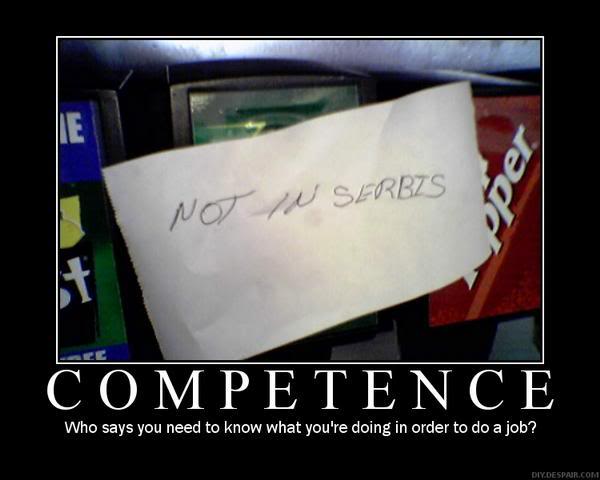
Not in SerbisHave returned to the online tables this week, probably playing more hands in the last few days than I did for the previous eight weeks combined.

This sort of routine has happened each summer I’ve been away at the World Series of Poker. During the Series I get the chance to play live here and there, but unsurprisingly will have little time or inclination to fire up the online games. Then once I return home, I find I am excited to play once again. And even a little bit inspired to learn and improve, too.

This week I’ve been flitting about between various games, including jumping into tourneys, too. While in Vegas I had the chance to play mixed games on a few occasions, and so I have been gravitating towards the 8-game mix on Stars. Have also put in hands of pot-limit Omaha, razz, and limit hold’em.

The 8-game mix in particular -- where one rotates between limit hold’em, Omaha/8, razz, stud, stud/8, no-limit hold’em, pot-limit Omaha, and 2-7 triple draw -- has gotten me thinking about this idea of “competence” in poker, perhaps because occasionally there one will not too infrequently run into players who appear to lack basic fundamental knowledge of a given game.

It’ll happen in other games, too, of course. Sit down at a low limit razz game and often somebody will be there wanting to play every hand with face cards showing. The presence of those without what seems basic “competence” does tend to highlight the whole idea of one’s own knowledge of rules and basic strategy of a given game. And maybe make one feel somehow special for knowing something someone else does not.

Before I got too carried away congratulating myself for my own competence -- e.g., knowing I wanted to see a deuce among my starting five cards before getting too involved in a 2-7 triple draw hand -- I started to think further about how “competence” is surely needed in poker, though probably shouldn’t be a goal in and of itself.

Back in the 1980s, a fellow named William Howell wrote a book called The Empathic Communicator in which he described the “four levels of competence” in a way that has been much-referred to ever since. In fact, Howell’s idea built on theories of learning established by others some time before, but his little scheme became kind of popular in the 1990s as a way of talking about teaching and how people learn.

Basically Howell just highlighted how people can have or lack competence and how people can possess differing levels of awareness of having or lacking competence. From there come the four levels of competence:

There’s “unconscious incompetence” in which a person doesn’t know how to do something, nor is that person even aware he or she lacks such knowledge. Kind of like those seemingly “Level Zero” thinkers one sometimes runs into at the poker tables (especially at the lower limits).

There’s “conscious incompetence” where one doesn’t know how to do something but realizes one lacks such knowledge. I know if there is something wrong with the motor of my car I cannot fix it myself, so I take it to the shop.

Then there’s “conscious competence” in which a person knows how to do something, but it requires special effort or concentration to show such knowledge. I sometimes think when I play certain games like 2-7 triple draw or razz or really anything besides hold’em, I am “consciously competent” at best.

Finally there’s “unconscious competence” which is probably best thought of as a “second nature”-kind of knowledge. You’ve done it so much that knowing how to do what you are doing comes without thinking. In poker, this would be the case for the player who has played so many hands of a given game that knowing what to do often -- if not always -- comes “naturally.”

By the way, some have talked about a fifth level of competence -- where one is conscious of being unconsciously competent and thus can perform while also being aware enough to explain what one is doing. Such is the level at which the best teachers would seem to operate.

I suppose when it comes to poker we all begin at that first level of “unconscious incompetence” and then (hopefully) move upwards as we play more and gather experience. I worry, though, that with most games I’ve settled for “conscious competence” -- a stage where I am basically having to remind myself again and again certain basic things about starting hand selection, the importance of position, odds and probabilities, and so forth.

Is it a right to remain ignorant? I don't know, but I refuse to find out.In fact, the more I think about it, I have to admit that with some games situations arise when I realize I might not even possess total competence -- in fact, I surely don’t -- which means at that moment I’m consciously incompetent.

And that I must have been unconsciously incompetent before having that little epiphany!

Boy, was I happy then.

Labels: , , ,


Older Posts

Copyright © 2006-2021 Hard-Boiled Poker.
All Rights Reserved.