Thursday, May 02, 2013

Best-of-Seven Series and Hold’em Hands

I am back to being more distracted by sports than by poker at the moment, with the NBA playoffs having earned a lot of my attention most evenings. Things are finally getting interesting there as many of these best-of-seven first round matchups have moved into the more exciting latter stages (e.g., games five, six, and perhaps some sevens to come).

I’m not an NHL fan, but I’m aware their playoffs have begun as well with the 16 teams making it to the hockey postseason similarly engaged in best-of-seven matchups as they start the lengthy process of determining a champion.

Was thinking today how the shifting dynamic of a best-of-seven tournament can resemble a Texas hold’em hand.

The first two games of a series -- both played at the higher-seeded team’s arena -- are a bit like preflop play. Having home court/ice could be said to be like playing from late position, where you are going to be able to operate a little more freely than otherwise and where expectations of winning are greater.

Then when a series reaches Game 3, that’s a bit like what happens after the flop. The first three community cards further define how players can proceed in a hand, much as the results of the first two games in a series can have influence on how teams perform going forward.

Game 4 continues in the same vein, sometimes ending with a sweep (like a bet-and-fold winning the hand right there), a team moving ahead 3-1 (assuming a position of strength going forward), or the series getting knotted 2-2 (as though flop betting -- or checking -- failed to establish one player as having the “lead” or appearing at an advantage to win the hand).

Game 5 is then very much like the turn. In both the playoffs and in poker, it’s the “pivotal” game or street. Again the series (or hand) can be over right here, but if it doesn’t, the team who wins Game 5 -- just like the player who plays the turn most effectively -- is often now in good position to end as winner.

I’d finish the analogy by referring to both Games 6 and 7 as the “river.” I’m more familiar with the NBA, where relatively few series actually get all of the way to Game 7. But however you look at it, both of those games are like the “endgame” portion of a poker hand where final, decisive moves are being made.

And I suppose when those series do get to a game 7, weird, unexpected things sometimes happen as well, much like a surprising river card that gives an underdog the win.

I’d explore all of this more thoroughly, but I think before watching tonight’s games I need instead to watch “The Adventures of Christopher Bosh in the Multiverse” again, starring Miami Heat forward and superhero from Zorg-nok Chris Bosh.

Labels: , , , ,

Wednesday, August 31, 2011

Life Magazine Tells of “‘Hold Me’: a wild new poker game” in 1968

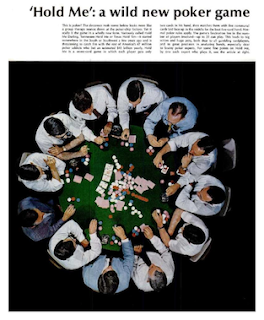
Life Magazine, Aug. 16, 1968When one looks at the relatively short history of Texas hold’em, the publication of the August 16, 1968 issue of Life magazine represents a fairly significant moment.

Just so happens then-presidential candidate Richard Nixon, considered by many to have been the most skilled poker player among all the U.S. presidents, was on the cover that week along with his wife, Pat, and Spiro and Judy Agnew. There is nothing about Nixon’s poker playing in the issue, though, as that part of his biography -- including how he’d actually funded his first Congressional campaign in 1946 with poker winnings earned while in the Navy during WWII -- was hardly being highlighted as part of his story.

Rather, it’s a short article within by A.D. Livingston titled “ ‘Hold Me’: a wild new poker game and how to tame it” that marks an important moment in hold’em’s history.

“This is poker?” begins the introduction to Livingston’s piece, referring incredulously to a nearby photo (see below). “The decorous mob scene below looks more like a group therapy seance down at the poker-chip factory. Yet it really is the game in a wholly new form.”

As will Livingston, the intro refers to the game by several names, including “Hold Me Darling,” “Tennessee Hold Me,” and “Texas Hold ‘Em.” Livingston’s piece is interesting because it speaks of the game as a relatively new phenomenon, addressing Life’s mainstream audience as mostly consisting of readers who have never heard of hold’em.

“I believe the game is a major event in the history of poker,” asserts Livingston, “and I predict it will replace stud for the rest of the century.”

'Hold Me,' a wild new poker game...Livingston’s piece begins with him describing a hand he played while trying to learn the game. Preflop betting caused him to become timid and fold AdKd to a professional player’s pocket queens. He admits he didn’t know the odds at the time, and a later session of trying to work them out at home leads him to conclude “it was really a mathematical toss-up.”

Livingston had to do such work himself because none of his poker books included any mention of the game.

“None of my books covered Hold Me or any game like it,” he says. “Nowhere could I find figures on the odds.”

The rest of his short piece spends some time speculating about why hold’em (in his view) is about to take over as the most popular poker variant -- more action (than stud or draw) is the big reason -- then concludes with a discussion of another hand involving the pro to whom he’d folded before.

In that hand, a huge three-way pot develops in which the pro somehow manages to fold pocket sevens on the river with the board showing 4-6-7-6-5, having correctly surmised one of his opponents had quad sixes. The analysis is a little specious, but we’re told the pro was able to use both his positional advantage and a knowledge of his opponent to surmise he was beaten. Meanwhile, the third player -- whom Livingston calls a “monkey” -- calls off his stack with a straight.

The piece ends with Livingston describing how he’d contacted a friend in Colorado to see if he had heard of this new game called “Hold Me Darling.” “‘Never heard of it,’” his friend says, adding “‘but a new game has really caught on. High Hold ’Em. Each player gets two cards down....’”

It’s the same game, it turns out, being played with a different name.

I take Livingston’s piece -- which is available online, if you're curious -- as strong evidence that hold’em’s history really only begins around the 1950s or thereabouts, not earlier in the century as some have claimed. I brought this matter up back in the spring in a post titled “Hold’em’s History Makes a Good Mystery.”

While the game was certainly around for some time prior to 1968, it’s having different names in different places suggests that while it was gaining in popularity, the game was -- as Livingston seems to assume -- still quite new to most. Its absence from poker books (most of which would have been books of rules, not strategy texts) also suggests a later start date -- say mid-century -- for hold’em.

All of which makes me appreciate even more Livingston’s prediction that hold’em was going to become the game of the late 20th century.

Nice call, sir!

Labels: , , , ,


Older Posts

Copyright © 2006-2021 Hard-Boiled Poker.
All Rights Reserved.