Saturday, July 01, 2006

Declarations of Independence

Edge of Outside, airing on Turner Classic Movies July 5 and July 19Awhile back I wrote a post in which I discussed my favorite Jim Thompson novel, Pop. 1280, and mentioned how several of Thompson’s novels have been made into films, including Sam Peckinpah’s terrific 1972 adaptation of The Getaway. Sometime after I made that post I received an email from someone asking me if I'd be interested in previewing an upcoming documentary on Turner Classic Movies focusing on independent filmmakers (like Peckinpah), called Edge of Outside. They’d send me a “screener” -- an advance copy of the program -- that I could watch and then write about on the blog.

Like someone who’s led the betting throughout the hand only to be check-raised on the river, I took a moment to weigh my decision. This is (primarily, anyway) a poker blog . . . how might Edge of Outside relate to poker, I wondered? Andy Bellin, author of Poker Nation (a decent little page-turner full of anecdotes from the life of a twentysomething poker player), recently posted a complaint on his blog (The Poker Chronicles) about all of the requests he receives to post press releases. Most of this “poker spam” concerns advertising newly-created poker sites, though . . . apparently nothing as interesting as a documentary about independent film. What to do, what to do . . . ?

As a limit player who has learned you can't get very far always folding on the river, I decided to make the call. As it turned out, I made the right decision.

Edge of Outside is an hour-long compilation of interviews with actors, directors, cinematographers, and others associated with the making of independent films. A few directors -- Samuel Fuller, Nicholas Ray, Orson Welles, Sam Peckinpah, Stanley Kubrick, John Cassavetes, David Lynch, Spike Lee, Quentin Tarantino -- are given special attention as principal players, although the show also gives one a pretty good sense of how independent film fits into the overall history of cinema. The point is made that early giants of cinema like D.W. Griffith and Charlie Chaplin were essentially “independent” insofar as they worked outside of the burgeoning studio system. Even directors like Frank Capra and Alfred Hitchcock are argued to be representatives of the independent, no-compromising spirit. The viewer also learns how other movements such as Italian Neorealism and the French New Wave influenced American independent film. All in all an entertaining and informative hour that should prove interesting to just about any moviegoer.

What might a poker player get out of Edge of Outside? I can think of a couple of things.

For one, the show does a great job characterizing the independent filmmaker -- that is, using many examples, the show ultimately provides a kind of anthology of qualities that just about every true independent possesses. Interestingly, many of the adjectives and phrases used by interviewees to describe the best independent filmmakers are also often used to describe the best poker players. They all possess seemingly unlimited self-confidence. They have a lot of “hutzpah.” They always act according to the force of their own convictions. They are inventive, creative, driven. They are mavericks. Both are great at telling “stories” that audiences can relate to and/or find believable. Like a great poker player, the independent filmmaker absorbs lessons learned from others (from earlier generations and from contemporaries) and forges his or her own peculiar, successful style.

The other subject that comes up in Edge of Outside that might intrigue poker players is, of course, money. Coming up with enough scratch to make the film is a constant theme for these artists. Many treat money as utterly unimportant, insisting that they aren’t making their films to get rich, but to realize their own artistic visions. On the surface, this disdain for money might make the independent filmmaker seem utterly alien to poker players. There might be other things that attract us to poker, but just about all of us are also “in it for the money.” One often hears, however, how the top players are able to forget about the concrete reality of what the chips they’re pushing back and forth represent, instead concentrating wholly on the game and making correct decisions. You can’t be blood simple and recklessly discount the value of the chips altogether, advise the pros, but neither can you worry too much that a particular bet on a particular hand is equivalent to a house payment or new car or the gas bill or whatever. While we are all ostensibly trying to make money playing poker, I think we all can agree (even us short-stacked saps) that worrying about how much we’re putting into a given hand creates unneeded interference when trying to think clearly at the table.

I can certainly recommend Edge of Outside. The show premieres this Wednesday, July 5 (don't know if TCM intended a reference to Independence Day here or not, but it would make sense if they did) and will be rebroadcast on July 19. I also recommend several of the films being shown on Wednesdays throughout July on TCM as part of their “month-long tribute to filmmakers who have worked on the edges of Hollywood.” If you haven’t seen ’em, I can vouch for Cassavetes’ A Woman Under the Influence (with Gena Rowlands and Peter Falk, both of whom are amazing here), Welles’s Othello, Arthur Penn’s Bonnie and Clyde, Francis Ford Coppola’s The Conversation, Robert Altman’s Nashville, and Martin Scorcese’s Raging Bull. Also catch Stanley Kubrick’s early triumph, Killer’s Kiss (airing the night of July 19), a genuinely suspenseful, noirish film that can certainly be described as “hard-boiled.”

Well, that was fun. Have to say I feel all right about the way I played that one. Nice hand, TCM.

Image: Edge of Outside (dir. Shannon Davis, 2006).

Labels: , , , , ,

Friday, May 26, 2006

Killer Poker, or Knowing What Counts

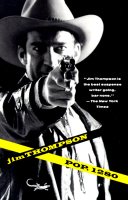
Pop. 1280 by Jim ThompsonFrom 1942 until the early ’70s, Jim Thompson wrote about thirty novels of the “hard-boiled” variety, all crime stories involving nefarious, morally-bankrupt characters engaged in a wide range of vice and mayhem.

Some sold reasonably well, but with a few exceptions nearly all were dismissed by critics as disposable “pulp.” None of his novels were in print at the time of his death in 1977. However, his stature (and critical reputation) soon grew when Vintage Crime/Black Lizard began reissuing several of his novels in the late ’80s.

Furthering his posthumous fame were film adaptations of several of his novels, including The Getaway (the 1972 version by Sam Peckinpah with Steve McQueen; skip the 1994 one), The Killer Inside Me (1976), The Kill-Off (1989), After Dark, My Sweet (1990), and The Grifters (1990).

Jim Thompson was a hell of a writer -- to paraphrase the title of one of his novels (A Hell of a Woman, also filmed as Série noire) -- and easily my favorite among the second generation of hard-boiled fiction writers who followed Hammett and Chandler. My favorite Thompson novel is probably Pop. 1280. It’s certainly the one I’ve read the most. It seems like at least once a year I pick it up and am again hooked by the first few pages in which the hilariously unreliable narrator and protagonist, Nick Corey, introduces himself.

I found myself thinking of Nick Corey and Pop. 1280 the other day while engaged in a 6-handed $0.50/$1.00 limit ring game. I had just gotten to the table, and so didn’t really have a read on any of the other players when I noticed the player who lost the most recent showdown enigmatically type “J3 K5” in the chat box. Checking the hand histories, I saw that the player to his right had won the last two hands with these holdings (Js 3s and Kh 5d), having hit a second pair both times to suck out on the complainer. As the cards were being dealt for the next hand, he added “u dont need good cards.”

Now I’ve been suckered in by this sort of thing in the past, taking one player’s word for another player’s lack of skill and thereby gravely underestimating an opponent to my own detriment. So rather than draw any hasty conclusions, I reserved judgment and watched the complainer (whom I’ll call Bellyache) begin to challenge the alleged donk (whom I’ll call The Fool).

Within about 20-30 hands, The Fool was up $15 and Bellyache was down about $7. (Looking back at the session later on Poker Tracker, I found The Fool ultimately made a cool $23.50 while Bellyache lost $6.75.) The two had been involved in numerous showdowns versus one another.

To give you an example, in one hand five of us had limped in to see a flop of 6h 3c 8c. The Fool checked from the small blind and Bellyache bet out from the BB. The table all called (including me on the button with Ad 9h), then The Fool check-raised. Bellyache called, as did one other player besides myself. The pot was $7.00 when the turn brought the Qs. The Fool bet out, Bellyache called, and the other player and I both folded. The river was the 5s, and again The Fool bet and Bellyache called. The Fool had 8h 6c, and so took down a nice pot of $10.50 after flopping top two pair. Bellyache had Js 3s, and with only bottom pair and no draw had open bet, called a check-raise, and called two more big bets.

The Fool had played the hand well, and clearly was benefitting from the fact that Bellyache refused to believe he or she could know how to check-raise a strong hand. Indeed, on that particular hand, the calls around the table of The Fool’s check-raise were probably also partially a result of Bellyache’s diagnosis that The Fool was a bad player.

This manner of playing upon others’ misreads is precisely how Nick Corey gets things done in Pop. 1280. As high sheriff of Potts County, Nick is constantly abused by others who disrespect his authority. One soon discovers, however, that Nick has a lot more going on upstairs than anyone else seems to realize, and in fact encourages others to underestimate him so as to be able to take advantage later on.

Early in the novel Nick goes to visit Ken Lacey, the sheriff of a neighboring county, with the apparent purpose of asking his advice regarding how best to handle a couple of pimps who are running a whorehouse and who don’t seem to care that Nick wants them to shut it down. He describes the neighboring town to the reader in awe-struck terms (“It was a real big place -- probably four, five thousand people”). He’s even impressed by the dogs in this town, including one “mongrel [who] would have made a fella stop and stare. Because I’m tellin’ you, he was really something! He had this high ass in the back, all spotted and speckled like a cow had farted bran on him . . . .” (This book is hi-friggin’-larious, I’m telling you.)

He continues the bumpkin-in-the-city routine with Lacey and his deputy, and they promptly make fun of him, at one point literally kicking him in the ass in order to give him “an ill-ustrated lesson” of "pre-zackly" what he needs to do to the pimps. Later on we discover Nick has hooked Lacey into a scam whereby Nick kills the pimps and frames Lacey for the murders. Nick describes Lacey’s reaction once he realizes he’s been had: “He blinked at me. Then the wild sweat broke out on his face again, and a streak of spit oozed from the corner of his mouth. And there was fear in his eyes. It had soaked in on him at last, the spot he was in.” Chilling.

The novel proceeds with further examples of such deceit. Near the end, Rose (one of Nick’s mistresses) challenges him to take responsibility for his actions. “Who planned those murders?” she asks. “Who tells a lie every time he draws a breath? Who the hell is it that’s been fornicating with me, and God knows how many others?” “Oh, well,” Nick answers. “It don’t count when I do those things.” “It don’t count!” she fires back. “What the hell do you mean?”

Here’s where I think Nick might be read as demonstrating the characteristics of one kind of successful poker player. Having tricked his enemies into underestimating him, he crushes them mercilessly, and, importantly, feels absolutely no remorse for having done so. The way Nick sees it, all of his actions are simply part of his job:

It’s what I’m supposed to do, you know, to punish the heck out of people for bein’ people. To coax ’em into revealin’ theirselves, an’ then kick the crap out of ’em. And it’s a god-danged hard job, Rose, honey, and I figure that if I can get a little pleasure in the process of trappin’ folks I’m mighty well entitled to it.
The Fool might well have felt something similar about Bellyache and the rest of the table while gathering our chips. When it comes down to it, who gives rip what your opponents think of you? And if they think less of you than they should, all the better. As Nick would say, that stuff don’t count nohow.

Image: Pop. 1280 (1964), Jim Thompson.

Labels: , , , , , ,


Older Posts

Copyright © 2006-2021 Hard-Boiled Poker.
All Rights Reserved.