Monday, September 04, 2006

The Getaway

'The Getaway' by Jim ThompsonTaking a break from watching that WSOP broadcast for a few days. Will get back to it. Have been playing a bit and reading some. Just reread Jim Thompson’s terrific 1958 hard-boiler The Getaway. Begins with a somewhat-botched bank heist that subsequently becomes a book-long chase of the crooks responsible. We spend most of the narrative following Carter “Doc” Cramer and his wife, Carol, on their murderous cross-country journey. They leave a trail of carnage behind them as they steal cars, hop trains, and hole up with friends. I say “hole up” because during one stopover they literally are forced to hide separately in underground caves in an effort to shake their pursuers. The chapter describing Carol’s rapid descent into an insane frenzy while inside the hole is one of the more harrowing passages you'll encounter in any work of fiction, I'd venture . . . hard not to feel a little claustrophobic just reading it.

There are other stellar passages in The Getaway describing these worldly, merciless characters. In the next post or two I might try to share a couple that seem to bear some relation to the kinds of situations and personalities one sometimes encounters at the poker table. Meanwhile, let me describe a few hands I’ve played lately in which the difficulty of “the getaway” was ably demonstrated. (Comments are welcome.)

Like Hand No. 122 of the WSOP Main Event final table, all three of these hands involve pocket queens. The first came in one of those FPP-qualifier satellites for the WCOOP over on PokerStars. I’ve now made four attempts to weasel my way into Event #7, the $200+$15 limit hold ’em tourney, none of which have been successful. The satellites I’ve tried have all been set up as “Turbo”-style tourneys with the blinds increasing every five minutes. They also allow rebuys during the first half hour (or six levels). Needless to say, the luck factor is quite high here.

I did make it down to 20th or so once (usually one has to reach the top four or five to qualify). I think I might’ve had an even better chance to make it, though, in the tourney featuring the hand I’m about to describe. There were about 75 players left (out of 198 entrants). I had 5,055 chips -- a bit below the average stack, if I remember correctly. I’m fifth in chips out of the eight players at my particular table. We were at level IX (the rebuy period was over); the blinds were 300/600 and the stakes 600/1,200 (this is a limit tourney, remember). I’m one off the cutoff and get dealt AsKs. Before the action gets around to me, ActionJane (with 4,960 chips at the start of the hand) raises from early position. It folds to me and I pop it to 1,800. I’d seen Jane preraise with ace-rag and small pairs already, and so I’m already thinking if the flop is favorable I’m probably going to take this hand as far as I can. It folds to the big blind who, already short-stacked, decides to put in his remaining 950 chips. ActionJane calls and the flop comes 2dAd5s. Jane bets 600, I raise it to 1,200, and she calls. Her call tells me I’m at worst tied in the hand -- nothing in her earlier play indicates she would slow down having flopped a set. I’m thinking she could well have treys or fours and is now hoping to plug the gutshot, or -- more likely -- she holds ace-queen. (Not really worried about the flush draw here.) The turn is the 2h and ActionJane check-calls me. We are now both nearly out of chips -- she’s down to her last 760, I’ve got 855, and the pot (including the sidepot) is a whopping 10,250. Neither of us is getting away at this point.

The river brings the Qd and damn if ActionJane doesn't decide to bet her last 760. Since I already had ace-queen in mind, I felt pretty certain I was sunk. But I had to call. The difference between 855 and 95 would be meaningless here, never mind the fact that I’m staring at over 14-to-1 pot odds. I call and sure enough she has QhQc. I’m pretty steamed that she didn’t go away after my raise on the flop, but in this sort of tournament one has to take chances, so I can’t really fault her play. (Next hand I’m all-in with QJ and am quickly dispatched in 72nd place.)

The other two hands are ones where I was dealt the queens. Both of these came up in my usual $0.50/$1.00 6-max limit game yesterday, occurring within about 30 minutes of each other (at different tables with different players). In the first it was folded to me sitting UTG+1 and I raised. The cutoff -- MrGreenJeans -- reraised, and both the button and the small blind called the three bets. The big blind folded and I closed the betting with a call. Four players and a $6.50 pot await the flop.

Whenever I see a flop with queens I involuntarily think “41%” -- that is, the chances an ace or a king will turn up among the three flopped cards. To be precise, that’s the chance an ace or king will come out if all eight are still in the deck (in which case, I’m less concerned). With a reraise and callers before the flop, I’m pretty confident at least one of my three opponents is holding an ace or a king; there may even be two of those scare cards among my opponents’ hands. Thus, the chances of seeing a king or ace flop decrease here, though if it comes it's gonna matter. (When I hold kings, I fret over “23%” -- the chance an ace will show.)

In this instance, the flop came Jc2cAs. The big blind checked to me, I bet, and MrGreenJeans again reraised. It folded back to me and I called. $8.50 in the pot.

The turn was the 6d. I thought a second and checked, and MrGreenJeans predictably bet the $1. Having only played a few orbits at this table, my read on MrGreenJeans was incomplete, although my initial impression was he was on the conservative side and wasn’t likely to show such aggression without the cards to back it up. I decided he had the ace (or perhaps kings or jacks) and I got away. I don’t always run and hide every time an ace or king says “boo!” to my pocket queens, but this time my heart just wasn’t in it. Various factors -- the most important probably being not having position -- made me less bold here.

A little later (at another table) I picked up QcQs on the button. It folded to the cutoff, MessyMarvin, who limped in and I raised. The small blind called as did MessyMarvin, so we had three players and $3.50 in the pot when the flop came 4sQd9h. The small blind checked and MessyMarvin bet. I had already witnessed some of MessyMarvin’s shenanigans -- e.g., raising with bottom pair, check-raising with overcards, etc. I was fairly confident he wasn’t betting a draw w/JT here. Willing to chance that the small blind wasn’t drawing either, I smooth called and the small blind called behind me. A $5.00 pot, then. The turn card was safe, the 7c. Again, the small blind checked and MessyMarvin bet out. This time I raised, the small blind folded, and Marvin three-bet. With the stone cold nuts, I happily capped the betting. The river was the very harmless 3c. (I couldn’t have asked for a more anxiety-free draw, actually.) MessyMarvin check-called and saw my trip queens was taking down this $14.25 pot. Rather than muck, he showed the table his 7s9d.

My slowplay on the flop was slightly risky, but given MessyMarvin’s earlier wildness I felt it was worth a try. As it happened, my smooth-call there made it a bit more difficult for Marvin to get away after pairing his seven. Of course, as those other hands and Thompson’s novel all demonstrate, getting away ain't always so easy . . . .

Image: The Getaway (1958), Jim Thompson, Amazon.

Labels: , , , , ,

Saturday, July 01, 2006

Declarations of Independence

Edge of Outside, airing on Turner Classic Movies July 5 and July 19Awhile back I wrote a post in which I discussed my favorite Jim Thompson novel, Pop. 1280, and mentioned how several of Thompson’s novels have been made into films, including Sam Peckinpah’s terrific 1972 adaptation of The Getaway. Sometime after I made that post I received an email from someone asking me if I'd be interested in previewing an upcoming documentary on Turner Classic Movies focusing on independent filmmakers (like Peckinpah), called Edge of Outside. They’d send me a “screener” -- an advance copy of the program -- that I could watch and then write about on the blog.

Like someone who’s led the betting throughout the hand only to be check-raised on the river, I took a moment to weigh my decision. This is (primarily, anyway) a poker blog . . . how might Edge of Outside relate to poker, I wondered? Andy Bellin, author of Poker Nation (a decent little page-turner full of anecdotes from the life of a twentysomething poker player), recently posted a complaint on his blog (The Poker Chronicles) about all of the requests he receives to post press releases. Most of this “poker spam” concerns advertising newly-created poker sites, though . . . apparently nothing as interesting as a documentary about independent film. What to do, what to do . . . ?

As a limit player who has learned you can't get very far always folding on the river, I decided to make the call. As it turned out, I made the right decision.

Edge of Outside is an hour-long compilation of interviews with actors, directors, cinematographers, and others associated with the making of independent films. A few directors -- Samuel Fuller, Nicholas Ray, Orson Welles, Sam Peckinpah, Stanley Kubrick, John Cassavetes, David Lynch, Spike Lee, Quentin Tarantino -- are given special attention as principal players, although the show also gives one a pretty good sense of how independent film fits into the overall history of cinema. The point is made that early giants of cinema like D.W. Griffith and Charlie Chaplin were essentially “independent” insofar as they worked outside of the burgeoning studio system. Even directors like Frank Capra and Alfred Hitchcock are argued to be representatives of the independent, no-compromising spirit. The viewer also learns how other movements such as Italian Neorealism and the French New Wave influenced American independent film. All in all an entertaining and informative hour that should prove interesting to just about any moviegoer.

What might a poker player get out of Edge of Outside? I can think of a couple of things.

For one, the show does a great job characterizing the independent filmmaker -- that is, using many examples, the show ultimately provides a kind of anthology of qualities that just about every true independent possesses. Interestingly, many of the adjectives and phrases used by interviewees to describe the best independent filmmakers are also often used to describe the best poker players. They all possess seemingly unlimited self-confidence. They have a lot of “hutzpah.” They always act according to the force of their own convictions. They are inventive, creative, driven. They are mavericks. Both are great at telling “stories” that audiences can relate to and/or find believable. Like a great poker player, the independent filmmaker absorbs lessons learned from others (from earlier generations and from contemporaries) and forges his or her own peculiar, successful style.

The other subject that comes up in Edge of Outside that might intrigue poker players is, of course, money. Coming up with enough scratch to make the film is a constant theme for these artists. Many treat money as utterly unimportant, insisting that they aren’t making their films to get rich, but to realize their own artistic visions. On the surface, this disdain for money might make the independent filmmaker seem utterly alien to poker players. There might be other things that attract us to poker, but just about all of us are also “in it for the money.” One often hears, however, how the top players are able to forget about the concrete reality of what the chips they’re pushing back and forth represent, instead concentrating wholly on the game and making correct decisions. You can’t be blood simple and recklessly discount the value of the chips altogether, advise the pros, but neither can you worry too much that a particular bet on a particular hand is equivalent to a house payment or new car or the gas bill or whatever. While we are all ostensibly trying to make money playing poker, I think we all can agree (even us short-stacked saps) that worrying about how much we’re putting into a given hand creates unneeded interference when trying to think clearly at the table.

I can certainly recommend Edge of Outside. The show premieres this Wednesday, July 5 (don't know if TCM intended a reference to Independence Day here or not, but it would make sense if they did) and will be rebroadcast on July 19. I also recommend several of the films being shown on Wednesdays throughout July on TCM as part of their “month-long tribute to filmmakers who have worked on the edges of Hollywood.” If you haven’t seen ’em, I can vouch for Cassavetes’ A Woman Under the Influence (with Gena Rowlands and Peter Falk, both of whom are amazing here), Welles’s Othello, Arthur Penn’s Bonnie and Clyde, Francis Ford Coppola’s The Conversation, Robert Altman’s Nashville, and Martin Scorcese’s Raging Bull. Also catch Stanley Kubrick’s early triumph, Killer’s Kiss (airing the night of July 19), a genuinely suspenseful, noirish film that can certainly be described as “hard-boiled.”

Well, that was fun. Have to say I feel all right about the way I played that one. Nice hand, TCM.

Image: Edge of Outside (dir. Shannon Davis, 2006).

Labels: , , , , ,

Friday, May 26, 2006

Killer Poker, or Knowing What Counts

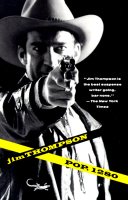
Pop. 1280 by Jim ThompsonFrom 1942 until the early ’70s, Jim Thompson wrote about thirty novels of the “hard-boiled” variety, all crime stories involving nefarious, morally-bankrupt characters engaged in a wide range of vice and mayhem.

Some sold reasonably well, but with a few exceptions nearly all were dismissed by critics as disposable “pulp.” None of his novels were in print at the time of his death in 1977. However, his stature (and critical reputation) soon grew when Vintage Crime/Black Lizard began reissuing several of his novels in the late ’80s.

Furthering his posthumous fame were film adaptations of several of his novels, including The Getaway (the 1972 version by Sam Peckinpah with Steve McQueen; skip the 1994 one), The Killer Inside Me (1976), The Kill-Off (1989), After Dark, My Sweet (1990), and The Grifters (1990).

Jim Thompson was a hell of a writer -- to paraphrase the title of one of his novels (A Hell of a Woman, also filmed as Série noire) -- and easily my favorite among the second generation of hard-boiled fiction writers who followed Hammett and Chandler. My favorite Thompson novel is probably Pop. 1280. It’s certainly the one I’ve read the most. It seems like at least once a year I pick it up and am again hooked by the first few pages in which the hilariously unreliable narrator and protagonist, Nick Corey, introduces himself.

I found myself thinking of Nick Corey and Pop. 1280 the other day while engaged in a 6-handed $0.50/$1.00 limit ring game. I had just gotten to the table, and so didn’t really have a read on any of the other players when I noticed the player who lost the most recent showdown enigmatically type “J3 K5” in the chat box. Checking the hand histories, I saw that the player to his right had won the last two hands with these holdings (Js 3s and Kh 5d), having hit a second pair both times to suck out on the complainer. As the cards were being dealt for the next hand, he added “u dont need good cards.”

Now I’ve been suckered in by this sort of thing in the past, taking one player’s word for another player’s lack of skill and thereby gravely underestimating an opponent to my own detriment. So rather than draw any hasty conclusions, I reserved judgment and watched the complainer (whom I’ll call Bellyache) begin to challenge the alleged donk (whom I’ll call The Fool).

Within about 20-30 hands, The Fool was up $15 and Bellyache was down about $7. (Looking back at the session later on Poker Tracker, I found The Fool ultimately made a cool $23.50 while Bellyache lost $6.75.) The two had been involved in numerous showdowns versus one another.

To give you an example, in one hand five of us had limped in to see a flop of 6h 3c 8c. The Fool checked from the small blind and Bellyache bet out from the BB. The table all called (including me on the button with Ad 9h), then The Fool check-raised. Bellyache called, as did one other player besides myself. The pot was $7.00 when the turn brought the Qs. The Fool bet out, Bellyache called, and the other player and I both folded. The river was the 5s, and again The Fool bet and Bellyache called. The Fool had 8h 6c, and so took down a nice pot of $10.50 after flopping top two pair. Bellyache had Js 3s, and with only bottom pair and no draw had open bet, called a check-raise, and called two more big bets.

The Fool had played the hand well, and clearly was benefitting from the fact that Bellyache refused to believe he or she could know how to check-raise a strong hand. Indeed, on that particular hand, the calls around the table of The Fool’s check-raise were probably also partially a result of Bellyache’s diagnosis that The Fool was a bad player.

This manner of playing upon others’ misreads is precisely how Nick Corey gets things done in Pop. 1280. As high sheriff of Potts County, Nick is constantly abused by others who disrespect his authority. One soon discovers, however, that Nick has a lot more going on upstairs than anyone else seems to realize, and in fact encourages others to underestimate him so as to be able to take advantage later on.

Early in the novel Nick goes to visit Ken Lacey, the sheriff of a neighboring county, with the apparent purpose of asking his advice regarding how best to handle a couple of pimps who are running a whorehouse and who don’t seem to care that Nick wants them to shut it down. He describes the neighboring town to the reader in awe-struck terms (“It was a real big place -- probably four, five thousand people”). He’s even impressed by the dogs in this town, including one “mongrel [who] would have made a fella stop and stare. Because I’m tellin’ you, he was really something! He had this high ass in the back, all spotted and speckled like a cow had farted bran on him . . . .” (This book is hi-friggin’-larious, I’m telling you.)

He continues the bumpkin-in-the-city routine with Lacey and his deputy, and they promptly make fun of him, at one point literally kicking him in the ass in order to give him “an ill-ustrated lesson” of "pre-zackly" what he needs to do to the pimps. Later on we discover Nick has hooked Lacey into a scam whereby Nick kills the pimps and frames Lacey for the murders. Nick describes Lacey’s reaction once he realizes he’s been had: “He blinked at me. Then the wild sweat broke out on his face again, and a streak of spit oozed from the corner of his mouth. And there was fear in his eyes. It had soaked in on him at last, the spot he was in.” Chilling.

The novel proceeds with further examples of such deceit. Near the end, Rose (one of Nick’s mistresses) challenges him to take responsibility for his actions. “Who planned those murders?” she asks. “Who tells a lie every time he draws a breath? Who the hell is it that’s been fornicating with me, and God knows how many others?” “Oh, well,” Nick answers. “It don’t count when I do those things.” “It don’t count!” she fires back. “What the hell do you mean?”

Here’s where I think Nick might be read as demonstrating the characteristics of one kind of successful poker player. Having tricked his enemies into underestimating him, he crushes them mercilessly, and, importantly, feels absolutely no remorse for having done so. The way Nick sees it, all of his actions are simply part of his job:

It’s what I’m supposed to do, you know, to punish the heck out of people for bein’ people. To coax ’em into revealin’ theirselves, an’ then kick the crap out of ’em. And it’s a god-danged hard job, Rose, honey, and I figure that if I can get a little pleasure in the process of trappin’ folks I’m mighty well entitled to it.
The Fool might well have felt something similar about Bellyache and the rest of the table while gathering our chips. When it comes down to it, who gives rip what your opponents think of you? And if they think less of you than they should, all the better. As Nick would say, that stuff don’t count nohow.

Image: Pop. 1280 (1964), Jim Thompson.

Labels: , , , , , ,


Older Posts

Copyright © 2006-2021 Hard-Boiled Poker.
All Rights Reserved.