Monday, December 22, 2014

Gould, Segal, and Walsh Look Back at California Split 40 Years Later

I continue to include Robert Altman’s 1974 film California Split as one of the features I assign in my “Poker in American Film and Culture” course. I’ve taught the course for several years now and have been including Split among the assignments since the beginning (along with The Cincinnati Kid, Rounders, and clips from about a dozen other films).

As anyone who has ever taught before well knows, whatever it is that comprises the subject matter of a class becomes a topic of intense study for the teacher, too. I’ve had the experience before of teaching certain texts dozens of times over, practically memorizing them as well as the various themes or ideas discussions about them tended to evoke.

The first few times teaching a given text typically require a lot of rereading (or rewatching in the case of a film), with the lecture notes going through a few drafts along the way as points get added and dropped. Usually, though, after teaching something several times the general shape of the conversation settles into a familiar groove, and while students might introduce new ideas or carry the conversation into unexpected places, as far as the text itself goes I’ll know the sucker backwards and forwards.

That is to say, if I’m going to stand before a group of people and lead a conversation about some assigned reading or viewing, I want to know the assignment better than anyone else in the room. (This would be true even if I didn’t have this more-than-slight tendency toward obsessiveness.) So yeah, I’ve seen California Split many, many, many times by now. And unlike some other texts with which I’ve studied in similarly comprehensive ways, Split continues to remain interesting to me even after having essentially committed it to memory.

Thus was I intrigued last week when Dr. Pauly drew my attention to a new three-part interview with California Split co-stars Elliott Gould and George Segal and the film’s writer and co-producer, Joseph Walsh. Kim Morgan conducted the interview for the Los Angeles Review of Books, and it can be read by following these links: Part I, Part II, and Part III.

The interview is long and full of digressions, and in a prefatory note Morgan suggests how “the conversation is flowing almost like an Altman film,” which is a fair assessment. The trio swap anecdotes and trivia about various Hollywood personalities throughout, and in fact don’t even really get into discussing Split until the latter section of the interview’s first part.

Having read Walsh’s memoir Gambler on the Loose which includes some discussion of the making of Split, I knew some of these stories. And in fact one story Walsh shares about Amarillo Slim Preston he had told me a few years ago. But there are several items in the interview I’d never known before, as well as some genuine insight about the characters of Charlie and Bill (based in large part on Walsh and Gould) that goes beyond what we’ve been able to come up with in our classes when discussing the film.

I like very much an idea that Morgan tosses out during the first part comparing casinos to movie sets with each being “an enclosed world of playing, making money, losing, performing,” an analogy strongly suggested by the tenuous, risky circumstances under which Split was made. And the group’s discussion of the enigmatic ending is especially enlightening, I think, with the stories about how it changed as they were filming it making it all the more intriguing. (That discussion comes in Part II of the interview.)

The ending of Split actually makes it an especially good film for the classroom, opening up all kinds of questions worth discussing and thinking about. I feel the same way about The Cincinnati Kid‘s ending, which also inspires a lot of interesting response from students who are invariably surprised by it. (Meanwhile, the ending of Rounders, though satisfying in some ways, doesn’t necessarily invite the same depth of existential rumination.)

If you’re a fan of California Split -- and whether you’ve seen the film once or dozens of times -- check out the interview with Gould, Segal, and Walsh and think further about an especially interesting text to study.

Labels: , , , , ,

Thursday, November 29, 2012

A Slim Story from Joseph Walsh

Yesterday I brought up California Split again as well as screenwriter Joseph Walsh’s 2008 book Gambler on the Loose. Not long after that book appeared and I wrote a review of it (for PokerNews), I got in contact with Walsh. We’ve been in touch ever since, and usually it’s around the time I teach the film in my class I find myself sending him another note to see how he’s doing and to share something with him about the discussion of Split.

The two of us had our exchange of messages again this week. I told him I hoped the replacement refs didn’t screw him over too much earlier this NFL season (and that the regular ones weren’t doing so, either). He replied by referring to that fourth-and-29 play in the Baltimore-San Diego game -- the one I was crying about on Monday -- and how it had him “reaching for the phone to call the paramedics.” But otherwise he’s doing great. Still “in action,” as they say.

I was reminded this time how back in the spring when we’d exchanged messages it wasn’t that long after the passing of “Amarillo” Slim Preston. It occurred to me then to ask Walsh if he had any Slim stories from the making of California Split. Preston has a cameo near the end of the film, and so I guessed Walsh probably had met and interacted with him at some point.

When the movie premiered in the summer of 1974, Preston was probably at the height of his popularity and renown as a poker player. He’d won the 1972 World Series of Poker Main Event, then had embarked on a kind of publicity tour afterwards to promote himself, his book (Play Poker to Win), as well as poker and the WSOP. He appeared on The Tonight Show with Johnny Carson multiple times during that period. Then in 1973 CBS filmed a documentary at the WSOP Main Event to show as part of its CBS Sports Spectacular, a kind of anthology show that often featured off-the-beaten-path sports programming.

That entire 47-minute show dealing with the 1973 WSOP is available on YouTube, if you’re curious to see it. As you might imagine, Preston is featured heavily as both the defending champ and, really, as the country’s most famous poker player at the time.

So, did Walsh have a Slim story? Yes, he did. I asked him this week if he’d mind if I shared it here, and he said it would be fine.

“Slim Story:

Since I barely knew Slim, I made an arrangement to have breakfast with him the day before we were going to start filming on ‘Split’. Soon as he sits down I say to him, ‘Slim, I’m going to offer you a bet you can’t refuse. In the next Keno game I’m going to pick one number and take 2 to 1 I hit it! Well, Slim, knowing he’s beating the price, says to me ‘you're on, son, and for how much.’ I reach into my pocket and put up two hundred bucks. Slim reaches into his pocket and takes out a roll of hundreds that must have been 6 inches thick.

I say to him, ‘You really come prepared.’ He says, ‘always’ and flicks off 4 hundred to cover the bet. One minute later the Keno game begins and the first number that lights up on the board is 9, the number I picked. If Slim had false teeth they would have fallen out of his mouth. It takes him about 4 seconds to recover and then he says to me ‘My god, son, you are spooky.’ Later in the next game, he tried to engage me in the same bet. I just smiled warmly and said ‘Sorry, Slim, you had your shot.’ We became instant friends.”

Thanks, Joey, for sharing that one -- a “Slim story” that rivals some of Preston’s own.

By the way, for fans of California Split here is an excellent compilation of reviews and interviews regarding the film on a cool website called Shooting Down Pictures. Lots of goodies there, including the whole background regarding the struggles to get the film made (and the alternate-universe-possibility that Steven Spielberg might’ve directed it), tons about the production, and an excerpt from an interview with Walsh in which he talks about what it was like working with Robert Altman.

(That picture of Walsh above is from another, more recent interview he did for Stop Smiling which focuses on the ending of the movie and how it diverged from what had been scripted.)

Labels: , , , , ,

Wednesday, November 28, 2012

Gambling As an Object of Inquiry

Was talking with students this week about the 1974 film California Split, a movie I’ve written about here several times and like more and more every time I see it and discuss it with groups watching it for the first time.

Thanks both to Robert Altman’s unique directorial style and Joseph Walsh’s unorthodox script, the movie can be a challenge for students who aren’t necessarily used to watching creatively complex films. But the movie works especially well at the end of the course -- that is, after we’ve already explored in detail the many ways poker has been a part of American history and culture and thus come to appreciate many of the themes the movie addresses.

I won’t rehearse all of those themes again. Here are some earlier posts in which I do:

  • Poker Review: California Split
  • California Split and First Impressions
  • Selling Stories in California Split

    As Joseph Walsh talks about in his 2008 memoir, Gambler on the Loose, his screenplay came largely from his own experiences as a gambler. Here’s a post in which I discuss Walsh’s funny (and also unorthodox) book.

    As I talk about in that post, in the book Walsh portrays himself as a person wholly under the spell of gambling, paradoxically praising it as a means to give one’s life more profound meaning (“Getting shut out of the action is unthinkable. A living death!”) and acknowledging it as a sickness of sorts (understood and accepted by “willing victims”). And the movie smartly delves into this love-hate relationship with gambling, presenting viewers with “a journey through the pain and gain of gambling” (as Walsh describes California Split in his introduction).

    Now I’m not really a gambler myself. I’ll play my small buy-in pools and maybe bet on a game once in a while when in a place where such a diversion is available. And sure, I understand and accept that playing poker is gambling, although not really in the same way betting on sports or playing the lottery or other forms of gambling are.

    That said, when Walsh draws lines between “us” and “them” in his book, I have to admit I really belong over on the “them” side -- that is, with the non-gamblers. “Non-gamblers tend to look at gamblers like an amusing freak show,” writes Walsh. “We tend to look at them like they barely exist. We match their interest in us, with disinterest in them.”

    He’s pegged me perfectly here. That is, as someone with what might be called an “academic” interest in gambling -- i.e., a curiosity about the people who gamble and the culture of gambling. When leading the discussion of California Split in class, it was hard for us not to talk about the character of Bill as an “addict” or someone with a “gambling problem.” Charlie, too, for that matter, although he appears to be much more comfortable with being a committed gambler.

    I think the class and I kind of had to talk about the characters in this way because we’re basically all non-gamblers. That is to say, for those of us who aren’t always “in action,” there’s something kind of alien to us about those who always are. We have never really felt the need to gamble, which makes it seem all the stranger to us when we watch a movie or read stories about people who do have that need.

    This morning I stumbled on an article about a woman in Australia who’d incredibly managed to lose $7.8 million playing slots online -- on the “online pokie machines,” as they call ’em down under. Now most of us will read a story like that and be puzzled how such a thing is even possible. Not only did she somehow manage successfully to steal money electronically more than a thousand times from her employer (she’s been found guilty of 1,410 instances of theft), but then she was able to lose all of those millions one spin at a time online, much of that time spent taken up with the business of chasing losses.

    To go back to Walsh’s dichotomy of “non-gamblers” and “gamblers,” I think the latter group is perhaps able at least to understand such extreme behavior, perhaps even to identify with it to some extent (and in some cases). Meanwhile the former group finds it as baffling as other addictive behaviors with which they have little or no personal experience.

    Still, some of us -- the non-gamblers -- are nonetheless fascinated. I suppose these stories about others’ willingness taking risks give us something by which to measure and consider our own risk-taking. For us, a “gambling problem” isn’t some sort of malady, but a puzzle to be solved.

    Labels: , , , ,

  • Monday, April 23, 2012

    Selling Stories in California Split

    'California Split' (1974)Last week I mentioned how I had rewatched The Cincinnati Kid and had noticed a connection I hadn’t necessarily picked up on before. Just a similarity in a couple of hands that seemed like it might have been intentional enough to read into somewhat.

    Was looking back at another great poker/gambling film this week -- California Split (1974) -- and noticed another interesting thread I hadn’t necessarily thought about too much before. (Both of these films are ones I show in my “Poker in American Film and Culture” class, which explains why I keep watching them over and over.)

    I’ve written about California Split here numerous times before, including writing a somewhat formal review and an appreciation of a speech by Charlie near the end in which he sizes up a table full of players just by looking at them. Thus I won’t go back over the whole story or the film’s several themes here other than to say it’s an amazingly realistic, thought-provoking look at the psychology of gambling as well as a cool chronicle of poker-room culture circa mid-1970s.

    As a Robert Altman-directed flick it carries an unorthodox style that might put some movie-watchers off, but to readers of this blog I recommend it without reservation as one of the best “poker movies” you’ll find. Anyhow, let me quickly share the new thread I noticed during this umpteenth viewing.

    Early on Charlie (Elliott Gould) mentions very briefly to Bill (George Segal) over Froot Loops and Budweiser how he once had a job selling ad space in a labor union magazine that actually did not exist. “Just get on a telephone and call people and say ‘Hey, you wanna buy some space?’” He explains further how he got to keep 45% of what he sold.

    Charlie tells Bill and Barbara about a job he once had in 'California Split'“How come you don’t get to keep all of it if it’s non-existent?” asks Barbara (Ann Prentiss), also at the breakfast table with the pair. “I’m not picking nothing up,” answers Charlie. “I’m just talking on the telephone.”

    She then asks Bill what his job is and he answers that he’s a writer -- for a magazine, actually. In other words, he legitimately sells stories for a living. We later see him kinda sorta working his job, although after having met Charlie he’s constantly finding excuses to get away and go gamble.

    That little exchange about Charlie’s less-than-ethical former job is one of dozens in the film that add lots of depth to both the characters as well as increase the overall believability of the world Altman creates in California Split. It seems incidental, and in fact most watching the film for the first time or even after several viewings probably wouldn’t remember the anecdote afterwards.

    Like I say, though, I’m seeing something more significant in the story this time around, thanks to a connection I saw between Charlie’s former job and a contentious conversation Bill has later with his bookie, Sparkie, portrayed by Joseph Walsh who wrote the film’s script. (As Walsh talks about in his 2008 memoir Gambler on the Loose, the story is somewhat based on his own rambling, gambling adventures with Gould.)

    Earlier Sparkie had given Bill an extra 10 days to pay him what he owed, but instead Bill put him off, then ran up even more debt. Now they are having a meeting at a restaurant, and Sparkie explains to him that he presently owes $2,200. Bill still doesn’t have the money, but it appears he has an explanation.

    “I tell you, this guy Lloyd Harris,” Bill begins, “who's the honcho where I work... we had a very good Christmas season and what he's created now is a slush fund out of which we are gonna be able to withdraw..."

    Sparkie doesn't want to hear Bill's story in 'California Split' (1974)From the start Sparkie is shaking his head, utterly impatient with Bill and not at all interested in hearing about his boss or how he plans to pay him at some later date.

    “You're not telling me a story now, are you?” asks Sparkie. Bill acts a little offended, saying “I don't know what you mean by ‘story,’” but it is clear that’s exactly what he’s trying to do -- to tell his bookie a story to delay further his paying.

    The story might be true or it might be a complete fiction, although from Sparkie’s perspective it really doesn’t matter one way or the other. It’s a story, being offered here as a stand-in for the cash Bill owes.

    The exchange reminded me of Charlie’s job selling ads to a non-existent magazine. Like Bill, Charlie had to invent stories to persuade others into parting with their money. You can readily see how this theme applies to poker, too, where we’re constantly doing something similar with one another in an effort to “negotiate” our way into getting others to buy our “stories” at the prices we set with our bets and raises.

    This particular theme also makes me think a lot about American culture, generally speaking. (Of course, viewing the film in the context of an American Studies course makes me think along those lines, too.) I’m thinking about how so many of the jobs we have and look upon as legitimate means to earning a living essentially boil down to getting others to buy our stories.

    Wouldn’t you agree? Or should I say, are you buyin’ any of this?

    Labels: , , ,

    Friday, March 20, 2009

    Confessions of a Non-Gambler

    A Vegas sportsbookI am a huge basketball fan, especially college, and so always follow the NCAA tournament fairly closely. Used to play a lot of hoops, which I think makes the game all the more interesting to watch. Haven’t played so much over the last few years, although every now and then I will come out of retirement to sink the odd fifty-footer.

    I also would generally always join a pool or two, sometimes expending a lot of effort during Monday, Tuesday, and Wednesday deciding how to fill out them brackets, then -- usually -- watching my carefully-calibrated prognostications all rapidly turn to dust by Thursday evening.

    I recall particularly enjoying one variation in which one was rewarded with bonus points for picking upsets correctly, with the stakes going up with each round (including the bonuses). Also, you didn’t fill out the whole sucker beforehand, but picks were made before each round, meaning you were never really out of it on Thursday. (But you could be toast by Saturday, I think.)

    It’s been a few years, though, since I’ve bothered with the brackets. I did half-heartedly fill out one over on ESPN at 11:30 a.m. yesterday, and see this morning I’m in 4,268,437th place heading into the second day of play. Sounds about right.

    While I’ve always been a sports fan, I never took much interest in sports betting, and I think since getting into poker I find myself even less inclined to gamble in that way than before. I know for many the opposite is true, with poker playing encouraging the desire to bet on sports or engage in other games of chance. Probably more so if one is a live player and thus usually not that far from the sports book and everything else the casino has to offer. But even online it isn’t that hard to click on over to the Bodog Sportsbook or other such places to lay yr moneys down.

    For me, though -- and perhaps for many others, too -- poker satisfies whatever “gamble” is in me just fine.

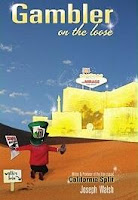
    Joseph Walsh, 'Gambler on the Loose' (2008)In Gambler on the Loose (2008), Joseph Walsh’s whimsical collection of autobiographical essays-slash-prose poems, Walsh tosses out dozens and dozens of maxims about gambling -- some uncanny in their precision and apparent accuracy, some obscure to the point of impenetrability, most hiliarious. I’ll quote just one:

    “When it comes to handicapping, keep in mind you are handicapped.”

    Of that I am acutely aware whenever I have tried -- in earnest -- to predict the outcome of a sports contest. Talk about a “game of partial information”!

    In any event, I hope everyone has a good weekend watching all those games of partial information in high definition.

    Labels: , , , ,

    Wednesday, October 22, 2008

    Joseph Walsh’s Gambler on the Loose

    Joseph Walsh's 'Gambler on the Loose' (2008)A while back I picked up a copy of a book called Gambler on the Loose by Joseph Walsh. Walsh wrote the screenplay for Robert Altman’s 1974 film California Split, probably one of the best films around for portraying the gambler’s mentality. Also a lot of fun for the way it gives us a documentary-like glimpse of live poker in the early 70s. (For more on Split, see here.)

    I had heard Walsh interviewed by Howard Schwartz on the Gamblers Book Club podcast back in July (the 7/12/08 episode). I keep recommending Schwartz’ podcast because it is one of the best ones out there right now, generally jumping to the front of my podcast queue whenever a new show gets delivered (every 2-3 weeks or so). Schwartz interviewed Walsh during the WSOP and they discussed his new book, and I eventually got myself a copy.

    Gambler on the Loose is essentially Walsh presenting his own story, although the way it is written it doesn’t really conform to narrative expectations for autobiography. He starts back in the 1940s when he was a child actor, quickly getting into how he became interested in sports betting as a teen, then carries the story up through the making of California Split and into the 1970s. The book is presented as a series of anecdotes, many of which are built around various “lessons” or more simply observations about what it means to be a gambler.

    The writing is infused with a kind of manic energy -- it is as though the wild, irrational impulses that sometimes drive the inveterate gambler are being exhibited by the author as well (he’s a “writer on the loose”). The result is a kind of homage-slash-diagnosis of the gambler, identifying all of his many neuroses and flaws without necessarily offering any real advice for overcoming them, but rather suggesting (repeatedly) this is how we are.

    “Pressing your luck is something inherent in your DNA,” writes Walsh (using the second person, as he often does). “Basic intelligence has very little to do with this, and is very seldom called on. It only gets in the way of your fun.” That comes from a chapter titled “Willing Victims.”

    I’m not going to write a full-fledged review of the book here. I will say the book is most definitely a fun read and even had me laughing out loud during certain stretches. I especially liked one passage in particular where Walsh tries to explain the difference between a gambler watching a sports event on which he’s placed a bet and “normal people” who watch simply as fans. Seems particularly appropriate to share on this day, with Game 1 of the World Series (of baseball, not poker) happening tonight. So you gamblers, take note.

    “If you gamble, you cannot watch a game with a roomful of normal people,” explains Walsh. “Show me a man who prefers to watch a sporting event with a house full of guests and I’ll show you a man who is not one of us.” Rather, the non-gambling sports fan “is a frivolous human being willing to be carefree and have a good time, totally irresponsible to what it takes to pull the game in, which is worry, emotional outburst, face contorting, and basic begging.... He ranks right along with the man who doesn’t drink and is thrilled with himself. Neither one of them can be trusted.”

    Walsh goes on to talk (only half-jokingly) about how such people “never experience true life.” Then comes what I thought to be one of the funniest passages in the book where he describes having to endure the very hell he is warning us all against.

    “[T]he simple face of the whole thing is,” he explains, “watching a key game with a roomful of people [who aren’t gamblers] is very bad health-wise. I’m not just talking about the pellagra, scurvy or spinal meningitis that might be running rampant in that living room. I’m talking about the good primal scream of pain that has to be stifled on these occasions. Do you know what your insides go through because you’re not willing to share this terrifying sound with the guests? How many of them, do you think, have stifled the big one for you? When you start to understand how little these people have done for you, and how much you have done for them, the need for separation becomes clear....”

    If yr curious about the book, here’s a website with more. Meanwhile, for those of you with something riding on the Phillies-Rays series, be certain to keep well clear of the “normal people.”

    Labels: , ,


    Older Posts

    Copyright © 2006-2021 Hard-Boiled Poker.
    All Rights Reserved.