Thursday, September 26, 2013

It Goes On and On and On

Was reading about this 21-plus hour “filibuster” by Senator Ted Cruz (R-TX) this week, with much of the commentary focused on reducing it to a peculiar kind of political performing with little practical consequence beyond the already controversial freshman senator alienating colleagues in both parties. And perhaps promoting his own star among a certain, small segment of the American voting public.

Some of the articles noted how “filibuster” was not really an accurate way of describing the performance, since Cruz knew even before starting that he had no way of achieving his ostensible goal of preventing the Senate from voting on a budget plan to keep the government open through a deadline coming up next Monday and thus maintain funding for the new “Obamacare” law. Thus was the speech and its inordinate length even more strange.

Like I say, Cruz began making enemies shortly after joining Congress this year -- even the iPhone-poker playing John McCain called him a “wacko bird” (along with a couple of others) back in the spring. And his speech contained a lot that appeared pretty wacko, especially out of context, including references to Duck Dynasty, White Castle burgers, the Friday the 13th and Nightmare on Elm Street film franchises, The Little Engine That Could, Ashton Kutcher, Darth Vader, Toby Keith, and Green Eggs and Ham.

Setting aside the specific political context for Cruz’s marathon play, there’s something curious about the wildly out-of-proportion step of speaking for 21-plus hours in such a forum.

Cruz came a bit shy of the longest ever filibuster speech by Strom Thurmond lasting 24 hours and 18 minutes in which he spoke against the Civil Rights Act of 1957, one of many actions in the South Carolinian’s long career in which he established his lamentable opposition to racial equality. Like Cruz, Thurmond also peppered his speech with a lot of obscure, irrelevant matters, most famously a digression on his grandmother’s biscuit recipe.

I’m thinking yet again about the debates this week about televised poker, and how the long, uninterrupted and unedited broadcasts may be better for demonstrating the game’s skill component, but are much less likely to retain an audience. Thus is TV poker necessarily reduced to highlights and other unusual moments that in real time disrupted the monotony but in an edited package are made to seem representative.

Much as commentators on the crazy-long senatorial speeches focus on irrelevant or tangential biscuit recipes and Dr. Seuss readings, so, too, does an hour-long program condensing a day’s worth of poker focus on the unusual.

Speaking of long-winded politicians, I’ve been continuing my Nixon studies and am now in the middle of his 1,100-plus page post-presidency opus, RN: The Memoirs of Richard Nixon.

I have to read it at home, as it’s too big to take anywhere. I mean, really, I’d need an extra suitcase to carry it on a tourney trip.

I could filibust open somebody’s head with this sucker.

Labels: , , , , , , ,

Wednesday, September 11, 2013

McCain Under the Gun

An item that popped up last week while I was in Barcelona was this story about former presidential candidate and U.S. senator John McCain getting caught playing a poker game on his iPhone during a Committee on Foreign Relations hearing. Not that any hearing of such a committee is unimportant, but in this case the topic was the possible use of force in Syria -- still being considered and the subject of President Obama’s prime time speech last night -- thus exposing McCain to some censure for having allowed his focus to drift.

When I saw a few tweets and then followed a link or two to read about the incident last week, I initially thought it was a Photoshop-fueled hoax. But soon it became clear that the photo above taken by Washington Post photographer Melina Mara was exactly what it appeared to be. McCain was playing a play money game, VIP Poker, and it looks like he was calling from under the gun with Q-2-offsuit (click to enlarge).

Almost unseemly to use that term in this particular context. “Under the gun,” I mean.

I immediately thought of the first chapter of James McManus’s Cowboys Full in which he focuses a lot on poker-playing presidents, and in fact draws a pretty sharp distinction between Obama and McCain.

Tipping his hand (pun intended) in terms of his political leanings, McManus favorably highlights Obama’s poker-playing background both by noting the many correspondences between political tactics and poker strategy while also linking Obama to a long list of U.S. presidents who played the game.

Meanwhile McCain is contrastingly drawn as a lesser candidate in part because of what seems a willful turning away from poker. McManus tells of McCain’s father, John S. McCain, Sr., once advising his children “Life is run by poker players, not systems analysts,” then notes how John III “turned out to prefer craps, a loud, mindless game in which the player never has a strategic advantage and must make impulse decisions and then rely on blind luck.”

Some might recall how in the run-up to the 2008 election both Obama’s poker background and McCain’s preference for craps were briefly highlighted, most particularly in a Time feature by Michael Weisskopf and Michael Scherer appearing in July and titled “Candidates’ Vices: Craps and Poker.” Going further than McManus does in his chapter, the article vigorously searches for all sorts of meaning in the two gambling games to discover ways they might reflect personality and indicators of leadership ability.

It was the memory of these stories about McCain and craps that probably added to my skepticism when first seeing the story last week. Wait, I thought... he was playing poker? But that’s not his game...?

Shortly after Mara’s photo whipped around the web, McCain deflected the incident with a jokey tweet that shruggingly tried to make light of its significance. “Scandal!” tweeted McCain. “Caught playing iPhone game at 3+ hour Senate hearing - worst of all I lost!”

Well, of course he lost. I mean really, limping queen-deuce UTG?

Op-eds since have mostly fallen into two categories -- Sheer Outrage and No Biggie. Late night comedians have all taken their shots, too. Jon Stewart on The Daily Show used more acid than others in his treatment:

David Letterman was relatively tame with his top ten:

And over on Conan O’Brien’s show came a sorta inspired clip from a newly imagined C-SPAN show, The Senatorial Hearing Poker Challenge:

However one responds to the story, it is safe to say “poker” doesn’t come off all that well here, once again playing the role of troublemaker.

I suppose the story wouldn’t have played too differently had McCain’s chosen game had been Words With Friends or Plants vs. Zombies. But there’s something about poker and the ready application of the game, its vocabulary, and its strategies to the world of politics that made the incident all the more enticing. And made it all the more likely to be passed around the web by the rest of us, similarly distracted by our phones.

Labels: , , , , , , , , , ,

Tuesday, November 04, 2008

Do Not Ask for Whom the Tells Show

Obama & McCainGonna be a lot of folks standing in line today as America finally decides who will be our next president. Lots of big races in the Senate and House, too. Expected turnout (overall) is supposed to be huge -- like in the 70% range, much higher than the usual 50% of registered voters who vote. And some of those lines are sure to be superlong. I believe 34 states (and the District of Columbia) had some sort of early voting, and while a lot of people took advantage, the majority of ballots will be cast today.

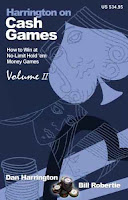
I voted about ten days ago. Went down to one of the public libraries near where I live, stood in line for just 45 minutes, and used one of those touch screen machines to cast my vote. Remembering a much longer wait back in 2004, I took a book this time, the second volume of Dan Harrington and Bill Robertie’s Harrington on Cash Games.

I’ve finished both books now. As was the case with the Harrington on Hold’em books, these are highly readable, smart discussions of strategy. I’m certain not everyone is buying into all of the various pieces of advice associated with the tight-aggressive style that gets the most attention in the two books, but there’s definitely a lot in there worth a poker player’s time.

'Harrington on Cash Games, Vol. II' (2008)When I was standing in line, I remember reading most of Part Eight, a kind of digression from the primary strategy discussion titled “Tells and Observations.” As you might expect from Harrington, the position taken is that physical tells such as those outlined with great specificity by Mike Caro in Caro’s Book of Poker Tells aren’t nearly as important as recognizing betting patterns.

As the authors put it, “the whole science of spotting tells is more difficult and less useful than most people suppose.” They refer to their 2+2 colleague Mason Malmuth’s point that “tells are only useful when they cause you to make the right decision when otherwise you would have made the wrong one.” And that circumstance -- the one where you actually are able to apply the info you (think you) have obtained in a way that is profitable -- they maintain just doesn’t come up all that often.

Dunno if I would be quite so dismissive of tells, though I do share the pair’s skepticism about being able to break the whole subject down like a “science.” Which is kind of ironic, given that Harrington and Robertie (and Malmuth) tend so frequently toward advice that is somehow “less human”-sounding than most.

You know what I mean -- all of those inordinately long compilations of probabilities when faced with a particular decision in one of their sample hand “problems.” There’s one in Volume II (Hand 6-2) where “you” call a middle-position raise from the cutoff with a pair of sevens, the flop comes 9-7-3 rainbow, and your opponent bets out about three-fourths of the pot. Then we get seven pages running through all of the possibilities (“He has nothing and we raise,” “He has nothing and we call,” “He has something and we raise,” “He has something and we call”), culminating with a chart (or “matrix”) showing the expected EV based on the probabilities established by this exhaustively thorough analysis. Certainly a useful discussion, though I can’t imagine any humans really play poker this way.

Anyhow, even if the authors are dismissive of the value of recognizing others’ tells, they do stress the importance of minimizing one’s own tells. They recommend minimizing one’s movements as much as possible (“The Patrik Antonius Way”), or following what they call “The Scripted Defense” whereby one follows the same, idiosyncratic pattern of movements every time one acts. Again, the idea seems to be to minimize one’s “human”-ness if possible.

There have been a few articles over the last few months analyzing the “tells” of Barack Obama and John McCain. For instance, this July article from the Telegraph concluded that both candidates need to work on their tells. Perhaps at one time -- such as during the debates -- that might have been a genuine concern. Of course, as far as the campaign goes, all that ends today.

Whomever comes out on top, he’ll have a hell of lot more than tells to worry about.

Labels: , , , , ,


Older Posts

Copyright © 2006-2021 Hard-Boiled Poker.
All Rights Reserved.