The Russian chess grandmaster Garry Kasparov has
an interesting new piece in the February 11, 2010 issue of
The New York Review of Books, a review of Spanish writer Diego Rasskin-Gutman’s
Chess Metaphors: Artificial Intelligence of the Human Mind. Much of the article concerns the book, but toward the end Kasparov makes a couple of interesting references to poker -- comparing it to chess and talking about both games in the context of advancing research in the field of artificial intelligence -- that I thought I’d share here.
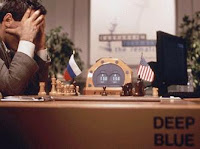
Kasparov begins by recounting how back in 1985 -- after he had defeated Anatoly Karpov and become World Chess Champion at age 22 -- he took on 32 chess-playing computers in a much publicized event in Hamburg and beat them all. Then he talks about the later 1997 match that he lost to IBM’s Deep Blue (pictured above) and some of the reactions that event caused, both within the chess world and in the culture at large.
While many outside of chess took Deep Blue’s triumph as “as a symbol of mankind's submission before the almighty computer,” Kasparov explains how the top chess players mostly took it in stride, and were in fact surprised it had taken that long for computers to catch up. And, in fact, among the artificial intelligence community -- “the AI crowd,” as Kasparov calls them -- there was some dismay that Deep Blue, while able to defeat a human at chess, still didn’t really seem to demonstrate human “intelligence.”
“Instead of a computer that thought and played chess like a human, with human creativity and intuition,” writes Kasparov, “they got one that played like a machine, systematically evaluating 200 million possible moves on the chess board per second and winning with brute number-crunching force.” In other words, for some Deep Blue’s win represented more of a programming triumph than a particularly significant advance in the development of AI.
Kasparov notes how today pretty much any home PC has the computing capacity to run a chess program “that will crush most grandmasters.” Even so, chess remains much too complex of a game to be “solved” once and for all argues Kasparov, citing Rasskin-Gutman’s book in a couple of places to support his point. He then moves into a longer discussion of the book, which sounds appealing for those interested in chess and/or discussions of how the human mind works.
I’m not going to summarize that entire discussion here (
check it out yourself, if you’re interested), but I did want to share what Kasparov says at the end of the review when he talks about how “the AI crowd” have begun to refocus their efforts away from chess and toward another game.
“Poker is now everywhere,” writes Kasparov, “as amateurs dream of winning millions and being on television for playing a card game whose complexities can be detailed on a single piece of paper.” Indeed, there was a time -- around the early 1970s -- when it looked like chess would experience a “boom” not unlike the one poker has enjoyed this past decade, although it didn’t quite pan out. I wrote a little about that a couple of years ago in a post called “
The Failed Ambassador” that was occasioned by the death of Bobby Fischer.
Getting back to the subject of artificial intelligence, Kasparov continues: “But while chess is a 100 percent information game -- both players are aware of all the data all the time -- and therefore directly susceptible to computing power, poker has hidden cards and variable stakes, creating critical roles for chance, bluffing, and risk management.”

As such, suggests Kasparov, poker is perhaps a much better game on which to focus AI research. He refers to the efforts of Jonathan Schaeffer, leader of the University of Alberta’s Computer Poker Research Group (CPRG) that has been developing poker-playing programs “Polaris” and “Polaris 2.0” that have taken on top pros like Phil Laak, Ali Eslami, and the Stoxpoker guys over the last couple of years. I actually had the chance a while back
to interview Schaeffer (following that first match with Laak and Eslami, see picture), who told me he believed “one of these days -- within 5 to 10 years -- two-person, limit Hold’em will be solved.”
My sense is that Kasparov isn’t quite as confident as Schaeffer regarding the possibility of “solving” even this relatively less complex variation of poker, though he does recognize how Schaeffer’s “digital players are performing better and better against strong humans -- with obvious implications for online gambling sites.”
The question remains, of course, as to whether or not these poker-playing computers are actually thinking “like humans” or not -- that is, when
Polaris 2.0 defeated the Stoxpoker guys back in the summer of 2008, to what extent did that victory represent a real advance in the creation of artificial intelligence as opposed to a mere triumph in “programming” (as Kasparov characterizes his defeat to Deep Blue)?
In any event, much as he reacted to the work of the chess programmers as having exciting implications for his game, Kasparov seems enthused about the work of Schaeffer and his colleagues at the University of Alberta, too. Referring again to poker’s growing popularity, Kasparov notes how there is a “current trend of many chess professionals taking up the more lucrative pastime of poker.”
These chess pros are smart guys. They see there’s more money to be made playing poker than chess these days. But some -- like Kasparov -- also see poker as offering other benefits, too, such as the opportunity to test ourselves in “partial information” situations in which we much learn to adapt, to weigh risk and reward, and to act accordingly.
In other words, besides being a game ripe for the study of artificial intelligence, poker can help us develop our
actual intelligence, too.
Labels: *the rumble, artificial intelligence, chess, Garry Kasparov, Jonathan Schaeffer, Polaris