Who Am Us, Anyway?
 To continue (for one more post, anyway) this discussion of “Poker and Nothingness” . . . . Okay, then. For those of us who keep playing, poker means something. But what?
 This week’s episode of Ante Up! did a nifty job of presenting and examining several of the reasons why people play poker. If you haven’t heard the show this week (#67), check it out. And if you don’t know about Ante Up!, well, get off yr keyster and start listenin’. With the retirement of Card Club on Lord Admiral Radio, Ante Up! is probably the poker podcast I enjoy and look forward to the most (closely followed by PokerDiagram and Rounders).
The main subject of this here episode -- “Psychology and Poker” -- was inspired by Cosenza’s recent announcement that he was through with online poker, a decision specifically prompted by a brutal bad beat -- losing a $430 pot to a rivered one-outer -- that punctuated an especially miserable weekend of online NL hold ’em. Cosenza wrote about his decision on the Ante Up! blog, prompting numerous comments, a thread over on the Card Clubs Network forums, and responses from both Long and occasional co-host Mike Fasso.
The hosts’ conversation was sincere and genuinely insightful (in my opinion). Although regular listeners already had a pretty good idea of the respective “player profiles” of both Cosenza and Long, the episode distinctly spelled out their many differences.
Cosenza specializes in no limit hold ’em, routinely playing games (both live and online) that feature $200 maximum buy-ins (e.g., the $1/$2 game at Full Tilt Poker). While not a professional, Cosenza is a consistently winning player who keeps careful records of his earnings and also cashes out frequently (i.e., he doesn’t play with his entire bankroll, and has in fact used his winnings to pay part of the mortgage on his house). He’s endured downswings and bad beats before. He’s also frequently skeptical of the “random number generators” used by online sites (one aspect of which I discussed a bit in a couple of earlier posts).
Conversely, Long does not specialize in any game in particular, although he does prefer limit games to no limit. He typically does not play for the stakes Cosenza does, and (as he admitted during this episode) is a losing player overall, although he isn’t terribly affected by that fact. (He likens the cost of poker to “tuition” -- i.e., he’s willing to pay to learn.) He’s spoken on the show before about losing swings and having had to reload his online accounts. He sympathizes with Cosenza’s skepticism regarding the "randomness" of shuffling programs online, but doesn’t seem to feel as adamant about the issue as does his co-host.
I’m not going to rehearse every detail of their conversation here, but I will make a couple of observations. The first is how in the course of describing their own motives the pair managed to identify a remarkable number of reasons why people play poker. Of these, the five they discussed most were (1) to make money; (2) to satisfy a desire to compete; (3) to experience an intellectual challenge; (4) to have fun/obtain pleasure; and (5) to experience the thrill of risk (i.e., to gamble).
For example, Long explained that having fun was for him a primary goal, and he suggested that Cosenza was more motivated by other motives -- namely, the first three (to make some scratch, to compete, and to be challenged) -- than by a desire to have fun. And Cosenza agreed Long was likely correct in his assessment. (Long also suggested Cosenza didn’t enjoy risk or “gambling” . . . a characterization which Cosenza only partially accepted.)
Note how all of these reasons are different “meaning-making” strategies employed by poker players. Or (to return the rarified air of the last post) different ways of combating “nothingness.” And they are all related, really. Notice how it is practically impossible to talk about one of these five motives without touching upon one or more of the others. Despite what some players might say, none actually play poker solely to make money and for no other reason. There are other ways of making money, most of them much easier than via poker. Poker “means” something else to these players, whether they realize it or not.
The second observation I’ll make is how both Cosenza and Long appear to contradict accepted stereotypes about limit and no limit players. Somewhat, anyway. I say that because Long loves to have fun, to be challenged, and doesn’t mind losing money -- three characteristics that seem to go against how limit players are typically characterized. Long hardly sounds like the image of limit “grinders” presented in Al Alvarez’s The Biggest Game in Town -- i.e., unimaginative “technicians” for whom “poker playing is strictly a business.” Nor does Cosenza sound like Alvarez’s no limit player attracted by “the romance of gambling,” somehow spellbound by the pleasure of risk-taking.
Proving (yet again) that poker can mean all sorts of things to different people. And . . . when you’re sitting there wondering if your pocket queens are any good against that check-raise all-in . . . for that guy sitting across the table, poker probably means something else to him than it does to you.
(Firesign Theatre fans recognize that post title as a line from their 1969 comedy LP How Can You Be in Two Places At Once, If You're Not Anywhere at All? Others, go get on the funway!)
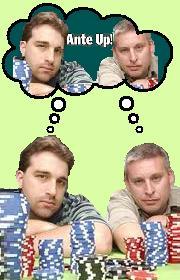
Image: Ante Up! (adapted).
Labels: *the rumble, Al Alvarez, Ante Up, existentialism, Firesign Theatre, podcasts, The Biggest Game in Town
posted by Short-Stacked Shamus at 9/22/2006 03:54:00 PM
0 comments


 on a board of


 . . .
. . .  . Dropped over 30 BB in those hands alone, plus probably suffered some tilty carry-over, I imagine. So maybe it was the cards. Another factor could well be fatigue -- I’ve been playing more (and longer) than usual lately while working off some of these summer bonuses, so perhaps the concentration is coming and going, thus increasing the likelihood of swings.