Tuesday, April 07, 2009

Nice Finish

UNC wins NCAALots of great comments on yesterday’s post (“The Waiting Game”). Check ’em out if you haven’t seen ’em. I like how the discussion evolved into a consideration of “The Waiting Metagame.” Also like B.J. Nemeth’s basketball analogies, which make sense to me.

Speaking of, I’ll have to talk a little basketball this morning, being a Tar Heels fan and all. I spent a number of years in Chapel Hill, including many days sitting in classrooms and nights going to games at the Dean Dome. So yeah, you could say I was fairly interested in seeing how things went last night in the big one.

I barely remember the 1977 final versus Marquette. Phil Ford, Mike O’Koren, and Walter “Sweet D” Davis (with his fingers taped together). Had whipped UNLV in the semis, but couldn’t overcome the emotional tidal wave created by it being Al McGuire’s farewell game as a coach for the Warriors. (Remember when teams had nicknames like Warriors?) Oh, and Butch Lee and Bo Ellis had something to do with it, too.

My memory of the 1981 final versus Indiana is a bit clearer. That was the one played in the Spectrum in Philadelphia on the day President Ronald Reagan was shot. Kind of a weird vibe all around for that one, with the Heels turning in a stinker while Isiah Thomas took it to the hoop against them over and over again.

The 1982 final -- with Michael Jordan, Sam Perkins, Matt Doherty, Jimmy Black, and Big Game James Worthy -- is much more vivid. Indeed, I’ve seen that one a few times over the years, marvelling over and again at how different the game was with no shot clock or three pointers. And at Freddie Brown’s pass.

I was in Chapel Hill in 1993, and after the game went to Franklin Street along with everyone else. Blue paint everywhere, bonfires, trees being uprooted. Everybody making the “time out” sign, mimicking Webber’s endgame miscue. Donald Williams had such a sweet shot. That was a team of overachievers, for sure, with George Lynch ably leading ’em.

Was full of anxiety in 2005 when Raymond Felton, Rashad McCants, Sean May, and the rest let Illinois come all of the way back in the second half from 15 down to tie the sucker. But Felton hit those free throws at the end and all was well.

Have to say I had a brief flashback to that near collapse last night, but somehow knew everything was going to be just fine. UNC had too much of a chip advantage, see. (We can get back to poker now, turning B.J.’s analogy the other way around.) A blue chip advantage, so to speak. And they used their advantage well, applying pressure from the get-go. By the second half, Michigan State was in a spot where they could double up several times but still would need a miracle.

Best case scenario for us Heels fans, really. A game where there wasn’t even any need for the endgame fouling to extend the game to which B.J. alludes.

GG, Heels!

(EDIT [added 4/7/09]: Dr. Pauly, whom I believe might have won a penny or three from betting on this here UNC victory, alerted me to this nifty time lapse vid of the scene at Franklin Street Monday night. Couldn’t figure how to embed here, but click through if yr curious. Reminds me of 1993, when I was there.)

Labels: , , ,

Monday, April 06, 2009

The Waiting Game

The Waiting GameWas watching PokerStars’ Spring Championship of Online Poker last night, one of those H.O.R.S.E. events (the $1,000+$50 buy-in one) in which TeamPokerStars pro Daniel “KidPoker” Negreanu had made it down to the cash bubble with a relatively short stack. They weren’t quite at hand-for-hand play yet when a player at Negreanu’s table with an even shorter stack began stalling every hand. And with the extra-long time banks given to players for the SCOOP events, some of the others at the table were beginning to get antsy.

A couple of comments were made, then, after a while, Negreanu couldn’t resist chiming in as well. “i wish we could bar guys that do that for life,” he said, referring to what the staller was doing explicitly as “cheating.” He suggested a possible penalty: “put something in the security software for repeat offenders. they keep stalling, they get dealt out for a level.”

The staller defended his actions, pointing out that it was within the rules for him to take as long as he was allowed. Negreanu wasn’t hearing it. “guys like this in the old days would totally get a beat down, for real,” he continued. “and if I have anything to do [with] it i’d like to give penalties to guys who shoot that angle.”

Since there was a lot of time with nothing else to do, the conversation continued with several players joining in, as did a couple of railbirds. Negreanu noted how “only low lifes” stalled and that “today so many younger kids dont get that its wrong so its a real problem.” Eventually the bubble finally did burst, and afterwards the player who had been stalling said he was sorry, though continued to maintain it was within his rights to stall.

“ya why say sorry?” typed Negreanu. “you are NOT sorry. You do it, and will do it again.”

The debate went on a little while longer before Negreanu decided he’d had enough, saying “this will tilt me for real” if he were to continue the discussion. A few more points were thrown around, then a railbird suggested the player in question “is going to be part of a Daniel blog.” Will have to keep an eye out for that.

After several minutes, the bubble finally burst, with both the staller and Negreanu having made the money. In fact -- speaking of cheating -- Justin “ZeeJustin” Bonomo, Negreanu’s All Strategy co-host who has recently been allowed back on the site after being banned for over three years for multi-accounting, was the bubble boy, going out in 65th.

As it happened, Negreanu would end up busting the player who had been stalling, but it was basically just happenstance that caused it. Both still had similarly small stacks, and they got heads up in a stud hand in which the staller was all in on third street with a pair of split kings to Negreanu’s three-flush. Negreanu drew out his flush, and the other fellow was out in 49th. Negreanu would last a little while longer before finally going out in 37th.

I found the whole exchange interesting to follow for a few reasons. One was just the spectacle of seeing Negreanu become so animated. Was perhaps a little untoward of him as a PokerStars representative to be getting into it with another player like that, but with Phil Hellmuth setting the standard for conduct with his poorly-typed screeds over on UltimateBet I think it is probably acceptable to allow KidPoker to blow off a little steam like this once in a while.

His comments suggesting possible changes in the rules (and implying his own potential influence for helping such changes to occur) were intriguing, too. My instinctive response was to side with the staller, frankly, and not to pay much heed to Negreanu’s claim that stalling was “cheating.” Nor was I all that moved by the talk of the “old days” and so forth, although I do appreciate how the generations tend to differ over what is acceptable and what is not.

What do you think? That such a tactic is squarely within the current rules seems to make the debate mostly moot, unless someone wants to make it a matter of “etiquette” or “courtesy” or whatever.

But what about Negreanu’s suggestion about changing the rules? Should they? Could they?

Labels: , , ,

Friday, April 03, 2009

When You’ve Begun to Think Like a Gun

When You’ve Begun to Think Like a GunBeen listening to these old John Cale albums over the last week or two. I’ll pull ’em out every couple of years. Not as good or interesting as the two Velvet Underground LPs on which Cale appeared (the one with Nico & White Light/White Heat), but full of surprises and cool moments, nonetheless. (I’m referring to the half dozen or so records Cale made during the early 1970s.)

One reason why I don’t wholeheartedly embrace Cale’s music is the fact that his lyrics -- while often suggestive -- are usually just a bit too opaque to produce any real response (in me, anyway). An exception is the song “Gun” from which my post title comes.

“Gun” is a rocker, with a driving, head-bobbin’ rhythm. As the title suggests, the song has a “hard-boiled” theme, told from the perspective of a ne’er-do-well criminal -- probably a hit man -- capable of all sorts of horrors who is reflecting on his trade. Can’t really say the story of “Gun” makes a lot of sense on a literal level, but it does a good job evoking the cool, cocky, morally-depraved atmosphere of a pulpy potboiler.

And the chorus delivers the message in a relatively point blank fashion (pun intended): “When you’ve begun to think like a gun, / The rest of the year has already gone. / When you’ve begun to think like a gun, / The days of the year have suddenly gone.”

Not to get overly academic about it, but I’ve always interpreted those lines as suggesting something about the speaker’s wholehearted commitment to executing the task before him -- his ability to forget everything and think of himself as a weapon, a tool designed to destroy. And when that happens, all that matters is now.

'Super System' by Doyle Brunson (1979)Lots of poker writers use similar language to describe effective, aggressive play, with Doyle Brunson’s chapter on no-limit hold’em in Super/System (first published in 1979) being the model for such “think like a gun”-style talk.

That chapter begins with Texas Dolly criticizing timid players who “ante themselves to death” or are “gutless” or don’t have the “courage” or “heart” or “muscle” for the game. “They’re weak,” says Brunson. “So you keep whamming on ’em and whamming on ’em and you just wear ‘em down. And, sooner or later, you’ll win all their money.” When he gets into specific strategy tips, he tends not to recommend fancy check-raises or slowplaying, favoring fast play and riding rushes. As Al Alvarez summarizes Brunson's advice in The Biggest Game in Town (1983): “the message is clear: aggression, aggression, aggression.”

Alvarez's book is also where we find that neat, metaphorical description of the difference between limit poker and no-limit poker from Crandall Addington that also evokes the idea of the player being a gun. Says Addington, “In limit, you are shooting at a target. In no-limit, the target comes alive and starts shooting back at you.”

The differences between limit and no-limit are huge, to be sure. But really, well-applied aggression can prove highly profitable in either game. In LHE, one sometimes encounters -- especially at the six-handed tables -- an aggressive, crafty player dominating the action. He’s the guy everyone is watching and reacting to. Sometimes I’m that guy; sometimes I’m one of the onlookers.

Sort of like he’s the one constantly waving a weapon around, putting everyone else on edge. Or who is the weapon. And you never know when he’s gonna fire that sucker again.

Other writers talk about using one’s “weapons” at the poker table. In The Poker Tournament Formula (2006), Arnold Snyder talks about how “the first step to victory in no-limit hold’em tournaments is knowing the three distinct weapons you will have at your disposal,” namely, your cards, your chips, and your position. Of course, you have to have the “heart” to use those weapons when necessary. One could refer to cards, chips, and position as your ammunition -- as bullets -- and you’re the gun firing them. Or not, in which case you get anted to death like Broomcorn’s uncle (as Brunson would say).

Nat Arem had a smart post yesterday in which he listed various qualities possessed by successful poker players, among which he included the “ability to view money as a tool.” Arem does a good job explaining that he’s not saying one needs to devalue money entirely, just value it appropriately -- “as a tool to make more money.” “Don’t even bother playing poker for serious money,” he says, “until you can mentally disconnect yourself from poker bankroll equaling spendable money.”

Indeed, the whole idea of a “bankroll” is informed by this concept -- that the money with which you play is a tool, a means. Or, ammunition. And you’re the gun. And the idea is to collect more ammo so you can keep firing.

'Fear' by John Cale (1974)Interestingly enough, the song “Gun” appears on Cale’s album Fear (1974), where it could be said to offer an antithetical view to the record’s opening track “Fear is a Man’s Best Friend.” Siouxsie & the Banshees did an especially good cover of it for their Through the Looking Glass (1987). Was poking around YouTube and saw an acoustic version featuring Cale and Siouxsie Sioux, which is pretty cool.

Had also seen a clip of the original smokin’ Cale tune on YouTube, but it appears to have been taken down. Check it out, if you can find it.

Labels: , , , ,

Thursday, April 02, 2009

Triple SCOOPs: Spring Championship of Online Poker Begins Today on PokerStars

Triple SCOOPSCOOP is here, peoples.

PokerStars has been staging its World Championship of Online Poker for seven years now. The site first launched in September 2001 -- gawd, could that be true? -- and the first WCOOP, a series of nine events, took place in July 2002. The “big one” that year was a $1,000+$50 no-limit hold’em tourney that attracted 238 entrants.

The series has gotten bigger and bigger each year, with last September’s WCOOP involving 33 events, culminating with the two-day, $5,000+$200 buy-in Main Event that attracted 2,185 players, creating a prize pool of over $10 million.

Shortly after last fall’s series, Stars decided they were going to run a spring series this time, too -- the Spring Championship of Online Poker -- which finally begins today. There will be 22 events over the next 11 days, with all 22 featuring “low,” “medium,” and “high” stakes versions of the tournaments that will run simultaneously.

For example, this afternoon things kick off at 2:30 p.m. Eastern time with Event No. 1, the Short-Handed No-Limit Hold’em with Rebuys event. The “low” version of the tourney has a $5.00+$0.50 buy-in (with $5 for rebuys & the add-on). The “medium” version is $50+$5. And the “high” version $500+$30. The three versions of Event No. 2, a pot-limit O/8 event, starts at 4:30 p.m. ET.

Oh, and get this: as an indication of how much the series has grown, all but one of the “high” stakes versions of the 22 events have buy-ins of at least $1,000+$50 (i.e., what it cost to enter the Main Event way back in 2002). Just Event No. 1 -- which is a rebuy event -- has a lower buy-in.

Last night I saw there were almost 16,000 entered into the “low” version of Event No. 1, suggesting this here little twist has proven pretty popular already. It’s a terrific idea, I think, to try to get us small timers involved. Speaking of, when I was looking at the tourney page last night I happened to notice the various satellites running for the sucker, and just for grins I jumped into one of the 35 FPP ones which awarded a single seat.

I think I might’ve played exactly one tournament all year, actually, one of those multi-table thingies for Silver Stars. So I have to admit my tourney instincts are pretty raw at the moment. I sat tight for most of the early stages of the single-table turbo, watching others give their chips to the only guy at the table who appeared willing to show any aggression at all. Was also vaguely distracted for a short while by American Idol, specifically when that Lady GaGa came on to do her big hit “Poker Face” which I felt obligated to watch for obvious reasons. (Don’t ask me what the hell that’s all about.)

Anyhow, I did win a couple of smallish pots here and there, meaning I had around 1,500 or so once we reached four-handed. That made me the short stack, but a fortuitious hand came up in which I was dealt AsTs, ended up all in preflop against two others, and a couple of aces happily rolled out to triple me up (they had K-Q and Q-J).

Soon enough I was heads up against the aggro guy, with him having around a 2-to-1 chip advantage. I started returning fire, and after he’d folded to a couple of my reraises I’d grabbed the lead. Ended up pushing with Q-10, he called me with J-9, my hand held up, and I won the seat.

Then I remembered I can’t make the start of the tourney this afternoon, so I unregistered. Looking over the rest of the schedule, I might try to win some more W$ and jump into a different SCOOP event later on. Or just play another one for a small discount.

There are lots of ways to satellite in. Or buy your way in with FPPs, too. Click here to see the full schedule and maybe pick yrself a spot to play along. And if somehow you have read all this and haven’t downloaded PokerStars and gotten an account, you can click here to take care of that.

I’ll be helping some with the coverage of SCOOP over on the recently revamped PokerStars blog, joining my buds Otis, Spaceman, F-Train, Change100, Tuscaloosa Johnny, Drizztdj, and California Jen. (I think that’s everyone.) So if you do decide to play, I might be watching.

That’s another cool side to SCOOP -- make a final table and get famous!

Labels: , , ,

Wednesday, April 01, 2009

Scoring Dream Team Poker

Dream Team Poker jerseysLike you, I followed online some of that “Dream Team Poker” tournament that happened last weekend at Caesars Palace. Partly because of the novelty of the sucker, partly because I actually had a few friends playing in it. Found myself checking in here and there between the basketball games on Saturday and Sunday to see how it was playing out and who was surviving.

For those who aren’t aware, the tournament was run like a regular poker tournament, but all entrants were both playing for themselves and as part of three-player “teams.” The entry fee was $500+$50 per person (so $1,500+$150 per team). Sixty percent of the prize pool went to the top seven teams, while the other 40% was divided among the top 25 individual players. The team score was determined by taking the top two finishers’ placement in the tourney, turning that into a number (e.g., finishing 13th place = 13 pts.), and the team with the lowest score won.

The buzz surrounding the event was quite positive. Surprisingly so. There were a total of 444 players there (148 teams), with a lot of “name” pros, celebrities, and familiar faces among the field. And just about everyone seems to have loved it, at least as far the commentaries on forums, blogs, and the podcasts go.

F-Train was scratching his head earlier in the week trying to figure out why exactly the event was such a hit. It sounds like both from his post and the comments that the event’s organizers helped their cause a bit by inviting a number of folks (some pros, some media) to play, and perhaps even providing some exemptions, too. Which is fine, though one wonders how popular the event would have been otherwise.

While I suppose I’m mostly ambivalent about the concept of team poker (sure, why not?), I did have a few more concrete responses to the event.

The Dream Team Poker logoFor one, I enjoyed hearing the participants and others getting excited about the tournament. Sounded like a hell of a good time, for most of ’em, anyway. As a fan of poker, I liked hearing people expressing such enthusiasm about the game. Poker can be a lot of fun, and it seems like the Dream Team idea -- perhaps in the way it sort of combined regular tourney poker and the “home game” -- did well to remind everybody of that fact.

Secondly, I’ve also liked how the tournament has inspired all sorts of thoughtful reflections about poker and its significance. If you’ve been listening to the podcasts this week or reading a few of the players’ blogs, you’ve heard various opinions about how poker can be an isolated activity, and how the tournament’s team concept made things different for a weekend. There have been other, interesting points made that were inspired by Dream Team Poker, too.

Finally, I have to throw out a comment about the scoring used in the event. F-Train called it “gimmicky,” which it was. It was also completely absurd, if you think about it at all.

Throwing out the lowest finishing team member’s score seems kind of arbitrary, but that isn’t the biggest problem with the scoring. The way it was done, the player finishing first received one point, second place got two points, and so forth all of the way down. Such a system therefore dictates that the difference between finishing first and second is equivalent to the difference between finishing 23rd and 24th, or 187th and 188th, etc.

Ridiculous. Has there ever been a tournament whose payout schedule followed a similar format? No. Why? Because to do so would be silly. Most tournaments’ payouts are determined so as to emphasize the importance of going deep and winning, awarding most of the prize money to those lasting the longest.

A better point system would also follow such a model. I would suggest deciding on a number of points for the tournament -- say, in this case, with 444 players, something like 4,440 points -- then create a “payout” structure for points that resembled a cash payout structure, only in this case have everyone “cash” for at least a point. You could give those finishing in the bottom half (223rd through 444th) one point each, the next 25% two points each, and so on. Then at the top give the first place finisher 10% of the points, second place 5%, and so on so as to make it more meaningful to go deep.

However it’s done, you have to set it up so that the difference between finishing 89th and 90th is relatively meaningless, while the difference between finishing first or second is the most meaningful jump in the tournament. That way you don’t muck with how the tournament is normally played, especially since the majority of the prize money was reserved for the teams.

Certainly sounds like they’ll try something like this again, probably fairly soon. Hopefully they’ll fix that point system moving forward.

(EDIT [added 4/2/09]: Check out the comments for a couple of smart refutations of this here idea, including a report on other aspects of the event from WPT tourney reporter B.J. Nemeth.)

Labels: , ,

Tuesday, March 31, 2009

Cards & Chance

Had one of those weird hands of limit hold’em yesterday (six-handed, $1/$2) in which I folded what would have been the best hand. Having trouble finding the hand in my hand history, so I cannot be as specific as I’d like about how it went down.

Was one of those three-handed situations in which my two opponents were aggressively semi-bluffing draws and I decided to get out with just ace-high. Can’t remember the exact board -- something scary like Q-Q-9-T with a couple of diamonds and I held Ah7h or the like. Ended up neither made his draw and the fellow with king-high ended up taking down the pot.

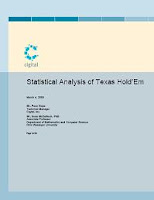
I call it a “weird” hand, but in fact, according to this new “Statistical Analysis of Texas Hold’em” released late last week by Cigital, Inc., it isn’t so weird at all for a player holding what would’ve been the winning hand to fold out before the showdown. In fact, it happens all the time.

You probably heard about this study. Researchers looked at 103,273,484 hands of hold’em played on PokerStars between 12/1/08 and 1/2/09. They only looked at cash games (no tourneys, no play money). They chose full ring or six-handed hands (no heads up games). And they generally avoided the microstakes since according to the researchers they “are considered too much like play money games.”

Of the 103 million-plus hands considered, 75.7% of the hands never got to showdown. Then, of the other 24.3% of hands, just over half of those (50.3%) “were won by the player who could make the best 5-card hand.” That is to say, only half of those hands -- or about 12% of the overall hands -- were actually won by the player originally dealt what turned out to be the best hand, with the rest of the showdowns “won by someone with an inferior 5-card hand because the player with the best 5-card hand folded prior to showdown.”

My vaguely remembered example above would’ve fit the criteria as a hand in which a player holding the best hand did not win the hand because he folded before the showdown. In fact, I’d venture to guess someone else at the table -- one of the players who folded before the flop -- probably folded a hand that would’ve beaten my ace-high.

The authors of the study maintain that while their “study does not quantify the effect that luck has on Texas Hold’em, it provides compelling statistics about the way that the outcomes of games are largely determined by players’ decisions rather than chance.”

'Statistical Analysis of Texas Hold'em' by Cigital, Inc.If you are interested, you can download the study here. As someone with an occasionally geeky interest in numbers, I would’ve liked to have seen the study share a more thorough breakdown of numbers. (My brief summary above essentially contains all of the pertinent stats mentioned in the report.) There’s some interesting stuff in there about their methodology and efforts to minimize error, though.

And their point is made, I think. Kind of an interesting approach to the whole “skill-vs.-luck” question, which I guess does ultimately show that it isn’t as though we’re all just sitting around the table hoping to hit hands. Some of us are, sure. But the rest of us are taking chips from those guys.

I think it is safe to say this study does not “prove” poker (or hold’em, specifically) is not “a game subject to chance,” to use the phrase one finds in the Unlawful Internet Gambling Enforcement Act of 2006 to describe gambling.

Of course, that doesn’t seem to have been the researchers’ intention. Their disclaimer at the beginning that their “study does not quantify the effect that luck has on Texas Hold’Em” essentially admits that luck does play some role in the game. Their purpose, rather, is to show that it isn’t entirely “subject to chance,” and that, given the way the numbers broke down, more often than not players’ decisions determine the outcomes of hands.

But part of me wants to say that even those hands that get folded before the showdown involve a certain element of chance. Don’t they? Let’s say you were me in that hand from above, the one in which I got bet out of a hand even though I was best. My opponents’ raising war on the turn forced me out, but those four community cards did, too. And none of us had any control over what those were going to be.

Kind of a chicken-or-egg type argument, I know.

Food for thought, I guess. Mmm... I think a chicken-and-egg biscuit would be a good way of resolving the matter.

Labels: , ,

Monday, March 30, 2009

Looking Back: The World Poker Tour Debuts

The hole card camera on the World Poker TourSix years ago today (March 30, 2003) the debut episode of the World Poker Tour aired on the Travel Channel. We’re you watching then?

Me neither. Took a few months for me to find that show, I have to say, not having been a regular viewer of the Travel Channel. ESPN would air its seven-episode presentation of the 2003 World Series of Poker Main Event that summer and early fall, and I think it was probably some time after that when I first saw the WPT.

That first episode featured the final table of the Five Diamond Poker Classic at the Bellagio, originally played on May 31, 2002. The $10,000+$200 tournament attracted 146 entrants, creating a prize pool of over $1.4 million. The final table featured Chris Bigler, Freddy Deeb, Gus Hansen, John Hennigan, John Juanda, and Scotty Nguyen.

I rewatched that debut episode a couple of weeks ago. You can, too, over at the WPT website.

While the WPT would refine the format somewhat, really just about everything was already in place there from the get-go. So that first episode remains fairly entertaining both from a “game show” perspective and in terms of the poker. We meet the hosts, “poker champion” Mike Sexton and “Hollywood home game sensation” Vince Van Patten, who early on give a “quick tutorial” on hold’em, then call the action in pretty much the same style they would continue to employ for the next hundred-plus episodes.

The players are introduced, and early on it is that clear Hansen -- the “Professional Backgammon Player” -- is pegged as an outsider of sorts, as though he’s giving poker a try and it seems to be working out for him. Hansen had a huge chip lead at the start of the final table, and appears to use it well throughout to apply pressure on the others. When play began, Hansen had over a million chips, Juanda and Deeb had a bit more than half a million, Nguyen was just under half a million, and Hennigan and Bigler were sitting on short stacks.

Hansen’s reputation as a wild, aggressive player was established with this show, although it turns out he doesn’t really get out of line much at all with his play (in my opinion). Not everyone felt the same way, though. One of my favorite moments in the episode comes after Deeb -- whom they call “Kassem,” not “Freddy” -- gets eliminated by the Great Dane, then says of Hansen “the guy who won that last hand from me, he play very bad, in my opinion. I would like to play this game with him every day for the rest of my life, if he plays like that. He could not beat me in the long run.”

Not gonna get into the specifics of the episode too deeply, so as not to ruin it for those who might want to give it a look. Like I say, they had the format pretty much down there already. Aside from not using Shana Hiatt enough yet. But they’d fix that.

Chan vs. Seidel, 1988 WSOPMuch is made of the WPT using the hole card cameras, with many citing that innovation as the catalyst that finally made poker on television popular. Of course, poker shows were showing hole cards even before the WPT. The British show Late Night Poker, which debuted in 1999, was showing hole cards by pointing cameras up through glass windows on the table. And even the older WSOP telecasts were giving viewers information about players’ hole cards. (Recall that clip of the last hand of the 1988 WSOP Main Event between Johnny Chan and Erik Seidel shown in Rounders in which the players’ hole cards are identified in circular insets in the bottom corners.)

The hole card cameras helped, for sure. But there were other factors in play, too, with the contemporaneous rise in popularity of online poker probably having more to do with the WPT’s success than anything else.

Hard to believe it’s only been six years, though. Even if the show hasn’t changed all that much over that period, seems like just about everything else has.

Labels: ,

Friday, March 27, 2009

Whatcha Gonna Do With All Them Chips? (On Changes to the Structures at the 2009 WSOP)

Structure sheet for Event No. 7 of the 2009 WSOP (click to view)Two months from today (May 27), the first event of the 2009 World Series of Poker kicks off at the Rio Hotel and Casino. Event No. 1, the Casino Employees no-limit hold’em tourney ($500 buy-in), begins that day (a Wednesday) at noon, followed the next day by Event No. 2, that $40,000 buy-in “40th Annual” no-limit hold’em event.

Earlier this month, officials rolled out the structures for the 57 events, with a major change being a difference in the starting stack sizes from 2x the buy-in to 3x. In other words, for those $1,500 events, players will begin with 4,500 chips rather than 3,000. Same goes for the other events, too -- e.g., 120,000 chips for that $40K event, 150,000 chips for the $50K H.O.R.S.E., and 30,000 chips for the $10K events, including the Main Event. All of the structure sheets can be found on the 2009 schedule page over at the World Series of Poker website.

Some recall a similar change being made two years ago, when the WSOP doubled the starting stack sizes. However, when that change was made the blinds and antes were also doubled throughout the schedule, making the change in starting chips relatively insignificant. Such is not the case this year, as most of the tournaments are keeping similar structures. For instance, in those $1,500 events, the blinds still begin at 25/50. I haven’t looked through all of the structure sheets, but I’m noticing a few have been altered somewhat -- e.g., the $50K H.O.R.S.E. event looks like it has a lot of differences in the way the blinds/antes/bring-ins increase in response to the larger starting stacks.

In fact, looking more closely at the structure sheet for Event No. 7, the first of those popular $1,500 no-limit hold’em tourneys, not only have they kept the same schedule with blinds/antes increasing at the same rate (with one-hour levels), but they’ve even added a couple of levels, too. There’s a 75/100 level now (Level 3), whereas before players went straight from 50/100 to 100/200. There’s also a 1,200/2,400/300 level (Level 14) that hadn’t been there before.

The structure for the Main Event is identical (i.e., no new levels), but as mentioned the players will have 30,000 chips to start rather than 20,000.

Arnold Snyder's 'The Poker Tournament Formula' (2006)These changes made me want to go back to Arnold Snyder’s Poker Tournament Formula books to help me see just how significant they might be. In his two-book sequence, Snyder provides formulas for calculating the “patience factor” and “skill level” of a given tournament according to its structure. The second book, The Poker Tournament Formula 2, concentrates more closely on slower-structured tournaments that require a higher skill level to play competitively, and thus adds another consideration to the mix which Snyder calls “utility factor.”

You can go over to Snyder’s website and read around to learn more about these concepts, if you are interested, perhaps starting here with this excerpt from the first book. There’s even an Excel spreadsheet over there you can download that can be used to calculate “patience factor” and “skill level.”

I did a little bit of number-crunching using the spreadsheet to try to get a quick estimate of how the changes might affect the some of the tournaments might go. I’ll just share here what I found regarding those $1,500 buy-in NLHE events (like Event No. 7).

The “patience factor” for the 2008 version of the $1,500 event was 14.93 according to Snyder’s formula. That number comes from looking at the structure and figuring out how many hours the “World’s Most Patient Player” (i.e., someone who folds every hand) would last, then squaring that number. According to the 2008 structure, the WMPP would last 3.86 hours, thus making the PF 14.93.
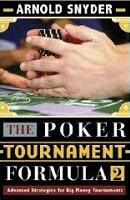
Arnold Snyder's 'The Poker Tournament Formula 2' (2008)From the PF, one then can derive both the “skill level” and “utility factor” of a given tournament. For Snyder, any tournament with a PF of more than 10 is a “Skill Level 6” tournament -- that is the top of his range, indicating the tournament should be for highly-skilled players only. His first book, by the way, focuses on the faster-structured tourneys, while the second one gets into talking about distinctions between slower-structured, “Skill Level 6” tourneys. Thus, in the second book, he introduces this idea of “utility level” to address some of the distinctions between the different slower-structured tourneys.

The increase in starting chips and extra Level 3 in the 2009 version of the $1,500 NLHE tourney means the WMPP can last 5.29 hours by folding every hand, making the PF 27.94. Still a “Skill Level 6” tourney, but now players have a much greater “utility factor” to consider.

The “utility factor” comes from comparing the PF to what Snyder calls the “starting competitive factor.” Assuming a stack of 60 big blinds gives one what Snyder calls “competitive utility” (i.e., you can make just about all the moves you’d like to make at all points during a hand), Snyder looks at how one’s starting stack compares to that figure, then multiplies that ratio times the PF to get the “utility factor.” The point here is to show that a higher PF doesn’t necessarily translate into a higher UF -- the rising blinds may still force you to action more quickly, depending on the relative ratio of your stack to the current size of the big blind.

So for those $1,500 events, back in 2008 the UF was in fact identical to the PF -- i.e., 14.93 -- since players started with exactly 60 big blinds (3,000 chips, with a big blind of 50). This year, those playing in the same events will start with 90 big blinds and the PF is higher, too, meaning their UF will be considerably higher at 41.91 (i.e., 90/60 = 1.5 x 27.94 = 41.91).

According to Snyder, tourneys with a UF between 6-20 are “Rank 1 Tournaments” in which “you definitely want to build a big stack early or bust out trying... because after an hour or two, the players who manage to build early stacks will not only be able to dominate their tables, but may also be able to play real poker against each other.”

Meanwhile, tourneys with a UF of 40-60 are “Rank 3 Tournaments.” In these “early risks are still required as you definitely need to double up before the third blind level,” but you won’t be quite as desperate early on (i.e., in the first two levels) as you would have been in a tournament with a lower UF.

All of which is to say, there’s going to be a difference here, I think, although it won’t be an inordinately huge alteration in the way the tourneys are played. I do like the changes, though, as they appear to make these $1,500 “donkaments” (as we reporters affectionately called them last summer) slightly less manic there at the very start, perhaps admitting a bit more play (or “skill”) to dictate how things go.

I should note as a postscript that not everyone buys into Snyder’s formulas and theories, but I think he has a good way of explaining such ideas and giving his readers useful ways of preparing for a variety of tournament structures.

And since we’re only two months away, I’d say it’s time to start planning!

Labels: , , ,

Thursday, March 26, 2009

Speaking of Twitter

TwitterI’ll admit to having a kind of mild curiosity about Twitter -- that social networking-slash-“microblogging” whatchamacallit everybody is talking about these days. Or tweeting about.

Since I have much more than a mild curiosity about language and modes of expression, that means I am necessarily going to be interested in this new way of communicating so many of my friends seem to have taken up. I haven’t looked into it far enough to know exactly how it all works, but do get the general idea that one signs up for an account, starts publicizing one’s activities in brief missives not to exceed 140 characters, can limit one’s readership or broadcast to the world, can subscribe to others’ feeds and “follow” them, and so forth.

If I understand it correctly, Twitter kind of resembles the “status” part of Facebook where one enters a phrase that then appears as a kind of update of what one is doing at that moment. You know, “Shamus is at the keyboard again, typing up another blog post.”

Actually, the idea of trying to say it all in 140 characters reminds me of my favorite haiku:
To express oneself
In seventeen syllables
Is very diffi
One could say Twitter has had its tipping point here in the last couple of months, having hit the mainstream in such a way that now people everywhere are discussing it and, in some cases, starting to analyze its cultural significance.

For example, I read an op-ed piece a couple of weeks ago by Leonard Pitts, the syndicated columnist who writes about politics and culture for the Miami Herald, in which Pitts criticized the Twitter phenomenon as a reflection on the shallowness of our culture. Pitts made fun of various people, including some of his media colleagues, who have been using Twitter to report on what shoes they were wearing or that their flights had been delayed. “More people have more ways to reach more people than at any point in history,” says Pitts, “[b]ut it turns out... many of us don't have a whole lot to say.”

Saw more evidence that Twitter has “tipped” yesterday, as Iggy pointed us to a piece by Jay “WhoJedi” Newnum in the Indianapolis Poker Examiner titled “How Twitter is Changing the Face of Poker.” Newnum has been involved with the poker media for sometime now -- you might remember him from some Card Player articles or guest spots on the old PokerWire podcast.

Newnum’s article is thoughtful in its reporting on the fact that like most every other aspect of our culture, more and more poker people are Twittering these days, too. (The article contains a lengthy list of those folks, if yr interested.)

Newnum’s purpose isn’t just to report on this trend, but to say that “Twitter has an even deeper impact on the poker world” in its effect on tournament reporting. Now, rather than rely on select sites to obtain information about one’s favorite player, “you can follow your favorite player and get their specific updates in real time, straight from the source” -- if, that is, your favorite player has his or her Blackberry at the table and is regularly posting such info on Twitter.

“Will Twitter replace poker tournament reporting?” asks Newnum. His answer is no, but he remains convinced that henceforth Twitter will have its effect on how people follow tourneys, with some perhaps forgoing the regular live blog-type reporting in favor of other, more specific channels of info. “[W]ith huge events such as the upcoming World Series of Poker,” says Newnum, “[Twitter] allows readers the specific content that they desire without having to wade through updates that mean nothing to them.”

Funnily enough, my instinctive response to this argument and/or phenomenon is ambivalence. That is to say, it all sort of affects me like those updates certain readers don’t want to have to “wade through.” Still find it interesting, though.

If I thought about it long enough, I’d probably share some of Leonard Pitts’ misgivings about Twitter as a reflection of our culture’s shallowness. My complaint is different from Pitts’, though. I wouldn’t fret so much about what people are writing about on Twitter, but rather over the way Twitter makes it easier for us to narrow our communications with the world by not “following” that which doesn’t already interest us. How are we ever going to learn about anything new if we’ve already decided the great majority of the the world’s offerings “mean nothing” to us?

With regard to poker tournament reporting, real time reports from individuals are neat-o, for sure, but anyone who’s played in a poker tourney knows the individual has a very uncertain, incomplete perspective on the tournament as a whole. Thus even those reports aren’t going to cut it, lacking the needed context that the live blogs and chip count pages provide. Those are always incomplete, too, of course. But they give at least some perspective, and so Newnum is right about Twitter not replacing poker tourney reporting.

As curious as I am about Twitter, I guess I have another problem with it that is a bit more personal. Anyone who has read this blog before knows what I’m talking about.

I’m up to about 5,000 characters now. It would have taken me 36 “tweets” to have said all this!

Maybe I should set up a Twitter account and try to deliver synopses of these long posts? For the “tl dr” crowd? (Too long, didn’t read.) Here is what I could have written for today:

Iggy points to interesting article from WhoJedi about Twitter’s effect on poker tourney reporting. Jedi’s right, but regular reporting not going anywhere. Not yet.

Actually, that wasn’t so diffi.

Labels: , , , ,

Wednesday, March 25, 2009

It’s a Gift

'It's a Gift' (1934) starring W.C. FieldsStill primarily sticking with limit hold’em. Have thoughts during the day -- when not playing poker -- about other games, tournaments, higher stakes, new challenges. But those thoughts all tend to evaporate when I log on to squeeze in the usually brief session I try to play each day.

Of course, being a recreational player makes it tough to pursue loftier goals. Or any goals, really, other than just finding something enjoyable and sticking with it. And maybe making a little cabbage, too.

The fact that I’m winning (modestly -- hovering under 2 big bets per 100 hands) also makes it less enticing to do anything differently. Will have to push just a little here over the next week to maintain my Silver Star over at PokerStars, which now only requires 1,200 base FPPs per month. I want to do that, as I have now gotten into the routine of taking the $50 whenever I reach 5,000 FPPs -- perhaps not the best investment of the points, but one that makes sense for someone like me who just about only plays cash games and isn’t looking to parlay a couple of freerolls into the Sunday Million.

Continue to encounter all varieties of players at $0.50/$1.00, including some spectacularly bad ones. Had a fairly typical example at my six-handed LHE table yesterday limping every single pot, then calling every street until the river where he’d fold unless he happened to make a pair. Was looking in PokerTracker after and saw how in over 100 hands he’d voluntarily put money in the pot 87.5% of the time, only raised preflop twice (pocket aces both times), won only 33.33% of his showdowns, etc. Fairly easy to spot these guys, against whom one simply has to wait for a hand, then value bet.

Meanwhile, I had a couple of other players at the same table who had bought in for $100 each. (Was writing about stack sizes in limit hold’em a couple of weeks ago.) One was up a bit, one was down. But I was watching both warily, operating according to the standard prejudice that their big stacks might suggest they were better than average players.

Now that I think about it, while a lot of times I just hop onto the first open table -- reckless, I know -- when given a choice I’ll pick the table with more small stacks, again thanks to this same prejudice. Didn’t do that yesterday, obviously.

In any event, the one guy who had bought in for $100 who was down about ten bucks or so was sitting on my immediate left. He seemed to be playing very few pots. As a result, I hadn’t really noticed what he’d been showing down, so I didn’t have much idea about him when I picked up JdQc in the big blind. It folded to the cutoff -- a loose-passive type -- who called, the button folded, and MrHundy completed in the small blind. I might have raised here, but I was playing this one passively myself, and so checked my option.

Flop came As8d5c. MrHundy checked, I’m not interested at all and check, and the cutoff also checks. Turn is the Kd, and again we all check. River the Th. How about that? Easy game. MrHundy checks, I bet, the cutoff thinks a bit and calls, and MrHundy also takes a moment before calling. I show my Broadway to win the small pot. The cutoff had Td9d -- middle pair and a busted flush draw.

What did MrHundy have? AhAc.

Will have to think of a name for this kind of hand -- sort of the opposite of a “So It Goes Hand,” really. A hand in which you make no mistakes, but also exert little or no effort, and surprisingly win thanks to someone else’s bungling. You know, the kind of hand where you realize when the pot is pushed your way that you Got It For Taking up space....

Oh, right. There’s already a name for that.

Labels: , ,

Newer Posts
Older Posts

Copyright © 2006-2021 Hard-Boiled Poker.
All Rights Reserved.