Tuesday, May 20, 2014

Skill, Luck, and Testimony

James McManus (Positively Fifth Street, Cowboys Full) yesterday contributed a column to the BloombergView website titled “Good Poker Players Aren’t Lucky” in which he shares details of a recently resolved misdemeanor case in Idaho involving two defendants charged with illegal gambling for having played poker.

As McManus explains, the defendants pleaded not guilty on the grounds that poker is a game of skill and therefore not covered by the anti-gambling statute they were charged with violating. A pretrial hearing was held in April to consider the defendants’ motion to dismiss the charges, with McManus himself among the witnesses who testified on their behalf.

McManus summarizes his testimony in the column, including sharing how he introduced a couple of different studies confirming poker’s skill component. I wasn’t familiar with one of them, a 2012 study called the “Economics of Poker: The Effect of Systemic Chance,” although its methodology and conclusions seemed to resemble those of a different study put out by Cigital, Inc. that I wrote about here back in 2009, called “Statistical Analysis of Texas Hold’em.”

The other study McManus shared was one I have read before, the one Freakonomics author Steven Levitt wrote with Thomas Miles titled “The Role of Skill Versus Luck in Poker: Evidence from the World Series of Poker.” Click here for a summary of that one, if you’re curious.

The testimony of McManus and others proved constructive for the defendants, as the judge in the dismissed the charges late last week. Sounded like it wasn't even close, actually, either confirming the skillfulness of the defense or the luck of drawing a receptive judge. “The case nudges Idaho, and perhaps other states, closer to understanding that the skill-to-luck ratio of America’s national card game makes it much more like playing baseball or the markets than like hoping a craps or keno or lottery number comes up,” concludes McManus.

Of course, objections against poker aren’t entirely informed by the hard-to-maintain case that it doesn’t involve skill and/or its affinity to other gambling games requires it be legislated similarly. Many people -- including legislators and other adjudicators -- don’t like poker for other reasons, too.

It’s a game in which money is an essential element, and while most of our lives are determined by the various games we play with each other for money, a lot of people are just too darned uncomfortable with being so explicit about doing so as poker requires us to do.

Labels: , , , , ,

Tuesday, March 31, 2009

Cards & Chance

Had one of those weird hands of limit hold’em yesterday (six-handed, $1/$2) in which I folded what would have been the best hand. Having trouble finding the hand in my hand history, so I cannot be as specific as I’d like about how it went down.

Was one of those three-handed situations in which my two opponents were aggressively semi-bluffing draws and I decided to get out with just ace-high. Can’t remember the exact board -- something scary like Q-Q-9-T with a couple of diamonds and I held Ah7h or the like. Ended up neither made his draw and the fellow with king-high ended up taking down the pot.
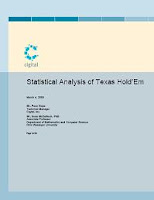
I call it a “weird” hand, but in fact, according to this new “Statistical Analysis of Texas Hold’em” released late last week by Cigital, Inc., it isn’t so weird at all for a player holding what would’ve been the winning hand to fold out before the showdown. In fact, it happens all the time.

You probably heard about this study. Researchers looked at 103,273,484 hands of hold’em played on PokerStars between 12/1/08 and 1/2/09. They only looked at cash games (no tourneys, no play money). They chose full ring or six-handed hands (no heads up games). And they generally avoided the microstakes since according to the researchers they “are considered too much like play money games.”

Of the 103 million-plus hands considered, 75.7% of the hands never got to showdown. Then, of the other 24.3% of hands, just over half of those (50.3%) “were won by the player who could make the best 5-card hand.” That is to say, only half of those hands -- or about 12% of the overall hands -- were actually won by the player originally dealt what turned out to be the best hand, with the rest of the showdowns “won by someone with an inferior 5-card hand because the player with the best 5-card hand folded prior to showdown.”

My vaguely remembered example above would’ve fit the criteria as a hand in which a player holding the best hand did not win the hand because he folded before the showdown. In fact, I’d venture to guess someone else at the table -- one of the players who folded before the flop -- probably folded a hand that would’ve beaten my ace-high.

The authors of the study maintain that while their “study does not quantify the effect that luck has on Texas Hold’em, it provides compelling statistics about the way that the outcomes of games are largely determined by players’ decisions rather than chance.”

'Statistical Analysis of Texas Hold'em' by Cigital, Inc.If you are interested, you can download the study here. As someone with an occasionally geeky interest in numbers, I would’ve liked to have seen the study share a more thorough breakdown of numbers. (My brief summary above essentially contains all of the pertinent stats mentioned in the report.) There’s some interesting stuff in there about their methodology and efforts to minimize error, though.

And their point is made, I think. Kind of an interesting approach to the whole “skill-vs.-luck” question, which I guess does ultimately show that it isn’t as though we’re all just sitting around the table hoping to hit hands. Some of us are, sure. But the rest of us are taking chips from those guys.

I think it is safe to say this study does not “prove” poker (or hold’em, specifically) is not “a game subject to chance,” to use the phrase one finds in the Unlawful Internet Gambling Enforcement Act of 2006 to describe gambling.

Of course, that doesn’t seem to have been the researchers’ intention. Their disclaimer at the beginning that their “study does not quantify the effect that luck has on Texas Hold’Em” essentially admits that luck does play some role in the game. Their purpose, rather, is to show that it isn’t entirely “subject to chance,” and that, given the way the numbers broke down, more often than not players’ decisions determine the outcomes of hands.

But part of me wants to say that even those hands that get folded before the showdown involve a certain element of chance. Don’t they? Let’s say you were me in that hand from above, the one in which I got bet out of a hand even though I was best. My opponents’ raising war on the turn forced me out, but those four community cards did, too. And none of us had any control over what those were going to be.

Kind of a chicken-or-egg type argument, I know.

Food for thought, I guess. Mmm... I think a chicken-and-egg biscuit would be a good way of resolving the matter.

Labels: , ,


Older Posts

Copyright © 2006-2021 Hard-Boiled Poker.
All Rights Reserved.