Tuesday, March 24, 2009

The Seven (and Eight) Percent Solution

'Poker Winners Are Different' (2009) by Alan SchoonmakerAt the start of Dr. Alan Schoonmaker’s new book Poker Winners Are Different, he begins by pointing out that overall the great majority of people who play poker lose at poker. Thus, poker winners are not only “different” -- they are uncommon, too, relatively speaking.

According to Dr. Al, “many experts estimate that -- because of the rake, tips, and other expenses -- 85-90 percent of all cardroom and online players are long-term losers, but they have no solid data.”

So basically an anecdotally-based claim there, somewhat supported by the fact that “many experts” are making it.

For further support, Schoonmaker then quotes Jay Lovinger, who had that “Jackpot Jay” column over on ESPN.com for a while a couple of years back. I remember reading that column, which I believe predated the “ESPN Poker Club,” Phil Gordon’s Poker Edge podcast, and all the other pokery stuff they have going on over on the site these days. Glancing through the archives, it appears Lovinger hasn’t written for ESPN since 2005.

Jackpot JayIf I remember the column, Lovinger was kind of an “average Joe”-type of poker player who wrote about his experiences trying to make it as a professional poker player for one year. Lovinger played both online and live, and in his columns talked about how it was going, including reporting his wins and losses. He went to the WSOP that year and wrote about that, too (à la James McManus and others).

My memory is that Lovinger didn’t fare all that well, or at least didn’t seem to from the columns I read. Which probably made the columns all the more interesting, actually.

In his book, Dr. Al points to one particular column Lovinger wrote called “Jay Delivers the Commandments” and looking at the column I see the headnote saying that it represents his last piece for ESPN. One of his “commandments” is titled “It’s a Tough Way to Make an Easy Living,” and it is from that one that Schoonmaker quotes Lovinger referring to a conversation he had with two different members of “online poker site management” who wished to remain anonymous.

Those two online poker site managers told Lovinger at the WSOP that summer that “only 8 and 7 percent, respectively, of all players on their sites finish the year in the black.” Lovinger also notes how even though the sites do track this information closely, “they are not about to publicize the results.” (Kind of relates to the point I was talking about yesterday with regard to tracking and reporting how people do in tournaments.)

Thus does Schoonmaker present some relatively hard evidence that yes, indeed, most players are losers, at least online. The rest of the book then discusses numerous qualities that the winners possess, providing a lot of useful advice and strategies for self-assessment along the way. A good read, and definitely helpful, I’d say.

I was very glad to see this reference early on, though, as I remember reading something very similar in an issue of Card Player about three years ago. It was an article about the booming online poker scene -- this was prior to Bush signing the Unlawful Internet Gambling Enforcement Act of 2006 into law (in October ’06). I remember distinctly reading how an online site manager who wished not to be named said that only 7 percent of the players on the site finished the year with any profit whatsoever.

One has to assume a good number of those among the players being tracked are those who make small deposits, lose it all, and never return. Even so, of those who make another deposit and stick around, one can probably assume the winners are in the minority.

I’ve mentioned that statistic on Hard-Boiled Poker once or twice, and have noticed when looking at traffic that a number of people have found those posts after searching for stats about winners and losers online. Some people want to know this stuff, it seems. Have more than once searched back through the old issues of Card Player to find the exact reference, but never could.

'The Seven-Per-Cent Solution' (1974) by Nicholas MeyerSo I was very glad to see Schoonmaker’s quote of Lovinger at the beginning of his book confirming that statistic. Indeed, reading it kind of felt like finally solving a long-term mystery for me.

So if you happen to be up online -- even just a few berries -- welcome to an exclusive club. Even if the forums suggest otherwise.

Labels: , , , , , , ,

Monday, March 23, 2009

For the Record (Thoughts on Tracking Tournament Winnings)

Mike Matusow's cashes at the 2008 WSOPYesterday I happened to be hunting around over on Hendon Mob looking up players’ stats. That’s the comprehensive, quite reliable site that compiles poker tournament winnings and presents them in a way where one can quickly see a player’s cashes, overall earnings, year-to-year stats, and so forth. Nearly 100,000 players are listed there.

Came across one dude’s totals and when I saw his lifetime earnings had one of those “yeah, but” moments as I wondered just how many tourneys he’d actually entered. I started to think about how it would be interesting for someone to compile statistics that included the number of tourneys a person had played, thus providing some added context to the number of cashes and total winnings.

I mean, the way it looks over on Hendon Mob, everyone is winning and no one is losing. All cashes, no fees.

Was pondering this one a bit more as the day wore on. I thought that while it would be improbable to expect all tournaments everywhere to make available complete lists of entrants to a site like Hendon Mob, perhaps the World Series of Poker and the World Poker Tour could handle such a thing with regard to their respective series of tournaments.

If the WSOP began keeping track of all entrants this way, they could compile databases such as one finds on PGA.com and its associated sites. Those guys keep track of everything everyone does it seems, including cuts made, scoring average, driving distance, greens in regulation, how they did on par threes, and so on.

If all entrants in poker tourneys were tracked, the WSOP could (say) for a given year show us who had the best ROI (return on investment) percentage, who did best in the higher buy-in events, who had the most cashes per entry, and the like. And eventually statistics could be compared from year to year, adding further information to consider when debating players’ relative abilities.

Later in the day I listened to Mike Matusow interviewed over on the Wise Hand Poker podcast (the 3/18/09 episode), and coincidentally he spoke to Wise about how in his opinion he had “the best year in the history of poker” in 2008, even though “nobody really wants to put it on record and say what kind of year [he] had.”

According to Matusow, he played in 21 tourneys, cashed in 11, made five final tables, and won one, Event No. 18 at the 2008 WSOP, the $5,000 No-Limit Deuce-to-Seven Draw w/Rebuys event. (By the way, that picture above lists Matusow’s 2008 WSOP cashes.) “Nobody realizes I only played 21 tournaments... when most people play a hundred,” he added.

Of course, 11 cashes looks impressive, anyway. But out of 21 tourneys -- if that’s accurate, well that is fairly special.

At first I thought Matusow was implicitly supporting this idea I had about keeping track of folks’ entries in order to produce stats which more closely indicated how well players were performing.

Then I realized -- what a horrible idea. Why?

Because the publication of such information, while perhaps satisfying fans’ curiosity, would likely have a detrimental effect on the players. And the tournaments, too. The WSOP or WPT would have little to gain, I would think, from showing all of its players (and the rest of the world) exactly how much they’ve lost over the course of their respective series. Could possibly discourage some from entering tourneys, even. In any event, I can’t really see how it would help.

A remarkable SharkScope graphOf course, sites like SharkScope (where the graph on the left representing one player’s stats appears) have made the publication of such information about players’ performances in online multi-table tourneys and sit-n-gos a significant part of that world, with players routinely looking up their opponents’ stats which do not hide the number of times they failed to cash. (SharkScope focuses on SNGs, while other sites provide similar info regarding MTTs.) I don’t suppose those sites have negatively affected the popularity of MTTs and SNGs -- in fact, one could perhaps argue they have added to their popularity (?) -- but I think the story for live tournament poker is considerably different.

Such are among the many special considerations those who wish to market poker as a sport -- particularly the professional tourney circuit -- have to keep in mind. The fact that most players pay their own way (aside from the lucky few whose sponsors pay their entry fees) means they cannot be treated the same as, say, those who secure PGA Tour cards or who qualify for the Sunday NASCAR races.

So it isn’t just that “nobody really wants to put it on record” how Matusow did last year. Nobody wants to put it on record how anybody did, I think. Not really.

Labels: , , , , ,

Friday, March 20, 2009

Confessions of a Non-Gambler

A Vegas sportsbookI am a huge basketball fan, especially college, and so always follow the NCAA tournament fairly closely. Used to play a lot of hoops, which I think makes the game all the more interesting to watch. Haven’t played so much over the last few years, although every now and then I will come out of retirement to sink the odd fifty-footer.

I also would generally always join a pool or two, sometimes expending a lot of effort during Monday, Tuesday, and Wednesday deciding how to fill out them brackets, then -- usually -- watching my carefully-calibrated prognostications all rapidly turn to dust by Thursday evening.

I recall particularly enjoying one variation in which one was rewarded with bonus points for picking upsets correctly, with the stakes going up with each round (including the bonuses). Also, you didn’t fill out the whole sucker beforehand, but picks were made before each round, meaning you were never really out of it on Thursday. (But you could be toast by Saturday, I think.)

It’s been a few years, though, since I’ve bothered with the brackets. I did half-heartedly fill out one over on ESPN at 11:30 a.m. yesterday, and see this morning I’m in 4,268,437th place heading into the second day of play. Sounds about right.

While I’ve always been a sports fan, I never took much interest in sports betting, and I think since getting into poker I find myself even less inclined to gamble in that way than before. I know for many the opposite is true, with poker playing encouraging the desire to bet on sports or engage in other games of chance. Probably more so if one is a live player and thus usually not that far from the sports book and everything else the casino has to offer. But even online it isn’t that hard to click on over to the Bodog Sportsbook or other such places to lay yr moneys down.

For me, though -- and perhaps for many others, too -- poker satisfies whatever “gamble” is in me just fine.

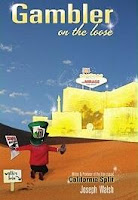
Joseph Walsh, 'Gambler on the Loose' (2008)In Gambler on the Loose (2008), Joseph Walsh’s whimsical collection of autobiographical essays-slash-prose poems, Walsh tosses out dozens and dozens of maxims about gambling -- some uncanny in their precision and apparent accuracy, some obscure to the point of impenetrability, most hiliarious. I’ll quote just one:

“When it comes to handicapping, keep in mind you are handicapped.”

Of that I am acutely aware whenever I have tried -- in earnest -- to predict the outcome of a sports contest. Talk about a “game of partial information”!

In any event, I hope everyone has a good weekend watching all those games of partial information in high definition.

Labels: , , , ,

Thursday, March 19, 2009

I Am Irony Man

Hellmuth doing what he loves bestYesterday a poster on Two Plus Two started a thread with the title “Who the hell is Matt Hawrilenko???!?”

The question was received with the usual dignity and aplomb such queries generally receive on 2+2, with the discussion quickly veering into a debate over what a “level” is, then someone asking the poster “Who the hell are you???!?”

The question does get answered, though. For those who do not know, Hawrilenko is perhaps best known as “Hoss_TBF,” the name under which he plays on several sites. He’s a highly successful online pro, having numerous big scores in tourneys as well as a formidable reputation as a limit player. He’s a “red pro” on Full Tilt, where he even has his own special $2,000/$4,000 heads up LHE table. As far as live play goes, he has a handful of World Series of Poker cashes, including a couple of final tables (one in a LHE event, the other in stud).

I heard Hawrilenko interviewed on the Two Plus Two Pokercast back in October -- around the time he was made a “red pro,” I believe. I remember him as a smart commentator who was able to articulate some genuine insights about high-stakes limit games.

Anyhow, the reason why the poster was asking about Hawrilenko is undoubtedly because of the fact that a little over a week ago “Hoss” played a lengthy session of LHE with Phil Hellmuth over on UltimateBet, after which Hawrilenko posted the chat from the session on his personal blog.

The day did not go well for Hellmuth, who (as we all know) finds it useful to call his opponents “morons” and the like whenever such a situation arises. Hawrilenko fires back some hilarious responses to some of Hellmuth’s Tourette’sish outbursts. For example:

PHILHELLMUTH: ******* op IDUIOT
PHILHELLMUTH: wtyf
HOSS_TBF: there is a program called mavis beacon teaches typing which
HOSS_TBF: i found very useful and you may as well


A little later, after Hellmuth whines “this isn’t aupposed to happen” (sic), Hawrilenko politely suggests: “phil, this is sincere: maybe you should do your breathing... exercises… i honestly do not want you to have another panic attack.”

It gets better. “I should have 50k right now,” complains Hellmuth. “Maybe if you started with 200k,” Hawrilenko opines.

Later Hellmuth, directing his comments not just to “Hoss” but to the rest of the table, cries “y’all are so awful I feel like ****,” to which Hawrilenko sensibly responds “you’re a silly goose.” Most of the Poker Brat’s attacks are reserved for Hawrilenko, though, whom Hellmuth says “plqys every single pot... and pays off like a slot machine.”

*exactly* like a slot machine,” Hawrilenko cheekily points out.

Anyhow, you’ve probably already heard about the most outrageous bit of chat to come from the UB-sponsored pro during this hilarious-though-disgraceful display. At the very end of the session, Hellmuth tells the table “congrats this is my biggest loss in two years playing online.” Just before that comes the following:

PHILHELLMUTH: wow amazing
PHILHELLMUTH: hoss Im having scurity review this session first time ever
PHILHELLMUTH: thats the truth


I’ve written before here about the amazing lack of self-awareness Hellmuth consistently demonstrates. But we’re through the looking glass here, for sure.

Try to imagine someone who has never heard of irony. Say he comes from another species whose capacity for abstract thought is limited in such a way that the concept is wholly alien. Explain to that person the sordid history of UltimateBet -- how players on the site were cheated out of millions of dollars over four-plus years, how the site subsequently mishandled the situation, how Hellmuth has been a paid representative since the site began, and so forth. Even that person might at least recognize something a little askew in all of this.

Wait a minute. We don’t have to imagine such a person utterly incapable of understanding irony. We know one already.

Labels: , , ,

Wednesday, March 18, 2009

Moments of Inspiration

PokerStars Blog One Time Chip™Was following the PokerStars blog last night. (By the way, I will be back on there before too long helping out with coverage of PokerStars’ Spring Championship of Online Poker [SCOOP] in April.)

Otis & Change100 are down in Uruguay covering the current Latin American Poker Tour stop. Before they get Day 1 of that sucker going today, they were finally playing out that tournament that had been interrupted back in December in Nuevo Vallarta, Mexico.

You remember Dr. Pauly’s reports from that one. Local officials came in and stopped the proceedings with 89 players left, and they ended up paying out the prize pool according to chip stacks at the time play was interrupted. Stars then invited the 89 to play an online freeroll down to nine, then had those nine meet up again yesterday in Uruguay, with Stars throwing in an extra 50,000 berries for the final tablists.

Anyhow, once they had gotten down to heads up last night, the bloggers were describing how one player, a fellow named Rory Cox, had pushed all in on a J-8-4 board. Cox held middle pair -- K-8 -- and got called by his opponent, Helen Prager. Prager also had middle pair with 8-3, but Cox had her outkicked. Prager had Cox covered, so he needed to sweat the turn and river and hope a trey didn’t pop out in order to stay alive.

“Hold just one time,” pleaded Cox. That prompted our intrepid bloggers to pull out something with which I was previously unfamiliar -- the official PokerStars Blog One Time Chip™ (pictured above).

In this explanation (from the recent EPT Copenhagen stop), PS blogger Howard Swains gives his colleague, Stephen Bartley, credit for the idea. Having helped with the live blogging at last summer’s World Series of Poker (for PokerNews), I am somewhat familiar with how those long days can occasionally encourage such creative shenanigans among those reporting.

Pretty inspired, really, this here One Time Chip™. The idea is that rather than have to endure players calling out “one time!” over and over again, the player tosses out the chip and, if he or she survives the hand, the player cannot do so again. (Kind of reminds one of Staples’ “Easy Button.”)

Anyhow, the PokerStars Blog One Time Chip™ appears to have worked for Cox. His hand held up, and he went on to take the title.

Was trying to come up with some other, similar innovations, though since I’m almost entirely an online player, all of my ideas came from the game we play on the internets. I’m sure you folks who regularly play live could think of some other ones that more closely fit with the PokerStars Blog One Time Chip™ idea.

The best one I came up with would be a method of handling those who complain about the game being somehow rigged to cause them to lose -- the ones Bill Rini refers to as “rigtards.” This here ideer would be easy enough to implement, and in fact I’d bet Julius Goat, inventor of (among other things) the Donkavatar, could probably tell us how to do it.

How does it work? Simple. Whenever a player chimes in the chat box with a “so fking rigged” following a hand, one could right-click over his or her avatar and choose to adjust it accordingly:

Tin Foil Hat Application

Labels: ,

Tuesday, March 17, 2009

I Know I’m Not Too Awesome Today

I'm tiredNot too much to say this morning, I’m afraid. Had a tidal wave of non-pokery stuff sweep over me the last couple of days. Lots of work-related matters suddenly crashing all around me. And some other, personal stuff, too.

All is well, but a bit tired today. And not too much to say.

If I had the energy, I might write a post that tried to respond earnestly to that Ed Miller column appearing in the most recent Card Player (Vol. 22, No. 5, dated March 17, 2008), titled “When Do I Know I’m Awesome?” I’ll add a link here when it eventually turns up over on the CP site. For now, you can read it on Miller’s blog, where he posted it yesterday. (Although I think eventually that will become unavailable.)

Since I lack the needed energy at the moment, I’m not going to get into the argument that deeply. As the title suggests, Miller is addressing that question of self-assessment, particularly with regard to whether or not one should consider moving up in stakes. As a long-time small-timer, it’s an issue over which I’m frequently fussing, for sure.

In his response to the question, Miller refuses to provide any sort of numerical formula about win rates or the like. Rather (he concludes) we’re talking a primarily psychological struggle here: “If you simply can’t get your brain there [to the higher stakes game], move down in stakes until you can.”

Along the way, Miller throws out a couple of premises for his argument regarding the psychology of poker. One is to say that despite being a “social game,” poker is essentially a “solitary exercise.” One reason for this is that “no one knows how much you’ve won or lost today, this week, or this month” -- probably true for most of us -- to which he adds “no one cares.” The latter may or may not be true for most of us, I’d think. But we get the point. For most intents and purposes, we’re on our own, for sure.

This solitary nature of the game leads Miller to his second premise, namely, that since we’re on our own it is often very difficult to tell how we’re doing. “There’s no good way to measure whether you’re a good player or not,” Miller claims, adding “It has to come from within.”

A little vague there, perhaps. (What is “it”?) Like I say, if I had more energy, I’d try more earnestly to unpack.

Even “Your results are irrelevant” when it comes to this business of self-assessment, says Miller. We’ve heard that before. And we’ve rejected it outright before, too. Even if we know we shouldn’t.

Interesting stuff. I’d like to think there are ways to measure our progress. But whatever they are, they take work. And energy. And focus. And will.

And well... I’m a little too tired today for that.

Labels: ,

Monday, March 16, 2009

On Something Else That Will Never Happen

What if?On last week’s episode of The Poker Beat (3/12/09), host Scott Huff led another engaging roundtable discussion of a few different pokery topics with B.J. Nemeth (World Poker Tour), Dan Michalski (Pokerati), and Gary Wise (ESPN, Wise Hand Poker). After they were done, Huff had Matthew Parvis (Bluff Magazine) on primarily to talk about that Bluff Online Poker Challenge.

One topic the initial gang of four spent some time examining was this recent “challenge” issued by the online training site BluefirePoker whereby the site is “offering $1,000,000 to President Obama or any member of the U.S. Congress willing to play a poker game against any of their poker pros, and the winnings can go to the charity of choice.” As the site explains (I’m quoting from their presser), BluefirePoker is willing to “put up $1,000,000 against $1 for a chance to play” with either Obama, a House representative, or a senator.

The point, says BluefirePoker, is to address the issue of “whether or not Poker is a game of chance or skill,” since that issue is currently a focus of attention in most legal debates over poker. “No one in their right mind would turn down this challenge if Poker were a game based on luck,” claims Bluefire, “because the odds are so far in their favor -- putting up $1 for a chance to win $1,000,000” for one’s chosen charity. Further details of the contest were left to be determined, although Bluefire stipulates that “the length of the game must... be long enough to demonstrate the advantage of skill because Poker prowess and experience demonstrate themselves over time.”

More than a little bit cheeky, this whole challenge thing. But it did get some national press last week, with even Fox News devoting a minute to reporting it. Fox News also spent some time reporting on dogs learning how to surf, I saw, so take that however you will. In any event, a few more of us have certainly heard of BluefirePoker now.

The discussion of the challenge on The Poker Beat was interesting, though the fellas spent way too long speculating exactly how the event would go down and how it would be viewed by the public. When Parvis came on afterwards, he sensibly noted that the challenge “is just never going to happen” -- that “there is not even a remote chance of it” actually taking place.

Indeed, BluefirePoker seems to be admitting as much when they suggest that “No one in their right mind” would refuse the challenge if it were true that poker is a luck-based game. In other words, according to BluefirePoker, by not accepting the challenge, Obama and Congress implicitly admit that poker is a skill-based game. Which appears to be the whole point here. (Whether or not it is a good point is another question.)

So if even those issuing the challenge do not mean for it actually to be accepted, it probably doesn’t make a lot of sense to discuss it as if it were.

Mark TwainThe challenge reminds me of a short story written by Mark Twain back and published around 1870 called “Science vs. Luck.” Twain was himself a poker player, and often explicitly defended the game as a worthwhile pastime. I suppose you could say the story is in its own way a defense of card-playing, too.

In the story, Twain imagines a trial taking place in Kentucky in which a dozen boys have been arrested for gambling. The boys had been playing a card game called “seven up” and betting on the outcome, and their lawyer decides to defend them by trying to prove that the game is based on skill (or “science”) and not luck, thereby demonstrating that they were not, in fact, gambling.

Both sides argue their respective positions, but no verdict is reached. It is therefore decided (somewhat preposterously) to play it out to settle the issue. Six clergymen, all of whom want to say the game is gambling, sit down to play some “seven up” with six laymen who believe the game is based on skill (or “science”). After several hours of the clergymen getting crushed in the game, they finally return with all in agreement that the game is, indeed, based on science and not luck, and the boys are acquitted. (If you are interested, you can read the story here.)

Twain’s story is obviously a fabulous fiction, and so probably shouldn’t be read as necessarily corresponding to reality in a direct fashion. Even so, I have always found the story problematic, since it seems to me that after losing the clergymen would be more likely to call it a luck-based game than not.

I mean, really, in poker isn’t it the losers who usually call the game luck and winners who call it skill?

In fact, rather than “prove” the card game is skill-based rather than based on chance, Twain’s story seems to me more obviously to prove the futility of “playing it out” to try to determine the question.

As would the BluefirePoker challenge, yes? Not that it will ever happen.

Labels: , ,

Friday, March 13, 2009

The “So It Goes Hand”

So it goesPut in a lot of hands yesterday -- for me, anyway. As I crept closer to clearing that deposit bonus on PokerStars, I decided just to push on through and get there and so ended up playing longer than I normally would. Had kind of an up and down day, ending about $15 down altogether, though scoring the extra $50 made it easier finally to walk away.

I have gotten into the habit here lately of not chatting at all (not that I ever did a heckuva lot of chatting previously), but yesterday broke that habit a few times to tell opponents “gh” after they had played well against me. I also might’ve added a “gh” or two after a couple of hands that weren’t necessarily well played but ones where I’d experienced some misfortune.

When I talk about my “misfortune,” I suppose I could be accused of referring to “bad beats,” although I’d like to draw a small distinction before I describe an example. And maybe coin a term while I’m at it. And yes, I am proceeding here with Cardgrrl’s admonition against bad beat stories from earlier this week in mind.

'The Poker Encyclopedia' by Elkan Allan and Hannah MackayIn The Poker Encyclopedia, Elkan Allan and Hannah Mackay define a “bad beat” as a “situation in which a player with a high expectation of winning the pot fails to win it.” They add that bad beats can come in a couple of varieties, with either a strong hand being beaten by an even stronger one (e.g., quad aces over quad kings) or an opponent hitting an improbable draw. However, what is most essential for it to be a bad beat, according to our encyclopedists, is that it involves a circumstance in which “luck mysteriously outmanoeuvers skill.”

So actually, the example of a strong hand being beaten by an even stronger one doesn’t necessarily have to be a “bad beat” if, in fact, both players play the hand with equal skill. Sure, “luck” does appear to trump “skill” in such a situation, but it doesn’t seem right (to me) for the loser to come away talking about the hand as a “bad beat.”

Here’s a quick example of the kind of hand to which I’m referring. We were five-handed, and I’d been at this same table for quite some time, meaning I had a good feel for how the other four players tended to play (or thought I did, anyhow). I was UTG (which could also be called the “hijack” seat in this short-handed game) where I picked up pocket deuces. I raised -- something I don’t always do with a pair of ducks, but the game was such that an UTG raise was sometimes enough to take the blinds. All folded except the big blind.

The flop came 3c2s4c. My opponent checked, I bet my set, and he called. The turn was the Qh. Again, the BB checked, I bet, and he just called. I considered ace-five as a possible holding, but would’ve expected a check-raise on the turn had that been the case. Seemed a lot like he was on a draw, or maybe had made a pair of some sort. The river was the 8s. He checked, I bet, and he check-raised. Queen-eight? Queen-ten? Ace-eight? A bluff? What would you do?

I three-bet, deciding it more likely than not my set was best, and he capped it. I called, and he turned over 6h5d to take a nice-sized pot.

I had to tell him “gh” as he certainly got the maximum out of me. Thinking about it from his perspective, waiting until the river to push might’ve been unorthodox, but if he’s putting me on high cards or a big pair, he hasn’t too much to worry about with that flop (other than a club draw, of course).

Going back to the encyclopedists’ definition of a “bad beat,” sure, luck played a role here. If I play the hand “perfectly,” I’m still going to lose (though perhaps not as many bets as I ultimately did). But I can’t really argue that luck “outmanoeuvred” skill in the hand, can I? (If I’m going to spell that word the British way, that is.)

This might not have been the best example, but what I’m talking about here isn’t so much a “bad beat” situation but an “I’m doomed” situation such as is sometimes referred to as getting “cold decked.” That term, of course, refers to an example of cheating whereby a deck has been prearranged to be dealt out in a certain sequence to ensure the outcome. The term originates from the fact that when the new, prearranged deck is introduced into play, the cards are cool to the touch because they haven’t been handled yet by the players.

But to say I was “cold decked” still sounds like I’m saying I was treated unfairly somehow. Yes, it was bad luck, but luck -- both good and bad -- is part of the game. When that dude who made a king-high flush paid me off big time with my ace-high flush the day before, he felt the same way. But it wasn’t a “bad beat” I’d laid on him, nor was there anything unfair about what had happened.

In my search for an apt descriptor, I’m resisting using another phrase that Cardgrrl recently devalued -- “It is what it is” -- an often-used, hands-up-in-the-air type phrase which I also don’t care for all that much, either.

We could call it a “Que sera sera hand” (whatever will be, will be), although that phrase has a couple of significant strikes against it. It is foreign, which sounds pretentious. And it introduces that Doris Day melody in our heads which is static most of us probably don’t need.

See, I’ve done it to you just now. Sorry.

'Slaughterhouse Five' by Kurt VonnegutSo I’m going to call it a “so it goes hand.” That’s the phrase -- “so it goes” -- Kurt Vonnegut uses about a hundred times or more in Slaughterhouse Five as a kind of shoulder-shrugging refrain in response to the various horrors life can produce. I like the way “so it goes” connotes both an acceptance of what has happened while also looking forward. The phrase might sound a bit too much like we’re relinquishing control over our fate altogether, though I think as long as we keep in mind it is only the past that is now beyond our control, we’re okay to move on.

The “it” is an ambiguous pronoun, its referent dependent on the speaker’s relative attitude, I suppose. “It” could mean “the way I always keep getting screwed.” Or “it” could simply mean “the game,” which “goes” on, ready or not. That second meaning is the one I prefer.

Maybe it seems awkward to refer to a hand as a “so it goes hand,” but I’ll throw it out there, nonetheless. Even if one doesn’t use the term, I think it is a good way to think at the tables. And -- not unlike telling someone “gh” -- probably has a beneficial effect on one’s overall mood.

I swear I got all of the way to the end of this before I realized the acronym produced by the phrase “so it goes hand.” That seals it.

Just try not to sigh too heavily when you say it, okay? Not looking for pity here.

Labels: , ,

Thursday, March 12, 2009

Stack Sizes in Limit Hold’em

Well of course size matters, silly!Have been continuing to play mostly brief sessions of $0.50/$1.00 fixed limit hold’em, almost exclusively six-handed. Spending most of my playing time on Poker Stars, where I’ve nearly cleared that deposit bonus I mentioned going for last month. I’m also Silver Star now, and so as soon as that deposit bonus clears I’m going to go ahead and trade some FPPs for cash as well.

Incidentally, if you hadn’t heard, Stars has lowered the FPP requirements for its VIP program. It now only takes 1,200 FPPs in a given month to reach Silver Star, and 3,000 FPPs for Gold Star. That means it will be a cinch for me to maintain Silver, and I could even conceivably push for Gold one month if I really wanted to do so, although I’m not really seeing much purpose to my doing that.

I essentially made the move back over to LHE from pot-limit Omaha on New Year’s Day, and so far the year has gone fairly well. To be honest, my profit per week has been about the same playing $0.50/$1.00 LHE as it was playing PLO25 and PLO50 (though much less swingy, natch). Not sure if that means I’m a better LHE player than PLO player, equally bad at both, or nothing at all. Likely the latter. In any case, I’ve been eyeing my win rate and bankroll and starting to have thoughts about moving up a notch to $1/$2 (where I’d been when I last played LHE regularly online about a year-and-a-half ago).

Over the last couple of weeks I’ve begun to notice one issue that I didn’t even really think was much of an issue when I came back to LHE -- stack sizes. Theoretically of little (or no) consequence, right? I mean it is fixed limit, so who cares if you have $20 or $200 behind?

No-limit and pot-limit games are fundamentally affected by stack sizes, which necessarily figure into just about every decision someone makes. When I was playing PLO, I finally got to the point (after several months of experimenting) where I routinely bought in for the maximum, which seemed to be the most potentially profitable choice given my style and skill level relative to that of my usual opponents.

Moving back over to fixed limit hold’em, I’ll admit I didn’t really give the buy-in much thought at all. Usually I just took whatever default buy-in was suggested to me by the software. PokerStars suggests $20 for the $0.50/$1.00 games, so that’s what I took. Full Tilt Poker suggests $10, and I similarly just clicked on through and sat down with the suggested amount over there, too. Necessarily noticed on FTP that I was having to rebuy any time I lost even one significant pot, and so began buying in for $20 there as well.

Finally it dawned on me. I shouldn’t buy in for just 20 big bets. I should buy in for more. And there are several good reasons why.

I have a number of books on my shelf that either focus primarily on LHE or have chapters or sections devoted to LHE. Few make any reference at all to stack sizes, which makes sense because there are a lot of other, more important factors to worry about. I’m finding a couple who do discuss the issue, though, and in both cases they are mostly focusing on how players psychologically respond to the stacks around the table.

'Internet Texas Hold'em' by Matthew HilgerIn his newly revised Internet Texas Hold’em, Matthew Hilger writes mainly about online play, and toward the end of the book has a short section on “Stack Sizes.” Hilger opines that players sitting at the fixed limit hold’em tables with small stacks generally fall into one of two groups: either they are playing lots of hands and thus have probably lost chips, or they are tight players who have just moved up from lower stakes. “Play aggressively against the scared player and don’t try to bluff the loose player,” Hilger advises. Clear enough.

With regard to one’s own stack, Hilger doesn’t specifically address how your own stack size might be interpreted by other players at the table, though one can infer that they’ll read your small stack similarly to how you read theirs. Hilger does recommend not letting your stack dip below ten big bets, thus leaving you in a situation where you may not have enough to maximize your profit should you hit a big hand. That said, Hilger says he “prefer[s] to sit down with at least forty times the big bet to minimize the chance [he] might have to add chips later.” That would be $40 at my $0.50/$1.00 tables. (Hilger’s discussion of stack sizes in LHE can be read online here.)

'Elements of Poker' by Tommy AngeloTommy Angelo also talks about the issue in Elements of Poker in a section titled “Stack Size Matters (Limit).” Angelo’s focus is primarily on live games, or “table games,” as he calls ’em. He starts off recommending that one “constantly survey the stacks” around the table for a couple of reasons: to remain aware of how people are doing, and to be prepared should you get involved in a hand with a player who hasn’t enough chips to play out a hand normally.

As far as one’s own stack goes, Angelo says “it is imperative to maintain a sizable stack at limit hold’em at all times,” both because you want to avoid ever getting into a hand without adequate chips to play it through and because of other, less quantifiable benefits that come from having big stacks of chips in front of you. When you are winning, you have lots and lots of chips, so you look like a winner. When you are losing, you still have a lot of chips in front of you, so you don’t look like a loser. And when you leave, you always are leaving with chips rather than not, which also tends to affect the way you feel about yourself. (The article, along with Angelo’s other discussions of stack sizes in no-limit cash games and tourneys, can be read online here.)

I do think that even at the $0.50/$1.00 tables other players will take note of your stack size and play accordingly. Thus, if I start with $20 and then manage to dip down under $10, I look vulnerable. Everyone knows I’ve lost a couple of pots, and I think the single digit has an added effect of suggesting further weakness (like I’m afraid to rebuy). If I start with $40, however, that issue generally doesn’t come up. I also don’t have to endure the dammit-I’ve-lost-and-now-have-to-rebuy-to-keep-playing feeling that isn’t always the most pleasant. Rebuying is a very small nuisance online, to be sure, but also can have a not-so-small psychological effect that can be avoided entirely if one starts out with a big enough stack to avoid having ever to do it.

Of course, some people seem to have no problem whatsoever with rebuying. I remember a session a couple of weeks ago in which I played a good while at one table with a fellow who constantly topped off his stack to $50 whenever he slipped even fifty cents below that mark. He’d win some hands and lose some hands, but to be honest I hadn’t really picked up on how he was doing overall. Finally it dawned on me that he must be losing pretty consistently if after all that time he was still sitting there with exactly $50. Checked PokerTracker afterwards and saw he’d dropped a whopping $60 in the 150 hands or so we’d played. (Of course, if I’d been using the PokerAce HUD I’d have seen just how much he was down while we were playing, but I’ve gotten out of the habit of using that.)

So I’ve been starting with $40. And I’ve been keeping track of what others have, too. It helps to have some idea who is winning and who is losing, and since many players just take the default buy-in, it is usually easy to see who’s up and who’s down.

Cash PlaysThis issue actually came up at the very beginning of the 2/26/09 episode of Cash Plays, the show over on PokerRoad that used to be hosted by Bart Hanson and has now been revived with Jeremiah Smith hosting. On that episode, Smith had Nick Schulman and Joe Cassidy as guests, and early on Schulman was talking about how he would play $100/$200 limit hold’em and would “always sit down with at least ten times what everyone else had on the table.”

“Why do limit players do that?” asked Smith. “You walk by a limit game, and you see players with a mountain of chips.” Schulman initially joked that he did it because he was an asshole, but added that he thought people “loved having tons of chips.” Cassidy agreed that “it is a perception thing.” “So it’s like a ‘mine is bigger than yours’ kind of thing?” asked Smith. His guests both agreed it was.

That’s part of it, for sure, but I think there’s definitely more going on here than just simple ego-boosting. As Al Alvarez eloquently put it in The Biggest Game in Town, “Chips are not just a way of keeping score; they combine with the cards to form the very language of the game.” And so the chips you have in front of you are always communicating something, even when they are sitting there quietly in stacks (large or small) before you while you play fixed limit hold’em.

Labels: , , , ,

Wednesday, March 11, 2009

The Hard-Boiled Poker Radio Show, Episode 14: The Hot Hundred Grand Caper

Shamus with headphonesThose of us who like to listen to poker podcasts have a lot to choose from these days. Wasn’t all that long ago when there were really only a couple producing regular shows. There was Card Club on Lord Admiral Radio. And Ante Up! and Card Player’s The Circuit. And that was pretty much it.

Now, of course, there are probably 30 or more shows out there regularly churning out new content for us to download onto our iPods or iPod-like devices. I’ve listed the ones with which I try to keep up over on the right-hand column, though have to admit there just ain’t enough time during the week to listen to every minute of every one.

So I know by producing my own podcast -- which I’ve been doing intermittently for nearly a year now -- I’m becoming less and less special as time goes by. Sort of like I’ve built and have been slowly furnishing a tiny little shack over on the far side of the busy poker podcast landscape. Still, I hope those of you who have given The Hard-Boiled Poker Radio Show a try have enjoyed it as something a little different from the rest of the many good podcasts we now have available to us.

Finally got that Episode 14 together and posted today. This one focuses a bit more directly on the “hard-boiled” side of things, with the two great novelists Raymond Chandler and Dashiell Hammett being primarily featured. I start out with a short anecdote about Chandler and poker, then talk a bit about Hammett before playing an old episode of The Adventures of Sam Spade.

You can listen to the show by clicking here (or right-click and “Save As” if you wanna download the sucker). Head over to the show’s blog to read the show notes. You can also get the HBPRS through iTunes, which is how I like to get podcasts these days.

Leave feedback here, at the show’s blog, a review on iTunes, or via an email to shamus at hardboiledpoker dot com. All thoughts and suggestions are welcome.

The Hard-Boiled Poker Radio ShowIn fact, one idea I have been considering is perhaps to invite folks to contribute audio segments to the show, if they’d like. The podcast is primarily devoted to storytelling, with the stories all focusing on poker and/or gambling. The only real restriction I’ve given myself on the show is to try to ensure all of the stories are somewhat “timeless” -- that is to say, a new listener can go back and download earlier shows and enjoy them as much today as when they were first posted.

So if you think you have an interesting story to tell that might fit with the show’s format and would like to share it, drop me a line. (Indeed, having others contribute now and then may well make it easier for me to produce shows more frequently.)

Labels: ,

Newer Posts
Older Posts

Copyright © 2006-2021 Hard-Boiled Poker.
All Rights Reserved.