Monday, July 10, 2006

Raymond Chandler Said a Lot of Things

Poker is about deception. We try to deceive others. We often deceive ourselves. He must be bluffing with a busted draw, we say, justifying a river call. Sometimes evidence to the contrary sits right before us, yet we see what we want to see. Makes us wonder, sometimes, why we do it. Why play a game that causes us to act in ways that contradict what our brains tell us are reasonable ways to proceed?

There’s a quote posted all over the internet attributed to Raymond Chandler that says “poker is as elaborate waste of human intelligence as you could find outside an advertising agency.” A great line. No wonder it gets cut-and-pasted as signature files, on poker blogs, and just about anywhere someone wants to make ironic reference to his or her obsession with the game.

A great line, all right. Even if Chandler never wrote it.

I’ve had occasion previously to refer to Chandler, one of the first-tier writers of hard-boiled detective fiction. None of Chandler’s novels deal specifically with poker. Some carry Phillip Marlowe, the private dick who narrates them all, into various gambling or “dine and dice”-type establishments, such as Eddie Mars’s Cypress Club in The Big Sleep or the Montecito, a gambling ship, in Farewell, My Lovely. But even there, Marlowe (and/or Chandler) doesn’t really offer much in the way of judgment upon gamblers or gambling.

As far as I am aware, Chandler (or Marlowe) never said much of anything about poker, positive or negative. No, the quote that keeps getting passed around like a yawn in an elevator is actually a revised version of a line that turns up in The Long Goodbye.

As a way to kill time while awaiting a meeting or some other rendez-vous, Marlowe sometimes pulls out a chess board and plays out famous matches as a kind of intellectual larking about. At one point about halfway through The Long Goodbye, Marlowe receives a phone call from Eileen Wade, a woman who had earlier hired him to locate her drunkard husband. After their conversation, Marlowe decides to spend the rest of the evening working out another famous chess puzzle. Here’s how that particular chapter ends:
She hung up and I set out the chessboard. I filled a pipe, paraded the chessmen and inspected them for French shaves and loose buttons, and played a championship tournament game between Gortchakoff and Meninkin, seventy-two moves to a draw, a prize specimen of the irresistible force meeting the immovable object, a battle without armor, a war without blood, and as elaborate a waste of human intelligence as you could find anywhere outside an advertising agency.
Someone somewhere along the way decided to rewrite the line as referring to poker, not chess. Probably right after a bad beat. In fact, it is easier to find the inaccurate “poker” version of the quotation on the internet than the actual quote. That’s the internet. A mile wide and an inch deep.

Like I said, often we see what we want to see, not what’s really there. Even an ad exec could tell you that.

Photo: Promo portrait photo of author Raymond Chandler, Fair use.

Labels: , , , ,

Thursday, June 01, 2006

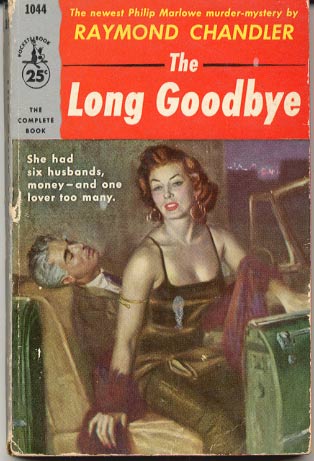
The Long Goodbye

The Long Goodbye by Raymond ChandlerHad a fairly lousy session of limit two days ago. A better detective would’ve perceived the first hand as a clue of things to come. I get As Qd in the BB and watch as a player in middle position raises and the table folds around to me. I smooth call and the flop comes Qc 8h Jd. I check, my opponent bets, I raise, and he calls. Now I don’t know this gee from a horse’s caboose, but he does appear to have gotten the message of strength from my check-raise. The turn is a blank (2c). I bet and he timidly calls, making the pot 6.25 big bets. The river brings a dreaded king, so I check-call him to see I’ve been three-outed when he shows the friggin’ Kc Qh.

So I begin by dropping 4 big bets to a cold deck. A couple of orbits later I get KK cracked for another decent-sized pot. (In fact, before I was done I’d be absurdly dealt kings four times, yet would only win once with them for an overall net of -9.25 BB on the four hands.) That I subsequently started to play some dicey starting hands out of position (ace-rag, two-gappers) only aggravated the situation further. We’ve all been there -- a bad beat or two and suddenly your otherwise-solid game takes a dive. Adding to the trouble is the fact that as your short stack becomes shorter, other players tend not to respect your raises (a factor contributing to my failures with King Kong, probably, as I was usually up against multiple opponents). (Incidentally, I’d argue this phenomenon to be as true in limit as it is in no-limit, despite the fact that theoretically it makes no difference in limit that your opponent has 30 more BB than you when the two of you are dueling for a pot -- as long as you have enough to play out the hand.) For all my misfortune, however, I definitely skilled my way to that losing session, realizing along the way that one of my biggest flaws is not knowing when to get away from a table that isn’t working for me.

Finding a new table online is laughably easy, so there’s no reason to stick around and play at a table where your image has evolved into that of a much lesser player. Yet there I’ll invariably stay, sometimes even as all of the players around the table have left and been replaced by new ones equally happy to receive my chips. It’s not even that I want to win my money back from the particular palookas that took it from me. Rather, it’s like I’m saying “Okay, Table 95987 (Real Money) . . . you took my twenty bucks and I’m gonna stay here ’til get every cent back if I have to play 65-offsuit UTG to do it . . . ! Okay, until I get half of it back . . . . All right then, until I land one nice pot. Fine, gimme one blind-steal for chrissake . . . .”

At the beginning of Raymond Chandler’s The Long Goodbye, Philip Marlowe talks about how he ends up getting involved with Terry Lennox against his own better judgment. “I’m supposed to be tough,” he says, “but there was something about the guy that got me.” From there proceeds his lengthy involvement with a case that in the end he knows he would have been better off avoiding altogether. Marlowe lets down his guard for a just a tic and before long finds himself in too deep.

It’s the opposite for me. “I’m supposed to be tough,” I tell myself, and thus refuse to say adios when I should. I need to develop a strategy here . . . perhaps some mechanical marker that tells me when I reach a certain point at a particular table that taking a hike is the right thing to do (and not an admission of less-than-manhood). In other words, some way to avoid the long goodbye. Suggestions will be most appreciated.

Image: The Long Goodbye (1953), Raymond Chandler.

Labels: , , ,


Older Posts

Copyright © 2006-2021 Hard-Boiled Poker.
All Rights Reserved.