Thursday, November 12, 2009

Reading & Writing

ReadingHad a long, long day of “real” life applesauce yesterday. Yea, I’m talking about the “day” job, which as of late has been turning into the “night” job, too, I’m sorry to report. Don’t plan to go into detail here -- as I said to a friend recently when the subject came up, the only thing worse than a bad beat story is to hear someone whimpering about his or her job. Suffice to say yr humble gumshoe has a lot else he’d rather be doing these days.

Changes are a afoot, though. Like hard-boiled writers do, I’ll leave that as a cliffhanger for now. Let’s turn the page.

Speaking of, for those who like hard-boiled fiction, my non-poker-related detective novel, Same Difference, is available for purchase. Makes a great Christmas gift! Am still waiting for it to turn up over on Amazon and other sites. (Thought that would have happened by now, but am still in limbo on that front.) Meanwhile, you can get it directly from Lulu by clicking here.

My novel, 'Same Difference'Big thanks to those who have picked it up already, and especially those who’ve read the sucker and sent along nice feedback. It’s a first novel, and I’m much encouraged to take what I’ve learned on this one as I set to work on a second.

The fact is, I have been thinking a lot recently about books and authors and the publishing world these days, mainly thanks to the books I happened to be reading. I’ve had the opportunity to review James McManus’s new one in a couple of places, Cowboys Full: The Story of Poker, including over at Betfair where I’ve begun a new weekly column. As I mentioned last week, I was able to interview McManus as well, and will be posting that interview as a follow-up piece over at Betfair tomorrow.

'For Richer, For Poorer' by Victoria Coren (2009)Other current poker reads at the moment are also in the non-strategy category. Am moving through Vicky Coren’s For Richer, For Poorer: A Love Affair with Poker, a smart, funny, literary memoir telling the story of Coren’s life and poker career. Coren does have an EPT title and other poker achievements to report, but she’s also a genuinely gifted writer, thus making her book especially enjoyable. Fans of McManus, Alvarez, Holden, et al. should really like this one, I’d think.

Also have just recently cracked open a copy of Doyle Brunson’s recently published autobiography, The Godfather of Poker, written with Mike Cochran. Have only glanced at the contents, but first appearances suggest a comprehensive telling of Texas Dolly’s story, which I imagine will include several familiar anecdotes -- especially for those who have read his Super/System or other books that include Brunson yarns -- as well as new material. By the way, the Entities over at Wicked Chops have interviewed Brunson about the book -- check it out.

The book is a handsomely bound hardback with what’s called “rough trim,” meaning that when the book is closed the pages have a jagged edge -- the kind of thing you see sometimes with older books, but not so much these days.
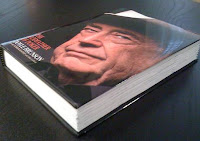
'The Godfather of Poker' by Doyle Brunson and Mike Cochran (2009)As I was reading about on the Gamblers Bookshop blog last month, some might think the use of this cut “looks like it’s defective but that’s the way the publisher wanted it.” I kind of like it (see pic), which along with the cover photo kind of lends the book a stately, dignified appearance that seems to suit Brunson’s status in the poker world.

As understood by just about everybody but Joan Rivers, that is.

Will be reviewing both Coren and Brunson’s autobiographies in the coming weeks elsewhere, though I’ll say something here about them as well, I imagine. Like I say, reading these books -- all of which can be regarded as the end results of long-term, carefully-nurtured meaningful projects for the respective writers, has gotten me thinking more and more about “the writer’s life.”

And how such a life seems to me like it might be worth living. (Stay tuned!)

Labels: , , , ,

Wednesday, November 11, 2009

Looking Back: 2009 WSOP November Nine on ESPN

Moon looks backThoroughly enjoyed ESPN’s rapidly-produced, two-and-a-half hour repackaging of the 2009 World Series of Poker Main Event final table last night. Liked the features and rhythm of the thing. Thought Norman Chad had a few genuine zingers in there, adding to the fun. My favorite was probably when Steve Begleiter put in the first reraise in that infamous Hand No. 90 versus Darvin Moon, and Chad quipped “That’s a big bet, particularly in this economy.” That was some good funny.

Did appreciate the extra half-hour, mostly taken up with the heads-up battle in which Joe Cada outlasted Darvin Moon. Actually by the very end of the show I was starting to feel like it didn’t really need to be much longer than it was. Perhaps having followed the action so closely as it happened made me less eager to see every hand again, but I think two-and-a-half hours of this sort of thing is probably plenty.

Liked the sportsmanship at the very end quite a bit. Also thought Phil Ivey came off as the coolest cat ever.

Joe Cada, 2009 WSOP ChampWas also thinking quite a bit during the show of the whole “luck-vs.-skill” contest once again, wondering now and then how it all might have appeared to those less familiar with what happened during the 364 hands and/or those who are less versed in poker, generally speaking. Did the selection of hands make it look like poker was a game of skill? Or did it come off as a drama-filled series of coin-flips in which chance ruled?

One of the most interesting aspects of poker, actually, is how difficult it is to say definitively whether in any given hand “luck” or “skill” prevailed. Outcomes are driven both by players’ actions and the cards dealt. In fact, two people watching (or playing) the same hand may likely come away with differing opinions about whether a hand was skillfully played or “played itself.” And it goes without saying that a person’s judgment is also highly influenced by his or her own poker-playing experience and knowledge.

I made a note last night of which hands were being shown. Of the 364 total hands, we got to see 32 on the telecast. Not going to rehearse all of the details of each hand here (you can read about them further on the PokerNews live blog), but here is a list with hand numbers and brief reminders of the action. You decide whether in each hand “luck” or “skill” seemed more important:
  • Hand No. 11 -- Moon limp-reraises with Ac3d from late position, forcing Schaffel to fold pocket nines in the big blind
  • Hand No. 14 -- Ivey’s all-in shove with pocket kings forces folds from Cada (pocket tens) and Shulman (pocket fives)
  • Hand No. 44 -- Akenhead survives going all in with K-Q versus Buchman’s A-K by spiking a queen on the river
  • Hand No. 45 -- Moon’s crazy play with A-4 versus Saout’s sorta crazy play with J-2 in which the latter fortunately flopped two pair; “I messed up big time,” said Moon afterwards
  • Hand No. 53 -- Cada’s loses a lot with 6c3c versus Moon after flopping a flush draw, then not getting there
  • Hand No. 54 -- Schaffel doubles up with pocket aces versus Akenhead’s pocket kings
  • Hand No. 59 -- Akenhead eliminated when his 3-3 can’t catch up to Schaffel’s 9-9
  • Hand No. 68 -- Schaffel eliminated with pocket aces versus Buchman’s pocket kings when a king flops, then Buchman makes quads on the turn
  • Hand No. 90 -- Moon’s crazy flop fold getting 8-to-1 or something versus Begleiter (see discussion here); Moon did have KhQc, it turned out, and Begleiter AsQs (overs, straight outs, and nut flush draw); and did Moon tell his wife he had queens afterwards???
  • Hand No. 92 -- Shulman folds pocket nines to Ivey’s all-in reraise with K-Q offsuit
  • Hand No. 106 -- With ace-high, Ivey pushes Begleiter off his pocket sevens on the river after a scary group of community cards had arrived
  • Hand No. 112 -- Ivey raises UTG with pocket jacks, Saout reraises from the button with pocket sevens, and Ivey folds (I believe this was the very last hand before the dinner break)
  • Hand No. 122 -- Shulman takes a big chunk from Cada when his A-K outlasts Cada’s A-J
  • Hand No. 131 -- Cada survives with pocket fours against Ivey’s As8c
  • Hand No. 153 -- Saout and Begleiter get all of the Frenchman’s chips in on an 8h3c9h flop; Saout has the flush draw, and Begleiter a pair of eights; the flush comes
  • Hand No. 175 -- Moon’s A-Q eliminates Ivey who had A-K after a queen flops; loved Ivey’s line when the turn brought a trey: “Close.”
  • Hand No. 187 -- Moon again uses A-Q to eliminate Begleiter, whose pocket queens turned to mush after an ace came on the river
  • Hand No. 195 -- Cada survives, spiking a set with pocket treys versus Shulman’s J-J
  • Hand No. 199 -- Cada’s pocket rockets survive versus Moon’s K-9 offsuit
  • Hand No. 236 --Shulman eliminated when his pocket sevens lose race to Saout’s A-9
  • Hand No. 259 --Buchman wins a big chunk of Saout’s stack after heavy betting on a ten-high flop; Saout had a ten, but Buchman had the better hand with A-A
  • Hand No. 264 -- Buchman loses a bunch back to Saout with A-Q versus the Frenchman’s A-K
  • Hand No. 271 -- Moon (KdJd) eliminates Buchman (Ad5c), turning a king
  • Hand No. 272 -- Cada survives, spiking a set with pocket deuces versus Cada’s Q-Q
  • Hand No. 276 -- Saout eliminated with pocket eights versus Cada’s A-K after Cada rivers a king
  • Hand No. 277 -- Moon slowplays pocket queens in first hand of heads up; ends up winning a decently-sized pot versus Cada’s 9-9
  • Hand No. 288 -- Moon check-raises with air on flop, then turns a queen to make top pair, ends up getting Cada to call a big value bet on end
  • Hand No. 293 -- Cada turns top two pair with QdJd and forces Moon to fold his fourth-best pair on the river
  • Hand No. 323 -- Moon pushes Cada off of his A-Q with a preflop four-bet; Moon says “I had a monster,” but it was A-J
  • Hand No. 347 -- Moon and Cada both have J-9 offsuit, but Moon’s aggressive betting gets him the pot on the turn
  • Hand No. 356 -- With the board Tc5d9hTd, Cada makes the big call with all of his chips with Jh9d; Moon has 8s7s, and Cada’s hand holds up
  • Hand No. 364 -- Cada wins the bracelet when his pocket nines outlast Moon’s QdJd
  • So what was your impression? Or your impression of how other viewers might have seen the show? Does poker look like roulette, or chess?

    (Photos courtesy the great FlipChip, natch.)

    Labels: , ,

    Tuesday, November 10, 2009

    Comeback Kid Cada 2009 WSOP Main Event Champ

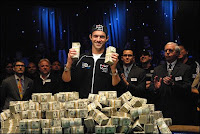
    What they were battling for (photo by the great FlipChip)Sat up into the wee hours following online that there heads-up clash last night. Went much longer than most observers -- including yr humble gumshoe -- had guessed it would. Over three hours, I believe, with Joe Cada finally outlasting Darvin Moon in a genuinely compelling, hard fought battle for the bracelet.
    (Photos in this post by the great FlipChip, natch.)

    Had great fun following the coverage on PokerNews, reading all the tweets, and listening to the Bluff Magazine audio. Usually I’d first read insta-reports of each action on Twitter, then hear David Chicotsky, Phil Hellmuth, Joe Sebok, and a rotating group of others comment on the Bluff feed, then read the short hand narratives by FerricRamsium and Donnie Peters. I’d also occasionally skip over to Dr. Pauly’s live blog, the ESPN blog kept by Andrew Feldman, the PokerStars blog, and a few other sites, too, to help fill out the scene. (Oh, and while yr poking around those links, check out F-Train's “November Nine Errata” for a few more items of interest.)

    Altogether gave a pretty good sense of what was happening, although I’ll certainly be intrigued to watch what ESPN puts together for tonight’s show, too.

    As I say, the action last night was fairly gripping, I thought. Some high-drama hands in there, as well as enough back-and-forthing for some thought-provoking patterns to emerge.

    It appeared on the very first hand that Moon had missed a great opportunity -- and perhaps displayed yet another example of awkward (or flat-out bad) play. Moon chose to limp in from the small blind/button, and we’d soon learn he held pocket queens. Cada then raised to 3.5 million from the big blind, and Moon called. The pair managed to put another 20 million each in the middle on the next two streets, but both checked the river, at which point Cada showed pocket nines. The two kings and one ace among the community cards surely kept all of Moon’s chips from going into the middle in that one, and it seemed clear that had he gone ahead and committed them preflop, Cada probably would’ve come along.

    In other words, it looked like from the first hand that Moon should have doubled up and taken the chip lead away from Cada, but instead he’d only closed the gap to about 110 million to 85 million. It also looked like the night was going to be over quickly.

    But that didn’t happen. For the next ten hands Moon chipped away, then took the lead in Hand No. 12 of heads up. Cada raised his button to 2.5 million for the sixth straight time, and Moon called. The flop came 6s5dJc, Moon checked, Cada continued for 3.5 million, and Moon check-raised to 8.5 million. Cada called. Both checked the Qd turn, then when the river came 2h, Moon bet 7.25 million and Cada called him. Moon showed Qh8s -- the flop check-raise had been with air, and he’d paired up on the turn -- and Cada mucked.

    Was partly happenstance, but somehow Moon had gotten the lead without going all in. Not once had Moon been all in with his tourney life at risk for the entire WSOP Main Event. That streak was still alive! And would remain so until the very last hand of the tournament, in fact.

    Darvin Moon and Joe Cada (photo by the great FlipChipAfter those first dozen hands it had become clear that Moon (a) was not going to play a passive, easily exploitable game, and (b) was not appearing to be playing an orthodox or “standard” game, either. Won’t presume to judge how well either player played without seeing hole cards, but it certainly seemed that despite Moon’s own protestations that he’d had practically zero experience at heads up, he was providing Cada -- who plays mostly heads-up online -- a genuine challenge.

    Cada would soon take the lead back, though. And by the time they took their first break of the night (after 52 hands played) they were essentially dead even. Over the next dozen hands Moon took several sizable pots, and suddenly he was sitting with a nearly 3-to-1 chip advantage with 145 million to Cada’s almost 50 million. Cada pushed all in before the flop on Hand No. 70 of heads up, but Moon declined. Then in Hand No. 80 came what was really the pivotal moment of the match.

    The blinds at that point were 600,000/1.2 million (with a 200,000 ante). Cada raised to 3 million from the button, and Moon called. The flop came Tc5d9h, and both checked. The turn brought the Td, and after Moon checked Cada bet 3 million. Moon check-raised all in, and after a long think Cada made the call with Jh9d. Moon showed 8s7s -- an open-ended straight draw. The river was the 3h, and Cada had rebounded to take the lead once more.

    An interesting play by Moon, and it sounded like Cada nearly let go of his hand, but he ultimately made the big call. There was a little break right after that hand, and one could hear the two players talking in the background of the Bluff Magazine audio broadcast. Cada could be heard sincerely complimenting Moon’s play, making reference to the fact that he plays a lot of heads up and that Moon compared favorably to his usual competition. Struck me as a pretty mature-sounding thing to say for the kid from Michigan who doesn’t turn 22 until later this month. Also humble, providing a stark contrast to the commentary by Hellmuth in the foreground.

    Speaking of the Poker Brat, he was just 24 when he won the 1989 WSOP, holding pocket nines for the winning hand. And as it would turn out, Cada would also have pocket nines -- 9c9d -- in Hand No. 88 of heads up, what would turn out to be the last hand of the night.

    Again Cada raised to 3 million from the button, Moon reraised to 8 million, Cada pushed, and Moon called with QdJd. The board ran out 8c2c7sKh7c, and Cada became the youngest Main Event champ ever.

    After a wild Saturday night/Sunday morning full of surprising suckouts and some pretty obvious missteps, it seems that Monday’s denouement helped improve the reputations of both players as skillful competitors. While each surely benefited from good fortune, sometimes in highly dramatic fashion, both showed they can play Texas hold’em, and so in that battle between luck and skill I was alluding to yesterday, skill did (in a sense) perhaps “win out.”

    I’m not alone, I don’t think, in liking both of these guys. Probably somewhat better for poker that the one who seems primed to join the professional circuit -- and not the fellow content to go back into the woods with his chainsaw (as amiable as he is) -- ended up on top.

    Am thinking more and more that next year I might just have to angle a way to get back out to Vegas in November to witness this spectacle go down. As I mentioned already, in 2008 I didn’t really have much of a pull to be there once they finally resumed the sucker. But this year I did, and I don’t think it was just because of the prospect of being there to see a Phil Ivey victory.

    Yeah, as fun as the online coverage was to follow, I think it would be fun to see the November Nine with my own peepers. And my peeps.

    Labels: , , ,

    Newer Posts
    Older Posts

    Copyright © 2006-2021 Hard-Boiled Poker.
    All Rights Reserved.