Tuesday, December 05, 2006

Number Crunching (4 of 4)

Without really planning to, I’ve been playing a lot of these 100-hand sessions here lately. I tend to be much more successful when playing short sessions (one of these days I’ll scan through my stats to confirm, but intuitively I know this to be the case). I generally two-table, so 100 hands takes around 35-40 minutes. About the length of two sides of Miles or Dolphy or Coltrane or whatever else I happen to spin while I play. (Can you tell I’m an old LP guy?)

Was involved in yet another two-outer during this most recent session, losing a small pot this time. Was in the BB with 4sTs. The cutoff limped, the SB called, and I checked my option. The flop came 4c3sTh and I checked. The cutoff bet, the SB called, and I check-raised. Both players called. The turn was the Qh and both players called my bet. The river was the Ks and I decided this time just to check, worried now that a better two pair was out there. The cutoff checked behind me, then showed KcKd. I only lost $2.50 on the hand, primarily because of how the cutoff butchered playing his or her kings (I see at least two obvious errors, perhaps more). People wonder about the online suckouts, but the fact is two-outer miracles are always gonna come more often when you have players misplaying hands like this.

In any event, having achieved some success at $0.50/$1.00 limit games, is it time to make the move to $1.00/$2.00? What factors need I consider when making my decision? Building on what has been discussed to this point, I see three primary questions I need to answer here. (1) How certain can I be that I am a winning player at my present limit? (2) If I decide to move up a limit, what sort of bankroll should I carry with me? (3) What other factors should I be on the lookout for when competing at the higher level?

To answer all three questions I am going to turn to Barry Tanenbaum, a regular columnist for CardPlayer magazine. Tanenbaum’s articles on limit hold ’em are always useful reading -- indeed, he is one of the few writers for the magazine whose articles I find myself going back to time and again. They are all archived over at the CardPlayer website -- if you’re a limit player you might go check ’em out. He has a book due out next spring (tentatively titled Advanced Strategies for Limit Hold ’em) that will collect some of his articles as well as incorporate new material. I’ll certainly be seeking out a copy when it appears.

To the questions:

(1) How certain can I be that I am a winning player at my present limit?


Tanenbaum also hosts an informative website of his own where he regularly posts a “Thought of the Week.” Last week’s thought (11/26/06) actually addresses my first question. According to Tanenbaum, 75,000 to 80,000 hands gives one “a good beginning” toward figuring out if one is a winning player, “but is not nearly enough to be definitive.” Even 100,000 hands, says Tanenbaum, isn’t really enough to know for sure.

He does confirm that making one big bet per hour (which for him -- being primarily a brick-and-mortar guy -- translates into 35-40 hands) is a good rate. In other words, my 2.5 BB/100 hands is not bad; indeed, is certainly enough to say I’m a “winning player” (taking into account, of course, that my sample size -- though large -- still isn’t large enough to make this claim definitively).

So the answer to my first question is “reasonably certain, though not definitively.” Assuming that’s enough for me to consider making the move, I proceed to the next question.

(2) If I decide to move up a limit, what sort of bankroll should I carry with me?

I could refer to the standard advice here regarding bankrolling for limit games and carry 300-500 BB with me to the tables (i.e., $600-$1,000 for the $1/$2 game). Or I could consult the bankroll calculator I used in my last post. The problem is, in order to use the calculator, I have to assume both what my win rate will be as well as what my standard deviation will be. Let’s just say (for the sake of argument) that I expect to earn 1.25 BB/100 hands (netting me the same profit I am currently enjoying), will experience a similar standard deviation (18 BB/100 hands), and will only stand a 5% “risk of ruin.” According to the calculator, with these stats I’ll need 388.25 big bets -- or $776.50 -- in order to endure the swings and ensure I won’t bust out.

The topic of bankroll came up on a thread over on the forum hosted on Tanenbaum’s website. Tanenbaum himself chimed in (as “pokerbear”) with this to say about maintaining one’s bankroll: “Establish a minimum bankroll. Every month when you win, pay yourself 50% of the total over the bankroll. If you fall below the bankroll minimum, you do not get paid (or you drop down in limits so the bankroll requirement gets lower). At the end of the year, reassess . . . .” The idea is always to keep for yourself a cushion above the minimum. Thus, if I do take, say, $800 to go play with at the $1/$2 limit tables, I should only cash out half of what I earn there, leaving behind enough to stay comfortable. (Again, I’ve intuitively followed this rule in the past, only cashing out when I can leave enough behind to play with comfortably.)

Of course, if I win more I’ll need less. (And if I win less I’ll need more.) But that’s putting the cart ahead of the horse, isn’t it? Can I expect to win at the same clip -- or even half the same clip -- at the higher stakes table? Not unless I adjust, that’s for certain. Mr. Tanenbaum . . . can you help me here . . . ?

(3) What other factors should I be on the lookout for when competing at the higher level?

Tanenbaum is on my mind not just because I’m a fan of his articles, but because I heard him recently on Keep Flopping Aces, a new poker podcast that I just found a week or so ago. The show -- one of several broadcast on the web audio network Hold ’em Radio -- is hosted by Lou Krieger and Amy Calistri. I’ve only heard a few episodes, but I like what I’ve heard thus far. Tanenbaum appeared on the 10/26 show. On last week’s show, Iggy (of Guinness and Poker and, now, IGGY at Pokerworks) appeared as a guest.

Anyhow, when on the show Tanenbaum made an observation about the challenge faced by players who, having been successful at one level, wish to move up and try higher stakes. He pointed out how people usually start out learning to play tight and thus place special emphasis on their own cards. Tanenbaum here echoes a much-cited refrain regarding the difference between limit and no limit hold ’em, neatly articulated by Barry Greenstein: “Play limit according to the strength of your hand, and no limit according to the strength of your opponent’s hands.” Like most, I started out playing limit this way, as a tight player primarily concerned with things like starting hand selection and whether or not my hand connected with the board.

Tanenbaum agrees that this strategy is a good way to play and win, especially when first starting out. However, as one moves up in stakes, one encounters more and more players who also know how to play a solid, tight-aggressive game. It therefore becomes imperative to expand one’s game a bit and become aware of other factors such as position, other players’ tendencies, the value of aggression, and the value of creating dead money. (Go listen to the podcast for further explanation of this idea -- an idea that sounds as though it may well form the primary thesis for Tanenbaum’s forthcoming book.)

I have taken shots at $1/$2 (indeed, I’ve written about some of those hands here before). However I’ve never stuck around there for very long, and every time I’ve tried it I’ve ended up with mixed (usually negative) results. The longest stint was for about two weeks where I went up, then down, then up a little, then down a lot, then said the heck with it and went back to my comfort zone. So I know from (some) experience that one encounters a higher percentage of players who have a clue. Indeed, I wrote a post about the subject several months back. In other words, there surely ain’t as many examples of folks butchering kings there as one tends to find at $0.50/$1.00, to be sure.

I’ll likely try to build up my online roll a bit here (closer to that $800 mark) and then make the move again. When I do, I’ll take it slow, playing 100-hand sessions (or thereabouts) and trying to spend some time assessing my play after each go.

Meanwhile, go check out Tanenbaum’s articles, his website, and Keep Flopping Aces. Good stuff all around.

Photo: Albert Einstein, 1931 (adapted), public domain.

Labels:

Sunday, December 03, 2006

Number Crunching (3 of 4)

After whimpering about losing to two-outers last post, I caught one of my own today (again on Absolute). Had kings and was up against a pair of eights. Flop came 844 and my adversary pushed hard, making me think overpair. The turn was a Q and I slowed down, figuring QQ or AA real possibilities. I had to stay, though. Had to find out. Then, like the conclusion of Tartuffe, the king stepped in at the end and improbably saved the day. (And helped make that particular sequence of 100 hands end in the black.)

Last post I wondered whether these numbers -- win rate, standard deviation, and number of hands played -- might also help in the effort to determine bankroll requirements. Seems like they should. In Simon’s original post (the one that got me on this train of cogitatin’), he linked to a site that includes a “bankroll calculator” that uses win rate, standard deviation, and “risk of ruin” (i.e., the chance one is willing to take of busting one’s entire roll) to compute bankroll requirements. The calculator follows a forumla created by BruceZ, a frequent poster over on the 2+2 Forums whose posts about math and probability are very well received over there. (Here’s the original thread where BruceZ’s formula was posted.)

When I enter my win rate (2.5 BB/100) and standard deviation (18 BB/100), I get the following bankroll requirements according to various levels of “risk of ruin”:

I’m playing $0.50/$1.00 limit, so one BB or “big bet” equals one dollar. According to the site on which this calculator can be found, BruceZ’s formula is on the conservative side (e.g., compared to one created by Mason Malmuth). In any event, we can see here that -- according to BruceZ’s calcuations -- I really need something in the neighborhood of $200-$300 to be reasonably comfortable I won’t tap out my funds playing at this limit. By the way, reading around I see most saying that 5% is about the highest risk of ruin most players can stand -- only maniacal thrillseekers go higher -- while less than 1% is probably much too low.

Kind of an interesting chart, I suppose. Notice that if I tried to play at my usual limit with only $44.92 as a bankroll, I’d face a 50-50 chance I might go bust. Back at the beginning of October I actually got to test this idea (in a way) when -- overreacting to the UIGEA passing & all of the predictions of armageddon that quickly followed -- I cashed out all my moneys except for $50 over on PokerStars. However, I continued to play my regular $0.50/$1.00 game. I managed all right for a few days, then had a downturn and at one point found myself literally down to my last chip (on Stars, anyway).

This was no doubt one of the goofier poker experiments I’ve ever tried. When the slide began, I decided to see if I could survive it without redepositing. Late one Sunday night I went to a table with my last $19.80 and proceeded to slip down into single digits. Before long I found myself sitting in the big blind with just $2.40 left having been dealt 9d5c. Woe is me. Only the small blind called, and the flop came 6dQc5s. The SB checked. Having caught a tiny part of the flop (and feeling not a little desperate), I most certainly bet, and the SB called. The turn was the Js. Again -- check, bet, call. The river was the 9s, giving me two pair but also perhaps completing a back door straight or flush. The SB checked, I crossed my fingers and chunked in my last 40 cents, and the SB called. Luckily for me, my opponent only had a pair of deuces, and I was still in the game (with $4.60).

I actually made it back up to $16.35 before leaving that table. And, eventually, I kicked it back up over $50 and on up to the more comfortable range I’m at right now. (I performed similar experiments on the other two sites I play as well -- Full Tilt Poker & Absolute -- though in neither case did I come so close to being “felted” as happened at Stars.) I knew it was harebrained to try to play without a roll like that . . . even if it were just an experiment. Not having chips did cause me to play differently -- and incorrectly, I am certain. Still, I think I did learn a modest lesson about bankroll management during my brief impersonation of a real, live degenerate gambler.

Getting back to the subject at hand, the bankroll calculator does echo what most suggest regarding bankrolls for limit games where one often hears 300 big bets as a standard recommendation. Some say 500 BB for online players (since they often multitable). And, of course, playing short-handed games (as I generally do) also tends to increase one’s variance, thus making it even more imperative to have a sufficient roll.

Ever since I began playing $0.50/$1.00 games, I have kept around $300-$400 available for use at the tables. Anytime I rise above that range I cash out a hundred, and so my “bankroll” per se is not identical to my overall winnings. In any event, it is good to know that the strategy I have intuitively followed (mostly) is supported by this here analysis of the numbers.

The next question, of course, concerns whether I might seriously consider moving up in stakes. Do these numbers I’ve established at one level offer any indication whatsoever about my chances for success at the next? Or am I tracing one long (albeit diverting) non sequitur here?

Well, either way, I have to play this one out. Have to find out.

Labels:

Friday, December 01, 2006

Number Crunching (2 of 4)

So a couple of days ago I signed off saying I was headed back to the tables for another hundred hands (or two). Went over to Absolute Poker and sat down at two tables (again, $0.50/$1.00, 6-max). I ended up playing right at 200 hands total, about 100 on each side. Table #1 was easy breezy -- caught cards, got paid off, made $15.25.

Table #2 was a different story.

On the very first hand I picked up JdKd in the big blind. A couple of players limped, then the button raised. We’re lookin’ at a family pot here, I estimate, and so call the raise. Five of us end up seeing the flop -- Ks6hJh. I end up check-raising the button & we eventually cap it (with the small blind coming along just for funsies). That makes $11 in the pot when the turn comes Jc. Sweet sassy molassey. I bet out this time, and both players call. The river is the Ad. I again bet, and the button’s raise confirms for me what I was already thinking -- big slick. The two of us end up capping it (the small blind finally bailed) and he shows me AhAs.

Argh. $21 pot lost to a two-outer. Oh well, it happens. I took it well, offering a meek “gh” and engaging in some kind-hearted banter with the table about the unlikelihood of the hand turning out the way it did. I steadily worked my way back from the quick $8 hole I had dug, getting into the black briefly at that table before falling back down to about a $3 deficit. Then came a hand where I was UTG and dealt JcQc. I limped, then (along with two other players) ended up calling a late position raiser -- I’ll call him STUMPY. So four of us were there to see (what was for me) a made-to-order flop: KhAsTd.

It checked to me and I bet out. I generally like to push flopped straights -- especially Broadway. Typically players (in this game, at this limit) rarely believe in flopped straights or flushes and thus will give you action, especially if they’ve paired high cards (as I expected someone did here). I also have to protect, of course. STUMPY raised and the small blind -- 23SKIDOO -- called the two bets. I might’ve kept pushing here, but figuring I wasn’t going to lose either player I just called ($7.50 in the pot).

[EDIT (added 12/3/06): As usual, I've chosen pseudonyms for my opponents here; please don’t mistake this here fellow for the “real” 23skidoo who inhabits our poker blogosphere (see comments).]

Then came the turn, the Ts. I feared the boat, but bet out anyway to see what was what. This time STUMPY (the preflop raiser) just called, but 23SKIDOO check-raised. Now I’d already seen ol’ 23SKIDOO preraising with any two high cards, so I was mostly convinced from the preflop action that he didn’t have the boat (though likely did make trips here). So I pushed, he pushed back, and STUMPY stuck around as well. After we had capped the betting, there was $19.50 in the pot when the river came the 6c. 23SKIDOO bet out again, and I just called, figuring I’d rather not contribute anymore here if indeed someone had the boat. Damned if STUMPY doesn’t decide he now wants to raise. 23SKIDOO reraised (of course). I gotta stick around (the pot is nearing 30 big bets). So I do. We cap. What did we all have?

*** SHOW DOWN ***
23SKIDOO - Shows [6h6s] (Full house, sixes full of tens)
STUMPY - Shows [ThJs] (Three of a kind, tens)
SHORT-STACKED SHAMUS - Mucks his friggin’ worthless straight
23SKIDOO Collects $31.50 from main pot
*** SUMMARY ***
Total Pot ($31.50) | Rake ($1)
Board [KhAsTdTs6c]

Miracudiculous! Another huge pot lost to a two-outer! (Although technically there were nine additional cards -- the remaining jacks [2], kings [3], and aces [3] & the case ten -- that would’ve beaten me as well.)

Got a bit tilty after that, I’m afraid, then had yet another cooler-ish hand -- where I flopped top pair and was called by bottom pair who then drew out quads -- that knocked me back even further. Finally I scampered away from this horror show of a table a full $24.05 lighter than when I’d first sat down.

Apologies for the unfortunate beat stories (couldn’t resist). Looking now over my last three sets of 100 hands, I won $5.15, won $15.25, and lost $24.05. Obviously, I experienced some serious variance in this small sample. But what should I be expecting?

I mentioned before that my win rate over the last 80,000 hands is 2.5 BB (“big bets”)/100 hands, and my standard deviation (according to Poker Tracker) is just under 18 BB/100 hands. Standard deviation is basically the average of how much off the average one tends to be. The number is actually a unit of measurement; thus, we can talk about what we might expect given “one standard deviation” or “two standard deviations” and so forth. The statisticians have all worked out long ago that we can expect our results to land within one standard deviation of the average about 68.3% of the time. That means for me that about 2/3 of the time when I sit down to play 100 hands, I usually end up finishing somewhere between 15.5 BB down and 20.5 BB up (with my win rate of 2.5 BB/100 sitting right there in the middle of the range of one standard deviation or 18 BB/100). In fact, in these last three 100-hand samples, I indeed landed within that range twice (winning 5.15 BB & 15.25 BB) and outside of it once (losing 24.05).

Statisticians have calculated that we can expect our result to land within a range of two standard deviations away from the average (a much wider range) about 95.4% of the time. And three standard deviations away about 99.7% of the time. Of course, it doesn’t really provide me a lot of security to be able to say that in my next 100 hands there is a 99.7% likelihood I’m going to finish somewhere between $51.50 down and $56.50 up! On average, I’m in the black . . . and I’ve played 80,000 hands! Can’t I say with some confidence that I’m a winning player (at this limit)?

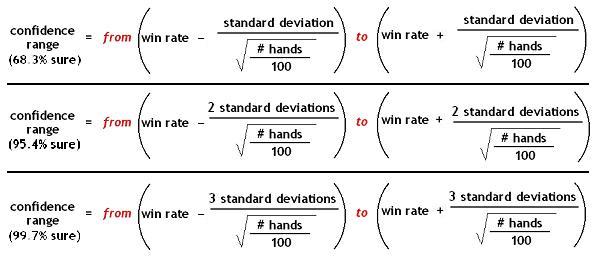
Actually, I can. And I can use these same figures (win rate, standard deviation, number of hands) to do so. The formulas (as Vern explains it in his post) work like this:

'Confidence Range'


Looks more daunting than it really is. Notice how the greater the number of standard deviations, the more sure you can be about the range. Also, the more hands you’ve played the smaller the range is going to be. 80,000 hands is actually a nice sample to use for this sort of thing.

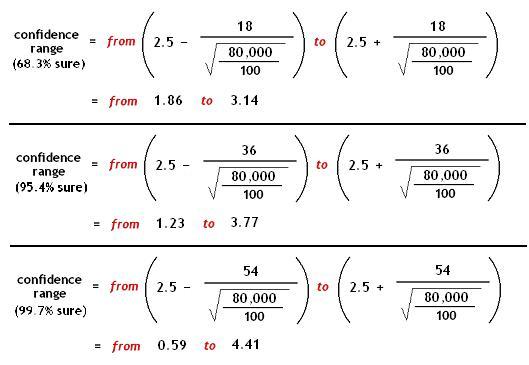
Here’s what happens when I plug in my numbers:

Shamus's 'Confidence Range'


This is some good news, I think. Even at three standard deviations, I’m still within an entirely positive range. Now if I had only had 10,000 hands with these same stats, I wouldn’t have been able to say that -- for that small of a sample, I would be 99.7% “confident” that my true win rate was between -2.9 BB to 7.9 BB. (In other words, I could not be confident I was a winner.) That’s one reason why people dismiss 2,000 or 3,000 or 10,000 hands as an insufficient sample.

Just for fun, let’s say these last 300 hands were the first 300 hands I ever played and I wanted to do a similar calculation right away. In the end I lost $3.65 in those hands, so my win rate there was -1.217 BB/100 hands. My standard deviation (which I had to calculate on my own) for these 300 hands was 16.305 BB/100. (Here’s a site that helps explain how to calculate this number if you don’t have Poker Tracker to do it for you.) Plugging these numbers into the formula tells me that after these 300 hands I could say with 99.97% confidence that my true win rate was between -28.93 BB/100 and +26.49 BB/100. That is to say, I wouldn’t have the first clue whether I could win at this game or not!

Okay . . . enough of that. The numbers are telling me I’m doing okay here at this game and limit. Now I assume my bankroll has been sufficient throughout the run (I’ve never busted), but could I further use these stats to determine bankroll requirements? I’ll work on that one next post.

For now, I’m headin’ back to the tables, where I feel utterly confident my next 44-outer simply has to hold up!

Photo: “A plot of a normal distribution (or bell-shaped curve) where each band has a width of 1,” Mwtoews. CC BY 2.5.

Labels:

Wednesday, November 29, 2006

Number Crunching (1 of 4)

Just got off the 6-max, $0.50/$1.00 limit hold ’em tables. Was playing one on PokerStars, the other on Full Tilt Poker. I played exactly 100 hands -- 50 on each site. Ended up ahead $4.70 on Full Tilt, and just $1.45 ahead on Stars. Was as much as $12 down on FTP, and as much as $9 or so ahead on Stars, before settling back to where I ended up -- a total of $5.15 gain for the 100 hands I played.

Is this typical? A post over on Simon’s Poker Blog a couple of months ago got me interested in this “standard deviation” business and so I’ve been diggin’ around, trying to figure out what to make of it. As Simon tells us, if you use Poker Tracker you can click on the “More Detail” button under “Session Notes” (in the ring game stats) and you’ll see your “standard deviation” neatly calculated for you. Should this number be meaningful?

Since the beginning of the year, I have played around 80,000 hands of 6-max, $0.50/$1.00 limit hold ’em. Only about half of ’em are here in my database, unfortunately, as I suffered a computer meltdown in the early summer and lost a few months’ worth of stats. Those of you who use Poker Tracker, avoid Shamus’s misfortune and backup your databases on a disc or external drive! It’s only a matter of copying a few .mdb files -- click here to read Pat’s instructions about backing up your data.

For the 36,000 or so hands (of the 6-max limit game) that I currently have in my database, I see that I currently enjoy a win rate of just over 2.5 BB/100 hands. (Here, BB = “big bets,” not big blinds, so we’re talking about $2.50/100 hands.) Now I know that rate has fluctuated between 2 and 3 during the entire run, but for the most part the rate has hung around the 2.5 mark pretty much throughout. I also know that before the crash, I had just about the same rate for the 50,000-odd hands I had in there before. (Reading around I see that 2 BB/100 hands is generally considered a decent rate for micro/low limit games, so I’m doing okay there, I suppose.)

Poker Tracker tells me my current “standard deviation” when playing this particular game at this particular limit is just a hair under 18 BB/100 hands. (That’s about where I was before the crash, also.) If understand it correctly, my “standard deviation” indicates the likelihood that I will in fact win my “average” 2.5 BB in the next 100 hands I play. (Please, if anyone knows better about any of this stuff, correct me mercilessly.)

Of course, I usually don’t earn exactly $2.50 for every 100 hands. Sometimes I earn $5.15 (like today). Sometimes I lose $12. Sometimes I win $20. Having a standard deviation of 18 BB/100 means that I will usually (but not always) land in a range anywhere from 20.5 BB up to 16.5 BB down. In other words, the number indicates the degree of “variance” I should expect when playing this particular game. In fact -- as my old statistics textbook explains -- “variance” is precisely the square of “standard deviation,” so these two terms are directly related to one another.

Now if I had literally made or lost no more than 2 or 3 BB for every 100 hands I played, my statistical deviation would have been much lower. But I didn’t. Obviously my wins and losses during those individual 100-hand segments were much greater, and thus my standard deviation is 18 BB/100. From reading around, I see that my number here isn’t necessarily that unusual. (Keep in mind I am playing 6-max games, where one tends to experience more variance than at full tables.) I could be wrong, but I’d venture to guess that my win rate (2.5 BB/100 hands) and my standard deviation (18 BB/100 hands) are both fairly typical for moderately successful players who spend most of their time at this limit.

The more hands a person has played, the more representative stats like win rates and standard deviations become. There is a lot of disagreement about how many hands constitutes a meaningful sample, but for the sake of argument I’m going to assume that my 80,000-hand sample is enough to ensure that these numbers mean something.

I thought I’d use the next three posts to “think out loud” and explain (to myself and to anyone else who is interested and who might help me) what these numbers -- my win rate, my standard deviation, the number of hands I’ve played -- might help me as I try to assess myself as a player. Here are the questions I thought I’d try to answer over the next three posts:

(1) How might I use these stats to predict how my next 100 hands (of 6-max, $0.50/$1.00 limit hold ’em) will go?

(2) How might I use these stats to determine what kind of bankroll is suitable for me to be playing this particular game at this particular limit?

(3) How might I use these stats to help decide whether or not it might be time for me to make the move (seriously, not just occasionally as I am doing now) to a higher limit game?

Before I do, though, I think I’ll head back to the tables for another hundred or two. Not sure yet what these stats are going to tell me, but I am pretty sure they ain’t gonna tell me math is more fun than poker.

Photo: “Chinese Abacus,” Dave Fischer. CC BY-SA 3.0.

Labels:

Monday, November 27, 2006

Something from Nothing

Had one of those relatively rare low limit hands yesterday where I not only ran a successful bluff (winning a medium-sized pot), but did so from early position against multiple players. A very fortunate hand, as it turned out. I was dealt QcKs in the small blind. One player limped, then there was a raise in late position. I called, as did the big blind and limper. So four of us saw the flop come 3cTc6c.

The table checked around to the preflop raiser who bet. Knew I was behind, but I raised anyway to see if I might chase one or both of the others out (and to see what I was up against across the table). Unfortunately both called, as did the preflop raiser. The turn brought the Ts, and I bet out again, representing trips. This time two of the remaining three players called. By now I was hoping the flush would not come. When the river brought the 6d, I took a chance and bet again. The first player quickly folded, and the preflop raiser lingered a moment (wondering if his ace would play, no doubt) before folding as well.

More fortunate than skillful, really. We all likely held overcards, and the one who took the lead ended up taking the pot. As it happened, being in early position probably was preferable.

Winning a pot with the worst hand is, of course, one of the undeniable delights of poker. Doing so illustrates in miniature what is really a fundamental pleasure of the game, namely, the chance it affords for one occasionally to feel as though he or she is getting “something from nothing.” One could argue that taking any sort of profit from the table, even a single pot, gives one a taste of that highly-tempting “romance of personal liberty” Al Alvarez writes about in The Biggest Game in Town. Alvarez, of course, is speaking of those high stakes players whose entire lives are examples of being able to “survive spectacularly well outside the system.” But even the low limit punter gets to understand -- in relative terms -- the momentary joy of feeling as though one has duped the universe (for once) into letting him or her have the best of it.

Speaking of making something from nothing, I have finally decided what I am going to do with that windfall of tournament dollars I talked about winning several posts back. Having won one of those PokerStars FPP satellites to the Sunday Million (36 players, 375 FPP to play, Turbo NLH), I found myself with 215 “T$” and what I considered three options: sell the T$ for cash, take a shot at the Sunday Million, or use the funds to play smaller buy-in tourneys.

I much appreciated the feedback I received when discussing my options here a couple of weeks ago. I also posted the dilemma as a poll question over on the Card Clubs Network Forums and got some genuinely thoughtful responses there as well (for which I was grateful). In the end, I decided on the latter option -- to use the winnings to fund entries into smaller buy-in tourneys.

I seriously considered trying the big one, then realized I simply wasn’t prepared to do so. Looking over my last couple of months of play, I noticed I’m playing tourneys (MTTs & SNGs) less than once per week. Seemed reasonable to wait until I had a bit more tourney experience under my belt so as to increase my chances should I ever decide to play the Sunday Million.

I also came close simply to selling my funds to Pocket Fives. (I even put in the request, but cancelled it an hour later.) Finally I decided I liked the idea of being able to “freeroll” my way through some tourneys as a way to gain experience (and perhaps some extra cabbage, too). Have been eyeing those $25K guarantees that run every night (the $5.00+rebuy tourneys) that seem to offer a decent prize pool for the investment. Anyone have any other favorite tourneys they play (in the $5-$20 range)?

So here I am again . . . in early postion, with a fairly decent holding. Might win, might lose. Getting something from nothing, either way . . . .

Labels:

Newer Posts
Older Posts

Copyright © 2006-2021 Hard-Boiled Poker.
All Rights Reserved.