Saturday, January 13, 2007

Nice Pot

Back to the tables. Thanks for your patience while I worked my way through those posts about The Cincinnati Kid. If you haven’t seen the film and get a chance to in the near future, come on back and read those posts and tell me whether or not I’m full of applesauce.

Have been playing on the $1.00/$2.00 limit tables almost exclusively here in the new year (only sitting at a $0.50/$1.00 table when waiting for a seat at the higher stakes table). Am consciously trying to choose full ring (10-player) games, although I’ll almost always sit down at a 6-max whenever there isn’t a seat open at a full ring game. Been playing mostly on Bodog from which I cannot import hand histories into Poker Tracker (not unless I pick up that DogWatch program, which I’m not sure I want to do). Poker Source Online should be sending me some books soon now that I have cleared the requirements -- if I followed those sign-up directions correctly, that is.

Even with Poker Tracker, I always additionally manually record into my little black book info about every session I play (the site, game/limit, hands played, time played, win/loss). Looking at these first twelve days of the new year -- lemme get out my calculator, here -- I’ve played almost 600 hands on 6-max tables & about three times that on full ring tables (nearly 1,800). I’ve earned about the same on each, actually -- a little over 30 big bets (or $60) at 6-max and almost the same amount at full ring. That’s a heady 5 BB/100 hands on 6-max, and about 1.67 BB/100 hands on full ring. A meaningless sample size, I know. Still, a good start for the year, I think. Bodog be good so far. (More on that later.)

Most of my sessions have been brief -- less than a 100 hands. Had a couple of marathons in there where I got stuck and battled back (or didn’t). But for the most part I’ve been playing hit-and-run, usually booking small wins. I’m also almost always playing just one table. Occasionally I’ll open up a second one if at a very slow full-ring game, but I’ve tried mainly to stick to the formula that’s proven most successful for me -- brief, single-table sessions where I’m able to concentrate on every decision I make.

I still make mistakes, of course. Having a hard time playing middle or low pairs out of position, particularly when heads-up against a preflop raiser. Have also gotten involved in a few expensive chases when essentially drawing dead. Barry Tanenbaum talks about how he’ll get up from a table once he’s made two clear mistakes in his play. If I were to get up at that point, my sessions probably wouldn’t last a half-hour.

Have become fairly well acclimated to playing the larger pots, I think. I’ve lost some big ones (by my short-stacked standards), and won a few, too. A couple of days ago I won a pot that exceeded $50 and realized afterwards that it was probably the largest pot I’d ever taken down. A semi-curious hand, actually . . . here’s how it went:

I’d been at this 6-max table for a short while and wasn’t running too well -- couple of folks had made their draws against me, I’d failed to make mine, etc. Was down about $25 or so for that particular session when I picked up KdKs in the big blind. Always nice to get cowboys, but awkward sometimes in the BB where you’re last to act preflop. My losing image (deserved or not) didn’t help either.

Jambon raised from UTG, and Pamplemousse immediately reraised. I fastened my seatbelt. It folded to Fromage in the small blind who called the three bets. I contemplated capping, but decided just to call as well. Correct or no? I couldn’t see what capping would accomplish here other than to give the table a pretty clear idea of my holding. Four players in. $11.50 in the pot (Bodog had already taken fifty cents for the rake at this point).

The flop was 4d3d5h. Fromage checked and I bet out. The subsequent action was intriguing: Jambon raised, Pamplemousse three-bet, and Fromage called the three bets. I figured both Jambon and Pamplemousse to hold overpairs, and Fromage probably to be drawing, perhaps with two diamonds or maybe even with just an ace. I went ahead and capped it this time, and all three stayed in.

The turn was the Ts. I liked that card and so put out my $2.00 bet. This time Jambon just called and Pamplemousse raised. Fromage again called. Could well be up against aces, I thought -- or did Pamplemousse turn a set? -- so I just called (as did Jambon). The pot had ballooned to $43.00 (Bodog had taken a dollar).

The river was the 8s. No flushes. Probably no straights, either, unless somebody had weirdly waded in with ace-deuce. We checked it around to Pamplemousse who bet out again. Predictably -- we were all getting better than 22-to-1 now -- all three of us called. Pamplemousse showed QhQd. Yes! Fromage showed AsKh. Sweet! I show my kings. And Jambon mucks his 6c6h. The cowboys had survived.

The hand doesn’t demonstrate much more than my good fortune, really. Fromage (with big slick) was probably the only player who made obvious mistakes, but even so, he was still drawing live on the river. I would have certainly slowed down with queens there if I were Pamplemousse, but I wouldn’t have folded, that’s for sure. Kind of the perfect storm for me -- everyone had a reason to stay to the end, but no one had more than just a few outs to beat me. In the end, I only had to put in $13 to win the $51 pot.

As I mentioned, Bodog has worked out pretty well for me thus far. While I dislike not having hand histories to enter into my database, I’m starting to think it might not be such a bad thing to play on a site where it is a bit more difficult for players to track your play. I was surfing around looking for information about alternative methods of dealing with Bodog hand histories when I stumbled onto this recent thread on the Flop Turn River forums. Someone in there suggests that not being Poker Tracker-friendly makes Bodog a more attractive site on which to play. Someone else cites how the games on Pacific Poker became more difficult as soon as they started making it easier to enter your data from there into PT. (The fact that Bodog limits folks to three tables at a time may also have something to do with the overall quality of player one tends to encounter.)

An interesting theory, I thought. Whaddya think . . . anything to it? Or just more applesauce?

Labels:

Thursday, January 11, 2007

The Last Hand of The Cincinnati Kid: Differences Between the Novel and Film

In the film, the Kid plays the last hand much more solidly than he does in the novel(Warning: If you’ve not seen or read The Cincinnati Kid and plan to, you might skip this here post as it gives away the ending.)

“In poker terms, the hand is a joke. But even in movie terms, there is no evident moral in the way things turn out.”

That’s what Anthony Holden says about the final hand of The Cincinnati Kid (the film) in his excellent autobiographical work Big Deal: Confessions of a Professional Poker Player. Holden refers both to the astronomical odds against such a hand being dealt (“The odds against any full house beating any straight flush, in a two-handed game, are 45,102,784 to 1” says Holden) as well as to the unlikelihood that skillful players would in real life have actually played the hand the way they do in the film (Holden believes the Man would’ve necessarily folded to The Kid’s third street bet).

Others have analyzed the hand more successfully than I ever could, so I’m not really going to try that here. Holden’s discussion is enlightening. Michael Wiesenberg has also written about the hand on several occasions, most recently in a CardPlayer column last summer. A few weeks after Wiesenberg’s column appeared, Roy Cooke also weighed in with an analysis. Wiesenberg and Cooke agree the hand (as it occurs in the film) is improbable, but both ultimately defend the players’ betting as at least within the realm of possibility (if unorthodox). Read their columns to see what they say about the hand (and other issues of interest, e.g., the string bets, the fact that they don’t seem to be playing table stakes, etc.).

Rather than try to match wits with these pros, I just wanted to make one small observation about the way the filmmakers changed the hand from what happens in Richard Jessup’s novel. The changes are minor, but significant (in my view), and perhaps help explain what the filmmakers are up to as far as conveying an overall message or theme is concerned. Here’s a quick run down of the action (first the film version, then the novel version), distilled into hand histories:


(I hope my math is correct and I’m being accurate here. If anyone sees any mistakes or obvious misrepresentations, please let me know.)

It appears to me that the film version deliberately changes the hand so as to make the Kid’s play appear more acceptable and the Man’s play less so. In Jessup’s novel, the Kid makes a much smaller bet on fourth street than he does in the film. In the novel, the Kid bets only $1,000 into a $5,820 pot, giving the Man almost 7-to-1 to call. In the film, the Kid at this point bets $3,000 into a $5,000 pot, making the Man’s call quite a bit more sketchy. Additionally, the narrator in Jessup’s novel tells us how the Kid suspects as early as third street that Lancey is going for a straight flush. So when the Man does end up with that scary 7h8hTh9h board, we see the Kid essentially talking himself out of his original read and betting (and taking the Man’s marker and calling the Man’s raise) anyway. Jessup portrays the Kid here as not only outchipped, but outmanned (as it were). The Man got lucky, to be sure, but it is clear that in the novel we are to understand the Kid is in over his head. The Man outplayed him.

In the film, the Kid seems to have played the hand much more solidly, and certainly better than Lancey does. The Man’s reckless call on fourth street makes it look like he’s no longer trying to outplay the Kid, but has decided to gamble. In the film, when we get to the river there is only one possible down card the Man could have that beats the Kid (not two), making it seem even more likely to the Kid that he’s correct to think he’s “got the Man!” In my view, the Kid’s play in the film -- especially on fourth and fifth streets -- is clearly better than in the novel.

All of which makes it seem even more unfair when the Man spikes that Jd and beats the Kid. Holden is right -- there is no “evident moral” here. A lot of poker players have a problem with that, but I think they’re missing the point. I believe the filmmakers’ altered that last hand from Jessup’s version so as to make it seem even more improbable. And unfair. In other words, the very criticism poker players make of the hand -- that it is a “joke” that is too unlikely to be believed -- ignores the possibility that the improbability and/or unfairness of the hand particularly suits the overall theme or “message” of the film.

I think changes in the hand show the filmmakers wanted explicitly to challenge the notion that in life (and/or in poker) there is no such thing as an “evident moral.”

Labels: ,

Tuesday, January 09, 2007

Poker Review: The Cincinnati Kid

Original poster for 'The Cincinnati Kid' (1965)Here’s my review proper of The Cincinnati Kid. If you haven’t seen the film and plan to, you should know that this post and the next one (in which I specifically discuss the final hand) contain spoilers.

Although highly esteemed by many in the poker world, The Cincinnati Kid is not generally rated as one of the “all-time” greats in film history. It certainly didn’t appear on the American Film Institute’s “100 Greatest Movies of All Time” list. (Then again, neither did The General, Meet Me in St. Louis, or The Conversation.) Generally speaking, critics tend to praise certain elements -- the acting, the suspenseful direction/editing, the mostly successful atmospheric recreation of 1930s New Orleans -- while dismissing the plot (as inconsequential or improbable) and/or theme (as superficial or obvious). Most critics give it at most three stars (out of four), some less -- e.g., Leonard Maltin gives it two-and-a-half stars, censuring its “side episodes of meaningless romance.” Even the director, Norman Jewison, introduces the film as his “ugly duckling” in the DVD commentary.

There are a few reasons why the film tends to get demoted to the “watch-it-only-when-there-isn’t-something-better-on” category, I think. One is the fact that despite boasting a truly remarkable, accomplished cast (Steve McQueen, Edward G. Robinson, Karl Malden, Ann-Margaret, Rip Torn, Tuesday Weld, Joan Blondell, Jack Weston, Cab Calloway), every single one of these actors (except perhaps Calloway) appeared in films that are markedly better than The Cincinnati Kid. (E.g., if you haven’t seen any films with Karl Malden, rent On the Waterfront already.) Another is its reputation -- not entirely undeserved, actually -- as having borrowed too heavily from the better-known, more highly regarded 1961 film, The Hustler. Finally, the fact that the film is, after all, a “poker movie” has relegated it to a kind of cult status for mainstream audiences -- in other words, the common view is that one probably has to be a poker player (or at least have an interest in poker) in order to find the film at all engaging.

The Kid prepares to call a bluffCan’t say I entirely disagree with any of these criticisms. Nor am I willing to go against the general consensus and try to elevate The Cincinnati Kid as some “forgotten classic” overlooked by critics and scholars. However, I do believe there’s a lot to like about the film. The performances by each of the above-named actors are all admirable. McQueen, Robinson, and Malden are terrific, of course, but I particularly enjoy Rip Torn as the embittered and corrupt William Jefferson Slade. (Ann-Margaret’s turn as bad girl Melba Nyle is probably overdone, but nevertheless effectively serves to create the contrast with Tuesday Weld’s Christian.) I think we care enough about the Kid and the other characters to be reasonably affected by the suspense of the story. And the atmospheric interludes presenting us Depression-era New Orleans are all fine, although in the end I find the decision to relocate Jessup’s story from St. Louis to be mostly arbitrary. (In his commentary, Jewison says the film was originally to be set in St. Louis, but was moved to New Orleans since the latter has “more of a special feeling” -- i.e., brief injections of ragtime jazz proved an economical way to affect mood.)

I additionally think the plot is cleverly constructed in a way that makes the film’s primary theme more evident and more affecting. Even though I don’t see much use in having moved the story to New Orleans -- and I also don’t really see any compelling reason to set it in the 1930s rather than the 1950s -- I do like other changes the film makes to Jessup’s story. The most significant alteration involves the character of the Shooter (played by Malden). Unlike in the novel, the Shooter is less of a mentor figure to Eric in the film. He’s a friend -- a longtime, loyal friend -- but he’s no role model for Eric, and actually ends up evolving into a kind of antagonist who hinders the Kid in his attempt to achieve his goal.

In the film, the Shooter is locked in a loveless marriage with the much younger (and wilder) Melba. He also has accrued some gambling debts -- Slade has $12,000 worth of markers on him. Slade also has a grudge against Lancey (whose last name has been changed from Hodges to Howard here), having suffered a large loss to the Man in a private match early in the film, and therefore wants to see the Kid humiliate him. Using the markers as leverage, Slade blackmails the Shooter (who is dealing in the game) into trying to cheat for the Kid. The Shooter does so during some of the early hands, but the Kid catches on and has the Shooter replaced as dealer.

Melba further complicates matters for the Kid. The subplot between the Kid and Christian essentially follows the same trajectory that occurs in the novel: she loves him and he loves her, but he makes it clear to her that the game is more important and she steps aside in order to allow him to pursue his goal of beating the Man. The film, however, has Melba chasing the Kid in Christian’s absence. He resists for most of the film, but during a break in the big game he succumbs to her temptations and sleeps with her (a decision that’s clearly linked to his disappointment with the Shooter for trying to cheat). Christian arrives shortly afterwards and learns of his betrayal -- a significant distraction he then must try to overcome when he returns to the game. (After the game is over and the Kid has lost, there is a brief shot of a forgiving Christian reuniting with him outside the hotel. This is the tacked-on last shot Jewison objects to in his commentary.)

Unlike Leonard Maltin, I don’t think these additions represent mere “side episodes of meaningless romance.” All of these changes heighten challenges faced by the Kid. It is certainly tempting to draw a causal connection between the Kid’s decision to sleep with Melba and his losing to Lancey. (This connection may well be intended by the filmmakers.) By doing so, he not only betrays Christian, he also betrays his friend, the Shooter, and thus could be seen as being “punished” for doing so. He also perhaps seems to violate a rule for male poker players not to allow women to dull their edge. (As Lancey tells him during a break, “Women are a universal problem in our business.”)

The last handBut is the Kid’s failure ultimately caused by his having allowed himself to be unduly distracted from the task at hand? I don’t think so. Despite all, he outplays the Man, right down to the final hand. Lancey only wins the all-or-nothing last hand thanks to a particularly fortunate river card -- a one-outer, in fact. As the Man says afterwards, he made “the wrong move at the right time” and won despite his error. (Details of that last hand to come in the next post.)

So I say I think the film does a good job plotting the story in a way that helps communicate the overall theme. But what is that theme? I see The Cincinnati Kid as being about the struggle to make meaning of one’s life, here fashioned as a maturation process (from “Kid” to “Man”). Eric has a goal and knows what is required of him to achieve that goal. However, the world isn’t necessarily going to cooperate -- there are factors out of his control that will affect whether or not he can succeed. Ironically, that is the very lesson -- no one, not even the Man, utterly controls one’s fate in this world -- that allows Eric to “grow up” into a fully-realized adult. When he loses the climactic hand to Lancey, he fails to become “the Man,” yet it is also clear he is no longer just a “kid.”

The successful exploration of this theme is why I particularly admire the film as a poker movie. Why? Because not only does it effectively “use” poker as a means to convey its overall theme, the theme is itself of central importance to poker. As we all know, we can play a hand utterly correctly, trapping our opponent beautifully and causing him to put all of his chips in with only the faintest trace of a chance of winning -- and still lose. Being a “man” (or adult) and not a child means understanding this can happen -- that the world is, ultimately, indifferent to our plight. The Cincinnati Kid ably conveys this truly existential idea.

As I’ve said, I want to add one more post that compares how that last hand appears in Jessup’s novel and how it goes down in the film. The result is the same -- Lancey’s straight flush bests the Kid’s full house -- but the way they get there (the betting, the cards drawn) is different. Significantly so, in my view.

Labels: ,

Sunday, January 07, 2007

Richard Jessup's The Cincinnati Kid

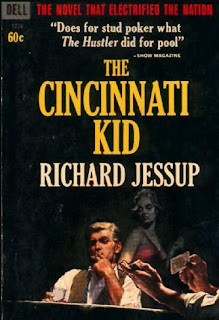
Richard Jessup's 1964 novel, 'The Cincinnati Kid'Last post I talked a bit about the commentaries that come with Warner Home Video’s DVD of The Cincinnati Kid. Now I want to say a few words about Richard Jessup’s 1964 novel on which the film is based. (By the way, those unfamiliar with the story can safely read this post without worrying about me spoiling anything too significant plot-wise for you.)

Jessup was born in Savannah, Georgia on New Year’s Day in 1925. He grew up in orphanages, then in his late teens ran away to become a merchant sailor, a career he continued until he started writing novels in his mid-twenties. Thus by the time he started writing, he had travelled widely and experienced much. He’d also read a great deal; in a 1970 interview he said he “read himself around the world” when working as a seaman, reading a book per day. At some point he also had a job as a dealer at a gambling joint in Harlem, an experience he certainly drew from when writing The Cincinnati Kid. Jessup would eventually pen 35 novels (or more), including a series of spy novels featuring an operative named Montgomery Nash. He also wrote a number of well-received westerns under the pseudonym Richard Telfair. He died of cancer in 1982.

The Cincinnati Kid is a novel of modest length (probably 35,000 words or so) that genuinely exemplifies a lot of the qualities one expects to find in “hard-boiled” fiction. There are no detectives or crimes or murders to investigate, but several other hallmarks of hard-boiled writing are evident. Looking at Bill Pronzini and Jack Adrian’s attempt to define the genre (in the introduction to their anthology, Hard-Boiled), Jessup’s novel certainly follows their guidelines. According to Pronzini and Adrian, a hard-boiled story first and foremost “deals with disorder, disaffection, and dissatisfaction.” The Kid’s dogged pursuit to beat “the Man” (Lancey Hodges) clearly signals his unease with his present circumstances. His ambition -- understood by some within the gambling world he inhabits, but incomprehensible to most of “straight” society -- also marks him as a “loner”-type operating outside the “system” (as hard-boiled protagonists often do). Furthermore, as Pronzini and Adrian point out, “good does not always triumph,” in such stories, “nor is justice always done.” Again, The Cincinnati Kid fits the bill.

So even though it isn’t a crime novel, there are a lot of reasons to liken Jessup to other hard-boiled authors. As Pronzini and Adrian explain, “A hard-boiled story must emphasize character and the problems inherent in human behavior. Character conflict is essential; the crime or threat of crime with which the story is concerned is of secondary importance.” Not surprising, then, to see the blurb from The Chicago Tribune reviewer claiming “Richard Jessup does for poker much the same thing that the late Raymond Chandler did for murder.”

I recommend the novel -- to fans of hard-boiled writing, certainly, but also to poker players. The novel offers a detailed look at the underground “rambling-gambling” poker scene, circa 1950s. (The film pushes the action back a couple of decades or so.) The reader is exposed to a lot nifty poker-related jargon here. The loose-aggressive player willing to take risks is described as having a lot of “cock” in him. The player who busts out of a game and must accept a loan from other players has gone “Tap City” (and is not allowed to play again until he’s paid back those debts). In five-card stud (the featured game) there is playing “no stay” (i.e., folding), and those players left in the hand vie for “no stay” money (i.e., dead money). When the players examine new packs of cards by sniffing their wrappers, it is explained they are looking for “the tell-tale odor of a hot iron and a tampered seal.” (The players perform this action in the film as well, and in his commentary Phil Gordon admits he has no idea why they do.) Such details -- clearly gleaned from Jessup’s dealer experience -- significantly add to the novel’s verisimilitude.

The story is set in St. Louis (the film moves the action to New Orleans), and Jessup’s descriptive style presents a succinct yet wide-ranging overview of the scene and many of the characters who populate it. Jessup frequently delves into the psychology of poker, carefully establishing the various reasons why poker and nothing else has the potential to satisfy Eric’s yearning to become “the Man.” Other pursuits fail him, as do other card games. Blackjack he dismisses as “a game of short bluff and limited scope.” “He gave bridge a try, but didn’t like the idea of partners.” He found craps harmless fun, “but still there was something in him that wanted a game where there was more personal control.” At last he comes around to poker, “first to draw poker and then he found stud to be the game that was right as rain.”

Incidentally, the film gives Eric a last name -- Stoner -- apparently meant as a reference to his poker face (and not intending any other connotations). In the novel he’s simply Eric, or, more often, “the Kid.” The Freudian implications in the nicknames of the story’s two combatants are more than a little obvious, of course. Jessup doesn’t shy away from exploring the connection between Eric’s wish to “be the Man” (i.e., be regarded as the best five-card stud player) and his struggle to mature into adulthood (i.e., to be a man, and not a “Kid”).

As in the film, the novel explores the subplot of Eric’s relationship with his girlfriend, Christian, and considers the extent to which that relationship interferes with his poker-related goals. When Eric visits Christian’s family (prior to his big showdown game with Lancey), her father quizzes him about the importance of his beating “the Man.” “Are you doing it for fun, then? Just to see if you can be king?” he asks. “No,” replies Eric, “it’s important to me.” “Now . . . which is more important to you, this king business, or Christian?” “If you got the guts to ask that question . . . I’ve got the guts to answer it. Christian, if you came right down to it, is not as important as doing what I have to do.” Christian’s father respects Eric’s position. “Son,” he says, “there never was a man worth a damn to my mind that let a woman -- his woman -- stand in the way of a thing he had to do.” Eric understands the principle. But can he live accordingly?

(Maybe I’ve just got the late, great James Brown on my mind, but Eric’s struggle in some ways reminds me of the one dramatized in the Godfather of Soul’s “It’s a Man’s Man’s Man’s World” -- first recorded in early 1966.)

As you might expect, Christian’s name also possesses symbolic value. During this same conversation her father asks Eric if he’s a believer. “In what?” responds Eric. “Religion.” “No.” (Although the film does take a number of chances, it doesn’t broach this particular subject.) Eric is pretty clearly presented here as an existentialist. “And you only play cards for a living?” incredulously asks Christian’s father. “Only play cards,” he responds.

The novel also presents the character of the Shooter differently than does the film. In Jessup’s story, the Shooter is more obviously a mentor figure for the Kid, having gone through precisely the same trial at an earlier stage in his poker career. He, too, took his shot at (his version of) “the Man,” unable when younger to resist making the attempt. Now the Shooter has settled into a less-risky, more methodical style of play. Unlike in the film, the Shooter has no woman here (and so there is no subplot involving her). He’s also a much more admirable character here than in the film, one who is clearly respected by others -- and deserving of such respect.

To say much more would indeed spoil the plot for those unfamiliar with it, so I’ll leave it there. Suffice it to say, the novel has a lot going for it, and ultimately stands as an important (though infrequently discussed) contribution to literature about poker.

The film is even better, though -- one of those rare instances of the adaptation exceeding the original. As I said before, I’ll review the film proper in the next post. I’m also going to add a fourth and final post to discuss that famous (or infamous, according to some) last hand that culminates the story, particularly concentrating on some of the differences between the way that hand is presented in the novel and the way the film portrays it.

Labels: ,

Friday, January 05, 2007

Commentary on the Commentary: The Cincinnati Kid

A few posts back I mentioned how I’d found a copy of the DVD version of The Cincinnati Kid (dir. Norman Jewison, 1965) in my stocking this year. The single best poker movie, as far as I’m concerned. That’s right -- better than Rounders (in my narrow view).

For all Rounders has going for it -- a compelling plot, decent characterization, an effective (occasionally transfixing) soundtrack by Christopher Young -- I’ve never really been all that big of a fan. I think my ambivalence has something to do with the fact that while the main character, Mike McDermott, often expresses ambition to “take a shot” at higher stakes, the film itself doesn’t ever take the same sort of chance. To be honest, if it weren’t for the poker I might well have forgotten this movie soon after I saw it. Though entertaining, Rounders is a mostly tame Hollywood fairy tale that I think misses out on several opportunities to introduce genuine tension into the lives of its characters. And, of course, (almost) all is resolved for our hero with that happily-flopped straight in the end.

The Cincinnati Kid
, meanwhile, is a film (and story) that strikes me as genuinely ambitious. There’s a sincere attempt made to examine from a number of different angles the game of poker and its significance -- to demonstrate how poker can enter into the process of “meaning-making” with which we all struggle (whether we play the game or not).

I thought I’d take three posts to talk about this here DVD (first released back in the spring of 2005). In this one I’m just going to offer a few words about the two commentary tracks that come with the disc. In the next one I’m going to talk a little bit about Richard Jessup’s novel (a bestseller in 1964) on which the film is based -- a fine, lean example of “hard-boiled” fiction. Then the third post will be my review of the film. (And if you have seen the film, read the book, or heard the commentary -- or just want to defend Rounders -- I’m curious to learn your thoughts as well.)

I should say those who haven’t seen The Cincinnati Kid and who don’t want to run into spoilers can safely read this post (regarding the commentary) and the next one (regarding Jessup’s novel). The third and last post will ruin it for you, though, and so you might well skip that one.

The DVD features two commentary tracks: one by Phil Gordon and Dave Foley (who, at the time, were co-hosting Celebrity Poker Showdown) and the other by the director, Norman Jewison. (There's also a short, mildy interesting “featurette” called “The Cincinnati Kid Plays According to Hoyle,” a promotional short for the film in which Jay Ose, a magician/gambler who served as a technical advisor for the film, performs a few card tricks for Joan Blondell.)

Gordon and Foley only comment on the poker-related scenes (one can program the disc to skip through scenes on which they do not comment). This led me to believe their commentary would include more genuine analysis regarding specific hands, or perhaps some ins and outs about five-card stud (the film’s featured game), but they don’t really offer anything along those lines. Frankly there’s nothing in the pair’s commentary regarding poker that a reasonably aware amateur player wouldn’t already know. I suspect that as was the case with Celebrity Poker Showdown, Gordon and Foley acted as though they were speaking to a wider audience than simply poker players. Don’t feel as though you’ve missed much if you pass on this track.

On the other hand, Jewison’s commentary is much more relevant and engaging -- both to film scholars/fans and to poker players. He offers a lot of inside dope regarding the mechanics of filming/cinematography, talks about what it was like working with McQueen and the other actors, and even makes some genuinely insightful observations about characterization and plot. (Regarding the latter, Jewison reiterates here his previously-stated objection to the studio’s tacked-on final shot of the film -- a plot addendum Jewison himself never endorsed.) Jewison even has some smart things to say about poker and its significance (both to the plot and generally speaking). I found it interesting to hear him say that back in the mid-sixties poker wasn’t considered a subject worthy of filming -- that few thought watching people playing a game of cards would be engaging enough for an audience. (How times have changed.) Jewison clearly understood then how compelling poker can be -- if presented carefully, that is. And Jessup’s tale of the Kid and the Man proved a terrific vehicle to support this theory.

Lewison also retells the story of why he took over directing the film from Sam Peckinpah, and he talks about how Ring Lardner, Jr. (the son of the great sportswriter/humorist and accomplished screenwriter in his own right) and Terry Southern (whose screen credits include Dr. Strangelove, The Loved One, and Easy Rider) came on board to pen the screenplay.

I thought it odd how amid all of the discussion of the plot and screenplay Jewison doesn’t mention Jessup’s novel a single time. (Neither do Gordon and Foley.) The way he talks about the screenplay and the crew’s decision to add this or that detail to a given scene, it almost sounds like the script is not an adaptation but an original work created by Lardner, Jr. and Southern. All of which is somewhat unfortunate for Jessup, whose novel contains many of the same qualities that make the film so special.

As I said, I’ve got a few things to say about Jessup’s novel, then will offer a “poker review” proper of the film after that.

Labels: ,

Wednesday, January 03, 2007

Getting Off to a Good Start, Part 2 (or, Who You Jivin' With That Cosmik Debris?)

I wrapped a newspaper 'round my head so I looked like I was deep . . .Big thanks to Iggy for the reference in his latest uber-post. Go check it out, y’all. (A slipped apostrophe makes my name Shamu -- a cool guru-sounding moniker, no? Is that a real poncho or is that a Sears poncho?) Note also his announcement that PokerWorks has added a few more bloggers to its roll, including Amy Calistri (of Aimlessly Chasing Amy, Keep Flopping Aces, and Poker Pages). Nice play, PokerWorks.

In my most recent post, I boasted a bit about having had an especially fortunate first hour of play with which to start of the new year. My friend Vera Valmore happened to see the post. “You’re setting yourself up,” she told me. Probably true, I thought. The chances of my second hour of play even coming close to that first hour (during which I scooped an absurd $55, or 27.5 BB) were slim indeed.

The point of that post (in part) was to recognize how starting a session well or poorly tends to affect one’s frame of mind, thereby also affecting one’s ability to play well. I talked about Barry Tanenbaum’s idea to “Always Start Slowly” in order to increase your chances of winning that first big hand you play. My January 1st session began with a nice big win in a hand where I flopped a set, turned a boat, and had three callers following me most of the way. What followed appeared to confirm Tanenbaum’s thesis about the good effects of winning that first hand.

(By the way, Barry Mulholland has a decent article in the current CardPlayer that relates pretty closely to this topic. The article is titled “Sometimes You Have to Play Poker Right Away.”)

So how did the second hour go? And the third?

I sat down at a full ring, $1.00/$2.00 limit game on Stars. Completely ignoring Tanenbaum’s advice to wait an orbit before posting, I went ahead and blithely tossed in a buck from the cutoff where I was dealt 4cAd. UTG raised and it folded around to me.

This, friends, seems precisely the “marginal situation” Tanenbaum says he avoids when first sitting down at a new table. There is $4.50 in the pot, and I’m looking at chucking in a second dollar for what is likely going to be a heads-up situation. Is 4.5-to-1 good enough with ace-rag unsuited? Compounding the problem, I have zero information about the raiser. I’m pretty sure Tanenbaum lets this one go. (In fact, he would’ve never posted the blind from the cutoff like I did.)

Of course, I called. The button also cold-calls the two bets, so we end up having three players seeing the flop: 4sAh7h.

About as good as it gets for A4-unsuited. Must be my year, thinks Shamus. The UTG preflop raiser bets out a buck and I, of course, raise it up. The button calls, the UTG reraises, and all three of us end up capping before the round is through. The UTG raiser runs out of funds here, so we’ve begun a small side pot. Altogether there’s $19.25 in the middle.

The turn card is the Th, possibly completing someone’s flush. I bet and when the button just calls I feel as though he doesn’t have it (although, again, I have zero knowledge of the player from which to draw, and so really have no idea if he’s capable of slow playing here). Then comes the river -- the Td. Crap on a cracker. Oh, right -- that’s why you don’t call preflop raises with ace-rag. I can’t be good anymore and so check, and the button also checks and turns over JhAc to take the hand. (UTG had been whistling in the dark with Kh9d.)

I’m $8 down and my seat isn’t even warm. Not just $8 down, actually. I’m something like 80% to win heading into that river, just needing to avoid a jack, a ten, or a seven (nine outs). If any of those other 37 cards come out, the button is surely going to pay one more big bet, and I’m going to take a $26.25 pot (removing a dollar for the rake). I’d have netted $16.25 on the hand, so I could cry that I’ve lost around $25 (or 12.5 BB) on this hand alone thanks to that river card!

Bad luck? Sure. But the hand began with what I immediately judged to be two bad decisions on my part -- to post the big blind from the cutoff rather than wait an orbit, and to call the preflop raise with ace-rag. Wonder if anyone else noticed that, I thought . . . .

I ended up taking it more slowly following that first hand, sitting through the next couple of orbits without playing too much. Wasn’t winning too much, either (I only took a single small pot of $3 during that stretch.) I was down about $15 total when I finally picked up pocket rockets in the cutoff. The table folded around to me and I raised. Much to my dismay, the button called, the small blind called, the big blind called, and the UTG player who was new to the table and had posted also called. So it was my AA vs. four other players, all of whom called my preflop raise without having voluntarily put any money in the pot beforehand.

I wondered for a moment if my loose play on Hand #1 had perhaps invited so much action. Stopped fretting, though, when the flop came 2h6hAd. The big blind bet out, I raised, the small blind reraised, and the three of us ended up capping it. (Hmm . . . didn’t seem like such an action flop.) The turn was the 6d, giving me the boat, aces-full. Both players checked and I also checked to give someone a chance to catch up and really pay me off. The river was the 9d and big blind again bet out. He and I ended up capping the betting (the small blind bailed). The pot had mushroomed to $37 (taking out the rake). What did he have?

You guessed it -- 6s6c. “Wow,” he typed when he saw my aces. “Last hand [I] thought you were on.”

I was down $30 (15 BB), not having played even 30 hands yet. I thought a bit about his comment. What could he have thought I had, if not aces? Ace-rag? Big slick, played recklessly against a board showing a pair and a flush possibility? Was I stubbornly running kings or queens through that board? If you look at how I played the hand -- particularly my check on the turn -- AA was the only hand I could possibly have had. If I knew what I was doing, that is. (Had my play on Hand #1 perhaps suggested otherwise?)

Ended up falling deeper in the hole, then regrouped and scraped my way back to a $20 loss for the entire session. When I told Vera how the day had gone, she passed on the opportunity to tell me “I told you so.” She did, however, make sarcastic reference to that gaudy win rate I’d established in the earlier session. Always good to be reminded poker ain’t as easy as it sometimes seems.

Labels:

Monday, January 01, 2007

Getting Off to a Good Start

Sat down earlier today for a short session on Bodog. First hand of the new year ($1.00/$2.00 limit, 6-max) goes like this: I get a pair of threes in the big blind. Three players call, the SB folds, I check. Flop comes TdAs3d. I bet and all three players stick around. Turn is the Tc. I bet again, and again all three players call. I’m doubting the ten is out there -- more likely a bunch of draws. River brings the 2d, completing somebody’s flush draw, probably. I bet once more. One player raises, the other two fold, I reraise, he calls. He turns over Jd5d for second-best. I scoop $27.25 after rake ($17.25 net on hand).

Decent start to the year, eh? Ended up netting around $55 (27.5 BB) for a hour’s worth of play (half 6-max, half full ring). (Wouldn’t it be nice to enjoy such a win rate for the rest of ’07!) That first hand was fortunate, of course. The fact that it was followed by such a successful session made me think of something Barry Tanenbaum said when he appeared on Keep Flopping Aces a couple of months ago (during the 10/26/06 show) when asked about the importance of getting off to a good start.

Near the start of that show’s third segment, co-host Lou Krieger asked Tanenbaum why he thought it was important whenever he sits down at a new game to try to win the first hand that he plays. Tanenbaum responded by saying he had a “philosophy” which he called “Always Start Slowly.” As he explained, “starting slowly” means not necessarily getting involved right away in those “marginal situations” he normally explores as part of his usual game. Don’t post the blind right away, he advises; rather wait an orbit and observe the other players. (Here Tanenbaum answers a question I pondered over in an earlier post.) Then, once you begin play initially adopt a conservative approach, continuing to observe and gather information about other players’ tendencies as you do.

According to Tanenbaum, another reason to try your best to win that first hand is to create a “winning” image that will subsequently help you in later hands. If you have a winning image, you will more likely succeed when later trying to represent a hand, to bluff off an opponent, to isolate an opponent, to get a free card, and so forth. Tanenbaum here essentially describes what I experienced today. Truth be told, that first hand really played itself -- any moron could’ve won with that sweet draw, probably netting exactly the same profit as I did. Nevertheless, after winning that first big pot the table essentially deferred to me from that point forward any time I showed aggression or even interest in a hand. I won a few more medium pots, but also lost smaller pots when better hands refused to raise me. For example, on a later hand I raised preflop with AK and had two callers. The flop was three baby cards (663 or something), I bet and one player called. The turn was another baby card (a seven, I believe), but put three spades on the board. We both checked. The river was a deuce, we both checked again, and he took the pot with a pair of tens. I’m certain my “winning image” (deserved or not) encouraged caution in my opponent, probably saving me at least one big bet.

I like Tanenbaum’s advice about trying to win the first hand. I haven’t checked my records, but intuitively I believe that my better sessions usually begin with a win (even a modest one), while my less successful sessions begin with a loss. I’ve said before how much I like Tanenbaum’s teachings for limit hold ’em. If you’re a limit player, go listen to that 10/26/06 episode of Keep Flopping Aces (lots of great advice in there -- here are Part I, Part II, and Part III), check out Tanenbaum’s website, and look up some of his archived CardPlayer columns. You’ll be glad you did.

I’ll add a couple of other observations to this “getting off to a good start” idea. For one, I don’t think Tanenbaum is saying necessarily that when sitting down for a new session you absolutely have to win the first hand you play. You do depend on the cards somewhat in limit hold ’em, and can’t always control the outcome of a hand with your betting (the way you might in NL). You could sit there and wait three orbits until you get dealt a pair of queens, then push hard only to be forced to pay off an opponent who with ace-rag spiked an ace on the river. Such things cannot be helped, really. Rather, I think Tanenbaum is essentially telling us not to push “marginal situations” (like, say, flopping middle pair) as aggressively so as to avoid making your first big showdown a hand that (1) you lose, and (2) creates the impression that you’re a “loser” who thinks middle pair is the cat’s pajamas.

The other benefit to getting off to a good start (that Tanenbaum doesn’t explicitly talk about in the interview, though he does imply) is the way it helps your confidence. I don’t know about you, but every time I start a new session I experience a small bit of apprehension about how it is going to go. It’s always nice to receive that initial verification that yes, indeed, I do know how to play this game (somewhat) and can even be successful at it. Perhaps the best players never suffer from such minor insecurities, but for those of us who do even a small, early victory can go a long way.

Anyhow, here’s hoping all of you get off to a good start here in 2007.

Labels:

Newer Posts
Older Posts

Copyright © 2006-2021 Hard-Boiled Poker.
All Rights Reserved.